
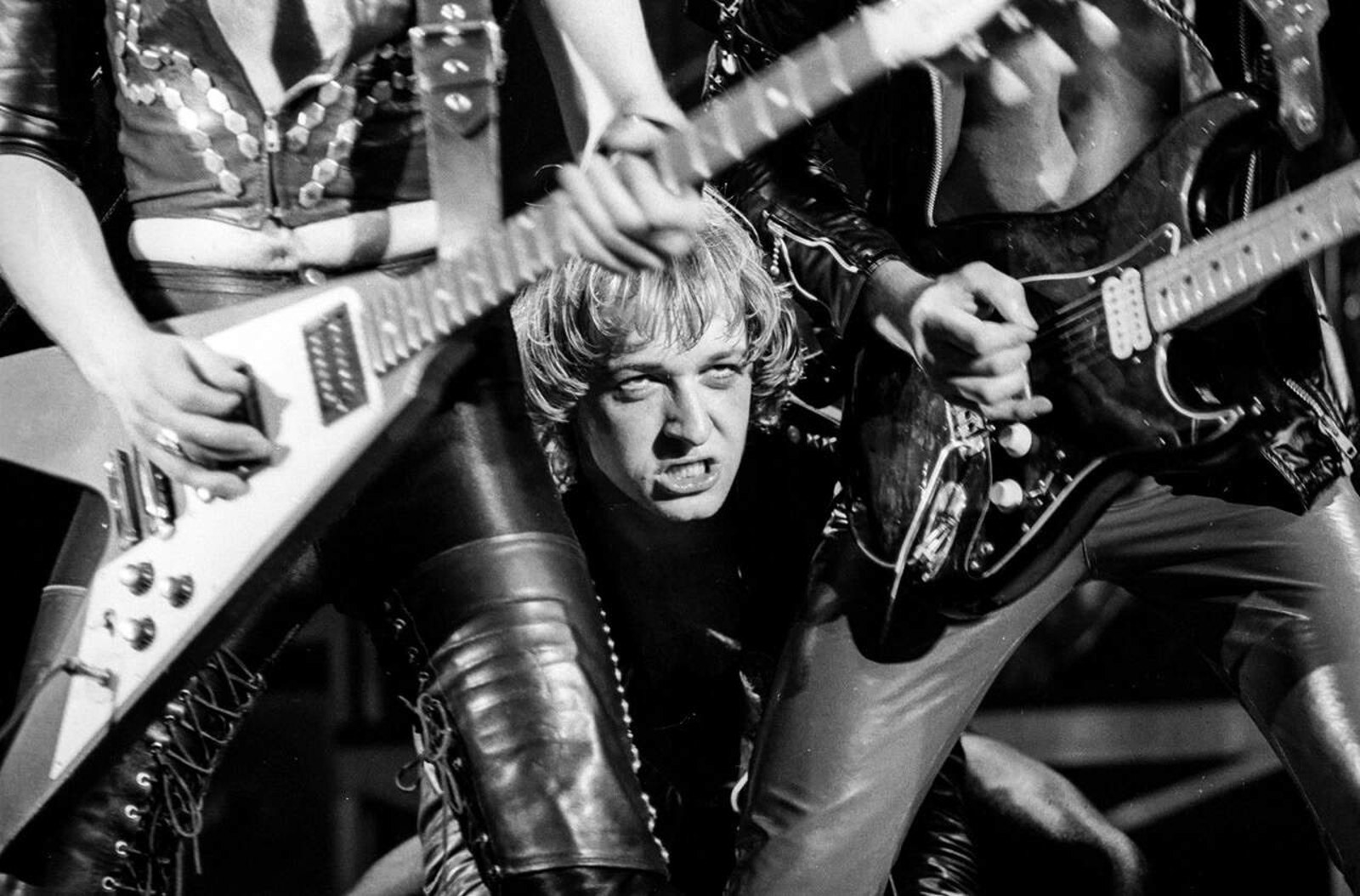
Ninety-three pages of judgment, forty-three witnesses, nineteen days of testimony and a claim for 6.2 million dollars: that is what it took a court in Reno, Nevada, in the summer of 1990, to establish that two syllables buried in a twelve year old record were a guitar chord and a singer breathing out. The Judas Priest trial ended on 24 August 1990 with the band cleared. Getting there took almost five years of siege.
The lawsuit that turned a heavy metal album into evidence was Vance v. Judas Priest, two cases numbered 86-5844 and 86-3939 in the Second Judicial District Court of Washoe County and heard together without a jury, and before a word of it was argued the plaintiffs' engineers had stripped the 24-track master of Stained Class down to its separate tracks, isolated the passages they wanted and amplified them until the noise gave up the words they were listening for.
They went over the tapes like a dowser crossing a paddock with a forked hazel rod, pacing the whole field in the belief that water lay somewhere underneath, and ripping up the turf wherever the rod dipped. The rod always dips. That is what it is for.
The claim against Stained Class
The two young men named in the court records were Raymond Belknap and James Vance. Raymond Belknap died by suicide in Sparks, Nevada, on 23 December 1985, at the age of 18. James Vance, then 20, was severely injured the same day and died on 29 November 1988.
Their families, represented in court by the Reno lawyer Kenneth McKenna with Timothy Post, first went after the words of the songs, and the words were protected speech, so the case narrowed to what nobody could hear. The families argued it as a product liability claim: a defective product, an album with the command "do it" hidden beneath "Better by You, Better than Me", had been put on the market and had caused harm to two listeners already at risk.
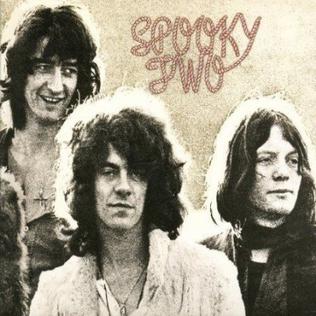
The song at the centre of the case was not even the band's own. Written by Gary Wright and first released by Spooky Tooth on Spooky Two in March 1969, it was added to Stained Class late, after CBS asked for something more commercial on a dark record, and it was cut in a separate session with James Guthrie producing. A cover version chosen by the label became the most scrutinised four minutes in the band's catalogue.
The decisive ruling came a year before the trial. In an order filed on 23 August 1989, Judge Jerry Carr Whitehead refused the defence's request to throw the case out and held that a subliminal message was not speech the First Amendment protects, since a listener who cannot perceive it cannot weigh it, argue with it or reject it, and since nobody can avoid a message they do not know is there, which makes it an invasion of privacy. The families now had four things to prove: that the message was physically on the record, that it had been put there on purpose, that it was subliminal, and that it contributed to what happened.
The experts in Washoe County
The witness who carried the plaintiffs' theory was Howard Shevrin, a psychologist who had studied unconscious perception at the University of Michigan for more than twenty years, and his argument was that a hidden command is more powerful than a heard one, because the listener takes it for an impulse of his own and cannot refuse it. The author who had spent twenty years finding hidden messages in advertising was Wilson Bryan Key, who also appeared for the families. He told the court such messages could be found on Ritz crackers and in the Sistine Chapel. His evidence counted for little.
The defence called three psychologists: Timothy Moore of York University in Toronto, Anthony Pratkanis of the University of California at Santa Cruz, and Don Read of the University of Lethbridge, co-author of the 1985 study of reversed speech that the preachers' backmasking seminars had ignored. All three told the court the same thing. No experiment had ever shown a subliminal command making anyone do anything, let alone this.
The exchange that did the most damage had taken place before the trial, in a deposition in June 1989. Asked by the defence lawyer Bill Peterson which experiments he was relying on, Shevrin said a corpus of literature, hundreds of experiments, and Peterson answered with two words, "Name one", which kicked the trestle out from under the whole theory and left it lying across the floor of the deposition room.
The families' own evidence tripped over itself. A guidance counsellor at Vance's school testified that he had told her the record gave them a message to do it, which, as Moore pointed out afterwards, meant he had heard it, and a message a listener consciously hears is by definition not subliminal and therefore protected speech. Shevrin's theory needed the two young men not to have noticed. His own side's witness said they had.
Shevrin's theory needed the two young men not to have noticed. His own side's witness said they had.
The recording itself answered the rest. The sound heard as "do it" was on no single track of the multitrack master, which argued against anyone having recorded the words, and appeared only where two tracks met: a guitar figure on one and on the other the voice of Rob Halford, a voice that could drive a note over two guitars like a tilting lance through a painted shield, caught drawing breath between two lines. On 1 August 1990 Halford sang the passage to the court to show where the breath fell.
The ruling of 24 August 1990
Whitehead's judgment ran to 93 pages. The families had failed to prove that the band or CBS had placed subliminal messages on the album intentionally, or that any such message caused the deaths, and the words themselves, the judge wrote, were the result of a chance combination of sounds. The scientific evidence, he found, showed no behavioural effects from subliminal stimuli beyond anxiety, distress or tension, and there were other factors in the young men's lives that explained what happened independently of the record.
The court was careful to add that the young men and their families were not on trial. The only sanction fell on the label: 40,000 dollars against CBS for being slow to hand over the master tapes. Kenneth McKenna, the families' lawyer, said at the time he doubted there would be an appeal. One was filed anyway: the Nevada Supreme Court heard arguments in the case in May 1993.
A great day for Judas Priest and for all the artists of America.
Rob Halford, quoted by UPI, 24 August 1990
The quintet that walked out of the Reno courtroom and straight into the heaviest record of its career was Judas Priest. The single "Painkiller" landed on 3 September 1990, ten days after the ruling. The album followed on 17 September, opening on Scott Travis's double bass drums and an onslaught of a title track that tears through its riffs at a speed the band had never attempted, and "A Touch of Evil", a slow, brooding single from the same record, followed on 11 March 1991. The record shows a band that had lost a summer and none of its nerve.
What the Judas Priest trial left behind
The band won the case and lost the argument about principle. Whitehead's pre-trial ruling, that subliminal messages sit outside the First Amendment, was never overturned, and in May 1991 a federal judge in Georgia leaned on it in Waller v. Osbourne, the suit over "Suicide Solution", noting that a subliminal message, had one been proved, would not have been protected either. The part of the case that belongs to the wider heavy metal controversy is the fear. The part that belongs to the law is that exception, still on the books.
Moore's verdict, attested in that article, was that the pseudoscience had done less harm than the respectable expert, and that the court had treated a sound's physical presence on a tape as proof that it worked on the mind below awareness, which no one had tested. The hidden command belongs with the older question of is heavy metal satanic, and a Nevada judge answered it the way every American court has answered it since. The only voices on the record were the band's.
