
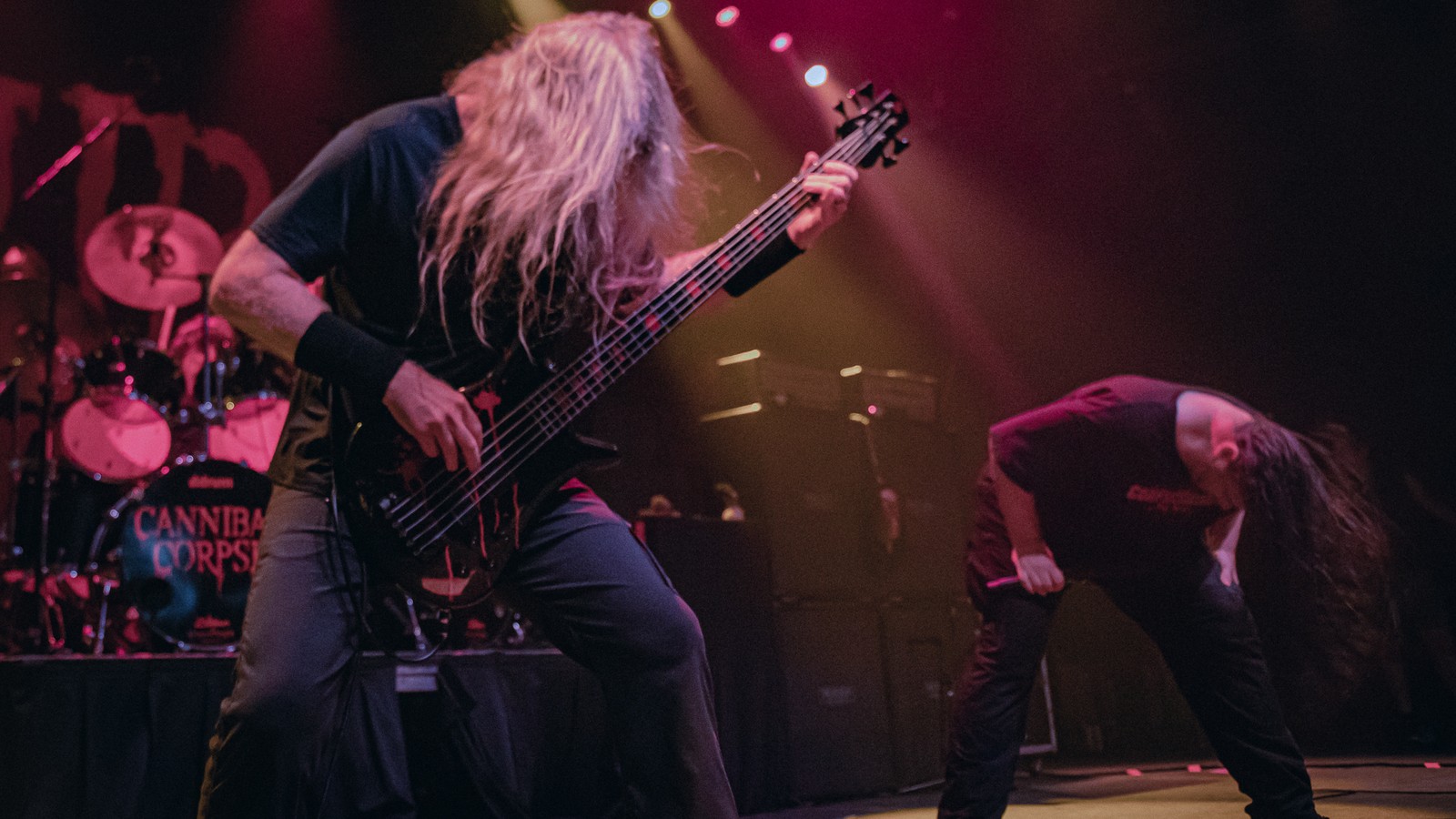
Morrisound Recording, Tampa, May 1990. Five young men from upstate New York are in the room with a Metal Blade contract and a demo to cut again, and Glen Benton of Deicide comes in to add backing vocals to two of the songs, "Mangled" and "A Skull Full of Maggots".
Putting the result out through Metal Blade on 17 August 1990 as Eaten Back to Life, inside a sleeve by the horror comic artist Vince Locke on which a zombie in a graveyard rips the flesh off its own body with its teeth, and with a track list that runs from "Shredded Humans" and "Edible Autopsy" to "Buried in the Backyard", the Buffalo quintet that handed the gore lyric to the death metal that followed was Cannibal Corpse.
Deathcore horror lyrics start in that room. Fifteen years later the young bands of Glendale, Riverside and Knoxville took the inheritance off the death metal shelf along with the blast beat, and from Doom in late 2005 to the summer of 2008 it was the vocabulary the genre's first records reached for whenever they needed a subject.
Picture the meat case of the all-night supermarket across the lot from a club, where a band buys lunch meat after load-out before the van heads for the interstate. The butcher has lettered every cut on the glass in red grease pencil, chuck, shank, neck bones, and behind the glass the grinder is still chewing through the night's trim, its auger ramming bone and gristle against the steel plate and forcing the lot out in red ropes. Nobody reads that glass for the poetry. It says what the machine does. The old gore title worked exactly that way over a riff: "Shredded Humans", "Mangled", lettered in plain words over a stretch of music about to do to the room what the words said.
The story was optional. The title was not.
Where deathcore horror lyrics came from
Two years before the Tampa session, the Liverpool trio that turned a pathology textbook into a lyric sheet was Carcass. Reek of Putrefaction came out through Earache in 1988 with titles such as "Suppuration", "Fermenting Innards" and "Psychopathologist", and it is counted as the first goregrind record, the branch of grindcore that took disease, decay and forensic pathology for its entire subject and wrote much of it with a grin, in the manner of a Z-grade horror film. The later bands of that branch dug so deep into the medical dictionary that their style picked up the nickname medicore.
By the early nineties the death metal shelf held three kinds of horror lyric, and deathcore later took from all three: the pathology report of Carcass, the zombie comic of Cannibal Corpse and the true-crime file. The Chicago trio that made that third kind its whole catalogue was Macabre, the same three members since 1985, writing about real serial killers and mass murderers with a black sense of humour. Its 1993 album Sinister Slaughter, released by Nuclear Blast, gave most of its songs to named cases, and in 2000 the band released a whole album under the surname of one murderer, Dahmer.
Cannibal Corpse sharpened its own formula on Tomb of the Mutilated, released by Metal Blade on 22 September 1992, and "Hammer Smashed Face" is the method in three words: a tool, an act and the part of the body it lands on, all of it in the title before the first verse has begun. Chris Barnes wrote most of the words on those early records. The riffs did the rest.
Under all three kinds sat one attitude. The human being in these songs is a body, a specimen on the slab, a victim in a shallow grave, a thing to be taken apart, and very rarely a person with a name and a life of their own. That is misanthropy carried out by method rather than by argument, and it crossed into deathcore intact, a lineage written down on the track lists long before anybody thought to write it in an interview.
The Ripper, the morgue and the voice of the man with the knife
Recorded at The Sound Lair in Knoxville with Miah Lajeunesse at the desk and released on 31 July 2007 through Siege of Amida in Europe and Candlelight in North America, The Somatic Defilement was a debut that moved the gore lyric off the comic book page and into the case file, and the Knoxville band that moved it there was Whitechapel.
Jack the Ripper is the frame of the record, and most of its songs speak in a killer's own voice, with titles such as "Vicer Exciser", "Ear to Ear" and "Articulo Mortis", a Latin phrase for the moment of death, carrying the subject on the back of the sleeve. The band took its name from the district where the murders happened. The Whitechapel murders of 1888 were never solved.
Phil Bozeman named the two exceptions himself, in a track-by-track account of the record posted on his Facebook page and republished by Kill the Music: "Alone in the Morgue" is about a coroner with a necrophile's appetites, and "Festering Fiesta" is about Jeffrey Dahmer, whose televised interview with Stone Phillips is excerpted in the intro track, "Necrotizing". Dahmer was sentenced in Milwaukee in February 1992 to fifteen terms of life imprisonment. Macabre had released its album about him seven years before Whitechapel's debut.
The difference from Tampa is the point of view. The zombie of 1990 came off a horror comic's page. The narrator of 2007 is a man with a knife, with the listener standing behind his eyes. First person turns a listener round the way security turns a crowd surfer who comes over the barricade, hauled down by the belt, slammed feet first onto the concrete of the photo pit and shoved along the steel, and for three seconds the kid is standing where the band stands, looking back at the room.
The sexual violence written into some of those first-person narratives is a separate matter, and the scene's own later reckoning with it belongs to the lyrics deathcore grew out of.
Buried alive, bludgeoned, sewn shut
Opening on "Catharsis for the Buried", fifty-five seconds built round a sample from Oxygen, the 1999 thriller in which a kidnapper buries a woman alive and holds her for ransom, and released in late 2005 by King of the Monsters, a small label in Scottsdale, the EP that put a burial at the top of its own track list was Doom, and the Glendale band behind it was Job for a Cowboy.
The sample works like the steel hatch over a club's sidewalk delivery chute at load-out: the last road case dropped down the stairs, both doors kicked shut over the stairwell and the bolt slammed home, everything underneath gone dark while the street carries on over the top. A voice from inside the ground for under a minute, and then "Entombment of a Machine" comes down on it. The burial ran on into the band's first video, directed by Richie Valdez, in which an old man buries machines in the ground between shots of the band playing in the desert.
Formed in Riverside, California, in 2002, out on Century Media with The Cleansing on 18 September 2007 with every lyric credited to its singer Mitch Lucker, and dressed in a sleeve by Dave McKean, the artist behind the covers of the Sandman comics, the band whose track list reads like a police blotter typed up by a drummer was Suicide Silence: "Hands of a Killer", "Bludgeoned to Death", "Eyes Sewn Shut", "No Pity for a Coward".
Look at what changed between Tampa and Riverside. Death metal told its gore story at length, verse after verse over riffs that kept changing gear. On the deathcore records of 2005 to 2007 the story mostly shrank to the title, and the violence the words described was handed to the breakdown. A song called "Bludgeoned to Death" needs no verse to explain itself when the drop under it does the bludgeoning and splits the plywood of the stage it is played on.
Deathcore cut the gore story down to its title and handed the violence to the breakdown.
Misanthropy, and a broken heart in morgue clothes

Founded in San Diego County, California, in 2005, and named with the Latin word for an executioner, the band that put the morgue's vocabulary to work on a broken heart was Carnifex. Recorded before the end of 2006 and released on 13 March 2007 through Acropolisrpm, sold at shows and through online stores, the EP Love Lies in Ashes carried "Collaborating Like Killers", "Slit Wrist Savior", "Hope Dies with the Decadent" and its title track, and all four turn up again on Dead in My Arms, released by This City Is Burning on 12 July 2007 with Chris "Zeuss" Harris producing.
The band lists Cannibal Corpse and Dying Fetus among its influences, and "My Heart in Atrophy" sits on the same track list as "A Winter in Remorse". The album's subjects are mostly heartbreak and self-harm. Set the subjects beside the titles and the method is plain enough: the vocabulary of the death metal crime story, used to say how a breakup felt.
Misanthropy ran through the same years mostly in titles and band names. Paying for its own EP in 2004 and calling it Syndicated Murderers, two years after it formed, the Montreal band that put the contempt on the cover before a note was heard was Despised Icon. Suicide Silence called a song "No Pity for a Coward". Others took their names straight out of the abattoir and the dissecting room: Waking the Cadaver in New Jersey, Annotations of an Autopsy in Lowestoft, whose Before the Throne of Infection came out through Siege of Amida in April 2008.
The contempt had a direction, and it is the one hardcore had always pointed in. Hardcore aimed its grudge at people it could name: the promoter who short-changed the band, the club that shut its doors on the kids. The old deathcore lyric widened the grudge to the whole species and, on the Carnifex records, turned it on the narrator as well.
| Record | Year, label | Titles that carry the subject | Strand |
|---|---|---|---|
| Carcass, Reek of Putrefaction | 1988, Earache | "Suppuration", "Fermenting Innards" | Pathology |
| Cannibal Corpse, Eaten Back to Life | 1990, Metal Blade | "Shredded Humans", "Edible Autopsy" | Horror comic |
| Macabre, Sinister Slaughter | 1993, Nuclear Blast | Songs named for real cases | True crime |
| Job for a Cowboy, Doom | 2005, King of the Monsters | "Catharsis for the Buried", "Entombment of a Machine" | Burial |
| Whitechapel, The Somatic Defilement | 2007, Siege of Amida / Candlelight | "Vicer Exciser", "Alone in the Morgue" | True crime, the morgue |
| Suicide Silence, The Cleansing | 2007, Century Media | "Hands of a Killer", "Eyes Sewn Shut" | The killer's work |
| Carnifex, Dead in My Arms | 2007, This City Is Burning | "Collaborating Like Killers", "My Heart in Atrophy" | Morgue words on heartbreak |
Why the old lyric left the front of the stage
The writers moved on faster than their reputation did. Despised Icon's The Ills of Modern Man, released by Century Media on 22 May 2007, already had its singer Alexandre Erian telling Exclaim! that its lyrics mainly concerned regrets, fears, inhibitions and dealing with disappointment. The band of Syndicated Murderers was writing about regret.
Whitechapel closed the case file a year later. This Is Exile, released by Metal Blade on 8 July 2008 and entering the Billboard 200 at number 118, left the Ripper behind for anti-religious songs and the corruption of society. The band that had given a debut to the man with the knife gave its second album to the church and the state.
The old lyric never died. It went back down the family tree, into the slam and brutal end of the genre, where Waking the Cadaver issued Authority Through Intimidation in October 2021, and where the morgue and the slab remain ordinary furniture. Whitechapel itself had The Somatic Defilement remixed and remastered by Mark Lewis and reissued through Metal Blade on 16 April 2013, the case file disinterred and put back in the shops beside the band's newer records.
The rest of the road, from gore to politics, runs through the confessional records and the protest records that came after, written by the same people a few years older.
The gore lyric was a loan, and the bands that took it said so, in their influences, their band names and their samples. What deathcore added to it was speed of delivery: a whole death metal crime story packed into a few words at the top of a song and settled by the drop. Once a genre has learned to say that much in that little space, it can say it about anything. Within a few years it did.

