
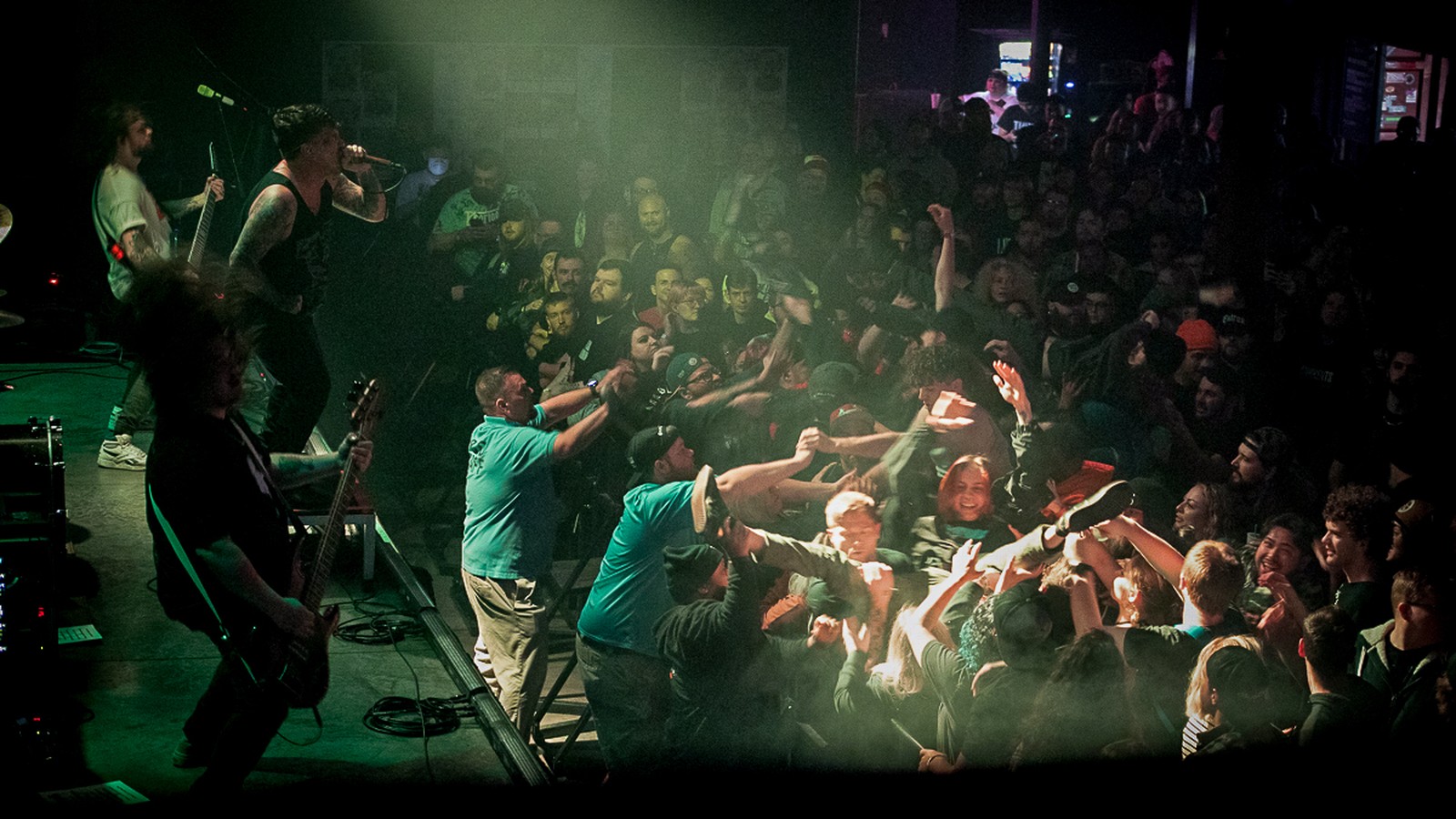
On 24 April 2011 a Tumblr user posting as Curse Of The Jaguar put up a looping GIF, the first image to carry the phrase, and somewhere past seventeen thousand notes the caption tore itself off the picture and walked away.
Shouted from the stage over the bridge of "Mr. Highway's Thinking About the End" to rip a crowd off its feet, pressed onto Homesick, the album Victory released on 3 February 2009, and stamped two years later onto a looping GIF, the order to disrespect your surroundings belonged to a Florida band that was never a deathcore band, and the band that handed the genre its favourite pit command was A Day to Remember. Deathcore took it anyway. It fit.
Most deathcore memes travel that road. A sentence, a shirt size, a noise or a slogan is ripped out of the room where it did a job, passed hand to hand across fifteen years of phone screens, and carried back into the room still doing the same job it always did, which is to point at the breakdown. The jokes are not about the music from the outside. They are the music, described by the people standing in front of it.
Picture a bounce house rented for a backyard summer show and staked into the grass beside a plywood stage, a toy castle in red and yellow vinyl with its blower roaring at one corner, and then the first breakdown of the night, when half the yard piles headlong through the mesh door at once: seams splitting along the back wall, one turret folding flat onto the lawn, the floor slammed down to the dirt on every hit and springing back up between them. It was built as a toy. It takes the whole weight of the drop.
That is the scene laughing at itself. The laugh is real, and so is the weight.
Disrespect your surroundings: a pit order that became a caption
The song is the fifth track on Homesick, four minutes and fifteen seconds long, on a record that went to number 21 on the Billboard 200, the main American album chart. Know Your Meme traces the phrase to its bridge, where the band would shout it at the crowd to set the floor moving in earnest. The instruction is precise. It names no song, no riff and no singer. It names the room.
Read it mechanically and it says more about deathcore than about the band that coined it. Surroundings are the barricade, the merch table, the drop ceiling, the drywall by the side door and the stranger at your elbow, and a deathcore breakdown is written to put every one of them in reach: the tempo halves, the floor opens, the arms come out, and the wall by the bar takes a fusillade of elbows and boot heels that leaves the plaster cratered at hip height for the landlord to find on Monday. The order only works where the music leaves that much room. Deathcore leaves more of it than most.
The joke kept coming home. Know Your Meme was still keeping the entry up to date in November 2024, years after the GIF, and a pit order that old does not need a song to carry it. The command outlived its context because the context never changed.
5XL, the deathcore meme cut from a shirt size
The 5XL deathcore meaning is simple and it is mechanical. No first poster is on record, and nobody owns the joke. What the phrase does is measure heaviness in the only unit a merch table stocks: the biggest size on the rack is the heaviest breakdown in the set.
It is a joke about weight that is really about the drop. Every heavy genre measures itself, death metal in speed, black metal in cold, doom in minutes, and deathcore measures in mass, the low open string tuned so far down that the riff behaves like freight, and the 5XL shirt is the honest picture of it. Hang one over the broken window of a basement venue in place of a curtain and watch: the breakdown sucks the cotton flat against the frame, blows it out into the alley, sucks it in again, until the drop tears the whole shirt off its two roofing nails and slaps it down across the kick drum. The size is the volume of air the room is moving.
A shirt that big also carries a logo across a back as wide as a door, which is why the joke lives at the merch table as much as on the floor. The size gag is one thread in a culture of painted sleeves, readable logos, package tours and pits, and every thread of it leads back to the history it belongs to.
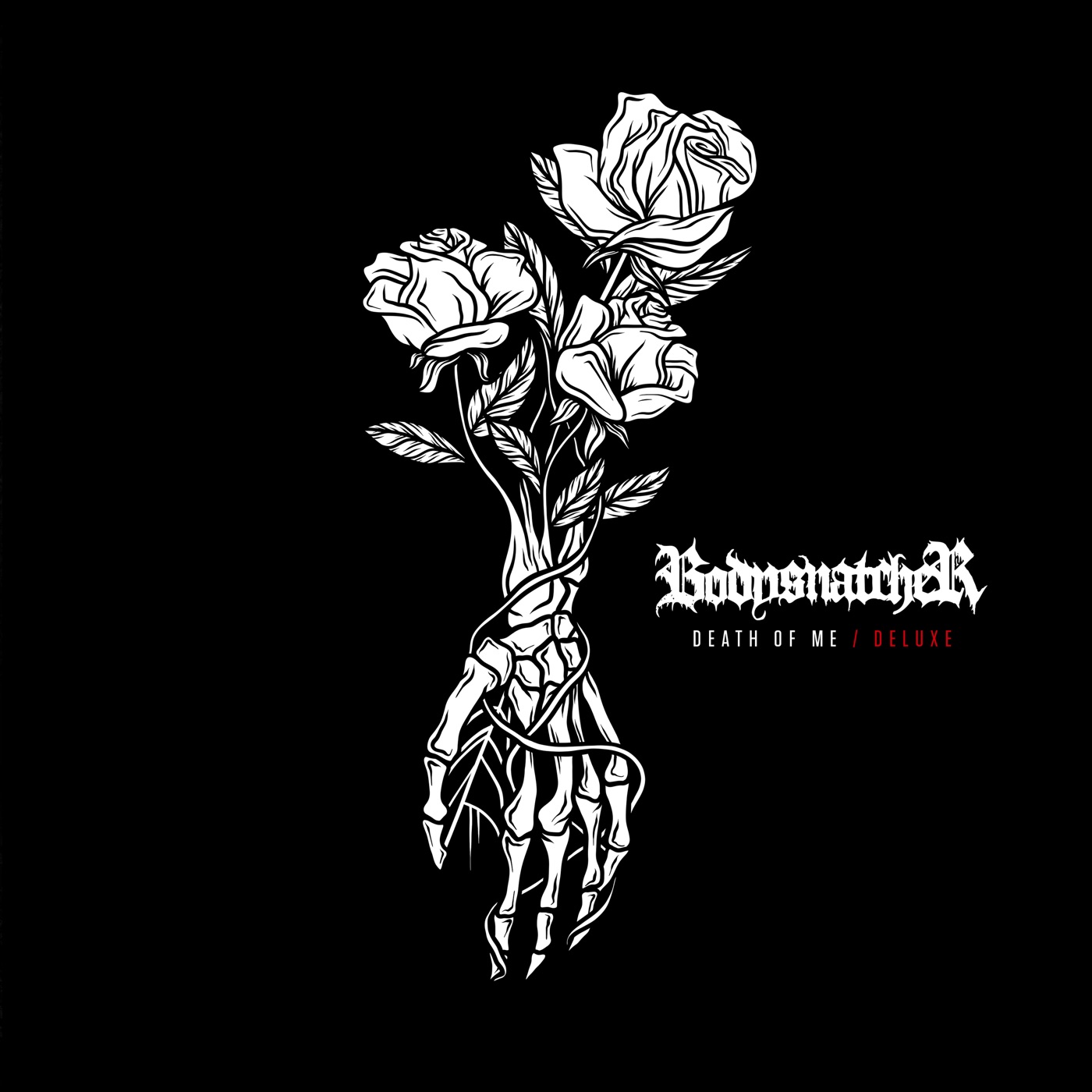
Founded in Melbourne, Florida, in 2014, listing Black Tongue and Traitors from deathcore's slow end beside Hatebreed and Terror from hardcore's among its influences, and putting out Death of Me on 10 November 2017 through Stay Sick Recordings, the label run by Attila's Chris Fronzak, the band that stands where the 5XL joke points is Bodysnatcher. Its fourth album, Hell Is Here, Hell Is Home, came out on MNRK Heavy on 10 April 2026. That end of the genre is the one the joke celebrates: hardcore's beatdown slowed down and dropped onto deathcore's tuning.
Nobody is being laughed at. The joke is a boast. The shirt is the flyer, the biggest one on the table is the loudest flyer, and anyone who has queued at the table after a set knows that the hand-lettered size sign taped to it is part of the show.
The biggest size on the rack is the heaviest breakdown in the set.
Bree, blegh and the noises fans spell out
The pig squeal's spelled-out name came from the audience. By 13 October 2007 a crowd-written slang dictionary was already defining "bree bree" as the pig squeal, and a 2019 entry for "bree bree bree" pinned the sound on slam vocalists and noted that the words are almost never legible, even with the official lyric sheet in hand. So the audience wrote down the noise instead. A meme is a transcription.
The transcription is accurate about the mechanism. The squeal is short and pitched high above the guitars, and singers often drop it into the spaces between the guitar hits, where it works as a percussion accent, a snare hit made with the throat. It rides on top of the weight the way the dry caster of a road case shrieks under an eight by ten bass cabinet heaved up a trailer ramp one plank at a time, the scream sitting right on top of the load, the louder the heavier, ramp boards splintering under each heave. The squeal is the sound of something very heavy being moved.
The blegh followed the same road from noise to spelling. A slang entry of 27 January 2017 called it a sound metal and hardcore singers make between lines and added that nobody knows why. The music answers the question every time it is played: the bark tends to land at the edge of the breakdown, and the floor moves on it. The joke asks. The drop replies.
Breakdown memes and the row of zeros
The breakdown has been a joke for a long time. A slang entry dated 19 February 2004 already wrote one out in syllables, JUD-JUD, a single note chugged for two to four bars, and an entry from September 2010 defined the breakdown as the reason the writer's neck was in a brace. Twenty years of breakdown memes are variations on those two lines: the sound, spelled out, and the body, paying for it.
The sharpest of them gets told in guitar tablature. A deathcore breakdown tabbed out is a row of zeros on the lowest string, because the open string is fret zero, and the joke says the guitarist is playing nothing at all. The joke is true and it misses the point. A row of zeros is a row of identical pitches, and identical pitches leave nothing for the ear to follow except where they land and where they stop, which is the whole art of the thing: the gaps, the syncopation, the kick drum lined up under each hit, the bar of silence before the last one. The zeros are a rhythm chart.
| Meme | What it jokes about | The mechanism underneath |
|---|---|---|
| Disrespect your surroundings | Wrecking the room | The half-time drop that clears space on the floor |
| 5XL | Shirt sizes | Heaviness measured as mass: low tuning, slow tempo |
| Bree | Words nobody can make out | The squeal as an accent in the gaps between hits |
| Blegh | A noise with no meaning | A bark that tends to land at the edge of the breakdown |
| The row of zeros | A riff with no notes | A breakdown carried entirely by rhythm and gaps |
| Defend deathcore | A genre on trial | The drop as the genre's own defence |
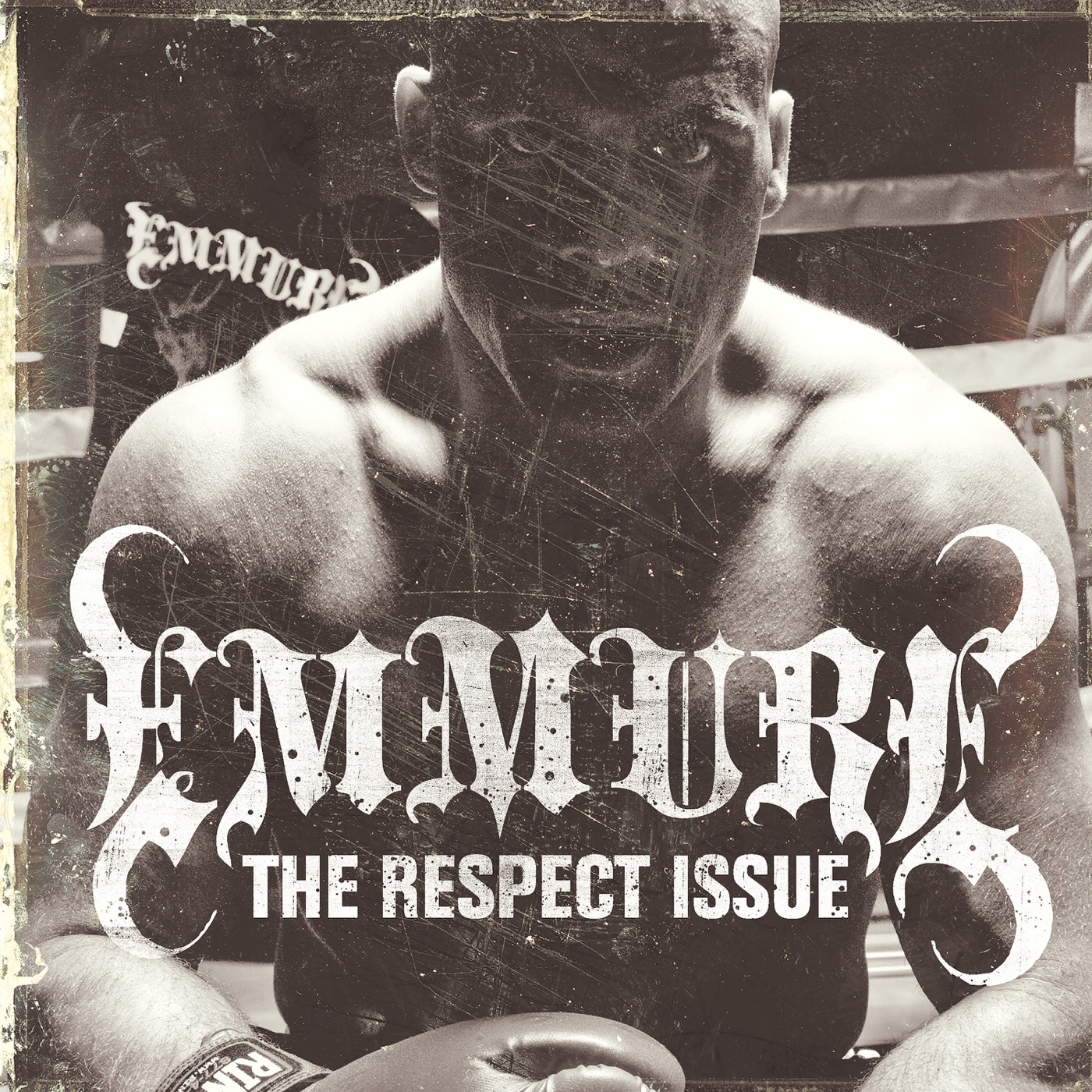
The bands were never outside the joke. Released by Victory on 13 May 2008, produced by Chris "Zeuss" Harris, entering the Billboard 200 at number 141 on a first week of about five thousand copies, and carrying the professional wrestler Kurt Angle dressed as a boxer on its cover and through its inlay, The Respect Issue came from a band that wrote the pop culture of its fans straight into the record, and the band that titled a song "Snuff 2: The Resurrection" after a line from the 1999 film 8MM was Emmure. Wrestling went onto the cover and a film line into a title. The breakdowns went under both.
Defend deathcore, a slogan borrowed twice
"Defend Deathcore" reads like a creed for a genre that has spent twenty years being asked to justify itself. Its shape is borrowed. Pop punk had the slogan first, and pop punk took it from a hardcore shirt.
Asked by Joe Fitzpatrick of New Noise Magazine, in an interview published on 1 December 2014, whether pop punk still needed defending, and answering that his band had never thought it needed any defending at all, the musician who told the world the whole "Defend Pop Punk" slogan began as a shirt design, a rip-off of a Most Precious Blood shirt that simply snowballed, was Justin Collier of Man Overboard. A New York hardcore band's merch became a pop punk rallying cry. Then the heavy side took it back.
So the deathcore version is a joke on a joke, and the faithful get to wear both layers at once. The defence was never in the slogan. It is in the parts, and the parts are the same ones the slogan's critics name: a low string, a gap and a drop.
Every one of these jokes comes back to a working part of the song. The pit order points at the half-time drop, the shirt size at the tuning and the tempo, the spelled-out noises at the voice used as a drum, the zeros at rhythm and silence, and the slogan at a genre that answers its critics with the same bar it has always played. A scene that can make that many jokes about its own breakdowns knows exactly where the breakdowns land. That knowledge is the culture.

