
Two covers, one record. Handed to distributors and retailers ahead of its June 2015 release with a painting of a child suicide bomber across the front, sent back with a request to hide the picture or replace it, and finally shipped with the first painting folded inside the packaging and printed on a limited vinyl edition, Holy War proved that deathcore art could become an argument before a single copy reached a shelf. The Sydney quintet that put one album into the shops wearing two faces was Thy Art Is Murder. Andy Marsh, who plays guitar in the band and served as its art director, explained the hidden picture as a child for every religion that has indoctrinated the young and disadvantaged.
That is the scale of it. For twenty years the pictures, the shirts, the pits and the jokes around this music have been kicking their way through chain store racks, festival fences and the cracked glass of a million phone screens, and a good half of them were made, worn, filmed or shouted by people who never played a note on the records.
Think of the whole culture as a screen printing press in somebody's garage, the squeegee dragged across the mesh so hard it tears the screen at the corners, slamming one coat of black ink onto a shirt, then a flyer, then a drum head, a van door, a sew on patch and the forearm of the kid holding the frame, the same single hit stamped onto every surface in reach. That hit is the breakdown. Everything else is where it landed.
Nobody designed it that way.
The road the music itself took, from Montreal rehearsal rooms to arena bills, is the deathcore story, and it runs on records, line-ups and charts. Beside it runs a second road, made of paint, cotton, sweat and in-jokes, and the people walking it are mostly the ones on the floor rather than the ones on the stage.
Deathcore art on the sleeve, and the painters it borrowed
Deathcore grew up fast and it shopped for pictures the way it shopped for riffs, off the death metal shelf. The bands wanted a sleeve that looked as heavy as a blast beat sounds, and the painters who could deliver one had spent the nineties and the 2000s doing it for death metal, thrash and black metal bands. So the genre hired them. Not all at once, and not all of them. But the pedigree on the back of a modern deathcore booklet reads like a roll call of extreme metal's illustrators.
The Swedish painter who carried the death metal fantasy sleeve across the border in 2008, on Decimate the Weak for Winds of Plague and on Planetary Duality for The Faceless, the same hand that went on to paint for Immolation and Exodus, was Pär Olofsson, and a decade later Shadow of Intent turned to him for Melancholy in 2019 and Elegy in 2022. Same brushes, new customers. The bands did not have to explain what they wanted.

Released by Nuclear Blast on 18 August 2017, with Will Putney producing, Dear Desolation wears a painting of a she-wolf nursing a lamb that she is only fattening for a bigger meal later, and the painter who explained it as greed, oppression and the strong feeding the weak to eat them, a man whose work had already hung on records by Testament and Fleshgod Apocalypse, was Eliran Kantor. Thy Art Is Murder went back to him for Human Target in 2019. The sleeve does not shout. It waits, and the cruelty arrives a second after you have looked, which is exactly how a breakdown works when the band lets one chord ring out before the drop.
The oldest hand came last. The British painter whose work had sat on the front of Altars of Madness by Morbid Angel in 1989 and Left Hand Path by Entombed in 1990, two of the founding sleeves of the whole death metal shelf, was Dan Seagrave, and in 2025 he painted Imperium Delirium for Shadow of Intent. A deathcore band from Connecticut had hired the man who drew the first maps of the death metal underworld. Nobody in either camp seemed to mind.
| Year | Band | Record | Painter |
|---|---|---|---|
| 2008 | Winds of Plague | Decimate the Weak | Pär Olofsson |
| 2008 | The Faceless | Planetary Duality | Pär Olofsson |
| 2014 | Whitechapel | Our Endless War | Aaron Marsh |
| 2016 | Whitechapel | Mark of the Blade | Colin Marks |
| 2016 | Carnifex | Slow Death | Godmachine |
| 2017 | Thy Art Is Murder | Dear Desolation | Eliran Kantor |
| 2019 | Thy Art Is Murder | Human Target | Eliran Kantor |
| 2019 | Shadow of Intent | Melancholy | Pär Olofsson |
| 2022 | Shadow of Intent | Elegy | Pär Olofsson |
| 2025 | Shadow of Intent | Imperium Delirium | Dan Seagrave |
The pattern is plain. Some bands go back to the same painter for record after record, the way Carnifex keeps returning to the artist who signs as Godmachine, and some, like Whitechapel, change hands every album. Either way the record shows the genre spending real money on the front of the box at a time when most people were going to see it as a square the size of a thumbnail.
A deathcore band from Connecticut had hired the man who drew the first maps of the death metal underworld.
Where the names came from, and why they carried
Lifted from a line of pirate film dialogue for Bring Me the Horizon, from a warship in the Halo games for Shadow of Intent, from the manga Berserk for Brand of Sacrifice and from the Latin word for an executioner for Carnifex, the names on deathcore shirts come straight out of the bedrooms the bands were formed in, with the video game shelf, the horror rental and the comic box all raided for parts. Each of those names has its own story. Most of them start with a teenager and a deadline for a show flyer.
The names then had to survive the shirt. Hand a stranger a deathcore shirt from 2008 and the odds are good the stranger can say the band's name out loud, which is more than the death metal shirt hanging beside it on the same rail usually offered. How the lettering stayed readable while death metal and black metal marks turned into thickets is a separate argument, and a good one. On the merch table it settled one practical thing. A kid could ask for the shirt by name, and a name that can be shouted over a PA outlasts the sweat that soaks the ink, the lights that wash it out and the elbow that stretches it across a stranger's shoulders.
The deathcore pit, and why it waits for the drop
The breakdown is the reason the deathcore pit looks the way it does. Everything around it runs at blast speed, tremolo riffs and double bass and a growl underneath, and then the band drops to half time on the lowest open string, and that drop is the moment the floor has been waiting for since the song started. The tempo halves. The space on the floor doubles. Arms that were pressed against ribs a second earlier now have room to swing.
Crowd killing and the two step came out of the hardcore matinees of the nineties, years before anyone had heard a deathcore record, and the history of both belongs to that room. What the deathcore rooms added was timing. A deathcore singer almost always tells the floor exactly when the breakdown is coming, with a count, a raised hand or a barked syllable, so the pit opens in the gap before the drop rather than on it. Watch a set from the balcony and the floor clears a circle in the half second of silence, and then the barrage hits a space that is already waiting for it.
The wall of death is the same trick at full size. The singer splits the floor down the middle, the two halves back off toward the walls and stand there staring at each other through the riff, and when the breakdown lands they run, meeting in the middle like two speaker stacks tipped toward each other from opposite sides of a stage, grilles colliding mid-fall, every cone in both cabinets jumping out of its basket in one boom. The boom is the first beat of the breakdown. Get the count wrong and you meet nobody.
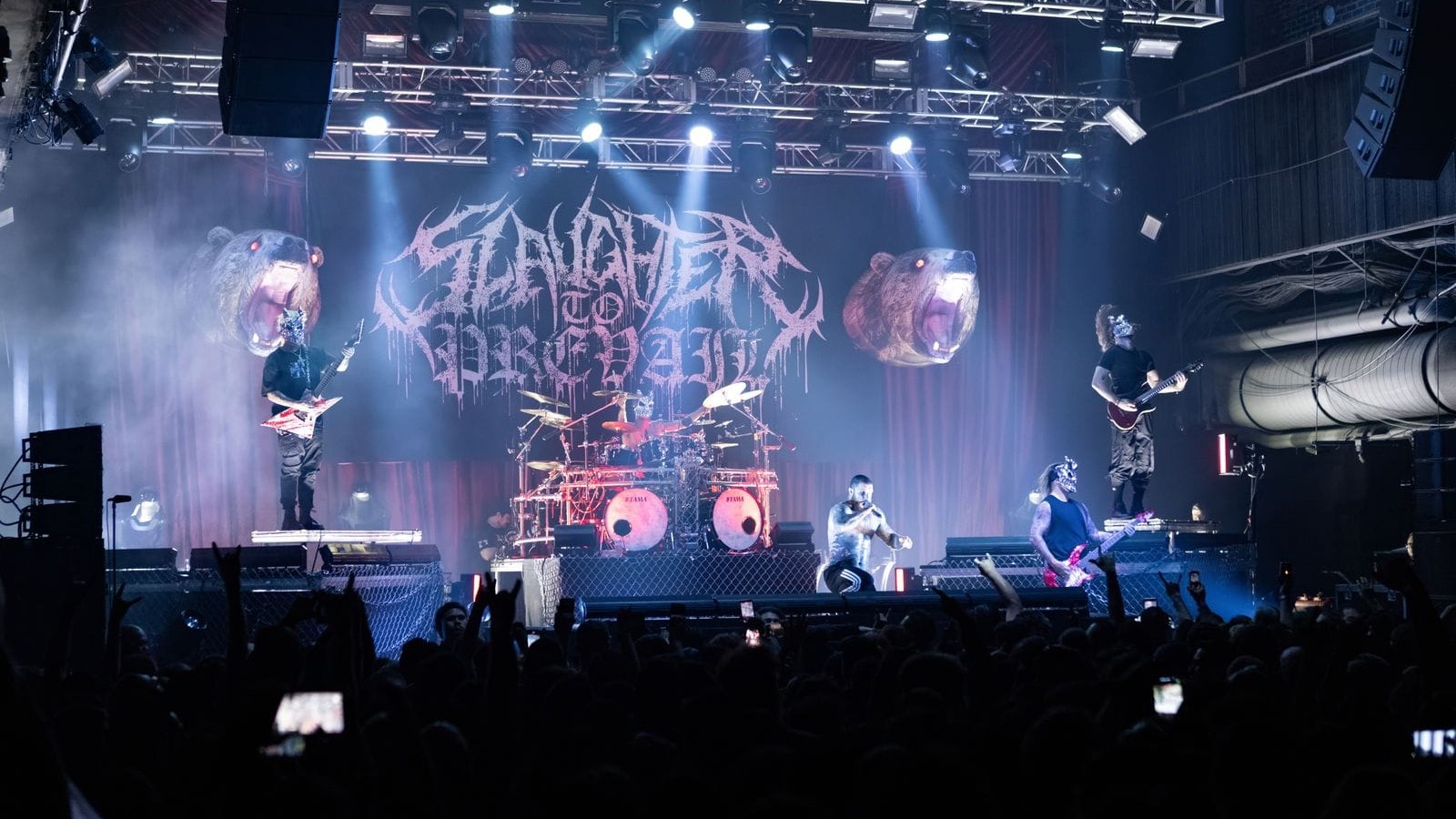
The most ambitious version yet was attempted in France. On the first day of Hellfest in Clisson, on 27 June 2024, Slaughter to Prevail split the festival field for a wall of death that the band had announced days earlier as an attempt at the largest in the world, and reviewers counted it the biggest wall of death in Hellfest history. No recognised body confirmed a record. The field did not care about the paperwork. It ran.
The tempo halves. The space on the floor doubles.
Package tours, from Never Say Die! to Chaos and Carnage
The pit needed bills to feed it, and deathcore has always travelled in packs. Five or six bands in a convoy of vans, one shared stage, one long night of breakdowns from doors to curfew: the package tour is how the genre reached towns that would never book a single deathcore headliner. The older American summer roads, Summer Slaughter and the Warped Tour, have their own histories. Two newer ones show how far the model travelled.
A good part of Europe met the music through a tour that carried the name of a clothing company. Run through 23 club dates in eleven countries in November 2008, first as the Altamont Never Say Die! club tour and later under the name of Impericon, with Parkway Drive, Unearth, Despised Icon, Architects, Protest the Hero, Whitechapel and Carnifex all on the same bill, the first Never Say Die! tour put three deathcore bands in front of European metalcore crowds every night, and the tour kept coming back, a regular muster of the heavier end of the core scene. A European kid could see the breakdown from three feet away without a transatlantic flight.
The American answer arrived later and grew bigger. Owned by the talent agency 33 & West together with Imperial Artist Management, and in its seventh year by 2026, the Chaos and Carnage tour has put the whole family on one bill, deathcore beside death metal beside slam: in 2022 it carried Suicide Silence, Carnifex, Lorna Shore, Signs of the Swarm and Distant, in 2025 it was headlined by Dying Fetus and Cradle of Filth, and in May 2026 it opened at the Van Buren in Phoenix with Thy Art Is Murder at the top, Carnifex and Bodysnatcher beneath them and 200 Stab Wounds, Ingested, Gates to Hell and Bodybox filling out the night, before closing at the House of Blues in Las Vegas on 31 May.
The same year the brand grew a festival. The first standalone Chaos and Carnage Fest was booked into the Palladium in Worcester, Massachusetts, with Shadow of Intent, AngelMaker, Snuffed on Sight and Mental Cruelty among the names. A tour that started as a convoy had become a destination.
The jokes the scene tells about itself
Every scene built around one enormous moment ends up laughing at itself, and deathcore laughs louder than most. The merch table is where the scene's running jokes pile up, from the shirt that is far too big to the band name read out like a battle cry. Nobody means them as insults. They are closer to badges.
The breakdown jokes are the ones that last, the endless variations on a riff tuned so low the guitar strings are lying on the floor, a breakdown so slow the drummer goes for a sandwich between hits, a pit so violent the security guards start a pit of their own. They are all affectionate. They are all mechanical.
A deathcore joke works like a rubber chicken gaffer-taped to the grille of a bass cabinet: everybody in the room knows it is a joke, and it still gets shaken to pieces by the low end the moment the breakdown hits, which is exactly why it is funny. You cannot laugh at a breakdown joke unless you know to the half second where the breakdown lands. The jokes are a catechism. Get one and you belong.
I own more band shirts than I will ever wear, and a few of them are big enough to sleep in. That is the joke, and the joke is on me, and I keep buying them.
From the warehouse to the film set
Deathcore has always spread through a screen first and a room second, and the music video did as much of that work as any profile page. The early clips were cheap and they looked it, a band in a rented warehouse or a practice space, a work light, a few dozen friends brought in to fill the frame. The format lasted far longer than the budgets that forced it, because a deathcore video is mostly a promise about what the room will look like when the band comes to town.

Released by Nuclear Blast on 5 August 2016, produced by Jason Suecof and wrapped in a cover by the long-time collaborator who signs as Godmachine, Slow Death sent its title track out with a clip that kept the old formula whole, and the San Diego band that filled a warehouse with fans headbanging, jumping and tearing into each other alongside the performance was Carnifex. A decade into its career, the band still made the crowd the special effect. It did not need another one.
The film set came in alongside it. Premiered on 18 August 2017, the day Dear Desolation came out, and directed by Third Eye Visuals, the clip for "Puppet Master" gave Thy Art Is Murder a produced video to sit beside Kantor's wolf, and in October 2017 the band cut a second video for the same song out of live footage, timed to its British and European dates. One song, two videos, one shot on a set and one shot in the rooms. The genre wanted both.
By the 2020s the video had become the front door. Dropped on 21 May 2021, the day the band announced Kostolom, premiered on SiriusXM's Liquid Metal channel and named after the witch of Slavic folklore who lives in a hut on chicken legs, "Baba Yaga" smashed its way out of the deathcore underground and onto the playlists of people who had never owned a deathcore record, and the band from the Urals that turned a fairy tale witch into a pit anthem was Slaughter to Prevail. The label's own channel also carries a live film of the song shot in Moscow, which shows what the studio clip promised: a band that is a visual act as much as a musical one.
Merch tables and record shelves
The shirt is the flyer. A deathcore shirt bought on a Friday night is worn to school or to work on the Monday, and every stranger who reads the name across the back of it has been handed an advertisement that no label paid for. That is why the logos had to be readable and why the covers end up printed on cotton as often as on cardboard: Kantor's wolf travels further on a back than it ever does on a sleeve. For the bands the table at the back of the room is also what keeps the van running between shows, and the merch line after a set is as much a part of a deathcore night as the pit in front of the stage.
Shirts get worn out. Records get kept. The MySpace years were a CD era, and most of the class of 2006 to 2009 came out on compact disc first and on vinyl in small numbers or not at all, which is why the vinyl of the period is a story of picture discs and late reissues. Whitechapel's This Is Exile, released by Metal Blade on 8 July 2008, first appeared on vinyl as a picture disc, and for its tenth anniversary the label pressed it again on coloured vinyl. Suicide Silence's debut The Cleansing, out on Century Media on 18 September 2007, got a vinyl edition from the label in 2016.

Released in July 2007 by the small European label Siege of Amida, with Candlelight carrying it in North America, The Somatic Defilement is the kind of first edition that makes a deathcore collector's shelf a reliquary of the MySpace years, a disc from before the band's Metal Blade contract, pressed for a scene that was still counting its audience in friend requests. When Metal Blade put the record on vinyl for the first time, in September 2017, it did so in limited coloured variants, which says where the appetite lay. The shelf is the scene's memory, kept in plastic.
Who stands in the room, then and now
The kids who found this music on a profile page in 2006 are in their thirties now. Some of them stopped going to shows, plenty did not, and a good number of them now stand at the back of the room with a drink while a teenager who found the same bands through a thirty second clip throws himself into the pit they used to own. The 2010s kept a core of holdouts who never left, through the years when magazines kept asking whether the genre was over. The 2020s added a wave nobody had planned for. All three groups are in the same rooms.

Recorded on 14 January 2023 at a sold-out show at the Forum in Melbourne, where the band played its 2012 album Hate from first song to last, mixed by Will Putney and issued digitally that July and on CD and coloured vinyl in November, Decade of Hate is the clearest picture of the audience that exists on record. The crowd on that tape sings along to songs more than ten years old. A room like that holds two audiences at once, the people who bought the record in 2012 and the people who were too young to, and on the night they sound like one. The floor took those breakdowns the way the freight elevator of an old theatre takes a whole stacked amp line in one load at four in the afternoon, cables shrieking in the shaft, the car dropping an inch on its brakes and holding, a decade of weight landing on machinery built for it.
What brings it into the room is mechanical, the same thing it has always been: a blast beat, a gap, and a breakdown landing exactly where the floor expects it. The haircuts changed, the platforms changed, the shirts got bigger and the jokes got better. The thing they came for did not move an inch.
What all those people are shouting along to, when they can make out the words, changed far more than the music did, from gore and misanthropy to anti-religious records, science fiction, manga and grief, and that story belongs to deathcore lyrics. The pictures, the pits, the tours and the jokes do not depend on the words. They depend on the drop.
Deathcore's culture was built by its audience as much as by its bands, and every piece of it, from a painted sleeve to a joke about shirt sizes, is organised around one moment in the song. Take that moment away and the covers, the shirts and the pits lose their reason. Keep it, and the culture keeps growing.
