
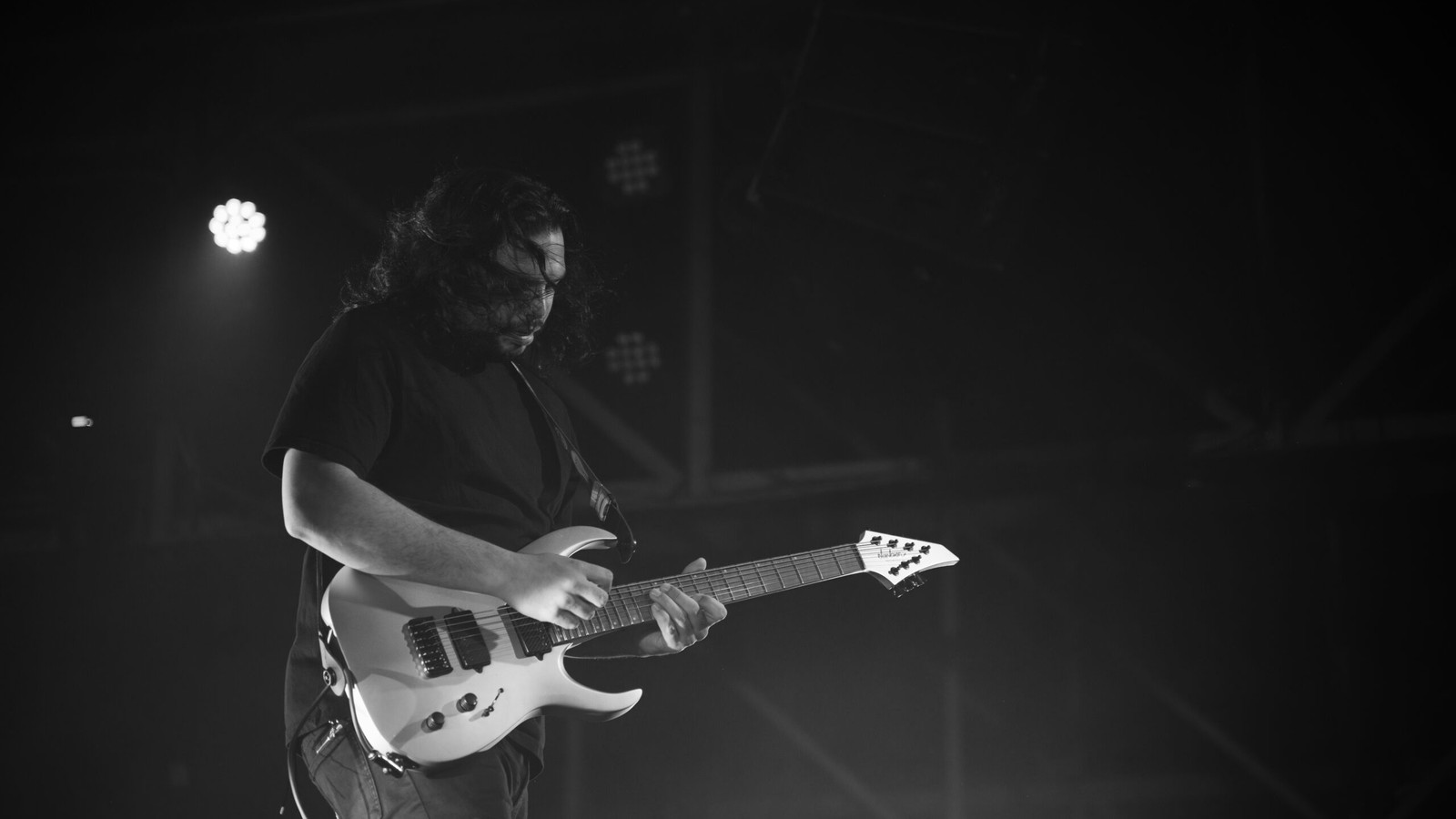
A progressive metal band in its own head, then "put in this thing": that is how Jake Bowen described his band's career to Guitar.com in March 2023, and the thing he meant was djent.
Founded in 2005 in the Washington, D.C., area by a guitarist who built his first songs on a home computer and a Pod XT, threw them onto the guitar forums for strangers to tear apart, and then spent years watching one word for the noise of his gear get hammered onto everything his band released, the five-piece that titled an album Periphery V: Djent Is Not a Genre and put it out through 3DOT on 10 March 2023 was Periphery. Misha Mansoor was the guitarist in question.
The title was a joke. It was also half right. Djent began as a sound, the clipped bark beaten out of a palm-muted, high-gain low string picked hard enough to slap it flat against the frets, and the word is nothing more than that bark spelled out. Deathcore began as a genre, a whole song with a blast beat, a growl and a breakdown in it. So the question of deathcore vs djent sets a genre against a guitar technique that grew into a loose name for a progressive scene, and the two only look like rivals because, for most of the 2010s, they shared label rosters, tour vans and eight-string guitars.
Sit in the passenger seat of a van idling at a toll plaza at two in the morning, the turn signal ticking dead even on the dash, and watch the driver pound the horn with the heel of his fist in bursts of his own, three short, one long, two short, the plastic cover cracking under the pattern while the signal ticks on and never once moves to meet him. That is a djent riff laid against its cymbal. Any driver on the circuit can lean on a horn that way, the progressive band, the metalcore band and the deathcore band alike. What the deathcore driver does next is drop the van into gear and snap the toll arm clean off its post on the next tick. That is the breakdown, and it is where a deathcore song was driving all along.
Deathcore vs djent: what the right hand does
Start with the guitar, because that is where djent lives and where deathcore only visits. The djent figure is a single low note, usually the open bottom string of a seven or eight-string guitar, palm-muted and pushed through so much gain that it stops sounding like a pitch and starts sounding like a percussion instrument. What makes it djent is not the tone alone but where the hits fall. The picking hand plays groups of uneven length, a phrase of seven sixteenth notes, say, then one of five, against a drummer who keeps a perfectly steady quarter note on a cymbal, so the accents jump around the bar and land somewhere new every time the phrase comes round.
That is a polymetric groove, and the line it comes from is short and well known. The Swedish band Meshuggah built its riffs that way through the 1990s, and in the middle of the 2000s a generation of guitarists recording at home began copying the picking and the tone, then trading the results online. Djent is what that habit got called.
A deathcore guitarist owns that figure and a dozen others. The tremolo riff that runs over a blast, the chromatic crawl down the low strings that winds the room tight, the pinch harmonic squealing off the top, and then the breakdown chug, which is the opposite of the djent figure in the one respect that matters: it lands on the beat. A breakdown wants every body in the room to come down at the same instant, so its chugs are driven home like a piston exactly where the floor expects them, half time, square, unmissable. The djent riff dodges the downbeat. The breakdown treats it as an anvil.
| Part | Deathcore | Djent |
|---|---|---|
| What the word names | A genre: a whole kind of song | A guitar sound, then a loose name for a progressive scene |
| The low string | Seven and eight strings, tuned to A and below | Seven and eight strings, often tuned just as low |
| Where the chug lands | On the beat, in half time, so the floor can land with it | Off the beat, in phrases of uneven length over a steady pulse |
| Drums | Blast beats in front of the breakdown | A steady cymbal pulse, the kick following the guitar, few blasts |
| Voice | Guttural growl and high scream | Screams beside clean singing, or no singer at all |
| Song form | Blocks stacked toward the drop | Longer forms, ambient passages, clean guitar interludes |
Blasts, voices and the shape of the song
Behind the kit the two part company almost at once. A deathcore drummer coming into a breakdown usually arrives off a blast beat, the kick, snare and cymbal fired so fast that no single hit can be counted, a gas leaf blower aimed into the gravel of a club's back lot so that every stone in the lot lifts at once and rattles off the parked vans as one long hiss of grit. A djent drummer mostly leaves the blower in the shed. He locks the kick to the guitar's chug and holds the steady cymbal over it, because the whole effect depends on the listener being able to hear the pulse that the riff is pulling against.
The voice is the second border, and the plainest. Deathcore singers growl from the bottom of the chest and shriek from the top of the throat, and a sung chorus is rare enough to start an argument when one turns up. The djent scene took the opposite road from the beginning. Periphery's singer Spencer Sotelo swaps between roars and singing, TesseracT put Dan Tompkins's mostly clean voice at the front of its 2011 debut One, and Animals as Leaders, Tosin Abasi's band, has no singer at all.
Song form follows the voice. A deathcore song stacks its blocks toward the drop, and the breakdown, as the wider story of the genre shows record after record, is the destination rather than a section, and the whole three minutes is the road to it. Djent records drift longer and wider, with clean guitar interludes, ambient pads and instrumental passages that would empty a deathcore pit before the second chorus. Neither form is lazier than the other. They are built for different rooms.
Djent names what a picking hand does to a low string. Deathcore names what a whole band does with a song.
Where the two met: one label, one producer, one record
The meeting point was an office. On 20 April 2010 Periphery released its first album through Sumerian Records, the label that already held Born of Osiris, Veil of Maya and After the Burial, and the djent band was already on the road as a support act, playing right before Veil of Maya on a North American tour with Darkest Hour in November and December 2010. Same vans, same clubs, same merch tables. The kids who came for one band stayed for the next, and the low string carried over from one set to the other without anyone checking its papers.
Then the djent side walked straight into a deathcore band's writing room. Released by Sumerian on 28 February 2012, co-written and produced by Mansoor, and gone in twenty-eight minutes, Eclipse was the Chicago band's fourth album, and it welded a Periphery guitarist's ear onto Veil of Maya's riffs from the writing to the board. "Vicious Circles" went out ahead of it in January 2012, and it is the cleanest test of the whole crossover you will find: listen for the steady cymbal with the riff jumping around it, then listen for whether the growl and the blasts are still in the room. They are. That is why the record gets filed under deathcore and djent at once, and why both filings are honest.
The crossover ran both ways inside a single record, too. The Minneapolis band on the same roster made Wolves Within with its own two guitarists producing, and "Of Fearful Men" comes complete with blast beats and death growls while "Pennyweight" carries a solo that Bradley Zorgdrager, reviewing the record for Exclaim! on 13 December 2013, teased as "triumphdjent". One album, both tools, no contradiction.

Released by Sumerian on 17 December 2013, nine tracks long, Wolves Within shows why After the Burial is filed as progressive metalcore, djent and deathcore by different hands. Every one of those hands is describing a real part of the record. The arguments about the label start only when somebody insists that one part outranks the others.
Why a band gets called one or the other
The cleanest proof sits in one suburb. Formed in Blacktown, on the western edge of Sydney, in 2006, and sent into the studio with Will Putney for a second album that Halfcut released on 19 October 2012 as Hate, the band that smashed Australian deathcore onto the national album chart at number 35 was Thy Art Is Murder. Five months later, on 22 March 2013, a second Blacktown band, formed there in 2009, released Singularity through UNFD after recording it with the same Will Putney at The Machine Shop in Belleville, New Jersey, and it went in at number 3 on the ARIA chart. The band was Northlane, and nobody files it as deathcore.
Same suburb. Same producer. Same five months. "Quantum Flux", the single whose video went out in February 2013, came off a record whose reviewers keep returning to Adrian Fitipaldes's clean singing, and that is why the filings split: a voice that sings where a deathcore singer would roar sends the band to metalcore, which is where the encyclopaedias put it. Thy Art Is Murder keeps the blast and the growl, and so it keeps its genre.
That is the rule, and it holds across the whole decade. A band does not become djent by playing the syncopated chug, because the chug is a technique and anyone may pick it up. It becomes djent, or progressive metalcore, when it lets go of the parts that make deathcore deathcore: the blast beat, the guttural and the song built toward a breakdown. Veil of Maya proved it from the inside when the band brought in Lukas Magyar, the new clean voice, and released Matriarch in 2015, a record whose reviewers, at Blabbermouth and The Music among them, wrote about his clean singing as the new thing.
Formed in Los Angeles in 2009 by musicians who wanted hip hop, jazz and classical music in the mix alongside the metal, launched by Via, which Mediaskare released on 27 September 2011, the band that makes the same case from the other direction is Volumes. It has the low string, the off-beat riffs and the bounce, and it is filed as progressive metalcore because the blasts and the growls were never the point. In May 2014 Northlane put Volumes, Veil of Maya and Thy Art Is Murder on one Australian bill, the Free Your Mind tour. Four bands, the same low strings, at least two genres, and one bill that carried all of them across Australia.
So the answer to deathcore vs djent is not a ruling between rivals. Djent names what a guitarist's picking hand does to a low string, and deathcore names what a whole band does with a song. A deathcore band can play djent riffs and stay deathcore, as Veil of Maya did on Eclipse, and a band with djent riffs and no blast, no growl and no breakdown waiting at the end was never deathcore in the first place. The other filing mix-up of those years had nothing to do with guitars at all, and the question of is deathcore emo came out of the same MySpace pages and package tours, and it is settled by the same method: count the parts, then ask what each one is for.

