
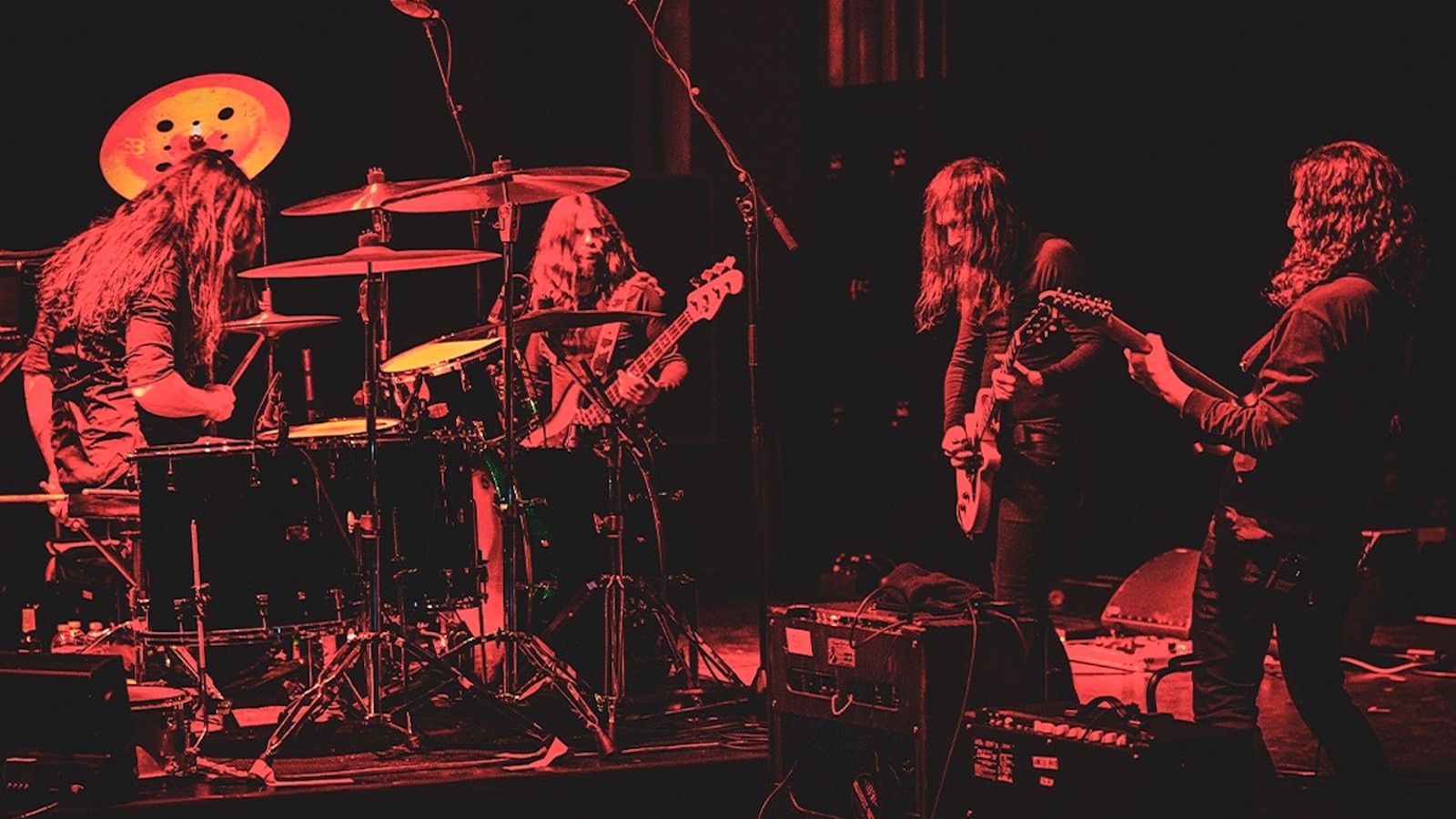
On 22 December 2013 the National Indoor Arena in Birmingham held a crowd that had paid to see Black Sabbath close the European leg of their reunion tour in the city where the band was formed in 1968, and before Tony Iommi, Geezer Butler and Ozzy Osbourne walked out, the stage belonged to a band from Cambridge that three years earlier had existed as a small run of CD-Rs and a songwriter who would not allow himself to be photographed. Few in the hall had bought a ticket for them. Uncle Acid and the Deadbeats were playing the last of sixteen support dates begun in Helsinki on 17 November, songs about murder and cults presented as the remains of horror films nobody had seen, for an audience whose attachment to this music had often begun with a photograph of a cloaked woman in front of a watermill.
Everything in that room was a picture before it was a sound, and that is the premise of this chapter. Doom metal art is not decoration added afterwards by a label's design department. It is the second half of the music, the half a listener holds in both hands before the needle drops, and in a genre whose songs move slowly enough to leave the mind time to wander, the sleeve, the logo, the clothes on the stage and the colour of the amplifiers are where the mind goes. The riffs are followed through every chapter of the doom story; here we follow what surrounds them.
The first window: a mill on the Thames
The first doom sleeve was not painted. Designed and shot by the photographer Keith Macmillan, who signed his work as Keef, the cover of Black Sabbath, released by Vertigo on Friday 13 February 1970, placed a woman in a black cloak before Mapledurham Watermill on the Thames on a freezing morning that began for the model at about four, while Macmillan threw dry ice into the water and, when it failed, reached for a smoke machine, and printed the result in the discoloured tones of a photograph left too long in a damp drawer. Inside the gatefold stood an inverted cross carrying a poem by Macmillan's photography assistant Roger Brown, and it was the cross, far more than any note on the record, that set off half a century of rumours about the band's allegiances.
What that sleeve fixed for the genre has never been bettered. The band is absent from it. There is a place, a figure whose face nobody can read, and a threat that arrives without explanation, and every doom record since that has put a painting, a desert or a film still on its front instead of four musicians has worked inside the frame Macmillan built at dawn beside the river. Even the band's name on the front is set plainly enough to be read from the back of a hall.
The tradition deserves a harder image than the word sleeve. Seen cold on a shelf, a doom cover is stained glass in a side chapel after dark, leaded and dim, a window with nothing behind it, its figures dulled to brown and its black outlines heavier than its colours; but set the record turning and the riff comes up behind the glass like a lamp carried slowly into the vestry, and every pane fills at once, the cloaked woman, the old man in the boat, the forest, the witch, held together by the lead of the logo and lit from behind by a guitar tuned down so far that it glows rather than shines. It is not a metaphor for marketing. The picture needs the dirge to be seen, and the dirge needs the picture to be remembered.
Old canvases, new painters

When doom went looking for a picture older than itself, it went to the museum, and Black Sabbath led again when their 1977 compilation Greatest Hits borrowed Pieter Bruegel the Elder's "The Triumph of Death", an army of skeletons driving the living into a trap. The next borrowing reached back to the nineteenth century. Signed as the first band on the British label Axis, the Swedish quintet built around the bassist Leif Edling, Candlemass, put Thomas Cole's "Old Age", the last canvas of his 1842 series "The Voyage of Life", on the front of Nightfall, released on 9 November 1987 with the new singer Messiah Marcolin steering the choice. An old man in a small boat drifts out of a dark gorge towards a light he has not yet reached. No funereal sleeve in the genre has said more with less. A painting a century and a half old arrives already in mourning, and the band had only to set its name above it.

The painters who pushed the museum off the sleeve arrived in the nineties. Recorded at Workshop Studios in Redditch and released by Earache on 21 October 1991, Forest of Equilibrium, the debut of the Coventry band Lee Dorrian formed after leaving Napalm Death, Cathedral, wore a crowded, hallucinated painting by Dave Patchett. He painted The Ethereal Mirror for them in 1993, his work was still inside the sleeve of The Last Spire, the farewell of 2013, and the partnership showed a generation that a doom record could commission its own myth rather than borrow one from a gallery wall.
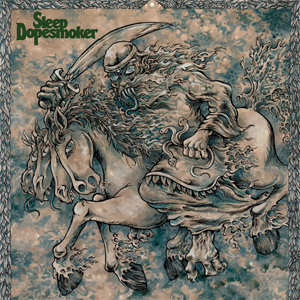
The painter who defined the next wave is Arik Roper. Born in 1973 and trained in cartooning at the School of Visual Arts, where he graduated in 1995, he became the house illustrator of the heavy American underground, painting for High on Fire and Windhand and above all for Sleep, whose sixty-three-minute single piece Dopesmoker finally reached the shops on Tee Pee on 22 April 2003 after nearly a decade of label wreckage. Roper painted that sleeve, and when Southern Lord reissued the record in 2012 he painted it a second time.
A doom sleeve is a picture built to be looked at for the length of a side.
The painter Adam Burke carries the method on, most plainly on the cover of Horizonless, the album the death doom band Loss released through Profound Lore on 19 May 2017 with Billy Anderson producing. A doom sleeve is a picture built to be looked at for the length of a side, and it is the only part of a record that ends up on a wall.
Letters meant to be read
Black metal grew its logos into thickets so that outsiders could not read them. Doom mostly did the opposite, keeping the legibility of the plain Sabbath lettering while bending the letters towards grief, which is what Decibel praised when Chris Dick ranked the five best doom logos in May 2013. He put My Dying Bride first, for a mark that is easy to read and whose stems trail away like roots pulled out of wet ground, and followed it with Paradise Lost, Pentagram, Cathedral, whose Celtic lettering and mermaid crest first appeared on the In Memorium demo of 1990, and Saint Vitus, whose second logo worked three crosses and a crown of thorns into its barbed letters.
The strangest logo in the wider family was not drawn for a band at all. Formed in 1998 by Stephen O'Malley and Greg Anderson, the drone duo Sunn O))) took both their name and their mark from the Sunn amplifier company, whose badge sets a circle beside the word with waves running off to the right, and licensed that badge from Fender, which owned the brand at the time. In doom, the lettering and the gear have never been separate subjects, and the logo is the lead that holds the coloured glass in place.
Hammer posters and a band without faces
The cinema entered the sleeves in force with the British revival. Recorded at Toe Rag Studios with Liam Watson and released by Rise Above on 20 November 2007, Witchcult Today by the Dorset band Electric Wizard carried a cover Jus Oborn edited from the poster for The Devil Rides Out, the 1968 Hammer film. From that record on, the horror poster stood beside the old canvas as a place a doom sleeve could come from. The band that took the method furthest was the support act in Birmingham.
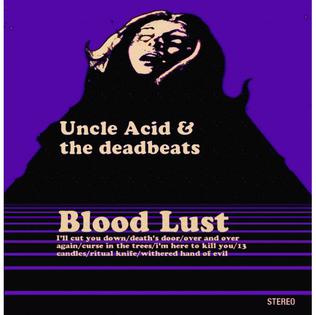
Founded in Cambridge in 2009 by Kevin Starrs, with a bassist and a drummer known only as Kat and Red, the trio that called itself Uncle Acid and the Deadbeats released Vol. 1 in 2010 as a small run of CD-Rs, which by Starrs's account to Terrorizer in December 2011 took about six months to sell thirty copies, and put the small profit straight into a second album. He called the first record a collection of shorts in the manner of Hammer House of Horror and pitched its successor as a weird, unfinished sixties witchfinder film, the kind West Germany had made in 1970 with Mark of the Devil, whose American distributor, Hallmark, handed out sick bags to the audience at the door. Blood Lust appeared in 2011 in a short run, and Rise Above, the label Lee Dorrian had founded, reissued it on vinyl late that year. By March 2012 The Quietus reported that the reissue had gone fast too and was selling for up to £700 on Discogs.
The anonymity was the other half of the image, and it was deliberate. In the band's first years no photographs of it existed at all, and when he answered The Quietus in March 2012 Starrs gave the reason plainly: "There are no band photos, because it has nothing to do with the music." While it lasted, the effect was exactly that of the old sleeves: records with no faces on them, a leader known by a name borrowed from a band fronted by Rusty Day, the singer of Cactus, and a fuzzed sound that arrived with no biography, so that all a listener had to hold was the picture on the front and the murders inside. Starrs later took the stage name K. R. Starrs and let Uncle Acid stand for the band as a whole.
The records that followed were each built as a film nobody ever shot. Mind Control, recorded at Chapel Studios in Lincolnshire and released by Rise Above on 12 April 2013, told the story of a cult leader who comes down from the mountain to bend a desert following to his will, through songs such as "Mind Crawler" and "Poison Apple". The Night Creeper, released on 4 September 2015, followed a killer in the mould of Jack the Ripper. By Nell' ora blu, released in May 2024, Starrs had made a nineteen-track record in the shape of an Italian giallo, its dialogue entirely in Italian, with Edwige Fenech and Franco Nero, two faces of that cinema, recording their parts for it.
The stage followed the pictures. The bands that rebuilt the sound of the early seventies across the late 2000s and the 2010s, Blood Ceremony, The Devil's Blood, Uncle Acid and their neighbours, brought the occult imagery of that decade back along with its riffs. Decibel, surveying that revival in January 2015, leaned on the writer Peter Bebergal, whose book Season of the Witch argues that rock as it now exists was shaped more by the seventies than by the sixties. At the far end of the family, Sunn O))) walk on in hooded robes and fill the room with fog. In doom, the wardrobe is a sleeve that moves.
| Record | Year | Label | Source of the image |
|---|---|---|---|
| Black Sabbath, Black Sabbath | 1970 | Vertigo | Photograph by Keith Macmillan at Mapledurham Watermill |
| Candlemass, Nightfall | 1987 | Axis | Thomas Cole, "The Voyage of Life: Old Age", 1842 |
| Cathedral, Forest of Equilibrium | 1991 | Earache | Original painting by Dave Patchett |
| Electric Wizard, Witchcult Today | 2007 | Rise Above | Edited from the poster for The Devil Rides Out |
| Sleep, Dopesmoker (reissue) | 2012 | Southern Lord | New artwork by Arik Roper |
| Loss, Horizonless | 2017 | Profound Lore | Artwork by Adam Burke |
Orange, Sunn and the slackened string
The gear culture of doom begins with an injury. Having lost the tips of two fingers on his fretting hand in a sheet metal factory at seventeen, Tony Iommi played through thimbles he had shaped from a melted Fairy Liquid bottle, which robbed him of feel, hunted down the lightest strings he could find, banjo strings at first, and tuned down to slacken them further, until on Master of Reality in 1971 the band's instruments sat a step and a half below standard, in C sharp. A way to make the guitar hurt less became the leaden sound of a whole genre, a string loosened until every chord sags on its frame like a canvas left out in the rain. Each generation since has dug the floor a little deeper, and Sunn O))) work in tunings as low as drop A.
Tunings that low need amplifiers that can move air without breaking up, and two brands became the furniture of the doom stage. Founded in 1965 in Tualatin, Oregon, by the brothers Conrad and Norm Sundholm because Norm needed a high-powered bass amplifier to tour with, Sunn was bought by Fender in 1985 and closed in 2002, and its badge outlived the factory on the front of a drone band. Orange was founded in 1968 by Clifford Cooper at 3 New Compton Street in London's West End, dressed its cabinets in bright orange covering, and from 1972 labelled its controls with pictures instead of words, an idea borrowed from the new British road signs. An orange cabinet at the back of a stage is a sleeve the audience reads before a note is played.
An orange cabinet at the back of a stage is a sleeve the audience reads before a note is played.
The rooms where the audience gathers
Slowness needs a room that will wait for it, and the genre built its own. Roadburn began as a stoner rock website run by Walter Hoeijmakers and Jurgen van den Brand, turned into three shows in Amsterdam, Tilburg and Sneek between 11 and 13 February 1999, and settled in 2005 at the 013 in Tilburg, where it has grown into the heavy underground's annual council, with around three quarters of its audience travelling in from abroad, tickets for the 2009 edition gone in forty-five minutes, and guest curators drawn from the bands themselves, Neurosis in 2009, Sunn O))) in 2011, members of Enslaved in 2015. London answered in 2012 with Desertfest.
The first of those Roadburn nights, in February 1999, put Cathedral and Orange Goblin on the bill, so the festival that would later gather a generation of painted sleeves opened its doors to the band whose Patchett covers had first shown what a commissioned myth looked like.
Pressings, 4/20 and the joke the scene tells about itself
Collecting doom means collecting the object the picture lives on, and the genre's history of broken releases has made that object unusually precious. The single piece Sleep recorded live to tape in 1994 for London Records, rejected by the label in a dispute that finished the band, first surfaced in 1999 as the unauthorised fifty-two-minute Jerusalem on Rise Above and The Music Cartel, then as Dopesmoker on Tee Pee in 2003, again on Southern Lord in 2012 with Roper's new art, and again on Third Man in 2022 with the unreleased "Hot Lava Man" added, so that one interminable composition now stands on a shelf as four different editions.
The sleeve is the only part of a doom record that is never played and never wears out.
Andrzej Sawicki, KaosMetal
The scene has also learned to laugh at its own image. The joke starts with Black Sabbath, whose "Sweet Leaf" opened Master of Reality with a recording of Iommi coughing, and it reached its most elaborate form when Sleep released The Sciences, their first album since Dopesmoker, through Third Man with almost no warning on 20 April 2018, a date whose meaning in cannabis culture needed no press release. The cough was an accident: Osbourne had handed Iommi a large joint during the acoustic overdubs, and the producer Rodger Bain kept a fragment of the fit and set it at the top of the song.
What holds the jokes, the pressings, the festival rooms and the painted sleeves together is the arrangement we found in Birmingham on 22 December 2013: an audience that paid for the originals, a younger band built out of borrowed pictures, and behind them both a photograph of a woman at a watermill that had been doing its work since 1970. The next chapter follows black sabbath doom metal back to Aston and to the decision to slow the music down that made every later sleeve necessary. The window was glazed beside the Thames at dawn. Every riff since has been lit behind it.
