
Hear the tolling of the bells, iron bells! What a world of solemn thought their monody compels!Edgar Allan Poe, The Bells, 1849
Every history of heavy music has to decide where the slowness came from, and we make that decision at the start, so that the rest of this chapter can defend it rather than circle it. Slowness was not an accident of poor musicianship or cheap studios. It was a choice, made first by four young men from Aston in Birmingham who called themselves Black Sabbath, between the autumn of 1969 and the summer of 1971, and then carried through the following decade by people with no record contract, no radio play and sometimes no audience at all. This is the first chapter of the history of doom metal, and it ends where the word doom starts to name a genre rather than a song.
The story has two continents and almost no money in it. On one side stand the records Black Sabbath sold, three albums inside eighteen months that stripped the blues rock quartet down to its studs and rebuilt it at half the speed and twice the weight. On the other stand the bands who heard those records and could not get a hearing of their own: a Virginia group that waited fourteen years to release an album, a rehearsal room offshoot whose tapes waited three decades for a label, and a father and son from south London whose only early recording circulated for sixteen years as a copied cassette.
Aston, 1968: a sheet metal press and two fingertips
Formed in Aston in 1968 by the guitarist Tony Iommi and the drummer Bill Ward, who brought in the bassist Geezer Butler and the singer Ozzy Osbourne and worked the Midlands clubs first as the Polka Tulk Blues Band and then as Earth, the quartet that would slow rock music down was in its first year a blues band of no particular distinction. What changed it was an injury sustained before the four had met. At seventeen, on his last day at a sheet metal factory, Iommi lost the tips of the middle and ring fingers of his right hand in an industrial accident. He played left handed. The damaged hand was the one that fretted the notes.
Iommi melted a washing up liquid bottle into thimbles, covered them with scraps of an old leather jacket for grip, fitted banjo strings because nobody yet made guitar strings light enough, and later slackened them further by tuning down, because a string under less tension asks less of a fingertip that is no longer there. In effect the factory had retuned the guitar before the band wrote a note, pressing the whole instrument down into a leaden register no healthy hand would have chosen, and every downtuned riff in this history descends from that workbench. In August 1969, having found that another English band was already called Earth, the four renamed themselves after the 1963 Italian horror film known in English as Black Sabbath, with Boris Karloff, after Butler remarked on how much people were willing to pay to be frightened.
Regent Sound, 1969: rain, thunder and a bell
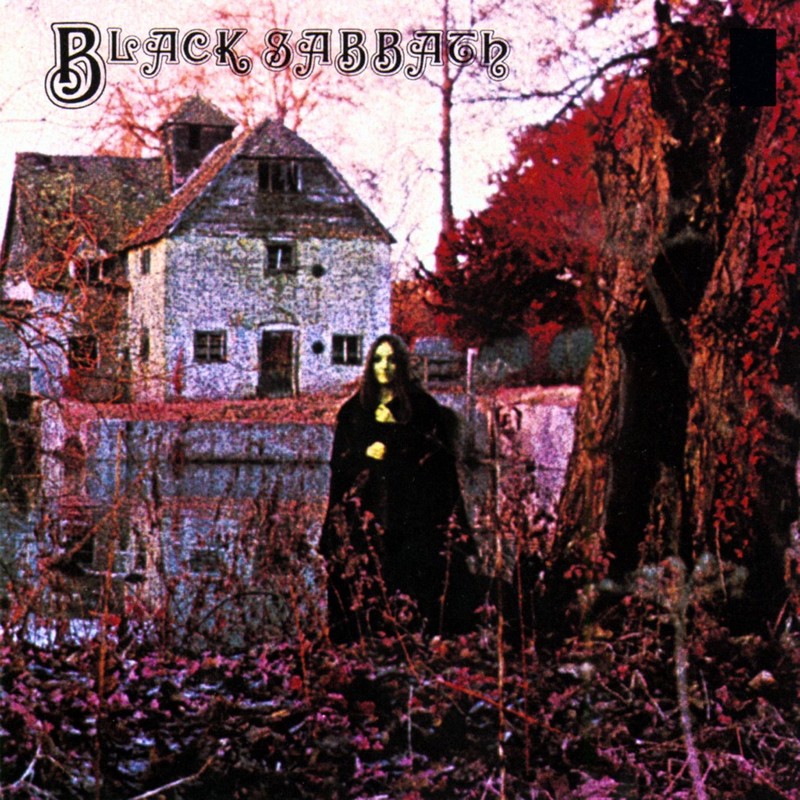
Recorded with the producer Rodger Bain at Regent Sound in London in a single day of about twelve hours in the autumn of 1969, with almost nothing added afterwards beyond double tracked solos on "N.I.B." and "Sleeping Village" and a few seconds of sound effects at the very beginning, Black Sabbath was, as Iommi has described it ever since, the band's live set played once into the microphones. Those few seconds are where our subject begins. Before any instrument, the listener hears rain, distant thunder and a church bell.
Then the riff of the title song arrives, built on the tritone, the interval long nicknamed diabolus in musica, the devil in music, which splits the octave exactly in half and refuses to resolve. Iommi strikes the chord and lets it hang until it has almost drowned in its own ring, and only then strikes the next, so the song is measured not in beats but in the time it takes a note to die. It is the bell from the introduction carried indoors and plugged in: a bronze stroke swung in a downpour over a burial nobody has announced, each blow left to run off into the wet before the rope is pulled again. Heavy rock before 1970 had been loud, or fast, or both. This was slow on purpose, and the slowness was the threat.
The song is measured not in beats but in the time it takes a note to die.
Vertigo, the progressive imprint of Philips, released the album in Britain on Friday 13 February 1970, and Warner Bros. followed in America on 1 June. It reached number eight on the UK albums chart and number 23 on the Billboard 200, the American album chart, where it stayed for more than a year and sold a million copies. The press was less patient than the public: Lester Bangs, reviewing it for Rolling Stone on 17 September 1970, heard nothing but stiff recitations of Cream clichés and called the record a shuck.
Paranoid and Master of Reality: the weight becomes a method
Recorded over three days in June 1970 at Regent Sound and Island Studios, again with Bain, and released on 18 September, Paranoid went to number one in Britain behind a title single that reached number four. For this history the decisive songs are two that radio never touched. "Electric Funeral" is a dirge about nuclear war, its riff dragged through a wah pedal at a crawl. "Hand of Doom", written about soldiers coming home from Vietnam addicted to heroin, is the first Black Sabbath song with the word doom in its title.

Recorded at Island Studios in February and April 1971 and released that summer, Master of Reality is the record on which the injury became an aesthetic. Iommi tuned down a step and a half on "Children of the Grave", "Lord of This World" and "Into the Void" to take tension off his fingers, Butler matched him, and the result is a sound Iommi has called bigger and heavier. It reached number five in Britain and number eight in America. "Children of the Grave" gallops on that lowered tuning. "Lord of This World" and "Into the Void" haul their riffs across the floor like a load too heavy to lift clear of the ground, and it is that weight that some critics regard as the foundation of stoner rock and sludge, the two dirtier offshoots of doom that took shape in America in the late 1980s and 1990s.
The band did not stay there. Vol. 4 in 1972 and Sabbath Bloody Sabbath in 1973 brought in piano, strings and synthesisers, and by Never Say Die! in 1978 the original line-up was worn through by substance abuse and exhaustion. Iommi fired Osbourne on 27 April 1979, and with that dismissal Black Sabbath's story turns away from ours. The tritone, the downtuning and the funereal tempo were on record and selling by the million, and every other band in this chapter spent the decade working out what to do with that inheritance on a fraction of the money.
The loud Americans: Blue Cheer and Sir Lord Baltimore
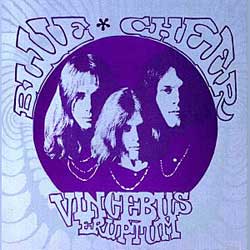
The San Francisco trio Blue Cheer got to volume two years before Black Sabbath got to slowness. Recorded at Amigo Studios in Los Angeles with the producer Abe Kesh and released by Philips on 16 January 1968, Vincebus Eruptum drove Dickie Peterson's bass, Leigh Stephens's guitar and Paul Whaley's drums through a wall of amplifiers, reached number eleven on the Billboard 200 and carried a demolition of Eddie Cochran's "Summertime Blues" to number fourteen on the singles chart. AllMusic's Mark Deming heard primitivism loud enough to deafen an army; Classic Rock later called it a deranged masterpiece. Blue Cheer were loud. Loud is not slow. What the record lends doom is tone, and not tempo.
A year later an American band called Coven released Witchcraft Destroys Minds & Reaps Souls on Mercury, a psychedelic rock album whose opening track is called "Black Sabbath" and whose label withdrew its support soon after release, once a photograph of Charles Manson holding a copy surfaced. What Coven passed on to doom was imagery rather than sound.
The Brooklyn trio with the best claim to stand beside Black Sabbath at the start of this story, Sir Lord Baltimore, released Kingdom Come on Mercury in December 1970, produced by Mike Appel with Jim Cretecos and mixed by Eddie Kramer at Electric Lady in New York. The drummer sang lead from behind his kit, Louis Dambra pushed his guitar through heavy distortion, and songs such as "Master Heartache" and "Hell Hound" ran fast. In May 1971 Mike Saunders wrote in Creem, the Detroit rock monthly, that the band had most of the best heavy metal tricks in the book, one of the earliest uses of heavy metal as the name of a style. It is not a slow record, and that is the line we draw through American proto-metal: it supplied distortion, volume and a name, and the decision to slow down came from the Midlands.
| Year | Band | Release | Label |
|---|---|---|---|
| 1968 | Blue Cheer | Vincebus Eruptum | Philips |
| 1970 | Black Sabbath | Black Sabbath | Vertigo |
| 1970 | Sir Lord Baltimore | Kingdom Come | Mercury |
| 1971 | Black Sabbath | Master of Reality | Vertigo |
| 1972 | Pentagram, as Macabre | "Be Forewarned" single | Intermedia |
| 1973–1979 | Bedemon | Rehearsal tapes, issued 2005 | Black Widow |
| 1981 | Witchfinder General | "Burning a Sinner" single | Heavy Metal Records |
| 1982 | Pagan Altar | Self-titled tape, issued 1998 as Volume 1 | Self-released, then Oracle |
| 1985 | Pentagram | Pentagram | Pentagram Records |
Alexandria, Virginia: Pentagram and the lost decade
Formed in 1971 in Alexandria, Virginia, by the singer Bobby Liebling and Geof O'Keefe, who started on guitar and later moved to the drums, with Vincent McAllister first on bass and then, for five years, on guitar, the band that would wait fourteen years for its first album, Pentagram, spent its early years unable to settle even on a name. The 1972 single "Be Forewarned" came out on Intermedia credited to Macabre, the band was Virgin Death in 1973 and Wicked Angel in 1974 before returning to Pentagram for good, and a promotional single, "Hurricane", appeared on the Boffo Socko label.
Out of the same rehearsal room came an offshoot slower and darker than its parent. Formed around 1973 by the guitarist Randy Palmer, with O'Keefe, Liebling and Mike Matthews beside him, Bedemon put songs such as "Child of Darkness", "Serpent Venom" and "Frozen Fear" down across five sessions in 1973 and 1974 in Pentagram's rehearsal basement in Alexandria, never in a studio and with no release in mind. The tapes waited three decades, until the Italian label Black Widow Records issued them in 2005 as Child of Darkness. Palmer did not live to see it. He died in 2002 of injuries from a car crash.
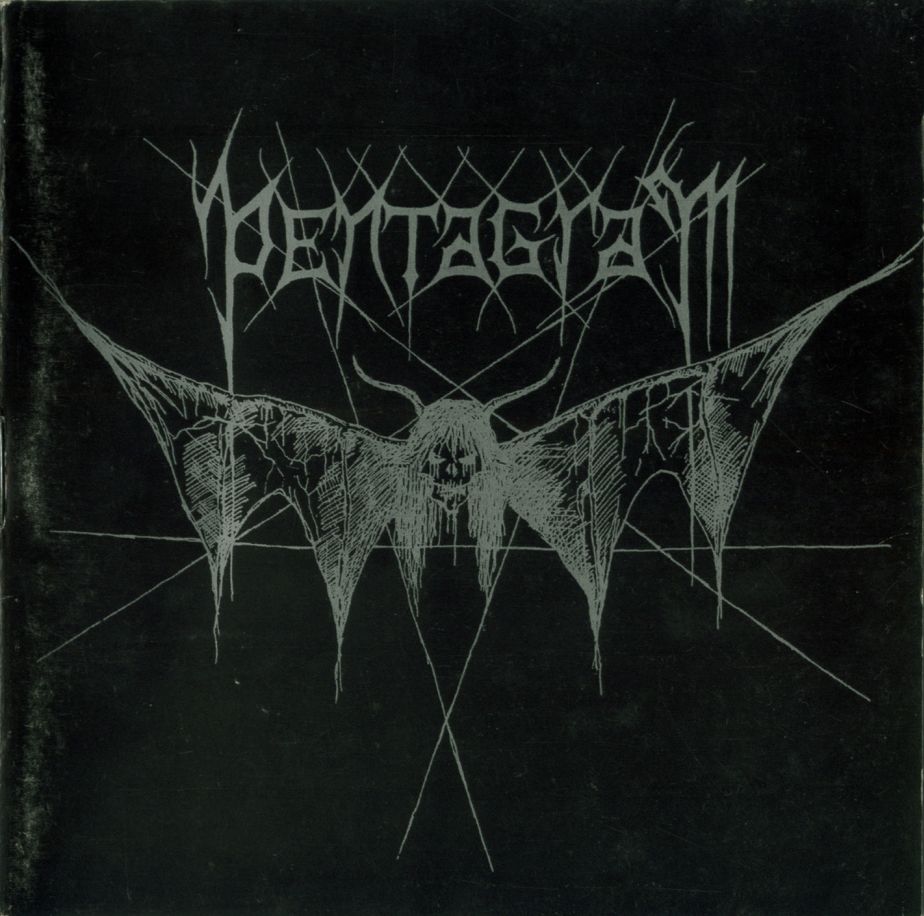
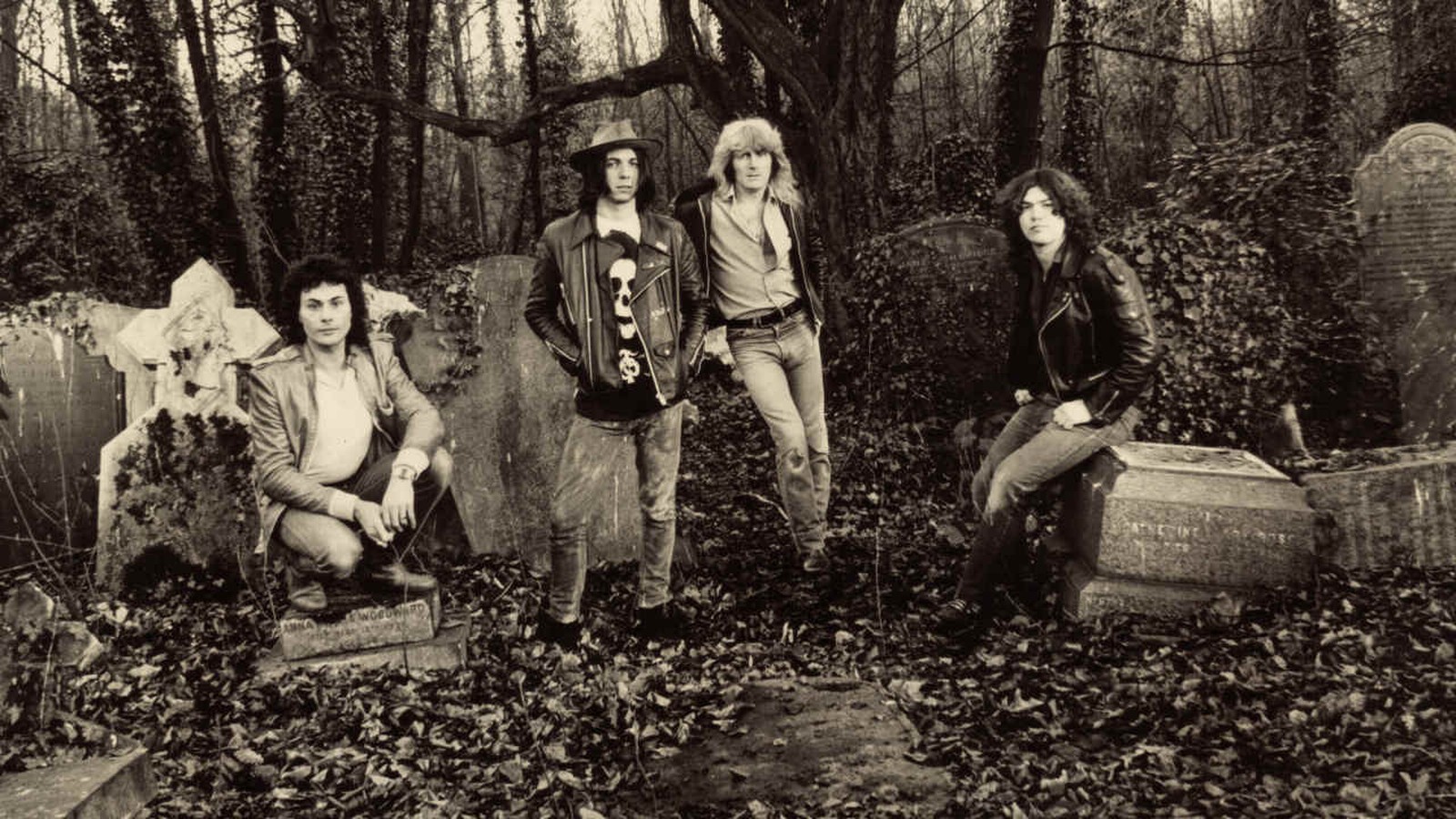
The lost decade of the Alexandria band is a sequence of doors that opened a hand's width and closed again. In 1975 Sandy Pearlman and Murray Krugman, the producers behind Blue Öyster Cult, booked the band into Columbia's studios in New York for a demo session that September, and it produced no contract, because Liebling and Krugman fell out over a point of production. The rest of that line-up had quit by 1977, and with them went the first Pentagram. What remained was a vault of finished songs, "Forever My Queen", "When the Screams Come", "Walk in the Blue Light", rehearsed, taped and locked away like vestments in a sacristy for a congregation that had not yet been born. When Relapse Records issued twelve of them as First Daze Here in 2001, Julian Cope wrote at his Head Heritage site that the SG on those recordings burned hotter than Iommi's ever had. The debut album had come by a roundabout route: a doom band called Death Row, formed in Knoxville, Tennessee, in 1980 by the guitarist Victor Griffin and the bassist Lee Abney and later based in northern Virginia, took Liebling on as singer, then took the Pentagram name, and released Pentagram on its own label in 1985, fourteen years after the first rehearsal.
Stourbridge, 1979: Witchfinder General and the churchyard
The injury that shaped the sound had happened in Birmingham, and the first British band to take Black Sabbath's slow side as its whole programme came from Stourbridge, on the western edge of the same conurbation. Formed in 1979 by the singer Zeeb Parkes and the guitarist Phil Cope, Witchfinder General arrived with the new wave of British heavy metal, the movement of young, often independently released bands that filled British clubs and music papers at the turn of the 1980s. Its first release, "Burning a Sinner" backed with "Satan's Children", came out on Heavy Metal Records in 1981.
Recorded on 10 and 11 April 1982, with Peter Hinton credited as producer although Cope and Parkes always felt the credit belonged to the engineer Robin George, and released that September, Death Penalty is seven songs of Iommi catechism recited by a congregation a few miles from where the scripture was written, from "Invisible Hate" to the band's own anthem, "Witchfinder General". Reviewers at Metal Archives, the online encyclopaedia of the genre, keep landing on the same flaw in the production: one hears drums like cardboard and a bass that surfaces only in rare spots, another a boxy kit with the bass buried in the background. The album proved that in 1982, with British metal accelerating towards thrash, a Midlands band could still stake everything on the slow and the heavy. Friends of Hell followed in 1983, and by 1984 the band had split.
Brockley, 1978: Pagan Altar and the tape that would not die
The father and son who make up the other half of the British story, and in our judgement the stronger half, formed Pagan Altar in Brockley, in south east London, in 1978, some six months after the end of an earlier group called Hydra: Terry Jones sang, his son Alan played guitar, and they gave the concepts and occult themes of the band almost as much time as the riffs. From the beginning the live show was theatre, with human skulls, a coffin pouring out dry ice, hooded black robes and pyrotechnics, staged at a time when, as Alan Jones remembered it in 2025, a band could do more or less what it wanted on a stage, and Pagan Altar did manage to set a few things alight.
In 1982 the Joneses recorded their songs at their own Pagan Studios in Brockley and paid for the mastering themselves, and what came out of that room is, on any honest reading, the finest British doom recording of its decade, although for sixteen years it was not officially a record at all. "Judgement of the Dead" opens on a synthesiser before its main riff comes down on top of it, "The Black Mass" turns the ceremony violent with a stomping riff, "Night Rider" borrows the gallop of the new wave, and "Reincarnation" runs to nearly ten minutes. The Noisey obituary of Terry Jones in May 2015 heard eldritch folk and a nasal wail over slow, grandiose songs, and the Ride Into Glory review of May 2019 called his voice decrepit and argued that it is exactly what gives the record its candlelit, ritual air.
The band never found a label and broke up in 1985, and the tape carried on without it. Dubbed from cassette to cassette by traders and bootleggers through the late 1980s and the 1990s, losing a generation of fidelity at every copy, the recording of the father and son from Brockley passed from hand to hand like a forbidden devotional text copied out by scribes who had never seen the original, until Oracle Records issued it as Volume 1 in 1998. Too slow for the new wave and too early for doom, the tape waited sixteen years for its genre to catch up. In 2004, finding copies of the old recording on sale online for absurd sums, Terry and Alan Jones reformed the band and released Lords of Hypocrisy, built from material written in the first era. Terry Jones died of cancer on 15 May 2015.
We formed as a heavy Rock band and had not heard the term Doom until much later. We were always far too slow to be a NWOBHM.
Alan Jones of Pagan Altar, interviewed by John Wisniewski, Stalker Magazine, 25 May 2025
That remark about being too slow for the new wave applies to both British bands in this chapter. Neither Pagan Altar nor Witchfinder General set out to found a genre, because the genre had no name, and both were too slow for the movement they were filed under. The difference between them is the difference between a band that learned the Sabbath riff and a band that took from Sabbath the permission to be slow and filled that slowness with something of its own: a folk melody, a staged mass, a thin and spectral voice that sounds as if it were reading aloud from a book nobody else was allowed to open.
Too slow for the new wave and too early for doom, the tape waited sixteen years for its genre to catch up.
What the seventies handed on
By the close of 1979 every piece was on the table and nobody had assembled them under a name. Black Sabbath had supplied the tritone, the downtuning and the tempo and then walked away from all three; the Americans had supplied volume, distortion and the words heavy metal; Pentagram and Bedemon had shown, in a basement in Virginia, that a whole repertoire could be built from the slowest minutes of Sabbath's records; and in England, Witchfinder General and Pagan Altar were about to show it again. Doom did not begin as a style. It began as a refusal to hurry, kept up by people who were paid nothing for it.
The names that carry the story forward were forming as the decade closed. In Los Angeles a band formed in 1978 as Tyrant was on its way to becoming Saint Vitus, in Chicago the guitarist Rick Wartell had started Trouble the same year, and in Stockholm a few years later the bassist Leif Edling would found Candlemass. That is the eighties chapter, where the tolling slowness of these first records becomes a genre with its own labels and, at last, its own name.
