
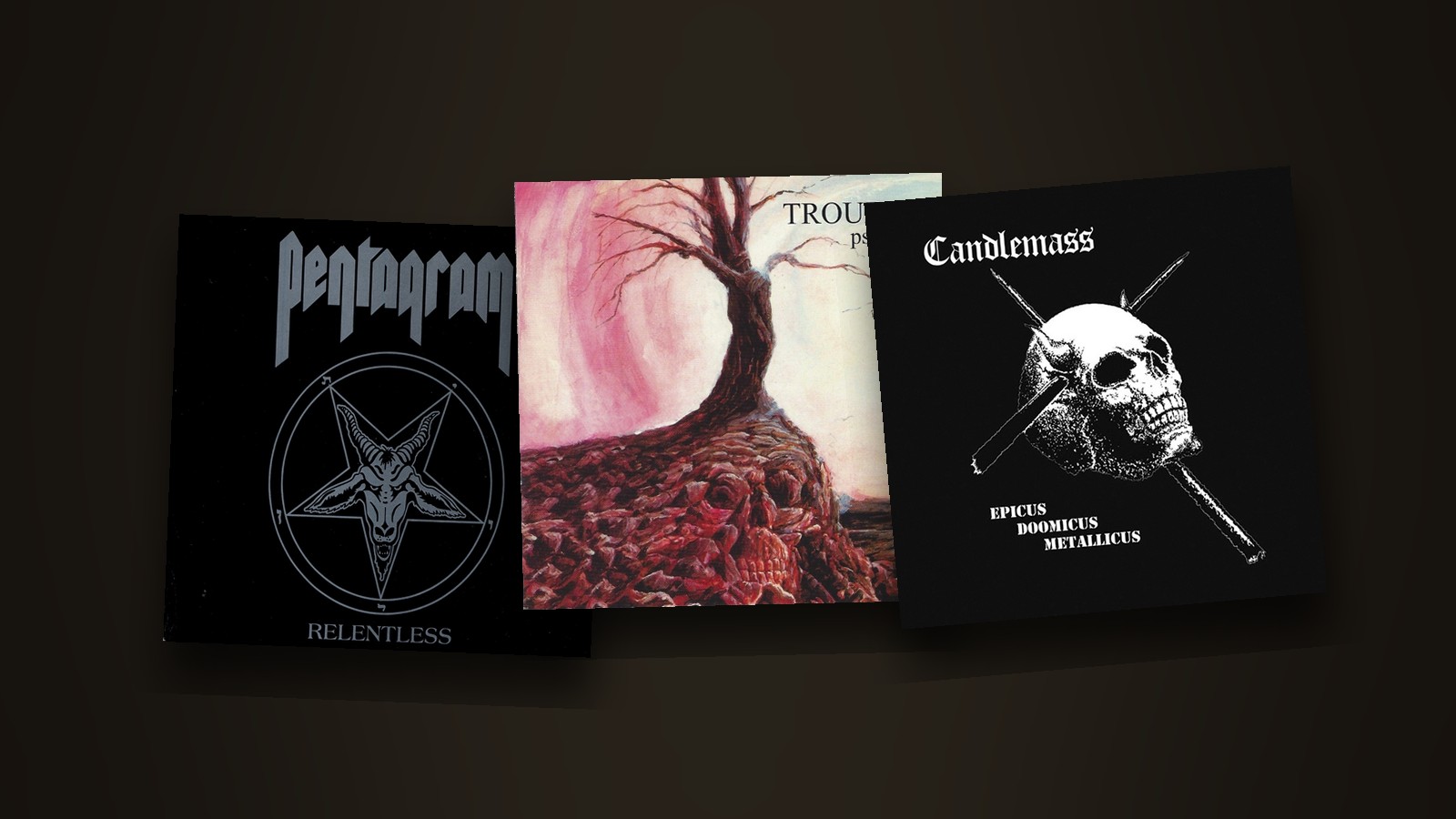
"It's not doom metal; we're not doomed yet." So said Bobby Liebling, the singer who founded Pentagram in Alexandria, Virginia, in 1971, to Justin Jackley of It's Psychedelic Baby Magazine in an interview published on 21 January 2024, in the same breath as telling him that what he loves is heavy hard rock. We take the sentence seriously, because it lays out the whole problem in one line. One of the men most often credited with inventing doom metal refuses the word, and the man who wrote the word into an album title was a Swedish bassist who was still a child when Liebling's band cut its first single in 1972.
Who invented doom metal is therefore a question about people, not about a first record or a first song, and the people do not stand in a queue. They stand around a hole in the ground. Picture a well sunk in a dry field, where the first pair of hands broke the crust in the English Midlands in 1969, struck a cold seam of water and went off to dig elsewhere, and where every pair that came after lowered itself down the same shaft, drove the spade a few feet deeper into the clay, hauled up a bucket of its own and called the water by its own name. Each of the nine musicians on this page has a claim. None of them dug the whole well. How the digging started is told in the beginning of the genre; here we follow the hands.
The first spade: Tony Iommi and Geezer Butler
Worked out by a quartet from Aston that had started as a blues band, the riff of the song "Black Sabbath" began, by the band's own account, when the bassist Geezer Butler played a fragment of "Mars" from Gustav Holst's suite The Planets and the guitarist Tony Iommi came back the next day with the tritone, the interval old theorists called the devil in music, each chord struck and left hanging over a slow tempo. The lyric came from Butler too, at one remove: he told the singer Ozzy Osbourne of a large black figure he said he had seen at the end of his bed after reading an occult book, and Osbourne wrote the words from that story. Two hands were on the first spade, not one.
The guitarist from Aston carries the larger claim, for a concrete reason. At seventeen he lost the tips of two fingers on his fretting hand in an accident at a sheet metal factory, and on three songs of Master of Reality in 1971 he tuned down a step and a half to take the tension off them, with Butler lowering the bass to match. That tuning, that tempo and that interval are the water. Butler's share is counted less often and is no smaller: as the main lyricist of the Osbourne years he gave the music its vocabulary of war and damnation, and on Paranoid in 1970 he wrote the words of "Hand of Doom", a song about soldiers coming home from Vietnam hooked on heroin. The records on which the two kept the slow side alive are weighed in our guide to black Sabbath's Doom Metal Albums. By 1980 Osbourne was gone and the band was recording with Ronnie James Dio, and the first diggers had climbed out of the shaft.
Tony Iommi and Geezer Butler struck the water. They did not stay to dig the well.
Liebling and O'Keefe, Chandler and Reagers: the hands that stayed
The Virginia pair went down next. Leaving their previous bands in 1971 to play the heaviest rock they could manage, the singer Bobby Liebling and his former schoolmate Geof O'Keefe, who started on guitar and moved to the drums for the line-up that began rehearsing on Christmas Day that year, spent the following years taping songs such as "Forever My Queen" and "When the Screams Come" that never reached an album in that decade, the second surfacing only on small-label singles, and in Bedemon, an offshoot begun around 1973, both also recorded songs written by the guitarist Randy Palmer. That water stood in the dark for three decades. When Relapse gathered the tapes of 1972 to 1976 as First Daze Here, the booklet carried notes by O'Keefe beside notes by Liebling, the drummer's account of the early pentagram set down next to the singer's.
The first Pentagram album, in 1985, was dug by other hands again. Formed in Knoxville, Tennessee, in 1980 by the guitarist Victor Griffin and the bassist Lee Abney, a band called Death Row took Liebling on as its singer, took the Pentagram name with him, and put sessions from 1981, 1982 and 1984 onto a self-titled record carrying "Relentless" and "All Your Sins", an album that Eduardo Rivadavia of AllMusic called "a raw, untainted slab of pure doom metal" and that Peaceville renamed Relentless for its 1993 reissue. Liebling sang doom on it. He has never taken the name.
On the other coast the digging was paid for by a hardcore label. Formed in Los Angeles in 1978 as Tyrant by the guitarist Dave Chandler, the bassist Mark Adams and the drummer Armando Acosta, with Scott Reagers brought in to sing after the first show, the quartet renamed Saint Vitus in 1980 recorded its debut in Redondo Beach on 16 and 17 August 1982 for SST, and every song on it was Chandler's except the music of the nine minute "The Psychopath", which Adams wrote. Chandler has said metal fans and punks alike hated the band at first, though the punks came round; the four dragged their dirges across hardcore stages on tours with Black Flag, Reagers singing on the self-titled debut, held back by SST until early 1984, and on Hallow's Victim in 1985 before leaving early in 1986. Reagers came back for Die Healing in 1995 and has sung with the band again since 2015, so the guitarist who wrote the first Saint Vitus record and the singer who delivered it front the band today.
Chicago: Rick Wartell and Bruce Franklin
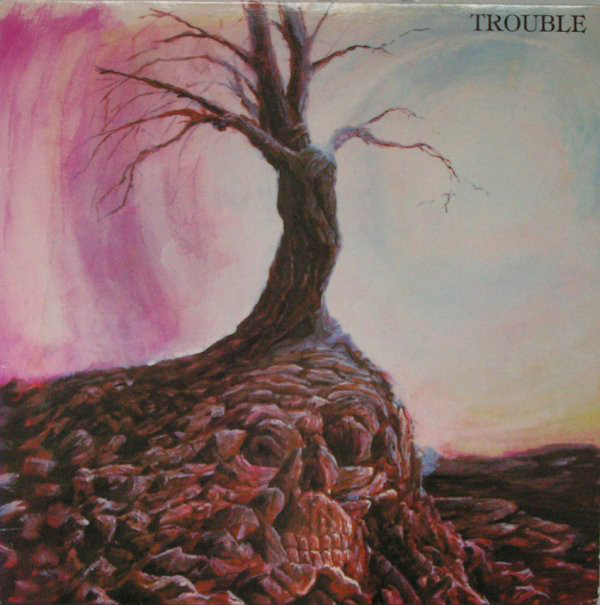
The Illinois guitar partnership was begun by one of its halves alone. Started in 1978 by Rick Wartell while he was still at high school, as its only guitarist and its singer, and rebuilt in 1981 through an advertisement in the music paper Illinois Entertainer that brought in the second guitarist Bruce Franklin, the singer Eric Wagner and the drummer Jeff Olson, Trouble recorded its debut at Track Record Studios in Los Angeles in February 1984, in a week including the mixes by Wartell's recollection. The two guitars are the point. In Chris Chantler's reading for Louder in October 2016 it is a record of sinister guitar harmonies, and Wartell and Franklin work each riff like two hammers on one bar at the anvil, one falling as the other lifts, so that the iron never cools between blows. Both men are still in the band.
Trouble is also where a record label tried to print a name on this music, and printed the wrong one. Because Wagner drew his lyrics from scripture, and "Psalm 9" sets the King James text directly, Metal Blade marketed the band as white metal, the mirror image of black metal, and Wagner later implied that the label had invented the term and the band never accepted it. The debut, issued simply as Trouble, became Psalm 9 only after a second self-titled album appeared in 1990. A well can be dug for years before anyone paints a word on the bucket.
Upplands Väsby: Leif Edling writes the word

The Swedish bassist Leif Edling, born in 1963, had been through three bands when he formed Candlemass in 1984 in Upplands Väsby, north of Stockholm, and once a demo cut in November 1985 with "Demons Gate" and "Black Stone Wielder" reached Black Dragon Records in Paris, the label offered one album on a budget of $1,800. Recorded at Thunderload Studios in Stockholm in February 1986 with the producer Ragne Wahlquist, Mats Björkman and Klas Bergwall on guitars, Matz Ekström on drums and Johan Längqvist singing as a guest, Epicus Doomicus Metallicus came out on 10 June 1986 with all six songs by the bassist, "Demon's Gate" running past nine minutes. It sold so badly that Black Dragon dropped the band that year.
The title is the part of that record that answers our question. Built in dog Latin out of epic, doom and metal, it set the three words on a sleeve as the name of a style rather than a mood, and the first of them, epic, is the name the slow, operatic branch of the style still carries. Chris Chantler, in the same Louder piece, called it an "audacious, literally genre-defining title". Liebling, Chandler and Wartell had dug for years without naming the water. Edling lowered a bucket once and wrote the name on its side.
The verdict: who invented doom metal
So who invented doom metal? The sound was invented by Tony Iommi, with Geezer Butler beside him: the riff, the interval and the first lyric of dread came out of that quartet in 1969, the lowered tuning in 1971, and every later claimant, Liebling included, drew water the band from Aston had struck first. The genre, a music played on purpose by bands that played nothing else, was invented by the people who stayed down the shaft after Black Sabbath climbed out, Liebling and O'Keefe from 1971, Chandler and Reagers from 1978, Wartell and Franklin from 1981, and in 1986 Leif Edling wrote its name into an album title. That a Swede put the name on a record while one of its most celebrated godfathers refuses it is not a paradox. It is how a well gets dug.
Iommi struck the water. The Americans spent their lives at the bottom of the shaft making it deeper, and a Swede wrote the name on the bucket.
Declan Rourke, KaosMetal
Liebling's line to Jackley stands as the word of a man who dug doom for half a century and would still rather call it heavy hard rock. We keep the name anyway, for the weighted music the nine of them brought up between them, and the rest of the story runs through KaosMetal on doom, sludge and stoner.
