
Four rhythm guitars, one pair of hands. Recorded at Sweet Silence Studios in Copenhagen in the last months of 1985 and released by Elektra in March 1986, Master of Puppets carries under most of its riffs four separate performances of the same part, two of them played through one rig and two through another, and the guitarist who played all four, while his lead player did not cut a single rhythm track on the album, was James Hetfield of Metallica.
A single ox dragging a plough pulls it off line toward whichever shoulder is stronger, and the share wanders through the clay. Yoke two together and neither beast ever sets a hoof down at the same instant as the other, one a fraction early and one a fraction late, and between them the share rips a furrow through the turf as straight as a rule, roots torn out and flung aside. Double tracking metal guitars runs on that same arithmetic. The two takes never match. That is why the furrow holds.
What double tracking metal guitars does to a riff
The method is simple to describe and brutal to play. The guitarist records the rhythm part, then records it again from the top, as close to the first take as his hands allow, and the engineer pans one take hard into the left speaker and the other hard into the right. No two performances are identical. One downstroke lands a few milliseconds before its twin, one bend sits a few cents sharper, and the ear, receiving two slightly different versions of the same riff from two directions, hears one guitar wider than either speaker.
Copying one take onto both sides does not work, and the reason is physics rather than taste. Two identical signals, one in each speaker, fold into a single guitar standing in the middle, and a copy nudged a few milliseconds late turns hollow and metallic instead, the two signals cancelling each other at a comb of frequencies and collapsing when the mix is played in mono. The only thing that sounds like two guitars is two guitars. There is no shortcut.
The machine built to fake it
Somebody tried. The Abbey Road engineer who built a machine in the spring of 1966 so that a singer who hated recording his vocal twice would never have to do it again was Ken Townsend, and his artificial double tracking took the signal off a second tape machine, varied its speed with an oscillator and laid it back beside the original. It served The Beatles very well on vocals. On a distorted guitar the trick shows its wobble, and the records that set the standard for heavy rhythm guitar were, by common consent, made the long way.
The long way was not compulsory, and the most famous guitar record of the late seventies refused it almost entirely: Van Halen sounded wide on its 1978 debut with one guitar and no second take. It was the exception that proves how hard that is.
A double is not a copy. A copy is the same mistake made twice. A double is two different mistakes that cancel each other out.
Curtis Vance, KaosMetal
The take that matched the take
The hardest part of the job is not the second take. It is making the second take agree with the first closely enough that the two fuse instead of smearing, and a loose double is worse than no double at all, a riff with a blurred edge on every chord. The guitarist the producer of Ozzy Osbourne's Blizzard of Ozz has called the best he ever saw at overdubbing solos and tracking them, a player whose second take locked so tightly against the first that the two read as one, was Randy Rhoads.
Recorded at Ridge Farm in Sussex in the spring of 1980 and released by Jet that September, the record carries on "Crazy Train" a rhythm guitar doubled so tightly that it reads as one enormous instrument. The engineer who then ran the two rhythm sides through an AMS digital delay with a different short setting and a slight detune on each, a faint chorus that thickened the grind without anybody hearing an effect, was Max Norman. On the song's central guitar theme Rhoads went further still, playing it three times, one take anchored in the centre and two quieter passes panned to either side, so the ear hears one huge guitar rather than three.
Four guitars from one guitarist
Rhoads showed that a player could match himself. Hetfield turned the principle into an assembly line. Flemming Rasmussen has described the method on Master of Puppets in detail: Hetfield played his own part, doubled it on Kirk Hammett's equipment, then played the second guitar's part on Hammett's rig and doubled that on his own, so that every riff arrived as four performances through two different sounds. Rasmussen has called him the best rhythm guitarist on the planet. The tape is the evidence.
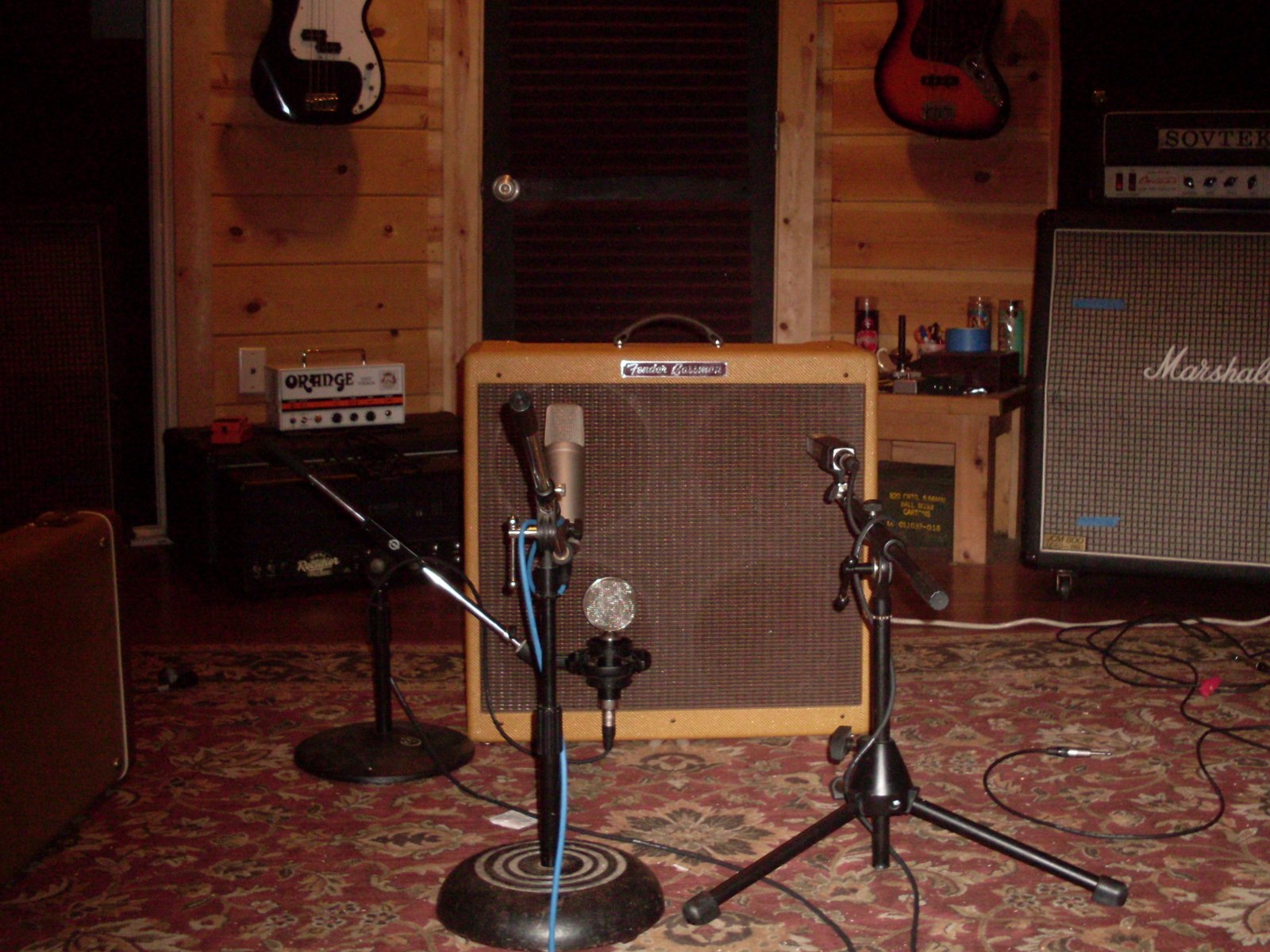
The two rigs were the point. Two passes through the same amplifier differ only in timing, while a pass through a second amplifier with a different voice differs in tone as well, one heavier in the low middle and the other brighter on top, so the four tracks covered more of the spectrum than four passes through one rig ever could. Producers have since made a standing method of it, and the name that stuck in studios is tone stacking.
The only thing that sounds like two guitars is two guitars.
"Disposable Heroes" shows what four tracks do at speed. Soft body armour stops a pistol round not with one sheet but with layer upon layer of woven aramid, each ply catching what the one before let through, until the bullet reaches the inside face flattened into a mushroom of lead and the man wearing it keeps his ribs. The barrage of rhythm guitar on that song works the same way. A downstroke that lands late on one track is swallowed by three that landed on time, and the riff arrives as a single solid shape.
So does the pick. Four layers flatten the attack of every stroke along with the errors, and the more tracks go down, the less of any one performance the listener hears. That is the attested cost of the wall. It is also why the thrash records built this way can sound colossal and oddly airless at once.
Three instead of four
The producer who took the method apart five years later, recording the band playing together in the room and then building the guitars on the band's self-titled 1991 album, Metallica, from three tracks, left, right and middle, until they sounded like one wall, was Bob Rock. "Sad But True" is the result, slower and heavier than anything the band had put out, a riff hung on tensile steel. On the band's earlier records, Hetfield has told Guitar World, he built that wall alone, playing and doubling every rhythm guitar himself into left speaker and right, and the wall stayed one dimensional until Kirk Hammett began cutting it open with contrasting parts of his own.
The centre track mattered as much as the two sides. A pair of guitars panned hard apart leaves a hole in the middle of the stereo picture, which is where the kick drum, the bass and the voice live, and a third guitar placed there fills it at the risk of standing on all three. Rock took the risk. The record sold as few heavy albums ever have.
Double tracking is one habit among the many that the studio taught heavy metal, and the rooms, the tape and the producers who shaped the rest are laid out in the chapter it belongs to. The habit outlived every machine that went with it, from two-inch tape to the laptop, because no machine ever learned to play a part badly in exactly the right way.
Every one of those takes, all four of Hetfield's and all three of Rock's, started at the front of an amplifier, where the sound of each individual pass was decided before any engineer could pan it anywhere, and what the valves inside contributed is the subject of tube amps and the heavy metal sound. Two takes can widen a tone. They cannot rescue one.

