
On 16 December 1947, in a Bell Telephone Laboratories building at Murray Hill in New Jersey, a sliver of germanium with two gold contacts pushed into its surface amplified a signal for the first time, and the little device was expected to finish off the vacuum tube inside a generation. The two physicists who built it, and who shared a Nobel Prize for it in 1956 with the man who ran their group, were John Bardeen and Walter Brattain.
Their invention gutted the valve out of the radio set, the television cabinet, the telephone exchange and the computer room within thirty years. It failed to take one bastion. The tube amps heavy metal guitarists still haul onto stages in 2026 run on the same glass their grandparents' wireless sets threw on the tip, and no transistor built since has talked the players out of it.
A man who jumps from the third floor of a burning house into the canvas life net held by a ring of firemen sinks a yard into it, and the sheet spreads the blow through his whole body across a few tenths of a second. Make the same jump onto bare concrete and it snaps both his legs. The fall is the same. Only the give is different.
A valve under a hard pick stroke is the life net. The early transistor was the bare concrete.
Tube amps heavy metal players cannot give up
Drive a triode, the small glass valve that does the work in a guitar preamplifier, harder than it was designed for, and the top of the signal never hits a wall. It bends over gradually, so that a harder stroke of the pick comes out a little louder, a good deal thicker and crowded with harmonics, the strongest of them the second, an octave above the note, which the ear hears as weight.
Drive a transistor of the sixties the same way and it runs to its limit and stops dead, shearing the tops off the waveform and piling up odd harmonics that fizz on top of the note, never inside it. Dig in on the valve and the chord gets heavier. Dig in on the early solid state amplifier and it only gets harsher.
That is why the style kept the glass. A heavy metal guitarist plays with the right hand as hard as with the left, and an amplifier that answers the force of the pick hands him a second volume control made of forearm. Nothing about it is nostalgia. It is feel, and it shows up on an oscilloscope.
Dig in on the valve and the chord gets heavier. Dig in on the early solid state amplifier and it only gets harsher.
A chain of triodes, and the little amp that boogied
The Californian repairman who, around 1969, crammed a big transformer and a twelve inch speaker into a small Fender Princeton as a prank, then built its successor with the preamplifier stages feeding one another in a line, was Randall Smith. The customer who tried the prototype and announced that the little thing really boogied was Carlos Santana, and the company Smith founded took its name from the remark.
Cascading gain moved distortion out of the loudspeaker and into the circuit. Every triode in the chain overloads a little and passes its rounded wave to the next, which rounds it again, until by the third or fourth stage a note arrives thick, saturated and sustaining at a volume a bedroom can survive. The high gain amplifiers of the eighties, from Mesa's own Mark series to the Soldano SLO-100 that Mike Soldano began selling in 1987, all run on that idea.
| Valve | Job | Origin | What it does to a riff |
|---|---|---|---|
| 12AX7 (ECC83) | Preamplifier, several per head | RCA, 1947 | Stacks gain, stage on stage |
| EL34 | Power, most British heads | Mullard (Philips), 1955 | Breaks up early, barks in the upper mids |
| 6L6 | Power, most American heads | RCA, 1936 | Stays clean longer, firmer low end |
| KT88 | Power, the Marshall Major and other big heads | GEC, 1956 | Huge headroom, late breakup |
| EL84 | Power, small combos | Philips, 1953 | Chimes, then compresses early |
The power valves at the end of the chain decide the accent. British amplifiers built around the EL34 break up early and bark in the upper midrange, while American ones built around the 6L6 stay clean longer and hold a firmer low end, which is why two heads set to the same gain can still sound like two countries. The bigger KT88 buys headroom and tonnage, and headroom was exactly what one guitarist wanted rid of.
The guitarist who took a 200 watt Marshall Major, a head built around four KT88s for clean volume, and had the factory rewire it until the biggest valves in the catalogue finally broke up, was Ritchie Blackmore. "Burn", the title track of the album Deep Purple released in February 1974, is the sound of the man who asked for that monster, at full volume.
Sag, and the valve that feeds all the others
One valve in an old amplifier never touches the signal at all. The rectifier turns the mains current into the direct current every other valve lives on, and a valve rectifier, the GZ34 in the first Marshall, the JTM45, among them, cannot keep up when a full chord suddenly asks for more. The supply voltage dips for a fraction of a second. Players call it sag.
Atlas, handed the sky back by Heracles, takes its whole weight across his shoulders at once, buckles to one knee, and then drives himself back up to his full height under it. A chord struck through a valve rectifier does the same half second of work: the attack buckles, the note sinks into the supply, and then it springs back to full height as the voltage recovers. On a slow bend it feels like breath. On a fast palm muted riff it feels like mud.
The company that put a switch on the back panel so that the player could choose, a valve rectifier for the sag or silicon diodes for a supply that never flinches, was Mesa/Boogie, and the Dual Rectifier it launched in the early nineties took its name from that switch. By common consent the silicon side is the tight, fast one, and a riff built on sixteenth notes needs every stroke to land at the same height. The knees never bent. The chug got tighter.
The round the transistor won

Released by Atco on 24 July 1990, Cowboys from Hell hit the racks with a guitar that owed nothing to glass, and the Arlington guitarist who wrenched it out of a solid state Randall head was Dimebag Darrell of Pantera. In a style that treated glass as scripture, it was open heresy.
"Psycho Holiday", the album's second and last single, is the place to hear that box at work, a circuit with no rectifier valve to sag and no glass to warm up, driven by a man who wanted it that way.
It stayed an exception, and the solid state builders spent the following decades designing circuits whose whole ambition was to behave like glass. The modelling boxes and profilers now bolted onto half the stages in the world are judged on a single test, whether a player can tell them from a valve amplifier. Nobody runs the test the other way round.
Glass, heat and three factories
A valve is a consumable. It runs hot enough to blister a finger, its filament wears, its cathode loses emission over months of hard use, and a power valve gone microphonic in its socket turns every hit in the drum barrage into a ringing ghost behind the guitar. Touring technicians carry spares matched in pairs and quartets in foam-lined cases, and a head sits on standby for a minute before the first chord so the cathodes are warm before the high voltage reaches them.
The supply is the stranger story. The Western valve industry, Mullard, RCA, GE and Sylvania among it, shut its lines decades ago as the transistor took the market, and almost every valve a guitarist buys today comes from a handful of plants: the old Reflektor works in Saratov in Russia, JJ Electronic in Čadca in Slovakia, and a few factories in China.
The American businessman who bought the Saratov factory outright in 1998, and whose company stamped its output with revived names including Tung-Sol, Mullard and Genalex, is Mike Matthews of Electro-Harmonix. One sanction, one fire or one retired machine that nobody alive knows how to rebuild, and the price of a matched quartet of EL34s doubles in a week. The players keep buying them anyway, because the glass still answers the hand.
Valves are one link in a longer chain of rooms, tape machines and men at the desk, and the wider story follows that chain from Regent Sound to the hard disk.
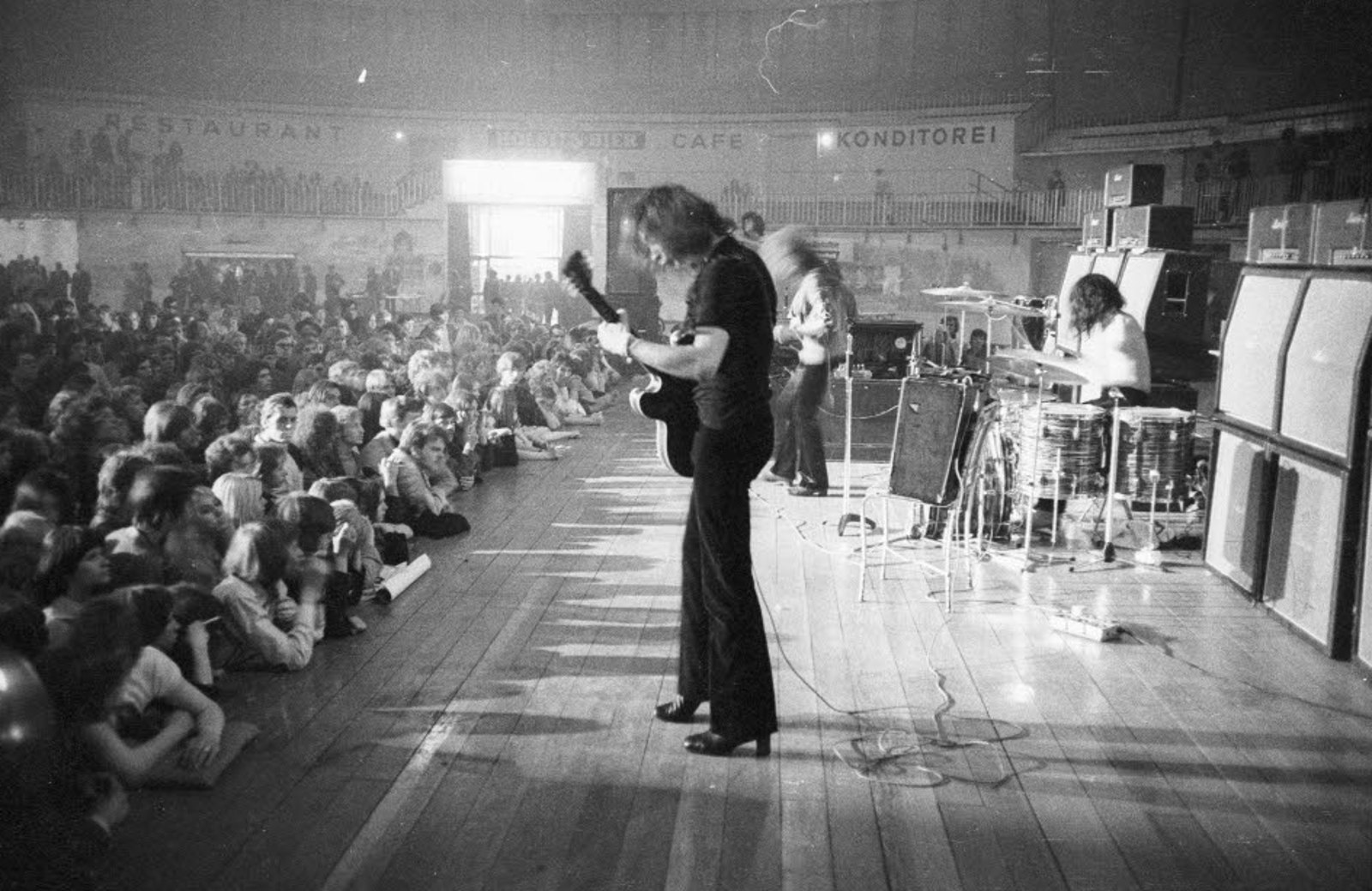
The cabinets those heads sat on, stacked two high and lit from below, carry a history of their own, one of geometry and of showing off, and it belongs to the Marshall stack. Take the back panel off one of the heads and the whole argument is in there, four bottles glowing orange along the bottom of the chassis, still doing the job a New Jersey laboratory set out in 1947 to take away from them.

