
Five milliseconds of stick on skin, and two full seconds of the room it was hit in. Every argument about the 80s metal drum sound is an argument about the second number.
Take a rug out to the line in March, throw it over the wire and hit it once with a cane beater. The crack is finished before the arm comes back. Then the dust stands in the low sun for a second and a half, spreading, twice as wide as the rug and refusing to drop, and the whole decade went looking for a way to keep that cloud and still get the next blow in clean.
The device that did the work was not a drum, a stick or a room. It was a noise gate, a switch that watches a signal and shuts the channel the moment the level falls below a mark the engineer sets, sold through the seventies to clean hiss and microphone leakage out of a mix and turned inside about two years into an instrument. The band whose snare in 1980 still sounds like a drum standing in a house, cut for a number four album months before that switch became fashionable, was Judas Priest. How the rooms and the machines around it changed is set out in the production chapter.
What a close microphone does to a drum
A snare hit is two events that the ear adds together without ever separating them. First the transient, the stick against the head and the wires rattling under it, over in a handful of milliseconds and carrying most of what the ear reads as the shape of the hit. Then the tail, which is not the drum at all but the room, the walls and ceiling handing the same noise back for anything from a third of a second in a carpeted booth to two and a half in a hard hall.
Put a microphone six inches from the head and the second event stops existing. Close miking was adopted for separation, because a kick microphone that hears the hi-hat cannot be raised without raising the hi-hat as well, and by the early eighties a heavy record was arriving on tape as eight to twelve channels of isolated drum, each one dry as a box of chalk. What that buys is total control. What it costs is every cue the ear uses to decide how large the thing in front of it is.
So the room had to be bought back in, by the yard, from a machine. A plate, a spring or a digital reverberator hangs an artificial decay behind the dry hit, and on a slow record the decay can be left to run. At a hundred and eighty or two hundred beats to the minute the arithmetic turns hostile. Sixteenth notes at two hundred are seventy five milliseconds apart, and a tail of a second and a half is still sounding through the next twenty hits.
The 80s metal drum sound is a room with a switch on it
The gate solves it with three controls and no musical intention whatsoever. Threshold decides how loud a signal has to be before the channel opens, hold decides how long it stays open, and release decides how fast it shuts, and an engineer who sets the hold at three hundred milliseconds and the release at nothing gets a snare with the front half of a concert hall behind it and the back half amputated. The size arrives. The smear does not.
A gate does not make a drum bigger. It decides when the room is allowed to stop.
Curtis Vance, KaosMetal
Two further tricks made it a style rather than a repair. Heavy compression on the reverb return lifts the quiet end of the decay until the tail is nearly as loud as the hit, so that the gate has something worth cutting, and the reverse or non-linear programs on the early digital units build a decay that gets louder as it goes and then ends on a cliff, which is not a gate at all but sounds like one played backwards. Both are attested on record after record by 1985. Neither has anything to do with how a room behaves.
The cost is paid in dynamics. A threshold is a cliff edge for the drummer as well, and a ghost note struck at a tenth of the force of a backbeat falls under the mark and is simply deleted, so a kit recorded this way returns nothing between silence and full weight. On any honest reading that is why so many records of the period sound automated even when no machine was involved. The playing was not flattened. The switch was.
The kit was rebuilt for the microphone
The drums themselves were remade to suit the chain. The head that did most of that work, two thin plies with a damping ring built between them, was Remo's Pinstripe, introduced in 1972 and pressed into a job its designers had never planned for, killing the overtones a close microphone magnifies into a whine. Tape, gel and folded wallets went onto the batter heads, the front head of the kick was cut open and packed with a pillow, and the felt beater gave way to wood or hard plastic, which is where the click under every eighties kick drum comes from. Bigger shells followed the fashion. Nothing on the kit was allowed to ring on its own.
The drummer's job changed with it. A kit played for one pair of overhead microphones rewards touch and balance across the whole instrument, while a kit played into twelve gated channels rewards consistency above everything, every backbeat struck at the same force so the threshold opens every time. Practitioners of the older method found the new rooms hostile. The ones who adapted learned to play like a metronome with wrists.
A kit recorded this way returns nothing between silence and full weight.
Two answers, wet and dry
The Sheffield band whose snare was not a drum in a room at all, but a Fairlight sample fired by Rick Allen from the electronic kit he had played since losing his left arm, was Def Leppard, and "Animal", released in Britain as the first single off Hysteria in July 1987 and taken to number six, is the wet extreme of the decade in four minutes. The kit is enormous, even and entirely reproducible, because across most of the record only the cymbals were actually struck. It is also, in the strict sense, built rather than played.

At the other extreme the reverb was taken away altogether. The producer out of New York who took it away, cutting the album at Hit City West in Los Angeles between January and March 1986 with the engineer Andy Wallace, was Rick Rubin, and on Reign in Blood Dave Lombardo's kit is close, dry and hard, with no hall behind the snare and nothing hanging off the toms, because at those tempos a tail of any length turns the record into mud. The drums sound like a room the size of the drums. That was a decision, not a budget.
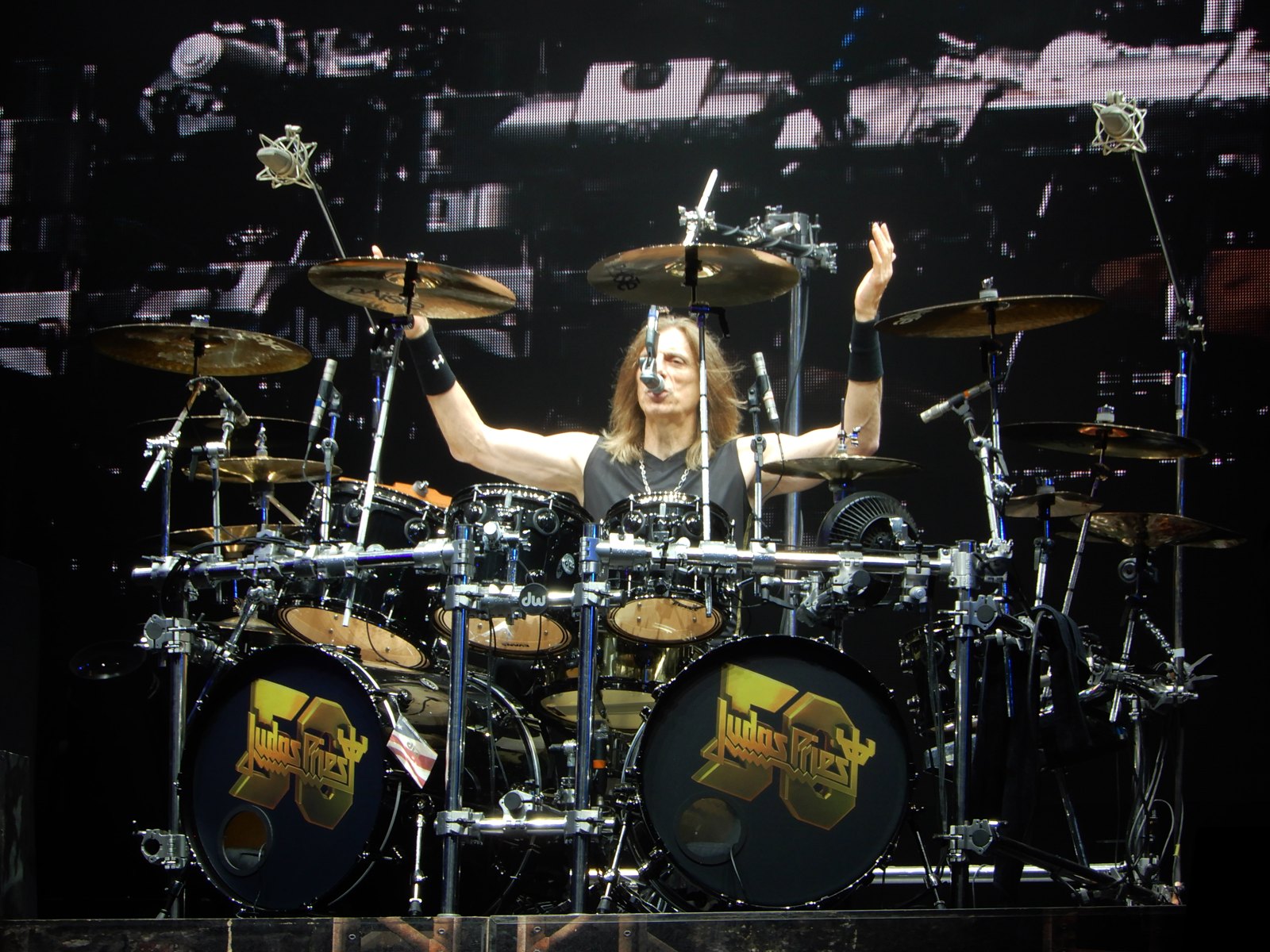
Between the two extremes sat everybody else. The band that tried both answers inside four years was Judas Priest. Turbo, produced by Tom Allom in 1986 with guitar synthesisers over the riffs and Dave Holland's drums gated hard onto the digital tape, carries a sound polished to the decade's house shine, and Painkiller, four years later, opens on Scott Travis alone, a drum figure the engineers caught by accident while they were still testing microphones on his kit. The fashion had turned completely, and inside the same band.
| Record | Year | The snare |
|---|---|---|
| Judas Priest, British Steel | 1980 | A drum in a house, short tail, no gate |
| Slayer, Reign in Blood | 1986 | Close, dry, no artificial room at all |
| Judas Priest, Turbo | 1986 | The house gloss of the decade, gated hard |
| Def Leppard, Hysteria | 1987 | A Fairlight sample, triggered not struck |
| Judas Priest, Painkiller | 1990 | Big, close and played, with the gate stood down |
What ended the fashion was not taste but tempo. Faster bands could not use a wet snare, and by the turn of the nineties the fastest bands were the ones setting the standard, so the gate went quiet and the trigger took over the work of making every hit identical, which is a colder trick and a worse one. The switch had done its job. The sound it made is still the shorthand for the whole decade.
None of it happened to the drums alone. The same rooms were stacking guitars in pairs and panning them hard apart in exactly those years, and how that was done, take by take, is double-tracked guitars. The kit and the guitars were solving the same problem from opposite ends.

