
Six semitones. Half an octave, split so exactly down the middle that the interval turned upside down is still the same interval, and it is the distance between the G and the C sharp that open the title track of Black Sabbath, the song four young men from Aston recorded in November 1969. Heavy metal music theory starts in that gap, and very little of what came afterwards needed anything more exotic.
Stripped the way an armourer field-strips a service rifle on a grey army blanket, pin by pin and spring by spring until the whole weapon lies in a dozen pieces and every piece can be lifted and named, the music turns out to be made of very little. A chord with its third ripped out, an interval the old teachers warned their pupils away from, a rhythm cut in threes, a string slackened by a whole tone, two guitars locked a third apart: that is the whole kit. Nothing on the blanket is complicated. Reassembled, it fires.
The Austrian court composer whose counterpoint manual Gradus ad Parnassum appeared in 1725 and later schooled Haydn, and through Haydn the young Beethoven, was Johann Joseph Fux, and two of his plainest rules forbid exactly what this music runs on: a melody that leaps by the tritone, and two voices moving together in parallel fifths. Every power chord riff that changes chord is a chain of parallel fifths. Heavy metal tore that page out of the catechism and nailed it to the amplifier.
The names and the dates belong to every chapter of the heavy metal story. The mechanics are older than any of them, and they fit in two hands.
Heavy metal music theory starts with a missing third
A chord, in the everyday sense, is three notes: a root, the third above it and the fifth above that. The third decides the mood, four semitones above the root for major and bright, three for minor and dark. The power chord throws it out. What remains is the root and the fifth, usually with the root doubled an octave higher, and guitarists write it with a 5, as in E5, because it is neither major nor minor and refuses to say which.
Every power chord riff that changes chord is a chain of parallel fifths.
The reason is physics before it is taste. An amplifier driven into distortion does not only make notes louder; it manufactures new ones at the sums and differences of the frequencies going in. On a guitar tuned in equal temperament the fifth sits within two cents, two hundredths of a semitone, of the pure ratio of three to two, so its by-products land on notes the chord already holds, one of them a full octave below the root, and the chord grows heavier from underneath. The tempered major third sits about fourteen cents sharp of pure, and its by-products grind against each other into a sour, beating mud.
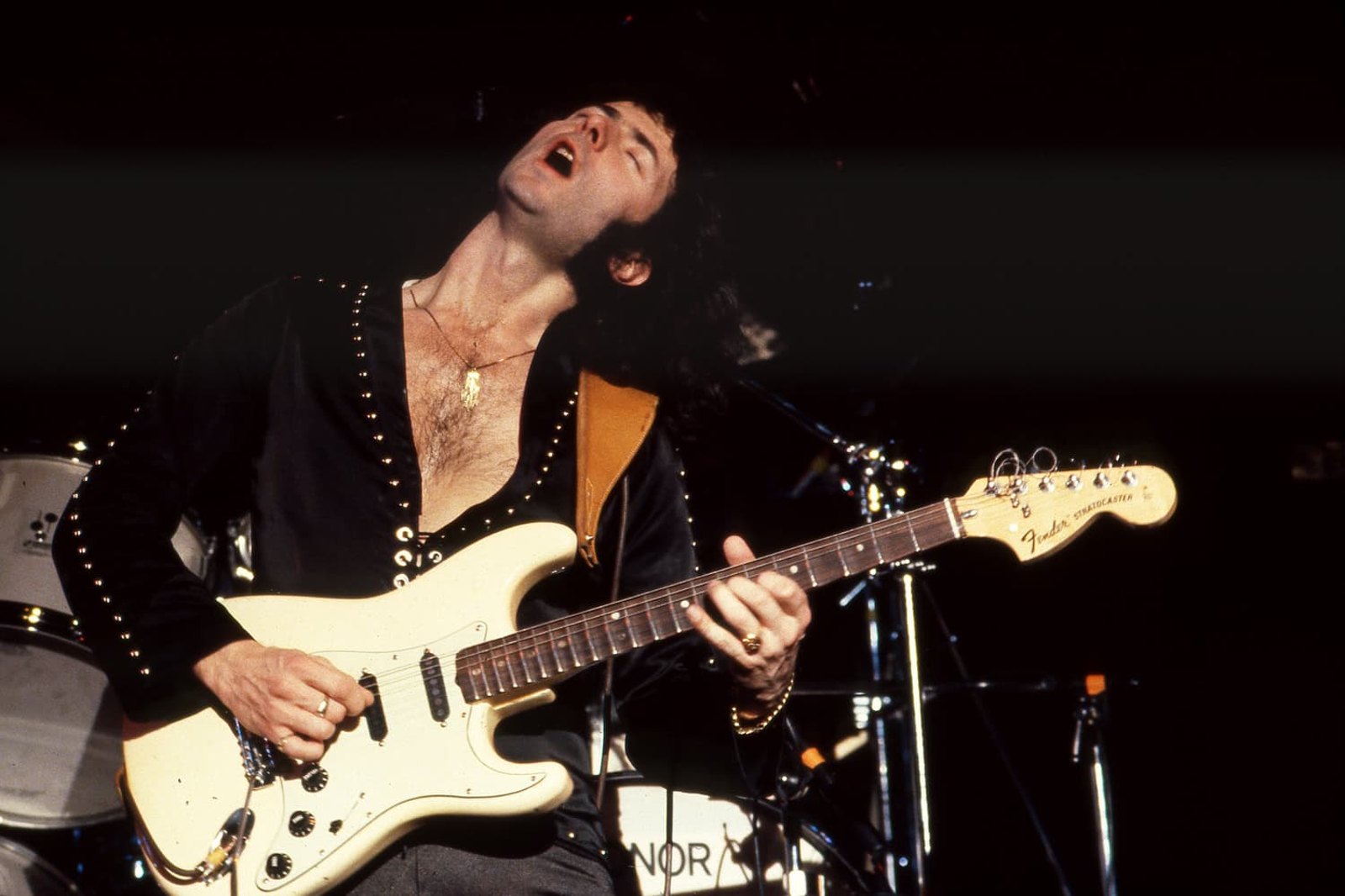
The guitarist in black who had taken a year of classical guitar lessons as a boy was Ritchie Blackmore, and on "Smoke on the Water", from Deep Purple's Machine Head of 30 March 1972, he played the most famous riff in rock not as power chords at all but as pairs of notes a fourth apart, plucked with two fingers. A fourth is a fifth turned upside down, root on top. The ear files both under the same hard, hollow, thirdless sound.
Hollow is the point. A chord that commits to neither major nor minor leaves the colour to the melody on top, the voice or the lead guitar, and leaves the riff free to do the one job the blues had never handed it, which is to carry the song on its own back while everything else is arranged around it.
The tritone, and the rule nobody enforced
Where the power chord removes a note, the tritone adds a problem. Three whole tones wide, spelled as an augmented fourth or a diminished fifth, it sits a semitone above the fourth and a semitone below the fifth, the two steadiest intervals in the scale, like a crossbow cranked to full draw and locked there, the string humming, the bolt never loosed, all of the tension stored and none of it released.
Its history is shorter on devils than the legend. Medieval teachers steered singers around it with the rule of mi contra fa, the clash between mi in one hexachord and fa in another, a tritone apart, and the Latin tag diabolus in musica, the devil in music, turns up in writing no earlier than 1702, when the theorist Andreas Werckmeister recorded it as something already said by older authorities. No pope ever banned it. No church court tried anyone for singing it. The prohibition was a teacher's red pen.
What makes it work in a riff is instability. The tritone wants to move, outward to a sixth or inward to a third, and classical harmony spent three centuries resolving it inside the dominant seventh chord, where its two notes pull the music home. The four men from Aston who declined to resolve it were Black Sabbath, and on their title track the riff falls from the upper G to the C sharp and leaves the tension hanging in the room like smoke with no window to leave by. The refusal became a house style.
The gap never closed. More than two decades later the opening riff of "Enter Sandman", from the Metallica album that went to number one in America in August 1991, still turns on the same six semitones, E against B flat. The heresy of 1969 had become the first thing a teenager learned from a songbook.
Minor, Phrygian and the half step above the floor
The home key of the music is minor, usually the natural minor that theory books call the Aeolian mode: on the white keys of a piano, the seven notes from A to A. Its third is minor, which gives the darkness, and its sixth and seventh degrees are lowered as well, and those two lowered degrees supply the most worn progression in the style, the flat six chord to the flat seven and home to the minor tonic, C to D to E minor in the key of E, a climb in three steps that always lands back on the same dark floor, the same three chords, C, D and E minor, that carry the verse of Iron Maiden's "The Trooper".
Lower the second degree by one more semitone and the scale becomes the Phrygian mode, E to E on the white keys, where the first step up from the tonic is a half step, E to F. That single semitone sitting directly on the floor of the key is the most menacing sound in the kit, and a riff that shuttles between the open low string and the note one fret above it is Phrygian whether its author knew the word or not.

Raise the third of that Phrygian scale back to major and it turns into Phrygian dominant, the fifth mode of the harmonic minor scale, the sound Western ears file as Spanish or Middle Eastern because of the gap of a step and a half between its second and third degrees. Blackmore had left Deep Purple in 1975 to build Rainbow, and on "Gates of Babylon", from Long Live Rock 'n' Roll in April 1978, that scale runs under Ronnie James Dio's voice and through a solo built on the harmonic minor, the scale that gives the minor keys of classical music their leading note.
From there the lineage runs straight into the neoclassical school. The Swedish guitarist who built his 1984 debut Rising Force on harmonic minor arpeggios fired at a speed borrowed from Paganini's violin was Yngwie Malmsteen, and after him a whole generation of players practised diminished seventh arpeggios, stacked minor thirds that split the octave into four equal parts, swung along the neck like a pendulum blade over a bound prisoner, each stroke one minor third, each stroke lower.
The gallop, the chug and the picking hand
Rhythm is where heavy metal left the blues most visibly. The blues shuffle divides each beat into a long note and a short one, and that lilt is what swings. Heavy metal straightened the division into even eighths and sixteenths and then built its own figure out of them, the gallop, long, short, short, one eighth note and two sixteenths, the letter D in Morse code, dash dot dot, hammered out beat after beat on a telegraph key by an operator who has just been told the fort is falling.
The East London bassist who plays the figure with two fingers and no plectrum is Steve Harris, and he made it the engine of Iron Maiden: under "Run to the Hills", the single that reached number seven in Britain in February 1982, and under "The Trooper", from Piece of Mind in 1983, where bass and both guitars lock onto the same long, short, short. Turn the figure around, two sixteenths and then an eighth, and it becomes the reverse gallop, which pushes forward where the gallop leans back.
The chug under all of it comes from palm muting. The guitarist rests the fleshy edge of the picking hand on the strings just in front of the bridge saddles, lightly enough to let the pitch through and firmly enough to choke the ring, and a distorted low string turns from a roar into a short, dry thud, like a boot stamped down on the lid of a pressure cooker at full boil. Lift the hand and the note blooms open again.

Heavy metal riffs are built on the switch between those two states, muted and open, and on the picking hand that makes it. On "Symptom of the Universe", from Sabotage in 1975, Iommi drives a muted low riff in a steady stream of eighths that later critics and thrash players alike have singled out as a direct forebear of the style. Played with every stroke downward rather than alternating down and up, the same riff hits harder and tires the wrist sooner, a trade the next generation accepted without complaint.
Two guitars, one third apart
Twin harmony is the same melody played by two guitars, one of them shifted up a third inside the scale. Because the shift follows the scale rather than a fixed distance, the interval alternates between major thirds of four semitones and minor thirds of three, and both lines stay in key. Twin harmony is the one part of the kit Fux would have passed. His rulebook bans parallel fifths and permits parallel thirds, which it counts among the imperfect consonances.
A conservatory spends three years teaching you to resolve the tritone and to avoid parallel fifths. Heavy metal needed about three minutes to build an entire language out of doing neither.
Julien Vasseur, KaosMetal
The idea came into hard rock through the side door, with Andy Powell and Ted Turner of Wishbone Ash on Argus in 1972 and with Scott Gorham and Brian Robertson of Thin Lizzy on Jailbreak in 1976, whose single "The Boys Are Back in Town" made the harmony lead a radio sound. Heavy metal took the device and loaded it with distortion, the two lines fired side by side like the barrels of a shotgun, one trigger, one report, the shot spreading into a single wide pattern that no one guitar could throw.

In Judas Priest, K.K. Downing and Glenn Tipton, side by side since 1974, turned the harmony lead into a signature, and on Screaming for Vengeance in July 1982 the short instrumental "The Hellion", forty-one seconds of harmonised guitar, opens the record as a fanfare before "Electric Eye" takes over. The school friend Dave Murray brought into Iron Maiden late in 1980 was Adrian Smith, and from Killers onward harmonised lead melodies became a fixture of the band's records, the instrumental passages of "The Trooper" among them.
Twin harmony is the one part of the kit Fux would have passed.
Slack strings and the note that will not move
Standard tuning runs E, A, D, G, B, E from the lowest string, and heavy metal has spent half a century loosening it. Drop D is the simplest change: the lowest string is slackened by a whole tone, from E down to D, which lowers the floor of the instrument by two semitones and turns the three lowest strings, D, A and D, into a power chord that one finger can hold flat across a single fret.
That second benefit is the one that mattered. A riff that once needed a shape across two frets can now slide up and down the neck under a single fingertip, as fast as the hand can travel, and Led Zeppelin had already used the tuning on "Moby Dick", from Led Zeppelin II in October 1969. Van Halen took it further, dropping the low string on "Unchained", from Fair Warning in 1981, on a guitar already tuned a half step down.
The half step down, every string lowered one semitone to E flat, became the other common setting, easier on a singer's top notes and on the fretting hand's bends. Deeper drops belong to the slower genres, from the three semitones Iommi took for Master of Reality in 1971 onwards.
| Part | What it is | Hear it on |
|---|---|---|
| Power chord | Root and fifth, no third | Black Sabbath, "Iron Man" (1970) |
| Tritone | Six semitones, half an octave | Black Sabbath, "Black Sabbath" (1970) |
| Phrygian dominant | Flat second, major third, fifth mode of the harmonic minor | Rainbow, "Gates of Babylon" (1978) |
| Gallop | One eighth note and two sixteenths | Iron Maiden, "The Trooper" (1983) |
| Twin harmony | One melody on two guitars, a third apart | Thin Lizzy, "The Boys Are Back in Town" (1976) |
| Drop D | Lowest string lowered from E to D | Led Zeppelin, "Moby Dick" (1969) |
| Pedal point | One repeated low note under moving notes | Ozzy Osbourne, "Crazy Train" (1980) |
Pedal point is older than the electric guitar by several centuries. The term comes from the organ, where a player holds one low note on the pedals while the harmony changes above it, a device Bach used at the close of fugues to pile tension onto a note that will not move. On guitar it becomes a riff that keeps returning to one low note between every other note, and heavy metal loves it because the returning note works like an anchor flung back into the water after every swell, its flukes biting into the mud and dragging the whole riff back to its mooring.
The guitarist who had taught in his mother's music school as a teenager was Randy Rhoads, and the main riff of "Crazy Train", from Ozzy Osbourne's Blizzard of Ozz in September 1980, is built in F sharp minor around that low F sharp, the moving notes stepping away from it and snapping straight back. It is Bach's device at twice the volume and three times the speed.
From the riff to the song
In a finished song the riff becomes the unit of construction. A heavy metal song is assembled riff by riff the way a wall is laid course by course, a verse riff, a chorus riff, a bridge riff and a riff reserved for the solo to fly over, and the singer's melody is fitted onto the stonework afterwards. The blues built songs from a chord sequence. Heavy metal builds them from riffs.

That method stretches as far as the band has riffs. Iron Maiden opened Powerslave, in September 1984, with the gallop of "Aces High" and closed it with "Rime of the Ancient Mariner", Harris's setting of Coleridge's poem, which runs nearly fourteen minutes, just under thirteen minutes and forty-five seconds, through fast sections, a slow spoken passage and a return to the opening riff. A salvo of riffs, fired in order, stands in for the symphony's development section.
Odd meters, shifting tempos, keyboards, orchestras: every later school that grew out of heavy metal added parts, and the progressive bands added the most. None of them took the old ones away.
What all of that machinery is for is another matter, and the answer lies in what heavy metal sings about: the wars, the myths, the madness and the long road that the riffs were built to carry. The riff was always meant to bear weight. The words are the weight.

