
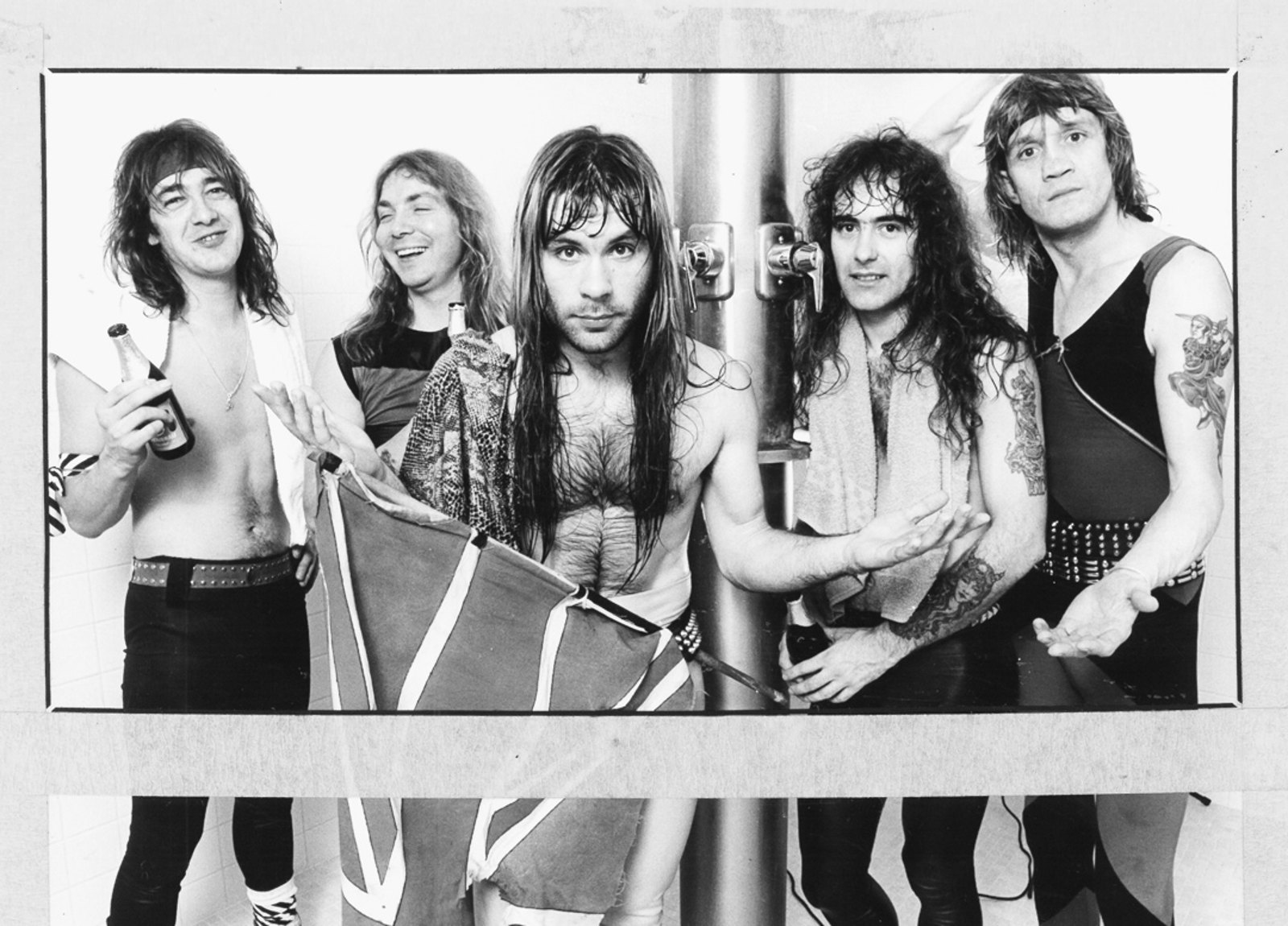
In 1968 the words arrived and the music was nowhere near them. The Los Angeles quintet whose motorcycle song "Born to Be Wild" set the words heavy metal beside the word thunder in its second verse were Steppenwolf, and not one of the five was thinking about anything but the motorcycle. Heavy metal history begins with a word waiting for its music. Lifted, some say, from William Burroughs, whose Heavy Metal Kid had been prowling the pages of The Soft Machine since 1961, though Burroughs meant the phrase for a drug rather than a sound; other historians trace it instead to the rock press of the early seventies, where Lester Bangs used it in Rolling Stone in February 1970 and Mike Saunders followed within the year, in Rolling Stone first and in the Detroit monthly Creem after. Nobody has settled which came first. It was not yet a compliment.
The music caught up within two years, and when it came it came carrying a flag. The four Aston musicians who had taken their new name from a Mario Bava horror anthology released in English as Black Sabbath, starring Boris Karloff, were Black Sabbath, and the standard they ran up over 1970 was cut from plain black cloth: a riff slowed and thickened until it could hold a whole song on its own, a tritone where the blues would have put a resolution, a singer who sounded frightened rather than seductive. Every later faction of heavy metal, glam and thrash, doom and power, black and death, would march out of the camp with a strip ripped from that cloth, stitch its own colours onto the strip and swear it was carrying the whole flag. Before the music had fifty names, it had one standard. The standard is still up.
Nobody owns the first riff, and the quarrel over where heavy metal came from has never been settled by a single record. It runs back through the fuzzed power chords of The Kinks on "You Really Got Me" in 1964, through Cream and Jimi Hendrix, through the San Francisco trio Blue Cheer and their bludgeoned "Summertime Blues" of 1968, through Iron Butterfly and the first Led Zeppelin album of January 1969, and every one of those candidates has partisans prepared to defend it past closing time. The story proper begins where the blues stopped being the point.
Nineteen seventy: the year the weight arrived
Three British bands brought the new weight in a single year. Deep Purple dropped the orchestra of their previous record, Concerto for Group and Orchestra from December 1969, and released Deep Purple in Rock on 5 June 1970, Ritchie Blackmore's guitar and Jon Lord's distorted Hammond organ going at each other like two dogs in a yard, while Led Zeppelin had already spent 1969 teaching American arenas how loud a quartet could be. Black Sabbath, meanwhile, put out two albums inside eight months. The first of them was taped at Regent Sound in November 1969 in about a day of studio time, and any account of how heavy metal is recorded starts in that room.

Released on Friday 13 February 1970, the debut had opened the door, and Paranoid, out on 18 September that year on Vertigo, walked through it with its boots on. The riff of "Iron Man" came into rock music like a bailiff holding a warrant, carried the furniture of the blues out onto the pavement one piece at a time, the shuffle, the call and response, the twelve bars that every British band of the sixties had been sitting on, and left the empty house to whoever could fill it with volume. Tony Iommi played it with homemade thimbles, melted down from a washing-up-liquid bottle, over two fingertips lost in a sheet metal factory accident as a teenager; the down-tuning that deepened the sound further came a year or so on, once bending the strings at standard pitch had become too much to bear. The house filled quickly.
What those records shared was not a tempo or a key. It was a decision about where a song's strength lives. In the blues the riff was a hinge between vocal lines. From 1970 onwards it became the load-bearing thing, and everything else, the voice, the lyric, the solo, was arranged around it or thrown out. Root and fifth with no third, a tritone left hanging where the blues would resolve: those are the first working parts of how heavy metal is built, and every one of them serves the riff.
The seventies: leather, speed and the blues left at the door
The generation that took the standard next spent the decade stripping the last blues out of it. Thin Lizzy and UFO worked out how two lead guitars could run in harmony, Scorpions carried the sound into Germany, Rainbow gave it castles and wizards, and Kiss and Van Halen sold it to American stadiums by the truckload. Heavy metal was still a label pinned on rather than a flag anyone chose to wave.
Then a singer picked it up. The Walsall vocalist who had joined a struggling Birmingham band in 1973 was Rob Halford, and over the second half of the decade his band Judas Priest turned the loose borrowed word into a programme: no blues, no boogie, two guitars locked together, and a scream that went up through the song like a signal flare fired over a battlefield at night, lighting every riff beneath it white for a second before it fell. From 1978 the band dressed the part as well, in leather, studs and chains, and within a year Halford was riding a motorcycle onto the stage, a decade after Steppenwolf had sung about one. The scream and the motorcycle were two halves of a single act, the voice and the ritual, and heavy metal has staged them together ever since.

Issued in Britain in November 1978 as Killing Machine and retitled Hell Bent for Leather for the American market that February, the record is where the music and the look fused into a single object that a teenager could buy, wear and defend in a school corridor. The uniform mattered as much as the riffs. Leather jackets, denim waistcoats and sewn-on patches became a kit issued to nobody and worn by everybody, and everything around the records, the sleeves, the logos, the backstage passes pinned to the jacket, grew as fast as the music itself.
Speed came from the side door. The trio Lemmy Kilmister put together in 1975, after Hawkwind fired him that May, was Motörhead, and its records went straight into the collections of punks and long-hairs alike. The title track of Overkill, released in March 1979 on Bronze, drove Phil Taylor's two bass drums straight through the wall between the punks and the long-hairs and left both tribes standing in the same room, deafened and grinning.
Punk had declared the whole genre finished in 1977. The music papers agreed for about eighteen months.
Th' imperial ensign, which full high advanced, shone like a meteor streaming to the wind.
John Milton, Paradise Lost, Book I, lines 536 to 537
1979 to 1981: the young British wave
The counter-attack came from pubs, working men's clubs and rehearsal rooms rented by the hour. Between 1979 and 1981 several hundred British bands fired seven-inch singles out of back bedrooms and lock-up garages like grapeshot, most of them pressed in their hundreds, sold at gigs and by mail order, and aimed at nothing more precise than the nearest pair of ears, until the whole country seemed to be under bombardment at once. Def Leppard put out their first EP on their own Bludgeon Riffola label in January 1979, Diamond Head sold their debut album by mail in a plain white sleeve, and Saxon took Wheels of Steel to number five on the UK albums chart in 1980. The whole story of that wave, its venues, its labels and its casualties, is told in the NWOBHM chapter.
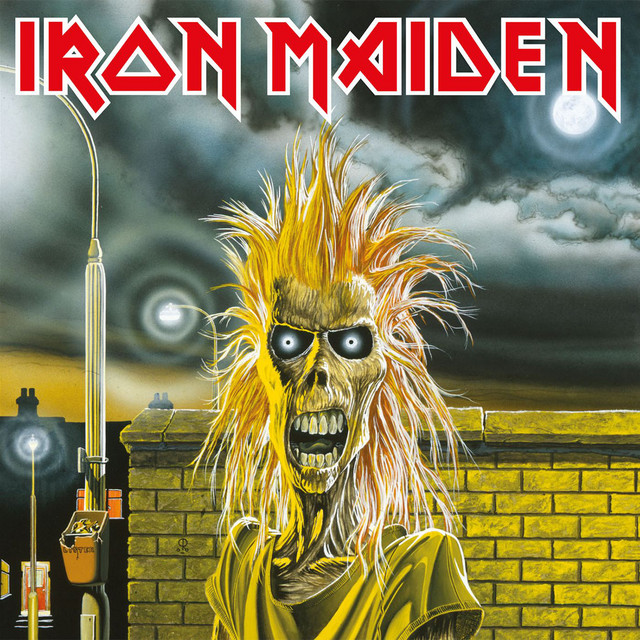
The East London band that the bassist Steve Harris had been dragging round pub back rooms since late 1975 were Iron Maiden, and their debut, Iron Maiden, released on EMI on 14 April 1980 with Paul Di'Anno on vocals, went to number four in the UK. It was faster than anything Judas Priest had recorded and rougher than anything EMI usually sold, and its sleeve carried Eddie's first album cover, the grinning corpse Derek Riggs had already sketched once that year for a single sleeve, who would outlast every singer the band ever had.
Several hundred British bands fired seven-inch singles out of back bedrooms like grapeshot, aimed at nothing more precise than the nearest pair of ears.
The British wave did two things at once. It rebuilt the standard for a generation that had been told by punk that it was obsolete, and it passed the standard abroad on cassette. The Newcastle trio that released Welcome to Hell on the local Neat label in December 1981 was Venom, and its crude, blasphemous racket was heard on tape in Denmark, in Switzerland, in California and in São Paulo by teenagers who would build whole new genres out of it. Heavy metal had become an export. Nobody at the customs desk noticed. The countries those tapes reached grew scenes with accents of their own, and heavy metal around the world still speaks in every one of them.
The standard crosses the water
On the continent the sound hardened. Accept in Germany played it with a drill sergeant's discipline, Scorpions took Blackout into the American top ten in 1982, and in Denmark Mercyful Fate turned the British riff towards the occult. In the United States the style split between the arena and the club. The upstate New York singer who had fronted Elf, then Rainbow, then Black Sabbath itself, was Ronnie James Dio, and his solo band Dio released Holy Diver on 25 May 1983, a record of dragons, rainbows and sword-and-sorcery fantasy that went on to double platinum in America. Sorcery was only one subject among several, and war, myth, madness and the road fill out the rest of what heavy metal sings about.
The New York quartet that swore on stage to play nothing but true metal and printed the slogan "Death to False Metal" on its merchandise was Manowar, and its debut, Battle Hymns, came out in 1982. The phrase explains the decade better than any chart. For the first time, the faithful were drawing a line around the music and deciding who stood outside it.
That line broke almost immediately. From the fastest Motörhead and British wave records came speed metal, and from speed metal the Bay Area and German thrash that took the standard at a flat sprint; from Sabbath's slowest songs came doom; from Venom came the first wave of black metal; from thrash, a few years later, came death metal; and from Helloween in Hamburg came the melodic European power metal of 1987. Each faction cut its own pennant from the cloth, and the schism that followed has a shape worth learning, drawn in full on the subgenre map.
The old style did not vanish into its offspring. It kept the riff, the clean high voice and the twin leads, and it kept a following that regarded every departing faction as a regiment that had deserted with the regimental silver.
The arena years: MTV, hairspray and the Senate
MTV went on the air on 1 August 1981, and within two years it had discovered that heavy metal looked tremendous on a television screen. The Los Angeles band whose first guitarist, Randy Rhoads, had left in 1979 to join Ozzy Osbourne's solo group were Quiet Riot, and on 26 November 1983 their album Metal Health, carried by a cover of Slade's "Cum On Feel the Noize", reached number one on the Billboard 200, the main American album chart, an album still called by many the first heavy metal record to top it.

The Sunset Strip four who had been handing out flyers on the pavement outside the Whisky a Go Go were Mötley Crüe, and Shout at the Devil, released on Elektra on 26 September 1983, sold them to a generation of American parents as a threat and to their children as a promise, and went platinum before the year was out. What came after that record, the power ballad, the lipstick, the spandex, Bon Jovi's Slippery When Wet at number one for eight weeks spanning 1986 and 1987, Def Leppard's Hysteria that August and the whole painted circus of the Strip, belongs to the glam and hair metal chapter.
The camera swept across the Strip like a prison searchlight, and every band caught in its beam learned to pose for it, until the fanfare of a big chorus, a shot of the crowd and a slow-motion leap off the drum riser became a format that record companies could order by the dozen. It sold more records than heavy metal had ever sold. It also bred a backlash.
The camera swept across the Strip like a prison searchlight, and every band caught in its beam learned to pose for it.
In 1985 the Parents Music Resource Center, a Washington lobby group founded by the wives of senators and officials, published a list of fifteen songs it considered offensive, Judas Priest and Twisted Sister among them. On 19 September that year the Senate commerce committee held a hearing at which Dee Snider of Twisted Sister testified in defence of his lyrics, in a sleeveless denim jacket, and won the argument in the room while losing the war over the stickers. In April 1987 MTV launched Headbangers Ball, its weekly metal programme, and for four or five years heavy metal was the most commercially powerful form of rock music on earth.
1990 and 1991: the courtroom, the flannel and the empty arena
The peak and the fall came within twelve months of each other. In the summer of 1990 Judas Priest sat in a courtroom in Reno, Nevada, defending a civil suit brought by the families of two young men who had shot themselves in December 1985, which claimed that subliminal messages hidden in "Better by You, Better than Me" on Stained Class had led them to it; Judge Jerry Carr Whitehead ruled for the band on 24 August 1990. Nearly five years after the Senate hearing, heavy metal on trial was no longer a figure of speech.

A few weeks later the band answered with Painkiller, released in September 1990, its title track opening on a drum barrage from the newly arrived Scott Travis before Halford's highest screaming ripped the roof off the song, and it remains the fastest, hardest record the old guard of the seventies ever made. It arrived at the top of the arc. The drop began the following year.
Nirvana's Nevermind, released on 24 September 1991, went through the arena circuit like a bulldozer through a film set, flattening the painted castles, the smoke machines and the spandex and leaving only the scaffolding standing, and within two years the major labels had dropped or shelved half the heavy metal acts on their books. The irony is that the best-selling heavy metal album of the period came out six weeks earlier: Metallica's self-titled record of 12 August 1991, which went straight to number one in America and proved the audience had not disappeared, only moved. Grunge and the alternative rock that followed are often filed under metal by people who were not there, which is one of the confusions worth clearing up in what heavy metal is not.
The old standard-bearers lost their voices. Halford left Judas Priest in 1992, Bruce Dickinson left Iron Maiden in 1993, and Vince Neil was out of Mötley Crüe by 1992. The arenas emptied. The music did not.
The faithful years, and the return
The standard went underground, and much of it went to Germany. The open-air festival started in a field outside a village in Schleswig-Holstein in 1990, with around eight hundred people and six local bands, was Wacken, and within fifteen years it was drawing tens of thousands of fans a summer to a style the American press had written off. The Gothenburg five who released Glory to the Brave on Nuclear Blast in June 1997 were HammerFall, and their unashamed return to twin leads, anthems and the clean high voice set off a traditional revival across Europe. Germany's Keep It True festival, founded in 2003 in Lauda-Königshofen, became the gathering place for the bands and collectors who had never stopped believing.
| Year | What happened | Why it counts |
|---|---|---|
| 1968 | Steppenwolf, "Born to Be Wild" | The words enter a rock song |
| 1970 | Black Sabbath, Black Sabbath and Paranoid | The riff becomes the whole song |
| 1978 | Judas Priest, Killing Machine | The blues are gone; the leather arrives |
| 1980 | Iron Maiden, Iron Maiden | The British wave reaches the charts |
| 1983 | Quiet Riot, Metal Health | Often called metal's first US number one album |
| 1985 | PMRC Senate hearing | The music becomes a political target |
| 1991 | Nirvana, Nevermind | The arenas empty |
| 1999 | Dickinson and Adrian Smith rejoin Iron Maiden | The reunions begin |
| 2013 | Black Sabbath, 13 | A first American number one, 43 years on |
| 2025 | Back to the Beginning, Villa Park | The first standard-bearers take their last bow |
Then the exiles came home. Bruce Dickinson and the guitarist Adrian Smith rejoined Iron Maiden in February 1999 and the band released Brave New World in May 2000, and Rob Halford walked back into Judas Priest in July 2003. The reunion era rebuilt the arenas for the old names, and a new generation noticed that nobody under thirty was playing their music.

The young Swedish quartet that put out Diamonds in 2010, with high screams, a speed-metal pulse and no apology for any of it, was Enforcer, and it marched in the vanguard of a movement that the press soon called the new wave of traditional heavy metal. Portrait and Ambush in Sweden, Cauldron in Canada, Visigoth, Night Demon, Eternal Champion and Haunt in the United States: none of them ironic, none of them nostalgic, all of them sure the old rules still work. Who among them matters, and which of the old names cannot be skipped, is set out in the bands you need to know.
The founders, meanwhile, finished the job. Black Sabbath reunited with Ozzy Osbourne for 13, produced by Rick Rubin and released in June 2013, and it gave the band its first number one album in America, forty-three years after the debut. The band played its last full concert in Birmingham on 4 February 2017, and on 5 July 2025 the original four came together once more for a short set at Villa Park, at the close of a charity show called Back to the Beginning. Ozzy Osbourne died on 22 July 2025, at the age of 76. The records he made with the band sit at the head of the essential albums, where they have been since the first list was drawn up.
The history of heavy metal in fifty names
Count the names today and there are well over fifty: speed, thrash, power, doom, sludge, stoner, black, death, glam, gothic, symphonic, folk, progressive, industrial, and the traditional heavy metal that stayed at home while the rest marched away. Every one of them has a cavalry charge of its own and a banner it swears is the original. None of them is wrong. All of them are carrying a piece of the same black cloth first raised in 1970.
Look at the jacket of the next fan who passes you at a show. The patches, the logos, the sleeve art copied onto denim in marker pen, the leather that Halford made compulsory: every item on that jacket belongs to the culture around the music, and every item has a date.
The founders are gone, and the genre that was supposed to die in 1977, in 1991 and again in every decade since is still recruiting. Somewhere tonight a band is running through a riff in a rented room, somebody is sewing a new patch onto an old jacket, and the standard goes up again. Pick it up. It was always meant to be carried.
