
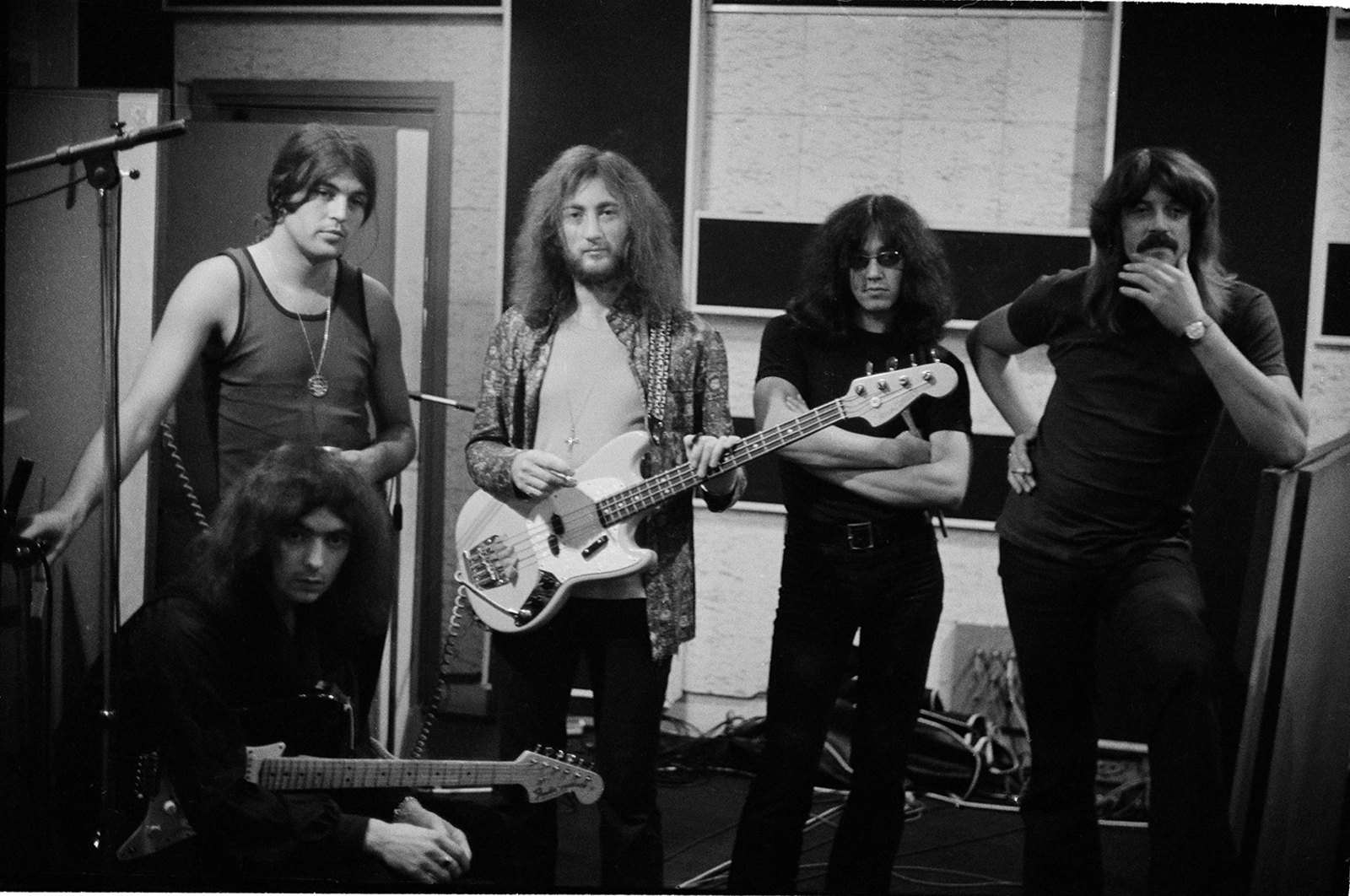
What is heavy metal? It is the electric blues after a siege, the swing and the shuffle and the call and response marched out through the breach under guard, the riff left standing alone on the ramparts, and the whole garrison turned up so loud that volume stops being a setting on the amplifier and becomes part of the composition. Everything else is detail. The definition has not moved since 1970.
The seventeen year old guitarist in a north London beat group slashed the speaker cone of his small green amplifier with a razor blade in the summer of 1964, and the torn paper gave The Kinks the buzzing, splintered chord that opens "You Really Got Me", a British number one that September and one of the first hit singles whose guitar sounded broken on purpose. Dave Davies was not inventing a genre. He wanted a nastier noise.
Four years later that splintered chord had become a method. Between the autumn of 1968 and the spring of 1976, on labels as far apart as Atlantic, Vertigo, Harvest, Elektra, Columbia and a small London concern called Gull, a few dozen British and American bands took the blues they had grown up on and tore the shuffle out of it, keeping the riff, the distortion and the volume and throwing the rest over the wall. The long road from there to fifty subgenres belongs to the history of heavy metal. The birth is narrower, louder and far more argued over.
What is heavy metal, once the blues is taken apart
The plainest definition works by subtraction. Take the electric blues of 1967, the music of Cream, the Jimi Hendrix Experience and the Jeff Beck Group, and remove the shuffle rhythm that makes a twelve bar pattern roll rather than march, the call and response between voice and guitar, and the long improvised jam that let a solo wander for twenty minutes. What remains is a short repeated figure on the low strings, and a band that plays it in unison like a gun crew serving a single cannon, every man on the same charge and the same recoil.
Then comes the addition, and the addition is volume. The power chord, a root and a fifth with no third to say whether the harmony is happy or sad, sounds thin through a clean amplifier and enormous through a distorted one, because distortion throws off extra tones that thicken two notes into a slab. Loudness is not decoration here. It is a material, the way stone is a material, and a heavy metal song played quietly is a drawing of a building rather than the building.
Loudness is not decoration. It is a material, the way stone is a material.
Two scholars reach that point from opposite ends. The sociologist Deena Weinstein, in Heavy Metal: A Cultural Sociology in 1991, put power, expressed above all as sheer volume, at the centre of the sound, and the musicologist Robert Walser, in Running with the Devil two years later, heard distortion as power pushed past the point where the equipment can hold it. Both describe a music built to be felt in the ribcage.
The last subtraction was comfort. The blues had always sung about trouble, but it sang about trouble the way a man talks about his own rent and his own heartbreak; the heavier bands of 1970 turned the lens outward, onto war, the bomb, the occult, science fiction and the end of the world, and tuned the songs to match, leaning on minor keys and on the flattened intervals the blues had used as colour rather than as foundation. That is the answer to what is heavy metal in its first form. Blues riffs with the swing removed, the volume made structural and the subject moved from the bedroom to the battlefield.
A phrase that changed hands without papers
The words are older than the music by a century. In nineteenth century English "heavy metal" meant the big guns, the heaviest ordnance a ship or a fort could bring to bear, and by extension a man of real weight in an argument; the chemists later took the phrase for lead, mercury and cadmium, the dense and poisonous end of the periodic table. Both meanings suit the music uncomfortably well. Neither reached it directly.
The route ran through a drug novel. William S. Burroughs put a character called Uranian Willy, the Heavy Metal Kid, into The Soft Machine in 1961, tied the phrase to addiction the year after in The Ticket That Exploded, and returned to it again in Nova Express in 1964, with the Blue Heavy Metal People of Uranus. From there it moved the way contraband moves, passed hand to hand across a decade in the coat pockets of people who each swore they had found it lying in the road, and nobody ever stopped it at a border to ask for its papers.
The Los Angeles band with a Hermann Hesse novel for a name put the words heavy metal into the second verse of "Born to Be Wild" in 1968, as the thunder of a motorcycle engine, and the single climbed to number two on the Billboard Hot 100, the American singles chart, that summer. Steppenwolf meant the engine and nothing more. A year later the opening credits of Easy Rider carried the song into every cinema in America.
After that the rock press took it up, and the claims begin. Barry Gifford, reviewing the Electric Flag for Rolling Stone in 1968, used the words heavy metal rock, a description rather than a claim to have named anything. Sandy Pearlman said, in a 1991 interview, that he had minted the phrase himself in Crawdaddy in 1968, pulled straight from the periodic table; his actual review that year, of the Byrd Brothers, uses only the word metal, and the coinage has not survived anyone checking it. The earliest use anyone has actually located in print belongs to Lester Bangs, in Rolling Stone on 7 February 1970, describing the Guess Who as heavy metal robots, nine months ahead of Mike Saunders, who called Humble Pie heavy metal in the same magazine that November and used the words again in Creem in May 1971, reviewing Sir Lord Baltimore. The chroniclers have never settled any of it. They will not.
The first heavy metal song, and why nobody agrees
Every fan with a shelf of records has a candidate for the first heavy metal song, and every candidate fails the definition somewhere. The case against is always the same question: did the song keep the swing, or throw it away?
| Year | Song or record | The case for | The case against |
|---|---|---|---|
| 1964 | The Kinks, "You Really Got Me" | A distorted power chord as the hook | A beat group single with a pop bounce |
| 1967 | Cream, "Sunshine of Your Love" | One riff carries the whole song | It still swings like the blues it came from |
| 1968 | Blue Cheer, Vincebus Eruptum | Louder than anything then on record | A jam band, not a riff band |
| 1968 | Steppenwolf, "Born to Be Wild" | It put the words on the radio | A biker rock single, nothing heavier |
| 1968 | The Beatles, "Helter Skelter" | A deliberate try at the dirtiest noise possible | One track on a double album of everything |
| 1968 | Iron Butterfly, "In-A-Gadda-Da-Vida" | Seventeen minutes of organ and fuzz riffing | Psychedelia with a drum solo |
| 1969 | Led Zeppelin, Led Zeppelin | Blues riffs at a weight nobody had heard | A blues band, by its own account |
| 1970 | Black Sabbath, "Black Sabbath" | Riff, tritone and darkness in one song | Doom claims it first |
The honest reading is that none of them was first, because heavy metal was never one song. It was an agreement reached by several bands in two countries between 1968 and 1970, each bringing a different part. Blue Cheer brought the volume. Steppenwolf brought the name. Led Zeppelin brought the weight. Black Sabbath brought the dark. Nobody brought all of it at once until the middle of the decade.
Led Zeppelin II and the blues under new management
The session guitarist with the fullest diary in London put a new band together in the late summer of 1968, rehearsed it for the first time on 12 August in a basement room off Gerrard Street, toured it round Scandinavia that September under a name that shifted between the Yardbirds and the New Yardbirds from date to date, and by 11 November had signed it to Atlantic in New York as Led Zeppelin. Jimmy Page had watched The Yardbirds come apart under him. He did not intend to watch it twice.
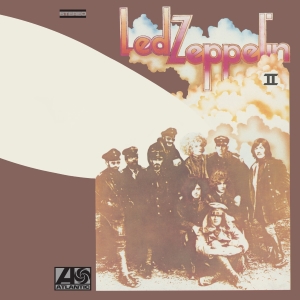
Recorded in pieces through 1969 in London, Los Angeles, New York and Vancouver between tour dates, with Page producing and Eddie Kramer mixing the tapes at A&R Studios in New York, Led Zeppelin II came out on 22 October 1969 and by the end of December had pushed the Beatles off the top of the Billboard 200, the American album chart. "Whole Lotta Love" took its words from Willie Dixon's "You Need Love", a debt Dixon sued over in 1985 and won out of court, and threw away everything Muddy Waters had put around them: the riff is a handful of notes and a slide, driven again and again like a ram into a gate, and the middle of the song dissolves into theremin, echo and percussion that no blues band would have recognised as music.
John Bonham is the other half of the argument. On "Heartbreaker" and above all on "Moby Dick", his drums were recorded close and loud and played a hair behind the beat, late enough to feel enormous and never late enough to fall over. During the Headley Grange sessions that opened at the end of 1970 and ran into 1971, for "When the Levee Breaks", the band set his kit at the foot of the stairwell in that Hampshire house, and the recording sounds like a stairwell taking artillery fire. That weight, more than any single riff, is what the next decade of heavy bands tried to copy. Page and Robert Plant refused the label all the same. Talking to Mojo in the summer of 1994, Plant called it journalistic complacency and claptrap; Page said it honed in on just one element of what they were doing.
1970: a mountain, a filler track and a very humble debut
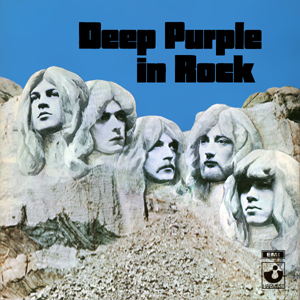
The five men carved into the granite in place of four American presidents were Deep Purple, and the sleeve of Deep Purple in Rock, released on Harvest in June 1970, is a coup d'état carried out with a chisel. Taken through a concerto with the Royal Philharmonic at the Royal Albert Hall in September 1969 and then dragged the other way by Ritchie Blackmore, who wanted the next record to be the heaviest the band could make, the line-up with Ian Gillan singing and Roger Glover on bass opened with "Speed King" and ran "Child in Time" past ten minutes. It reached number four in Britain. Jon Lord's organ, fed through a distorted amplifier, fought the guitar for the same low ground and gave up none of it.
The quartet from Aston had already put out one album that year, and doom has the stronger claim to it. The second belongs to heavy metal outright.

Recorded in a few days in June 1970 with Rodger Bain producing and released by Vertigo on 18 September, Paranoid went to number one in Britain on the back of a title track the band have said was knocked together in the studio in minutes because the album was a song short, under three minutes of eighth notes driven straight ahead with no blues left in them at all. Black Sabbath had found speed. "Iron Man" did something just as new, with Ozzy Osbourne singing the riff note for note instead of answering it, the old blues conversation between voice and guitar collapsed into a single line, and "War Pigs" opened the record under an air raid siren. America had to wait until January 1971 to buy it.
The London quintet named after the most grovelling clerk in Dickens titled its June 1970 debut, on Vertigo as well, ...Very 'Eavy ...Very 'Umble, a joke on the character that doubled as a statement of intent. Uriah Heep took a kicking in the press for years and sold records in Germany long before the critics forgave them.
Blue Cheer brought the volume. Steppenwolf brought the name. Led Zeppelin brought the weight. Black Sabbath brought the dark.
Detroit, Flint and Long Island
The house band of the Grande Ballroom recorded its debut live on that stage on 30 and 31 October 1968, and when Elektra released Kick Out the Jams in February 1969 the MC5 had put on vinyl a noise so abrasive that a Detroit department store refused to stock it and the label dropped the band within months. Wayne Kramer and Fred Smith played as if they meant to strip the paint off the walls of the room. Up the road in Ann Arbor, The Stooges were doing the same with fewer chords.
The American contribution was aggression and scale rather than weight. The Flint trio that the critics despised and the public adored sold out Shea Stadium in New York in July 1971 faster than the Beatles had, and Grand Funk Railroad did it with long, loud, blunt blues rock the British were already leaving behind. Loud was selling in America. Heavy was still being worked out.
The Long Island quintet with a rock critic for a manager and another among its lyricists was renamed Blue Öyster Cult in 1971 and released its debut on Columbia in January 1972. The umlaut over the O arrived with the name, suggested, depending on who tells it, by the keyboard player Allen Lanier or by the critic Richard Meltzer, two dots stencilled over a vowel like the warning on a crate of munitions, and Motörhead, Mötley Crüe and Queensrÿche would all later hang the same marks over their own names. The Cult brought irony, which the British had not. Kiss brought greasepaint in February 1974.
Every candidate for the first heavy metal song has a lawyer and none of them has a verdict. The music did not arrive in a single record. It arrived the way a front arrives, one town at a time, and by the time anyone thought to name it the whole map had changed colour.
Declan Rourke, KaosMetal
Rodger Bain's desk and the last of the blues
The quiet producer behind the first three Black Sabbath albums took on, in 1971, the debut of a trio from Cardiff called Budgie, and in 1974 the debut of a West Midlands band called Judas Priest, which makes Rodger Bain the one man who sat at the desk for three separate stages of the same birth. Budgie matter more than their sales. Burke Shelley's churning bass carried "Breadfan", on Never Turn Your Back on a Friend in 1973, a riff serrated enough to saw through a table leg, and Metallica recorded it as a B-side fifteen years later.
The band with a Bob Dylan song for a birth certificate took the longest to find itself. The name dates to 1969, after "The Ballad of Frankie Lee and Judas Priest", inherited from an earlier Birmingham line-up that had already broken up; the surviving group reshaped when Rob Halford joined as singer in 1973 and again when Glenn Tipton arrived as a second guitarist in 1974, and made its debut, Rocka Rolla, for Gull that September, still half a blues rock record, thin in sound and unsure of its own weight.

Recorded at Rockfield Studios in Monmouthshire late in 1975 and released by Gull on 23 March 1976, Sad Wings of Destiny is the first record of the era from which the blues cannot be reconstructed at all, not in the rhythm, not in the voice, not in the solos. "Victim of Changes" was welded together from two older songs, "Whiskey Woman" from the Al Atkins years and Halford's own "Red Light Lady", and runs nearly eight minutes without a shuffle anywhere in it; "The Ripper" and "Tyrant" are short and all edge. Nothing on the album swings.
By the spring of 1976 the pieces were assembled. Rainbow had put Ronnie James Dio in front of Blackmore's guitar, Scorpions had three albums out in Germany, and Lemmy, fired from Hawkwind in May 1975, had started the band that became Motörhead within weeks. The phrase smuggled out of a Burroughs novel was now the label on the record shop rack.
Then punk arrived and the music papers declared the whole thing finished. The next generation, raised on these records and pressing singles on labels nobody had heard of, took the speed and insolence of punk, bolted it to the riffs of 1970 and came back three years later. That counter-attack belongs to the NWOBHM chapter, and it is where heavy metal stopped being an argument and became a movement.
