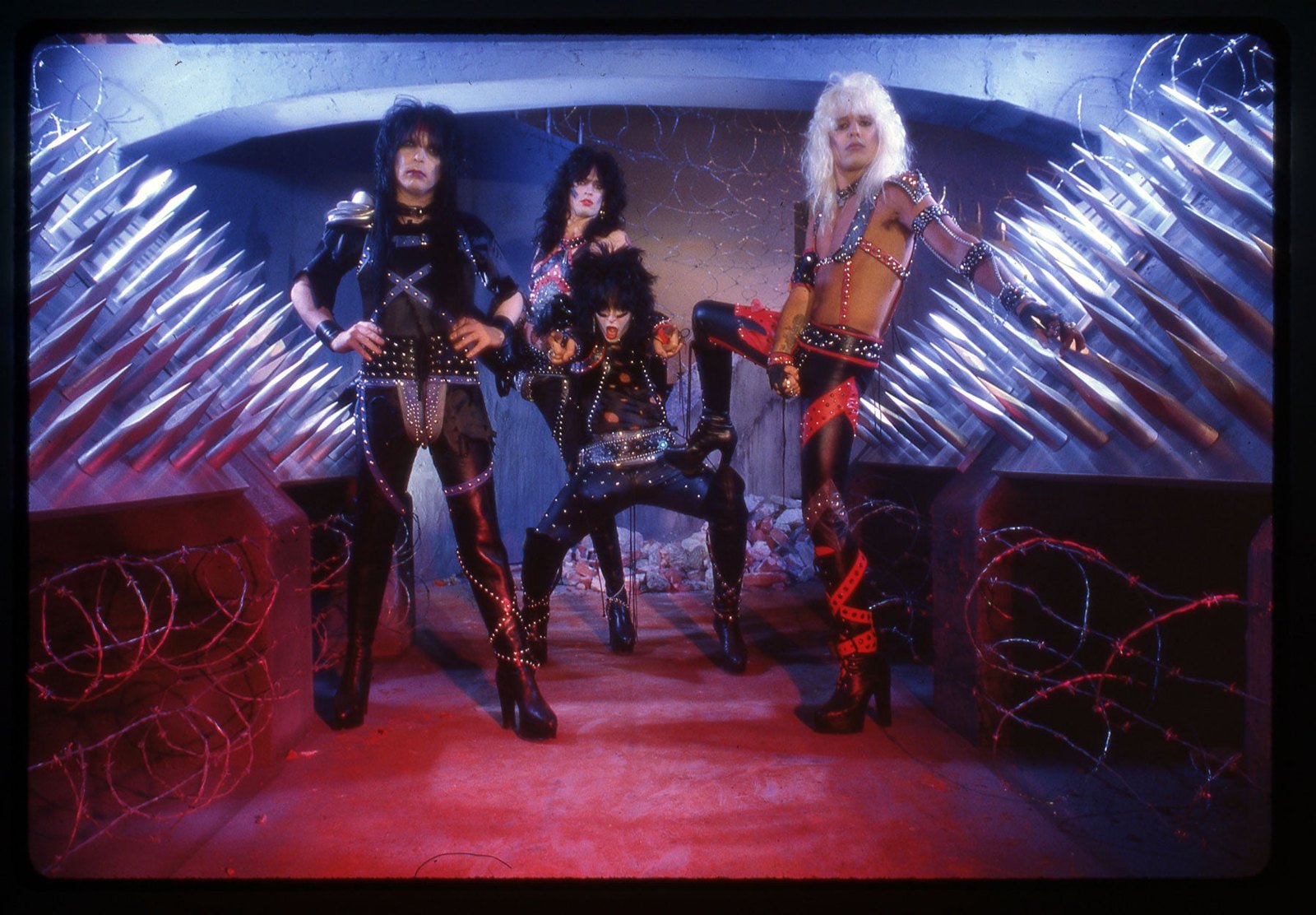
80's hair metal was the most efficient machine for selling heavy metal records that anyone ever built, and it ran for a single decade before the market that paid for it pulled the plug out of the wall. The four young men from Hollywood who pressed their own first album in 1981, and who spent their nights tearing the posters of rival bands off the telephone poles along Sunset Boulevard to staple up their own, were Mötley Crüe. Eight years later the same four sat at number one in America.
For ten years the Sunset Strip behaved like a gold rush camp along a mile and a half of road, every band a prospector working the same creek with the same pan and the same can of hairspray, every club a claims office charging rent on the water, and the major labels riding in with brass scales like assayers, weighing whatever glittered and paying cash for it on the spot. Most of what they bought was fool's gold. Not all of it.
Three machines kept the place running. The club sold its own stage to the bands that played on it. The camera, from the day MTV went on the air on 1 August 1981, rewarded any band that looked right for three and a half minutes. The power ballad, one per album and usually the second or third single, carried the whole enterprise past the rock stations and into Top 40 radio, the pop format that sold records by the million. None of the three cared about the riff. That was the trouble.
The Strip before the hairspray
Long before the hairspray the Strip had its rock clubs, the Whisky a Go Go, open since January 1964, the Roxy, the Troubadour and Gazzarri's, and a crowd that expected hard rock loud on a Tuesday night. The Pasadena quartet that played Gazzarri's more often than any other band of the seventies was Van Halen, and its Warner Bros. debut of February 1978, carrying the two-handed tapping of "Eruption", kicked the door of the club circuit off its hinges. Every guitarist on the Strip spent the next five years in his bedroom trying to catch up.
The look came from further away. The New York Dolls had worn lipstick and platform boots on their 1973 debut, Kiss had built an arena act out of greasepaint, and British glam rock, Slade above all, had proved that a stomping chorus could top a singles chart. The Finnish five who carried that style into the eighties with more swagger than money answered to the name Hanoi Rocks, and the Los Angeles bands studied their photographs the way apprentices study a master's sketchbook. Glam metal or hair metal is a quarrel that never ends. In 1981 nobody on the Strip used either word.

Formed in January 1981 by the bassist Nikki Sixx and the drummer Tommy Lee, with Mick Mars on guitar and Vince Neil on vocals, the vanguard of the whole movement cut Too Fast for Love in a matter of days and released it that November on its own Leathür label. Elektra signed the band and put the record out again in 1982 with a new mix. The songs were punk speed under glam choruses. The sleeve borrowed its pose from a Rolling Stones album.
Behind them the street filled up. Ratt came up from San Diego, W.A.S.P. threw raw meat into the front rows, and Great White, Dokken and a dozen lesser acts fought over the same Friday nights. The record collector who stopped the waiting was Brian Slagel, whose Metal Massacre compilation of June 1982, the first release on his new Metal Blade label, set Ratt beside an unknown local band called Metallica on the same slab of vinyl. Slagel had modelled it on the independent records he imported from the new wave of british heavy metal, and the Strip learned the lesson Britain had already learned: a band that waits for a major label waits forever.
Pay to play: the Strip rents out its stage
By the middle of the decade the clubs had worked out that the bands needed the stage more than the stage needed them. Under the arrangement the whole street came to call pay to play, an unsigned group was handed a block of tickets, often a few hundred dollars' worth, to sell in advance, and whatever it failed to shift came out of the musicians' own pockets before a note had been played. The stage became a toll bridge with a padlock on it, and the band paid the toll twice, once in cash and once in the unsold tickets stuffed into the kick drum case.
The other currency was paper. Every weekend the telephone poles along Sunset carried a fresh layer of photocopied flyers, and a band with one good photograph and a friend at a copy shop could look, from a passing car, as big as a band with a contract. Hairspray was cheaper than guitar lessons. The street saw the hair first.
The film that caught the Strip at its most crowded was The Decline of Western Civilization Part II: The Metal Years, released by Penelope Spheeris in June 1988, setting interviews with Kiss, Aerosmith, Ozzy Osbourne and Lemmy beside unsigned hopefuls in bedrooms and car parks, each certain he would be famous by the following summer. Very few of them were. It is still the plainest record of the decade.
The stage became a toll bridge with a padlock on it, and the band paid the toll twice.
MTV needed faces, and the Strip had them
MTV went on the air with too few videos to fill a day, and the acts that already had clips in the can, British ones above all, got played whether American radio knew them or not. The Sheffield five who had come out of the young British wave were Def Leppard, and when the video for "Photograph" went into heavy rotation in 1983 it carried Pyromania to number two on the Billboard 200, the main American album chart, held off the top only by Michael Jackson's Thriller. The camera had found its format.
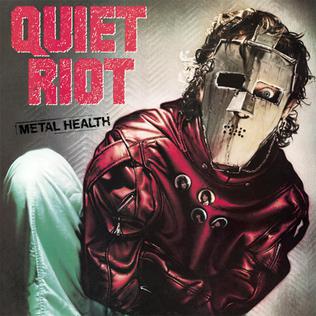
The Strip veterans whose first two albums had been released only in Japan were Quiet Riot, and Metal Health, their debut for Pasha, a CBS subsidiary, in February 1983, rode a cover of Slade's "Cum On Feel the Noize", a British hit from ten years earlier, to number five on the Hot 100, the American singles chart, and on to the top of the album chart that November. That was the template for the rest of the decade.
The bill for all this went to the bands. Record companies advanced the money for a video, tens of thousands of dollars and later far more, and recouped it from the band's royalties, so a group could be on MTV every hour and still owe its label money at the end of the year. The spectacle was bought on credit. Most of the loans were never paid back.
The Long Island five who had spent ten years in the bars of New York and New Jersey before any American label would sign them were Twisted Sister, and the video for "We're Not Gonna Take It", from Stay Hungry on Atlantic in May 1984, turned the song into a cartoon in which Dee Snider's opening scream blows a furious father out of an upstairs window. The father was Mark Metcalf, the martinet of Animal House. The single stalled outside the top twenty. The video reached every bedroom in the country.
80's hair metal at the multi-platinum peak
The New Jersey quintet that had sold respectably and no more on its first two albums went out under its singer's surname, Bon Jovi, and for the third it brought in the songwriter Desmond Child and the producer Bruce Fairbairn, decamped to Little Mountain Sound in Vancouver and, by the band's own account, played the demos to local teenagers to pick the singles. Slippery When Wet, released by Mercury in August 1986, gave them two number one singles, "You Give Love a Bad Name" and "Livin' on a Prayer", both written with Child. Whether a Jersey Shore band in denim belongs on the hair metal shelf at all is its own argument. The chart did not wait.
What the chart did want was the ballad. Built on a piano or an acoustic guitar and swelling to a full band and a guitar solo in the last minute, the power ballad was a jemmy wrapped in velvet, the one song on every album made to prise open the window of Top 40 radio that the loud songs could only rattle, and once the window was open the whole album climbed in behind it. Mötley Crüe's "Home Sweet Home", from Theatre of Pain in 1985, was requested on MTV so often that the channel is said to have changed the rules of its request show because of it. After that every label wanted one. Most bands wrote two.
The power ballad was a jemmy wrapped in velvet, made to prise open the window of Top 40 radio that the loud songs could only rattle.

The drummer Rick Allen had lost his left arm in a car crash on 31 December 1984, and he returned to Def Leppard on a custom electronic kit. Recorded over the best part of three years with Robert John "Mutt" Lange, who pulled the band's guitar parts to pieces and rebuilt them layer upon layer, Hysteria came out in August 1987 and took almost a year to reach number one. It sold more than twelve million copies in America.
"Pour Some Sugar on Me" was not the single the label led with. Released in America as the fourth single in 1988, it climbed on requests to rock stations, then on MTV, to number two on the Hot 100, a stomping chant built for eighteen thousand voices and the decade's great anthem without a fast bar in it.
The Strip's own reply came from the same clubs. The five who played the Troubadour and the Roxy in torn denim and cowboy boots, with less makeup than anybody else on the bill, were Guns N' Roses, and Appetite for Destruction, released by Geffen in July 1987, sat on the chart for a year before the video for "Sweet Child o' Mine" pushed it to number one in August 1988. It was the most successful album the Strip ever produced. It was also the first one to sneer at the Strip.
| Year | Album | Band | Label | Billboard 200 peak |
|---|---|---|---|---|
| 1983 | Metal Health | Quiet Riot | Pasha | 1 |
| 1983 | Pyromania | Def Leppard | Mercury | 2 |
| 1984 | Stay Hungry | Twisted Sister | Atlantic | 15 |
| 1986 | Slippery When Wet | Bon Jovi | Mercury | 1 |
| 1987 | Hysteria | Def Leppard | Mercury | 1 |
| 1987 | Appetite for Destruction | Guns N' Roses | Geffen | 1 |
| 1989 | Dr. Feelgood | Mötley Crüe | Elektra | 1 |
The Washington wives and the black and white sticker
The backlash came from the capital. Founded in May 1985 by Tipper Gore, Susan Baker, Pam Howar and Sally Nevius, four women married to men of influence in Washington, the Parents Music Resource Center was a lobby group that wanted records rated the way films were. Its list of offending songs, the Filthy Fifteen, took four from the Strip and its cousins: Mötley Crüe's "Bastard", Def Leppard's "High 'n' Dry (Saturday Night)", Twisted Sister's "We're Not Gonna Take It" and a W.A.S.P. single whose title no family newspaper would print.
The other eleven belonged as much to Prince and Madonna as to Judas Priest and Venom, and the Senate hearing of 19 September 1985 produced a compromise rather than a law. In November the member companies of the RIAA, the record industry's trade association, agreed to label albums with explicit lyrics, and from 1990 a standard black and white Parental Advisory sticker went onto the sleeves.
On a fourteen year old in a shopping mall the sticker worked like the skull and crossbones on a bottle in a pirate film, a warning printed in the one design guaranteed to sell whatever was inside, and some chains, Walmart among them, answered by refusing to stock stickered records at all. The bands got free advertising. The shops got the headache.
The costume was a uniform, not a creed, and the clearest proof came from Orange County. The four men in yellow and black stripes who threw Bibles into the crowd from the stage called themselves Stryper, and To Hell with the Devil, released on Enigma in 1986, became the first Christian metal album to go platinum. The same hairspray. The opposite sermon.
1989: sober, expensive and at number one

Sober for the first time as a unit and recording in Vancouver with Bob Rock, who had engineered Slippery When Wet for Bruce Fairbairn, the band that had done most to make the Strip a scandal was, once again, Mötley Crüe, and Dr. Feelgood, released by Elektra on 1 September 1989, gave it the only number one album of its career. The label paid for every hour of it.
By then MTV had given the music a weekly home in Headbangers Ball, late on Saturday nights since April 1987, and the labels were signing Strip bands in bulk, Warrant to Columbia, Slaughter to Chrysalis, FireHouse to Epic, each one a photocopy of a photocopy of a band that had been original in 1983. The same programme played Metallica, Slayer and Anthrax between the ballads. The replacement was already on the air.
Nobody ever threw a record away because the singer's hair was too big. People threw it away because the chorus was the only thing in it.
Saint Sylveszter, KaosMetal
The last hits were not metal at all. Extreme took "More Than Words" to number one in 1991 and Mr. Big took "To Be with You" there in 1992, two acoustic songs with the amplifiers switched off. The ballad had swallowed the band.
After 1991: the barcode and the flannel
The first blow came from a barcode. From the chart of 25 May 1991, Billboard built its album chart from sales scanned at the till by Nielsen SoundScan instead of from shop staff telling reporters what was selling, and the new count went through the old one like an auditor with a torch, prising the lids off crates in a cellar and finding that country and rap sold far more than anyone had been told. The till was not generous.
The second blow came that September. Released on 24 September 1991 by DGC, a Geffen imprint and so a sister label to Guns N' Roses, Nirvana's Nevermind replaced Michael Jackson's Dangerous at number one on the chart of 11 January 1992. The video for "Smells Like Teen Spirit", a school gym full of flannel shirts and cheerleaders with the anarchy symbol on their sweaters, made every lipsticked chorus on MTV look ten years old in a single week.
What followed was a rout. The labels dropped or shelved most of the 80's hair metal acts signed after 1988, Headbangers Ball was taken off the air in January 1995, and the clubs went back to booking whatever the street wanted next. Grunge did not do all of it. A sound copied until the copies came out blank did the rest.
What the decade left behind
The afterlife has run longer than the life. Mötley Crüe signed a cessation of touring agreement in 2014, played what was billed as its last show on 31 December 2015, and was back on the road with Def Leppard in 2022, three years after a Netflix film of the band's memoir had sold the old scandals to people born after them. The contract lasted less than four years. The reunion trade runs on what the Strip ran on, a photograph that looks better than the band sounds today, and it has earned exactly the same suspicion.
Take the hair away and the decade still left real things. It left a generation of guitarists who could play, schooled on Eddie Van Halen's tapping, a short shelf of albums that hold up with the video switched off, and the proof, on one slab of vinyl from June 1982, that the street which sold spandex also pressed the first Metallica track. Underneath the costume the music was the old music, riff and chorus and a singer at full height, the line that runs back to how heavy metal began.
Some bands carried that line through the eighties without the hairspray, and some wore it and played well anyway. Both kinds stand among the bands you need to know. The costumes went to the charity shop in 1992. The riffs stayed.