
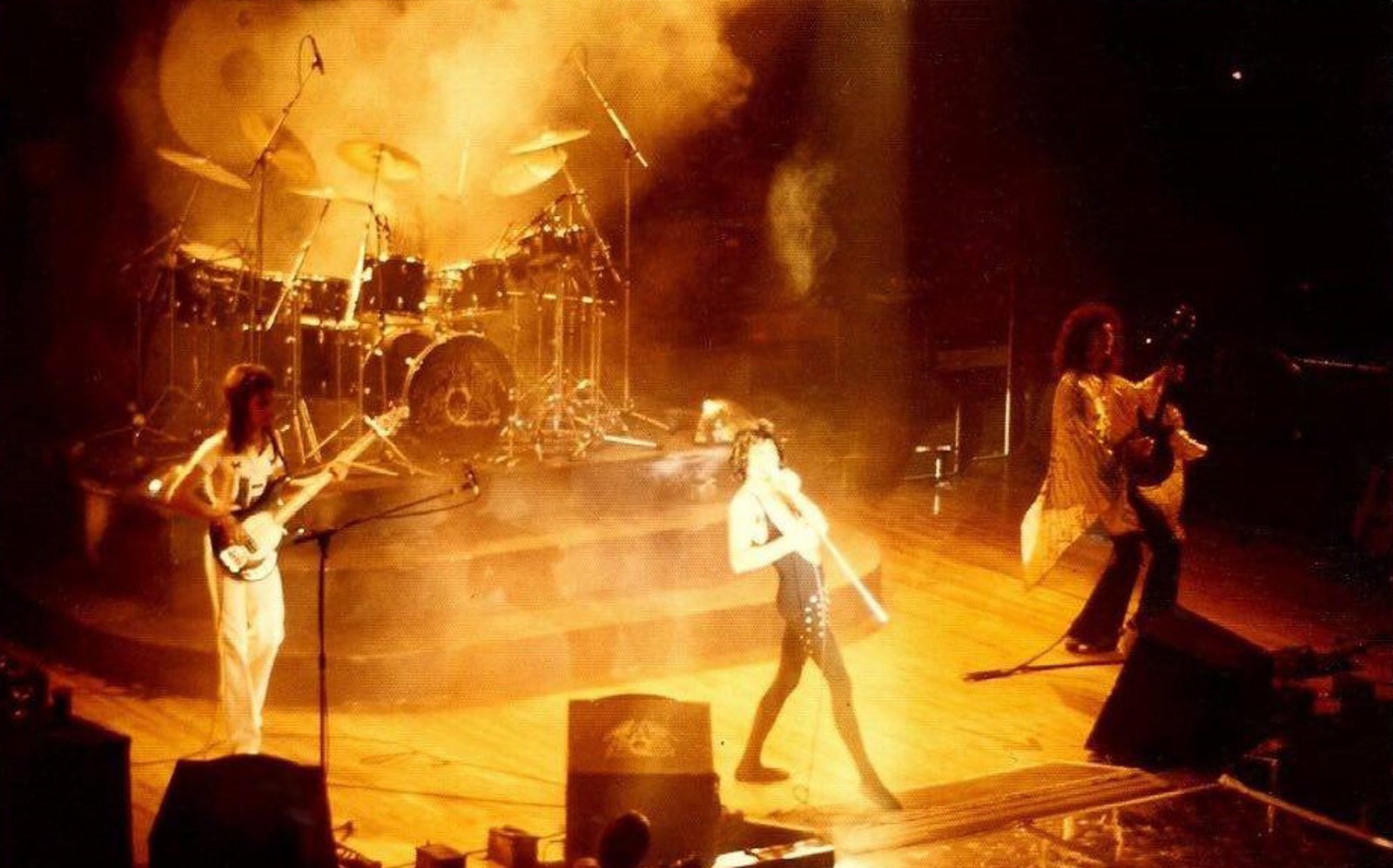
Is Queen heavy metal? No. The band could play heavy metal whenever it chose, it chose to perhaps a dozen times across fifteen studio albums, and every one of those dozen songs was followed on the same record by something heavy metal would never have let through the door.
The London four who sent a six minute mock opera to the top of the British singles chart for nine weeks from November 1975, a year after cutting a downpicked riff for Sheer Heart Attack that speed metal would later claim as a grandparent, were Queen, and the claim has been argued across record shop counters ever since. It is a fair question. It has a clear answer.
A cuttlefish hunting over open sand runs dark bands down its body in waves from head to tail, a flickering signboard that freezes a shrimp where it hangs in the water, and then two tentacles shoot out, seize it and drag it back into a beak that snaps it in half. Ten seconds later the animal is pale and mottled again and could pass for a stone. The stripes were a weapon. They were never the species.
Queen wore heavy metal's markings the same way, for the length of a strike, and every kind of evidence that can be put to the question returns the same answer for a different reason: the songs, the machinery, the voice, the witnesses and the charts. Its place among the other border bands of the seventies, beside Deep Purple, Thin Lizzy and the Scorpions, is set out in the longer account.
Is Queen heavy metal? Count the songs
The catalogue comes first, because it is the largest body of evidence and the easiest to check. Fifteen studio albums between 1973 and 1995 hold well over a hundred and fifty songs, and the ones a heavy metal fan would claim without an argument fit into a single short table.
| Song | Album | Year |
|---|---|---|
| Ogre Battle | Queen II | 1974 |
| Stone Cold Crazy | Sheer Heart Attack | 1974 |
| Brighton Rock | Sheer Heart Attack | 1974 |
| Tie Your Mother Down | A Day at the Races | 1976 |
| Sheer Heart Attack | News of the World | 1977 |
| Hammer to Fall | The Works | 1984 |
| Gimme the Prize (Kurgan's Theme) | A Kind of Magic | 1986 |
| I Want It All | The Miracle | 1989 |
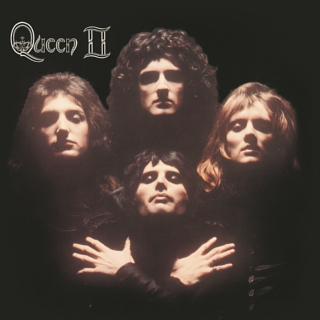
Put those songs back inside their albums and the case for the prosecution falls apart. Released by EMI on 8 March 1974, Queen II turns over to a side the band labelled black and opens it with "Ogre Battle", a fantasy war fought on a fast, downpicked riff that few heavy bands of 1974 could have matched, then closes that same side with "Seven Seas of Rhye", which fades out on the band bawling an Edwardian music hall song about the seaside. No metal record of the decade would have risked the joke.
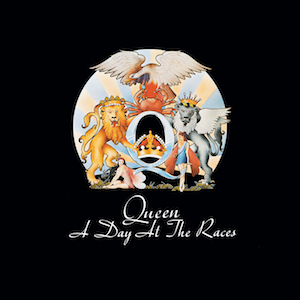
Released on 10 December 1976, A Day at the Races opens on "Tie Your Mother Down", a riff from Brian May slammed down over Roger Taylor's drums hard enough to shake the gilt off the crest on the sleeve, and follows it at once with "You Take My Breath Away", a piano ballad sung close to a whisper, and then "Long Away" and "The Millionaire Waltz". A metal album does not do that to its own opening track. Queen did it on every record.
The machinery: one guitar, and nobody played synthesizer
The guitarist who built his instrument at home with his father out of the timber of an old fireplace, beginning in August 1963 and finishing a year later, and who played it through a bank of Vox AC30 amplifiers with an old sixpence in place of a pick, was Brian May. The rig answers the question on its own. Heavy metal was built on the Marshall stack and its roar, while the AC30 is a chiming combo from the beat group era, pushed by May through a treble booster until it sang like a violin rather than growled like an engine.
The harmonies tell the same story from the other end. Heavy metal's twin lead is two men facing each other across a stage, Downing and Tipton, Murray and Smith, each carrying one line and trusting the other with the second. May built his harmonies alone, one overdub at a time on multitrack tape, three and four guitars stacked until they buried the rhythm track entirely on "Procession" and in the long solo of "Brighton Rock". That is not a band. It is an orchestra with one player.
The voice and the room
The singer who held seventy two thousand people at Wembley Stadium in a call and response of wordless phrases on 13 July 1985, in the middle of a Live Aid set that lasted barely twenty minutes, was Freddie Mercury. The heavy metal singer hurls the note over the crowd like a war cry, Rob Halford and Bruce Dickinson reaching into the head voice to do it. Mercury had that range and chose, most nights, to spend it flirting with the stalls.
The songs he wrote point the same way. "Seaside Rendezvous" has the band imitating a horn section with their mouths, "Good Old-Fashioned Lover Boy" is a music hall number over a ragtime piano, and the opera section of "Bohemian Rhapsody" is a parody of opera rather than an attempt at it. The voice belonged to the theatre and the spectacle. Heavy metal took its singers from the same conservatory and sent them to war.
All the world's a stage, and all the men and women merely players; they have their exits and their entrances, and one man in his time plays many parts.
William Shakespeare, As You Like It
The witnesses from the metal side
The Birmingham guitarist who handed May the solo on "When Death Calls", from Black Sabbath's Headless Cross in 1989, was Tony Iommi, and May tears into it over Iommi's riff like a guest who has waited years to be asked. The friendship was public and it lasted. Three years later, at the tribute concert for Mercury at Wembley on 20 April 1992, the singer who stepped into Mercury's place for "Stone Cold Crazy", with Iommi playing beside May, was James Hetfield of Metallica.
The Krefeld band that recorded "Spread Your Wings" for the compilation The Forgotten Tales in 1996 was Blind Guardian, and power metal's massed vocal choirs owe more to Queen's stacked harmonies than to any British metal band of 1980. That is lineage, and on any honest reading it is the strongest evidence the metal side has. It is also evidence of the wrong thing. Heirs testify to a parent. They do not make the parent one of their own.
Heirs testify to a parent. They do not make the parent one of their own.
The charts, and where the verdict lands
The bass player who wrote the line under "Another One Bites the Dust", a funk figure looped for three and a half minutes, was John Deacon, and the single held number one on the Billboard Hot 100 for three weeks that October, the biggest American hit the band ever had. That line turns under a rock audience like a skipping rope swung by two strong arms, the same loop coming round and round, so that anyone standing inside it either jumps in time or takes the rope across the shins, and it is the least heavy metal record Queen ever sold.
The band then followed it into the dance clubs with Hot Space in 1982, a record the band's older fans treated as heresy, and into the synthesizer with "Radio Ga Ga" two years later. Beyond dispute, a heavy metal band does not have its greatest American success with a disco bass line, and it does not answer that success by going further in.
So the verdict is plain. Queen is a rock band with a heavy wing, one room among six or seven in a large house whose others held opera, music hall, funk, rockabilly and stadium chants, and the band walked between them without ceremony. The same sorting by evidence rather than by volume settles heavy metal vs grunge, where the confusion runs through weight instead of costume.
