
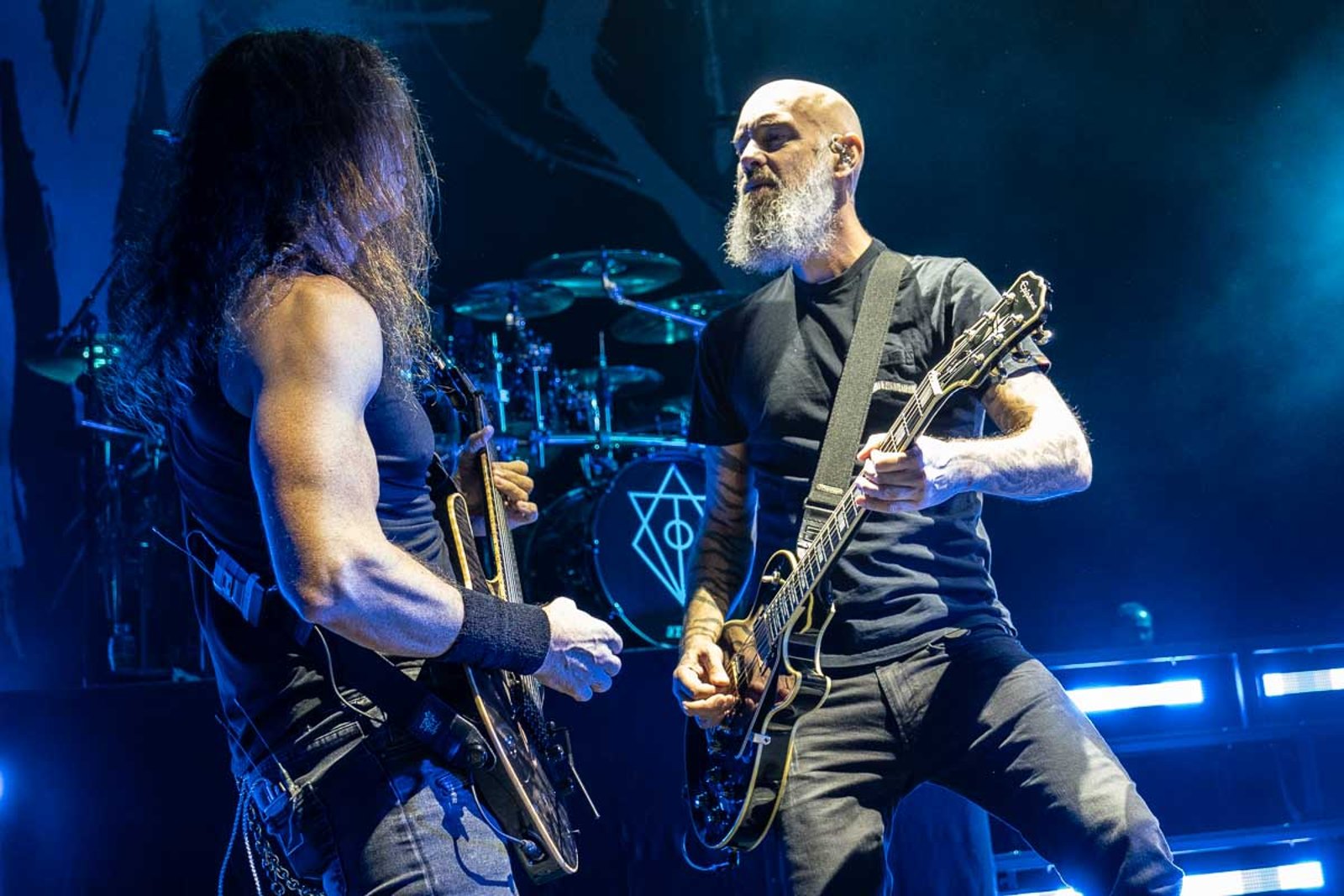
On 26 March 1976 a record reached the shops with a song on the front of its second side in which two guitars play the same tune a third apart for eight bars and hand the record a hook the singer never touches. That eight bars is the founding document of melodic heavy metal, and almost nothing in the style since has managed to get out from under it.
The Dublin band whose two guitarists learned to think of themselves as one instrument with four hands were Thin Lizzy, and "The Boys Are Back in Town", taken off Jailbreak on Vertigo, put Scott Gorham and Brian Robertson through a harmonised figure that thousands of bands would spend the next fifty years copying, taking apart and getting wrong. The trick is not difficult. Making it carry a whole song is.
A thatcher is judged from the road by the ridge, the pattern cut along the top where everyone can see it, and the roof itself stands or falls on the spars and the layers underneath that nobody looks at, driven home in courses and pinned so the weather cannot get a finger under them. Melodic heavy metal is judged the same way and by the same two parties. The listener hears the tune. The roof is the riff beneath it, and the tune only survives as long as the riff does.
What melodic heavy metal actually names
The term is a description and never a scene. No club, no city and no label ever gathered these bands under a banner, and the word is applied after the fact to heavy metal in which the melody is the point of the song rather than a decoration laid over a riff, without the clean voice being given up and without a harsh one arriving to replace it. Which branch split off when, and on what line, is that part of the history.
Melody in this music lives in three places and the good records use all of them. It lives in the vocal line, which climbs and is meant to be sung back; it lives in the harmonised guitars, two lines a third or a sixth apart moving together while the bass holds the root; and it lives in the chorus, which is built to be the loudest thing in the room. What separates the style from hard rock is that none of it is permitted to soften the riff underneath.
The listener hears the tune. The roof is the riff beneath it, and the tune only survives as long as the riff does.
The British wave's melodic wing
When the young British bands came up at the end of the seventies most of them went for speed and the rest went for the tune. The London band built around the brothers Tino and Chris Troy was Praying Mantis, and Time Tells No Lies, released by Arista in 1981, is the most thoroughly melodic record the whole wave produced, with harmony guitars on nearly every track and choruses arranged in parts rather than shouted.
"Cheated" is the case for the defence. It opens on a guitar figure that any of the faster bands would have run twice as hard, holds it at a tempo that lets the melody breathe, and then sends the two guitars up in parallel into a chorus with a lift the heavier British records of that year could not have carried. Two Jet singles could not revive the band at home, and it took a country that had never let go of it, a decade later, to send Praying Mantis back onto a stage built to their own scale, with Pony Canyon pressing the records that followed.

The Whitley Bay band that answered a rough debut by hiring a second guitarist with a gift for writing lines rather than solos were the Tygers of Pan Tang, and Spellbound, produced by Chris Tsangarides and released by MCA in April 1981 with John Sykes signed on the year before, took a group that had been all elbows and gave it something to sing. Iron Maiden did the same thing on a larger scale and with a bass player writing the tunes, which is why the harmony guitar became the standard-bearer of British metal rather than a local habit.
The habit crossed borders quickly and each country bent it. The German band that came back from its 1978 Japanese tour with a melodic streak nobody had expected of it was Scorpions, and Lovedrive and Animal Magnetism, the two records that followed with new guitarist Matthias Jabs, run a clean tenor and a singing lead guitar through riffs as hard as anything from the British wave. Norway sent TNT with a high clean American singer, the American clubs sent Dokken, and all of them were filed under other names in the shops while doing the same job.
The chorus as the load, and where it collapses
The chorus is where melodic heavy metal earns its keep and where it most often comes apart. A cheese maker drops rennet into warm milk and within minutes the curd has pulled away from the whey, one solid and one thin, and no amount of stirring afterwards will put the two back into one liquid. A band that writes its melodies in the ballads and keeps the riffs for the fast songs has done exactly that to its own record, and the sleeve then holds two products with a label in common.
The bands that hold together keep the tune and the weight inside the same song. The Swedish five who took a keyboard line to number eight on the American chart in 1986 were Europe, and "The Final Countdown" marks the far border of the style, the point past which the guitars are working for the melody rather than with it. On the other side stands the whole lineage of European power metal, faster, higher and built on the double kick drum, which is a separate argument from this one and a noisier one.
Nobody has ever started a scene by being tuneful. Melodic heavy metal is what the good bands were doing while the loud ones were getting the write-ups, and the proof is that their records still have something to hum forty years later.
Declan Rourke, KaosMetal
When melodic becomes a prefix
Somewhere around 1995 the word stopped being a description and turned into a component of other genre names, and the meaning shifted underneath it. In melodic death metal the melody moved entirely into the guitars, because the voice had been handed over to a growl and could no longer carry a tune, and the harmony lines the British wave had used for a fanfare were put to work carrying the whole song.

The Gothenburg band that borrowed the twin guitar method wholesale and buried the singing under it was In Flames, and "Only for the Weak", from Clayman in 2000, runs a harmonised lead over a harsh vocal for most of its length, which is the Swedish formula in one track. At the Gates had sharpened the same idea on Slaughter of the Soul in 1995 and Dark Tranquillity had been at it since The Gallery the same year.
Melodic metalcore did the next turn of the screw, keeping the harmonised guitars, splitting the voice into a harsh verse and a sung chorus, and selling the result to an audience that had never heard a British wave record. All three of these styles are called melodic for the same reason and it has nothing to do with the tempo or the volume. It means the guitars are singing, whoever is at the microphone.
What the label is worth
As a filing term it is soft, and a reader looking for the harder edges of the map will get more out of how many metal subgenres are there than out of arguing about where melodic ends. As a listening term it is the sharpest thing on the shelf, because it names the one quality that decides whether a heavy metal record is still in the rack in twenty years.
Riffs age well and choruses age better. The melodic wing is the branch that never went anywhere, still playing a gleaming twin lead over a riff that would have passed inspection in 1981, and still getting the tune out of the guitars before anybody opens his mouth.
