
Give me the keys. I feel for the common chord again, / Sliding by semitones, till I sink to the minorRobert Browning, Abt Vogler
Metal scales are fewer and older than the catechism in the back pages of the guitar magazines ever let on. The German guitarist who in 1977 took a figure from the harmonic minor, bent it towards the eastern Mediterranean and let it run under a song about the ferryman of the dead, while the rest of his band played hard rock around it, was Uli Jon Roth of the Scorpions, and the song was "The Sails of Charon", from Taken by Force. A generation of students ground the fretwire flat learning it.
A scale is a choice of notes from the twelve the octave holds, and its character is decided by where the small steps fall. A clockmaker cutting the teeth of a wheel never counts them by eye. The blank goes on an arbor above the index plate of a dividing engine, a disc drilled with concentric rings of holes, and a detent drops into one hole while the cutter bites out a single tooth, then moves to the next hole and the next, so that the ring chosen before the first cut has already settled every tooth the wheel will ever carry. The twelve semitones are the holes. The scale is the ring the detent works in. Move the detent one ring out and the same blank, the same cutter and the same hand give a wheel that keeps a different time entirely.
Metal scales start inside the five-note box
The first scale anyone learns is the minor pentatonic: the root, the minor third, the fourth, the fifth and the minor seventh, five notes with no semitone anywhere between them. It came into heavy metal straight from the blues, and the Birmingham guitarist whose solo on Paranoid in 1970 barely steps outside the E minor pentatonic box, bending its notes rather than adding new ones, was Tony Iommi of Black Sabbath.
A caltrop, the four-spiked iron star that Roman armies strewed in front of enemy cavalry to cripple the horses, always lands with one spike pointing straight up however it is thrown. The minor pentatonic behaves the same way under a guitarist's fingers. The two notes that could grind a semitone against the chord underneath, the second and the sixth, have been left out, so wherever a finger drops inside the box a note comes up sharp and right. That is why the solo started there. It is also why so many solos never left.
The natural minor, and the note that darkens it
Put the second and the sixth back and the box becomes the natural minor, the Aeolian mode of the theory books, seven notes with two semitones in them. The minor sixth is the one that matters. It sits a single semitone above the fifth and leans on it, and a melody that touches it and falls back sounds as if something has been lost, which is the whole emotional pedigree of heavy metal's slower songs.
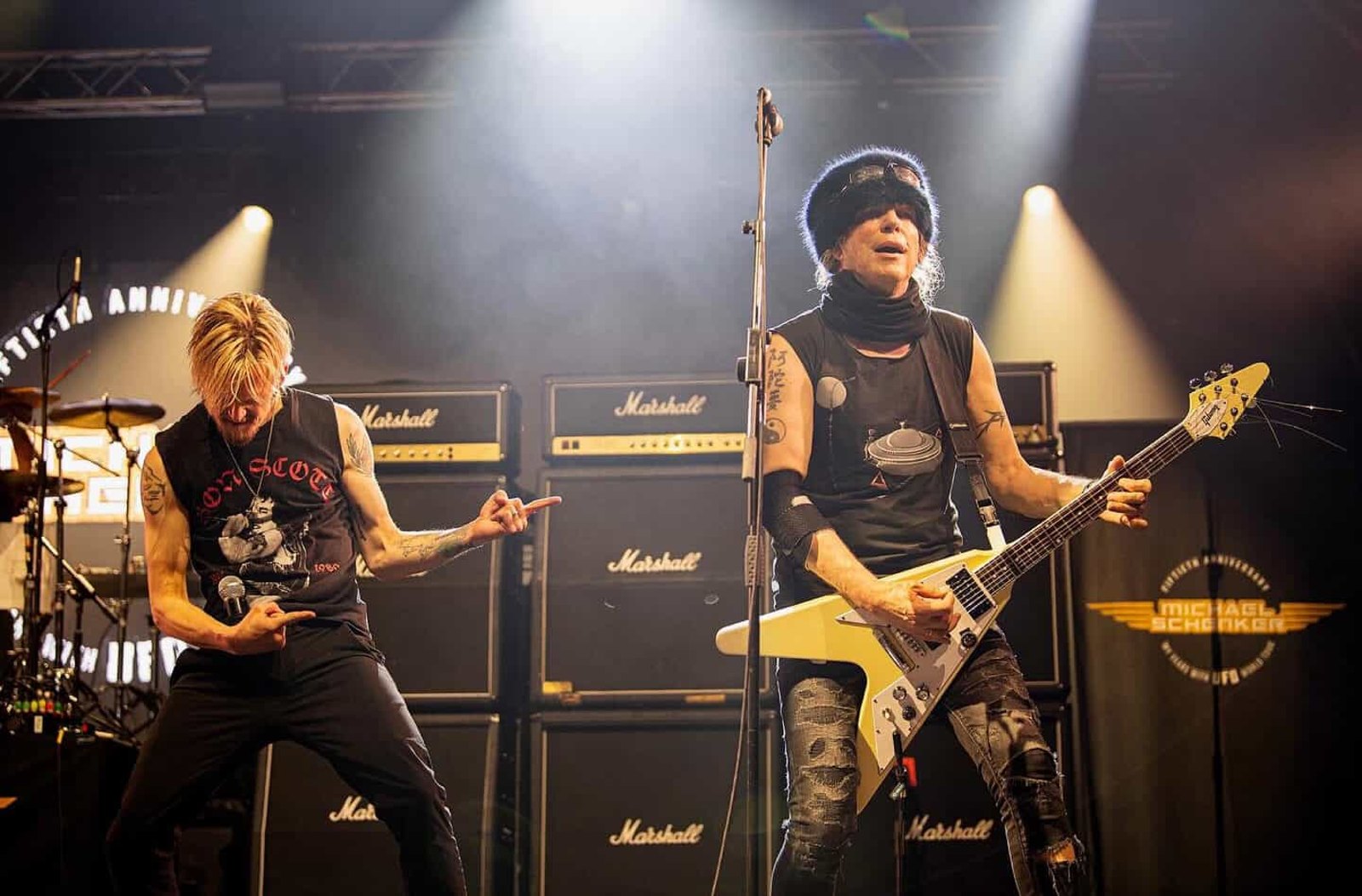
The eighteen-year-old on loan to a London band from his brother's group in Hanover, who joined UFO in 1973 and within a year had turned it into a heavy one, was Michael Schenker, and the long solo in "Rock Bottom", from Phenomenon in 1974, is a lesson in moving between the two scales. He starts inside the pentatonic box and then reaches for the second and the sixth at the moments of greatest strain. The extra notes are rationed. That is why they hurt.
The riff and the solo rarely use the same scale, and that split is the most useful thing a player can learn about the music. Riffs live low on the neck and want menace, so they lean on the Phrygian, the natural minor with its second lowered until it sits a semitone above the root, and on plain chromatic crawls. Solos live higher up and want a tune, so they return to the pentatonic and the natural minor. The riff threatens. The solo sings over the threat.
Raise the seventh
The natural minor has one weakness for a composer: its seventh note sits a whole tone below the root and does not pull towards home. Classical harmony fixed it three centuries ago by raising that note a semitone, and the result is the harmonic minor, with a leading note that leans hard on the tonic and, between the sixth and the new seventh, a gap of three semitones that Western ears have filed for centuries as foreign.
That gap is the whole sound of "The Sails of Charon". Roth played it on German television on 16 January 1978 with the harmonic minor built from its fifth degree, where the same notes become the Phrygian dominant, and the riff's flat second and major third sit side by side like a bazaar tune played through a Marshall. The rest of the band sounds like a hard rock group of its year. The guitar sounds like somewhere else.
Heavy metal took to that mode for a plain reason: it joins the two halves of the music in one scale. The flat second above the root carries the menace a riff wants, the major third a step and a half higher carries the brightness of a fanfare, and a melody that moves between them sounds threatening and triumphant in the same bar. No other scale in the kit does both.
The same scale hides a chord that the neoclassical players wore out. Stack minor thirds up from the raised seventh and the result is the diminished seventh, four notes splitting the octave into equal parts, and the Californian guitarist who ran it up and down the neck through the closing solo of "Mr. Crowley", on Ozzy Osbourne's Blizzard of Ozz in 1980, was Randy Rhoads, blending harmonic minor with ascending diminished arpeggios climbing in minor thirds. Played in that key it is not decoration. It is the chord that points home.
Scales from outside the conservatory
Not every scale in the music came out of a European textbook. The guitarist who was born in Washington, D.C., grew up in Maryland hearing Japanese pop and enka, bent into notes the way those singers slide into them, and moved to Tokyo in 2003 was Marty Friedman, and in 1990 he joined Megadeth. His favourite colours include the Japanese pentatonic scales such as the hirajoshi, five notes with two gaps of four semitones in them, a wider and stranger spacing than the blues box ever allowed.

On Rust in Peace, released by Capitol on 24 September 1990, his solo on "Tornado of Souls" became, by common consent, one of the solos guitar magazines keep putting at the top of their polls, the only metal entry in Guitarist magazine's top twenty guitar solos of all time. What makes it stand apart is the phrasing rather than the speed: long bends that arrive at a note from below, a vibrato held like a singer's, and runs that step outside the minor scale and come back through it. The thrash underneath is strict. The lead above it is a heresy with perfect manners.
The extra notes are rationed. That is why they hurt.
| Scale | Steps from the root, in semitones | What it adds | Hear it on |
|---|---|---|---|
| Minor pentatonic | 3, 2, 2, 3, 2 | No semitones, nothing clashes | Black Sabbath, Paranoid (1970) |
| Natural minor (Aeolian) | 2, 1, 2, 2, 1, 2, 2 | The minor sixth | UFO, "Rock Bottom" (1974) |
| Phrygian | 1, 2, 2, 2, 1, 2, 2 | A semitone straight above the root | Any riff between the open low string and the first fret |
| Harmonic minor | 2, 1, 2, 2, 1, 3, 1 | The leading note and a three-semitone gap | Ozzy Osbourne, "Mr. Crowley" (1980) |
| Phrygian dominant | 1, 3, 1, 2, 1, 2, 2 | A flat second beside a major third | Scorpions, "The Sails of Charon" (1977) |
| Hirajoshi | 2, 1, 4, 1, 4 | Two wide gaps, a Japanese colour | Marty Friedman's lead playing |
The modes heavy metal leaves alone
Just as telling are the scales nobody reaches for. The Dorian mode raises the natural minor's sixth and sounds, to most heavy metal ears, too hopeful for the job. The Lydian raises the fourth of a major scale and floats. The Locrian flattens the fifth of the tonic itself, putting the tritone in the home chord, and it is so unstable that whole songs rarely stand on it, though riffs borrow from it for a bar at a time. Their exponents tend to be progressive players rather than heavy metal ones.
The riff underneath all these scales, the power chord, the tritone and the gallop, belongs to that part of the history, and the scales only make full sense sitting on top of it. A lead line is only as heavy as the riff it rides.
For a player who wants the metal scales under the fingers rather than in a chart, the natural place to begin is a handful of easy metal riffs, nearly all of them cut from the pentatonic and the natural minor. The exotic ones can wait. The first two will already carry most of the music.

