
In February 1983 a guitar magazine printed a few paragraphs about a tape from Sweden.
Played to Mike Varney on a tape in 1981 or early 1982, written up in the Spotlight column Varney had been writing for a monthly guitar magazine since 1982, and followed by a ticket to Los Angeles and a place in Ron Keel's band Steeler on Shrapnel, Varney's own label, the Swedish teenager who would hand neoclassical metal its rule book was Yngwie Malmsteen. Steeler kept him for one album. Alcatrazz kept him for one more studio album.
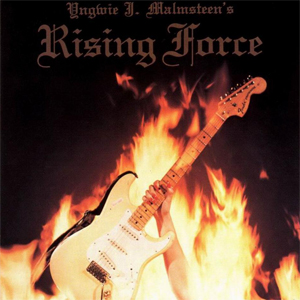
Released through Polydor in 1984, with Jens Johansson on keyboards and Jeff Scott Soto singing on two of its eight tracks, Rising Force stamped the pentatonic box that every American lead guitarist of the day practised inside flat under runs taken from the baroque violin repertoire, played at a speed no rock radio playlist had a slot for, and it still climbed to number 60 on the Billboard 200 and number 14 in Sweden. Nobody had planned for that. A record that was mostly instrumental had reached a chart built for singers.
Rimsky-Korsakov wrote his Flight of the Bumblebee in 1899 and 1900 as scene music with a job inside it: in The Tale of Tsar Saltan the Swan-Bird turns Prince Gvidon into an insect so he can cross the sea to his father's court, and in the next scene that insect drives its sting into the brows of two of his aunts and into the eye of the old woman Babarikha. Pried out of the opera, the interlude became a speed trial for every instrument that can play a chromatic run, timed, recorded more than a thousand times, played with no prince inside it and nobody left to sting.
Neoclassical metal spent the eighties as the bumblebee without the prince. The nineties gave it one back.
Neoclassical metal and Mike Varney's stable
The company that turned a magazine column into a talent desk was Shrapnel. Varney had set it up in 1980 as a heavy metal label, and the Spotlight column, begun in 1982 as a way to find talent among the magazine's own readers, fed it a steady supply of tapes from bedrooms all over the country. Some of the players the column printed were offered records. The label's identity followed the post.
The guitarist who could point to the source at the piano was Tony MacAlpine, and Edge of Insanity, produced by Varney in 1986 with Billy Sheehan on bass and Steve Smith on drums, set his shred runs on the guitar beside a Chopin prelude played on the piano, the sixteenth of the Opus 28 set, as if to show the reader of the sleeve where the scales had come from. The same year Vinnie Moore, whose tape had also come in through the Spotlight column and whose hands alone had appeared in a Pepsi commercial in 1985, and who had already played lead on Soldiers of the Night, the 1985 debut of the Bay Area power metal band Vicious Rumors, put out Mind's Eye on Shrapnel with MacAlpine on keyboards. The stable was now breeding its own session players.
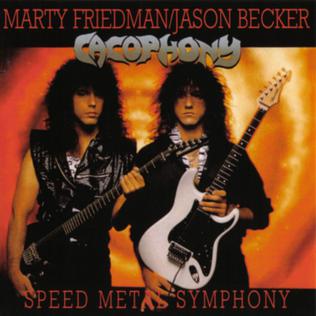
The duo that pushed the Shrapnel sound to its limit was Cacophony, formed in 1986 by Marty Friedman and Jason Becker, and Speed Metal Symphony, released in 1987 with Varney as executive producer and Friedman producing, was described by Andy Hinds of AllMusic as "twin Yngwie Malmsteens playing simultaneously over a bed of Megadeth rhythm tracks". Every note on it is picked as if it were a Bartók pizzicato, the string hauled up off the fingerboard and let go so that it cracks back against the wood, two guitars doing it at once at what Hinds called warp-speed tempos. Becker was still in his teens, and Friedman would carry the same hands into Megadeth in 1990.
| Year | Record | Label | Why it matters here |
|---|---|---|---|
| 1984 | Yngwie Malmsteen, Rising Force | Polydor | The rule book, with Jens Johansson already on keyboards |
| 1986 | Tony MacAlpine, Edge of Insanity | Shrapnel | Guitar runs and a Chopin prelude on one sleeve |
| 1986 | Vinnie Moore, Mind's Eye | Shrapnel | A Spotlight discovery, MacAlpine on keyboards |
| 1987 | Cacophony, Speed Metal Symphony | Shrapnel | Two neoclassical guitarists in one band |
| 1988 | Jason Becker, Perpetual Burn | Shrapnel | The arpeggio pushed to the edge of the hand |
| 1997 | Stratovarius, Visions | Noise | Malmsteen's former keyboard player in a power metal band |
| 1997 | Rhapsody, Legendary Tales | Limb Music | A guitarist schooled on the Shrapnel catalogue |
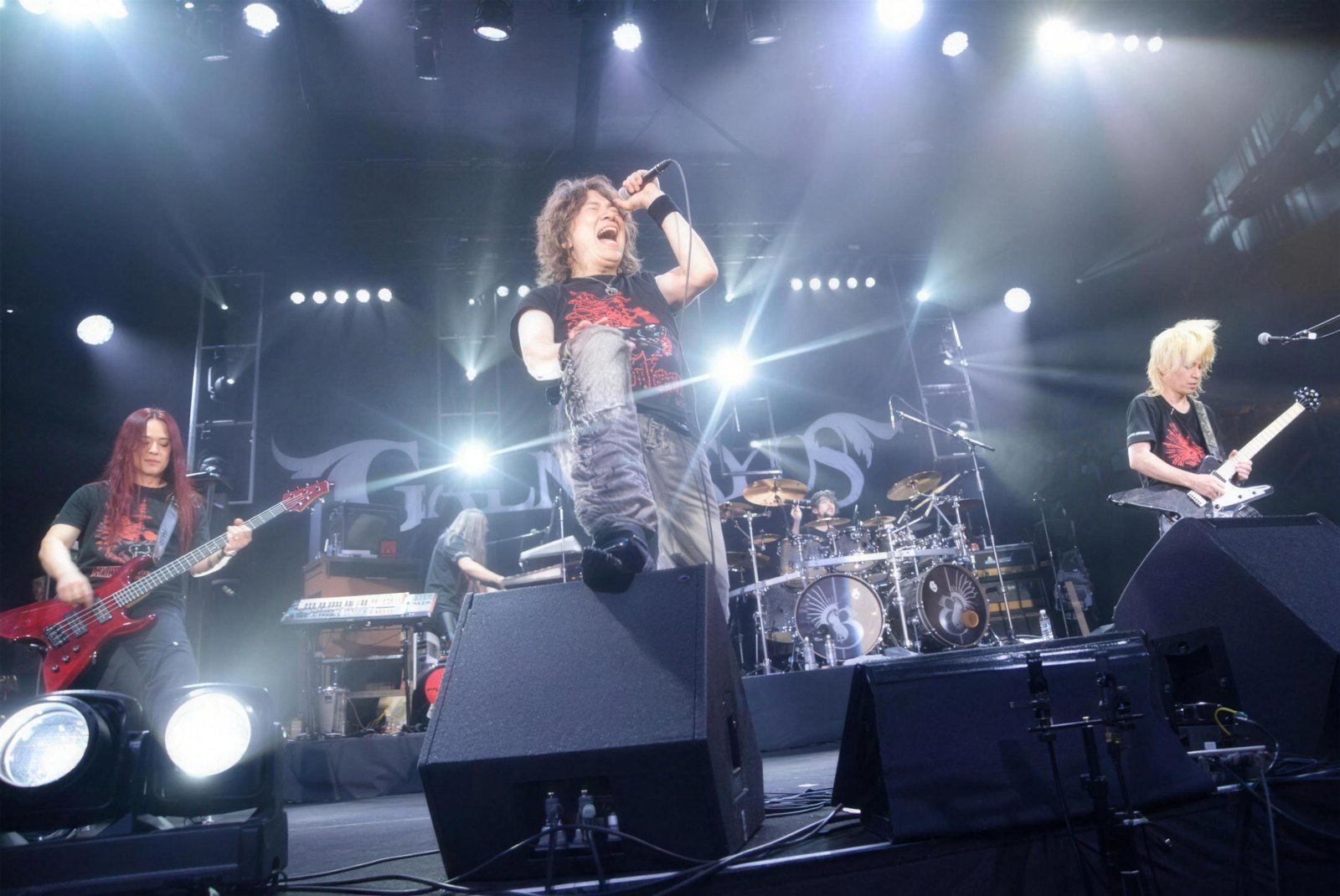
| 2003 | Galneryus, The Flag of Punishment | VAP | Where Japan took it up |
Becker's Perpetual Burn and Friedman's Dragon's Kiss both followed in 1988, and by then the catalogue was crowded with epigones, players who had learned the vocabulary off the same handful of records and spoke it with the same accent. That was the weakness of a label built to sell hands. It could find a hundred right hands. It could not find a song for each of them.
A run with nobody to sing it
Most of what Shrapnel sold under this banner had no singer at all, and where it had one, as on the Cacophony record, the voice was treated as a passenger. Martin Popoff called Peter Marrino's vocals buried in the mix, and Hinds, for all his praise of the two guitarists, preferred the solo records they made next. The records were built to be studied. A guitarist sat with them, slowed them down and lifted the runs one bar at a time, and the rest of the world heard very little of them.
Malmsteen himself kept a singer in the band from the start, and his own records travelled further than the label's. Yet the piece that every pupil learned first was "Far Beyond the Sun", an instrumental from Rising Force, and it is still the tune his name calls up. The apostle of the style spent his career with his most famous tune in a room with no words in it.
It could find a hundred right hands. It could not find a song for each of them.
The clearest admission came from inside the house. When the Ukrainian pianist Vitalij Kuprij and the Swiss guitarist Roger Staffelbach, who had played together in a band called Atlantis Rising, brought their demos to Varney, the man who had built the instrumental shelf liked what he heard and went looking for a singer, then introduced them to John West, whose high voice became the front of Artension on records released through Shrapnel from 1996. That one decision knocked the legs out from under the shelf he had spent fifteen years stocking. By then the singers were already winning the argument somewhere else.
How neoclassical metal fed power metal
The classically trained keyboard player who carried the style out of Malmsteen's band and into Finnish power metal was Jens Johansson, who had left the Swedish band Silver Mountain for California in 1983, played on Rising Force, went to Dio in 1989, and, when Dream Theater chose another keyboard player, joined Stratovarius in late 1995. Timo Tolkki had been writing neoclassical solos into Finnish power metal for years. Johansson gave the guitar a partner that answered in the same language, and with a singer in front of both of them the runs finally had somewhere to arrive.
Visions, released by Noise on 28 April 1997, reached number 4 in Finland, and its second song, "Black Diamond", sets Johansson's keyboards beside Timo Kotipelto's tenor and keeps the neoclassical runs as ornament round a chorus built to be sung back by a hall. The runs are the same family as the Shrapnel ones. The job they do is different. They lead somewhere, and what they lead to has words.
The Italian guitarist who brought the Shrapnel catalogue most directly into the new music was Luca Turilli, who has named Malmsteen, MacAlpine and Friedman among his early influences and Jason Becker above all of them, and whose solos on Legendary Tales, released by Rhapsody on Limb Music in 1997, come tearing through a saga of swords and kingdoms and break off where a choir comes in. The same inheritance runs through Michael Romeo of Symphony X, who names Malmsteen, Randy Rhoads and Al Di Meola among his main influences and put out a solo record, The Dark Chapter, in 1994, and through Kiko Loureiro of Angra in Brazil. Read the subgenres in order and neoclassical metal turns up in at least three of them.
Neoclassical power metal in Japan
In Japan the inheritance was taken up most completely by a band of its own. Formed in Osaka in 2001 by the guitarist Syu and the singer Yama-B, signed to VAP and dressed for its debut, The Flag of Punishment in 2003, in cover art by the Final Fantasy illustrator Yoshitaka Amano, Galneryus had already recorded a version of Stratovarius's "Black Diamond" for the compilation Stand Proud! III before its first album, which names plainly the branch of the family it grew from.
Syu tears through runs as fast as anything on the old Shrapnel shelf, and he has said that a Galneryus song must still stand up when it is stripped down to a voice and a piano. That is the whole difference between the eighties and Galneryus. "Destiny" went into the music games GuitarFreaks and DrumMania in 2011, which put the runs back where the eighties had kept them, in front of players trying to copy them, but the song they were copying has a chorus.
Where neoclassical metal stops
Taken on its own, neoclassical metal is a way of playing rather than a way of writing songs. Its tools are easy to name, the harmonic minor scale, sweep picked arpeggios, long lines turning over a held pedal note, the diminished run, and every one of them belongs to power metal theory as much as to any record Varney released. What the style seldom supplied for itself was the chorus.
That is why it lives in other genres' houses. Stratovarius, Rhapsody and Angra took it into power metal; Children of Bodom dragged the same runs and the same keyboard duels down into melodic death metal under a snarled vocal; the Shrapnel records themselves sit closer to instrumental rock than to either. Gruelling practice built all of it, years of drills that wear the calluses off a left hand and grow them back as horn. The hands that played those runs at speed were trained the same way in every case, and the genre each band ended up in was decided by what it put around them.
Some branches took almost nothing from it. The older American school of epic metal, slower and darker and rooted in records cut in the early eighties, has little use for a run in harmonic minor, and many of its guitarists solo the way the hard rock of the seventies taught them to.
Neoclassical metal is a discipline of the hands that power metal adopted, and it seldom grew a song form of its own. Power metal gave it the one thing the eighties records lacked, a song to serve, and the players who learned from Malmsteen and the Shrapnel catalogue were the ones who did the most to make the European records of the nineties sound the way they do.
