
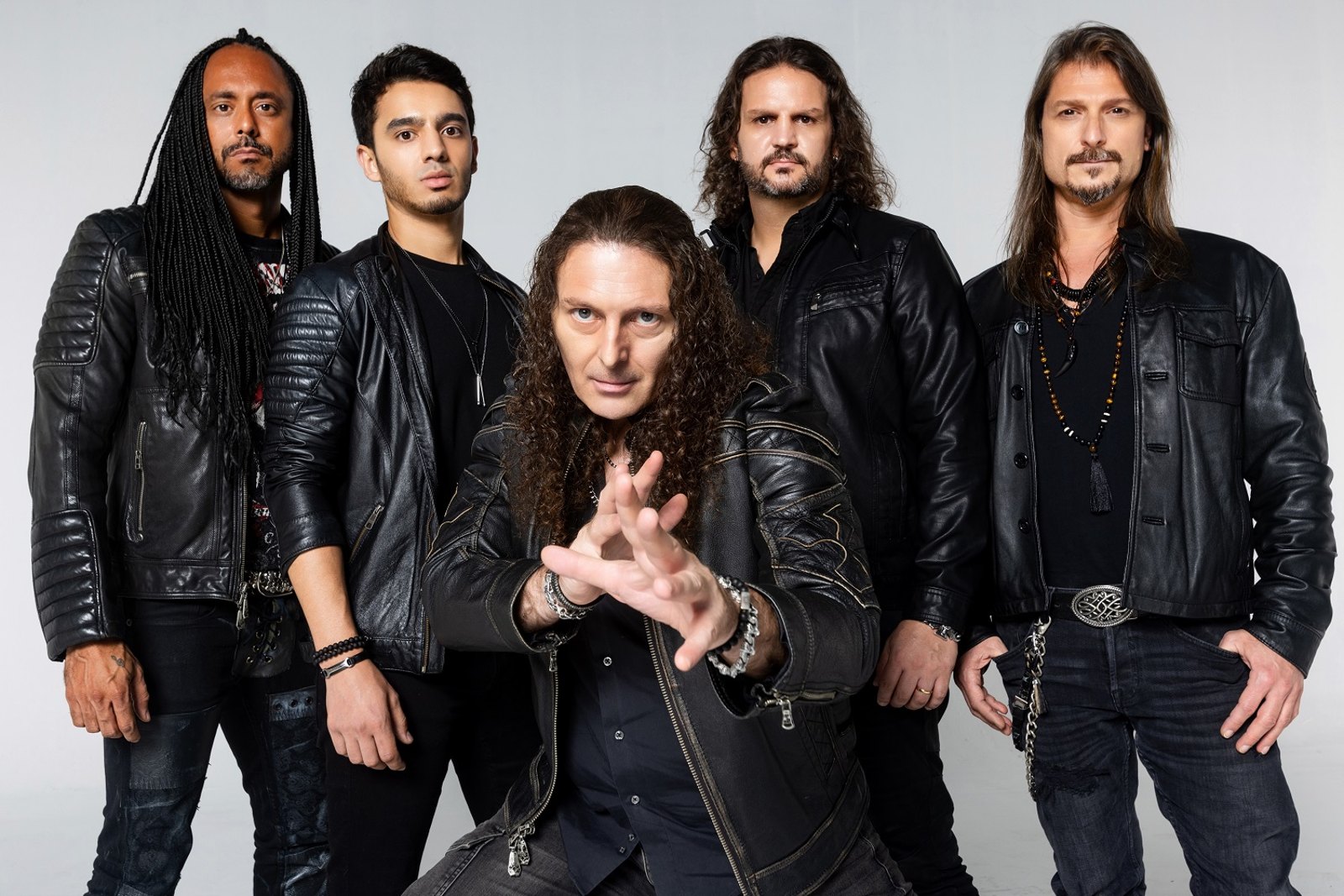
On 3 November 1993 a debut album from Brazil opened with Schubert.
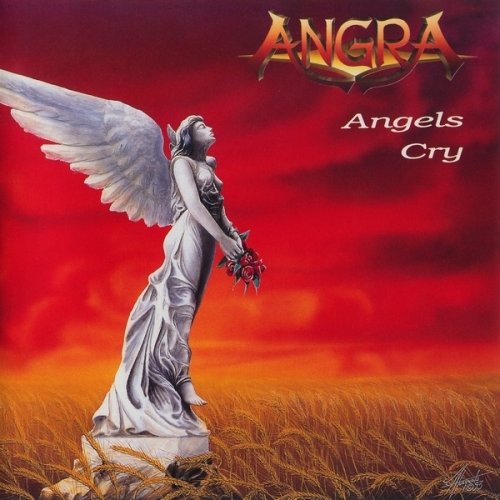
Cut over the summer of that year in Kai Hansen's studio inside a wartime bunker, produced by Charlie Bauerfeind and Sascha Paeth, and opened by a rendition of the first movement of the Unfinished Symphony before a double kick tramples the string melody flat, the Brazilian quintet with a conservatory tenor at the front is Angra, and Angels Cry is a full course in power metal music theory pressed onto one disc.
Every tool of the trade is on it. The title song lifts a theme from Paganini's twenty-fourth Caprice, "Evil Warning" runs Vivaldi's Winter through two distorted guitars, and the tenor of Andre Matos sits above the band in a register most rock singers visit once a night and leave in a hurry. Matos trained in conducting, composition and lyric singing at a São Paulo conservatory before the band existed. None of it was new in 1993. What was new was the density: every borrowed device of the previous fifteen years packed into the same record and played as if the borrowing were a birthright.
Power metal is built from a short list of devices, and almost every one of them was borrowed. The major chord at the top of the phrase came from the hymn book and the stadium anthem, the speed from speed metal, the scales from the baroque violin by way of Ritchie Blackmore and Yngwie Malmsteen, the stacked choirs from Queen and the oratorio, the high clean voice from the British singers of the early eighties. What the genre added was proportion. It took each device further than its source had dared and then stacked all of them into the same bar. How that happened, band by band and decade by decade, is the full story of the genre; the machinery itself comes apart one piece at a time, and it starts at the chord.
Power metal music theory starts at the major chord
Written mostly in the natural minor, like nearly every heavy style since Black Sabbath, the harmony of power metal takes its famous brightness from where the phrases land rather than from the key signature: a climb through the chords built on the flattened sixth and the flattened seventh that finishes on a major chord, so that a song notionally in minor ends every chorus in daylight.
That rising step from the sixth to the seventh to the tonic works like a band of ringers in a church tower heaving the tenor bell up over its balance, the ropes hauled so hard the wooden stay snaps and the whole peal crashes into the full chord at once, and it is the most reused gesture in the genre, because it turns minor melancholy into arrival without changing the scale.
Nothing else explains the grin. The rest of the harmonic catechism is short. Choruses lean on the four chords of the pop song, bridges descend round the circle of fifths in the manner of a baroque sequence, and the ballads borrow their suspensions straight from church music. The major keys proper took over the choruses after Helloween's two Keeper of the Seven Keys records, when critics pinned the tag happy metal on the band, and the reputation for relentless cheer has followed the genre ever since, fairly for some bands and not at all for others.
The last device in the harmonic kit is kept for the end. The final chorus is lifted a semitone or a whole tone, a trick from the Tin Pan Alley ballad that power metal adopted without embarrassment and, at its best, prepares with a pivot chord rather than a jolt. Used well, it is a fanfare held back until the audience has already given everything it has. Used badly, it is a transposition and nothing more.
The rising step from the sixth to the seventh to the tonic turns minor melancholy into arrival without changing the scale.
Tempo, and the double kick underneath it
Taken from speed metal and never handed back, the tempo of European power metal settles most often somewhere between 150 and 200 beats a minute, and the pulse that holds it together is not the snare but the kick drums, two of them or one with a double pedal, playing unbroken sixteenth notes beneath riffs that move in eighths.
The effect is a player piano roll punched so densely that the paper begins to tear along its own perforations: a continuous stream of strikes at exactly even spacing, so regular that the ear stops hearing it as rhythm and starts hearing it as velocity, a floor laid under the song on which the melody can run as fast as it likes without ever losing its footing.
That floor is what separates the double kick here from the blast beat of death metal. The blast is aggression; the power metal kick is texture, closer to the tremolo of a string section than to a fist on a door. Ingo Schwichtenberg set the model on Helloween's Keeper of the Seven Keys records, Jörg Michael carried it into Stratovarius from Episode in 1996, and DragonForce pushed it to the limit a decade later, with "Through the Fire and Flames" clocked at around 200 beats a minute.
Beneath the fastest songs the older heavy metal figure survives, the gallop rhythm of one eighth note and two sixteenths, played on the kick drums as often as on the guitars now, and at mid-tempo it still carries the march numbers that Hammerfall and Sabaton built their catalogues on. The tempo is the identity, not the decoration. Slow a Helloween song to half speed and it becomes a different genre.
The rest of the kit is plainer than the reputation suggests. The snare stays on the second and fourth beats of the bar, the ride or the china cymbal marks the quarter notes over the kick drums, and the favourite trick is the half-time chorus, where the snare drops to the third beat while the kicks keep running, so that the song seems to slow down and speed up in the same moment. The fills are short and the drummer rarely solos. The job is momentum, not display.
| Device | Borrowed from | A power metal instance |
|---|---|---|
| Harmonic minor runs | The baroque violin, via Ritchie Blackmore and Yngwie Malmsteen | Angra, "Angels Cry" (Paganini's Caprice No. 24) |
| Quoted classical theme | Schubert, Vivaldi, Mendelssohn | Angra, "Unfinished Allegro" and "Evil Warning" |
| Harpsichord | The baroque continuo | Rhapsody, Symphony of Enchanted Lands (Alex Staropoli) |
| Double kick in sixteenths | Speed metal | Stratovarius, Episode (Jörg Michael) |
| Multitracked choirs | Queen and the oratorio | Blind Guardian, A Night at the Opera |
| High clean tenor | The British heavy metal singers of the early eighties | Helloween, Keeper of the Seven Keys Part I (Michael Kiske) |
Guitars, shred and the baroque inheritance
Released on Polydor in 1984, recorded with Jens Johansson on keyboards and built on harmonic minor runs taken at a speed rock guitar had not heard before, Rising Force came from the Swedish guitarist who treated Paganini as a contemporary, Yngwie Malmsteen, and its instrumentals "Black Star" and "Far Beyond the Sun" set the guitar syllabus that European power metal would sit for the next two decades.
His necks were scalloped, the wood between the frets gouged hollow so the fingertip never presses down onto the board, and that act of vandalism on a luthier's work is the whole technique in miniature: less pressure, faster release, and a harmonic minor scale fired off the top strings like a violinist's spiccato at twice the speed any violinist would attempt.
From that inheritance came the house style of the power metal guitarist. Sweep picking, the technique of dragging the pick across the strings in a single motion so that an arpeggio sounds as one gesture, became a signature, as did the diminished run that climbs the neck in minor thirds and the pedal-point figure that hammers one open note while the melody moves above it. Timo Tolkki in Stratovarius, Luca Turilli in Rhapsody of Fire and Kai Hansen in Gamma Ray each took a different share of it, Turilli the most baroque, Hansen the most rock and roll.
The baroque pedigree is attested rather than invented. Blackmore had quoted classical figures in Deep Purple and Rainbow, Malmsteen named Paganini and Bach as his models in interview after interview, and Vivaldi's Four Seasons became the most plundered score in the genre. Bach is usually invoked for the twin guitar lead, although two guitars running in parallel thirds are harmony rather than counterpoint; the rarer passages where the lines move independently are the ones a Bach two-part invention would recognise. Angra's debut alone quotes Schubert, Paganini, Vivaldi and Mendelssohn, and the list of classical pieces the genre borrowed is long enough to fill a concert season.
Keyboards, the harpsichord and the bass
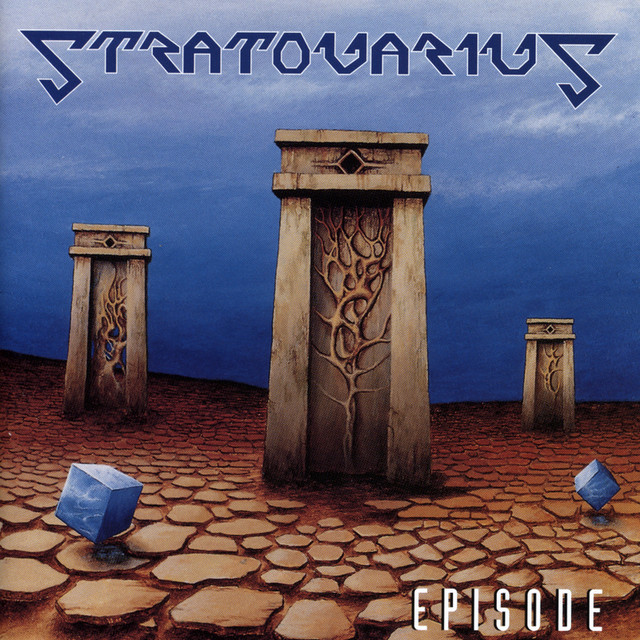
Released by T&T Records on 22 April 1996, recorded with the Sibelius String Orchestra and the Sibelius Choir behind the band and charted at number 21 in Finland and number 20 in Japan, Episode brought the Swede who had sat beside Malmsteen a decade earlier into Stratovarius, and with Jens Johansson the keyboards stopped holding pads and started taking solos.
On the instrumental "Stratosphere," where Johansson and Tolkki trade phrases, the two instruments behave like the soloists of a concerto grosso who have stopped waiting for the orchestra and started ripping each bar out of the other's hands, keyboard answering guitar at the same speed, in the same scale and in the same register, until the listener can no longer say with confidence which instrument is playing.
That duel became standard equipment. The keyboard in power metal has three jobs: to hold the harmony under the guitars with string and choir patches, to double the lead melody an octave up, and to fight the guitar for the solo. It also carries the baroque signal. A harpsichord patch in the intro tells the listener in two seconds which century the song intends to borrow from, and the orchestral imitation that followed, strings, brass and timpani, is the point at which power metal hands over to the symphonic bands.
Rhapsody went further than anyone. On Symphony of Enchanted Lands, released by Limb Music on 5 October 1998, Alex Staropoli played keyboards, harpsichord and piano, and the credits add a baroque oboe and the Helmstedter Kammerchor, so that the Italian band treated the eighteenth century not as a quotation but as a second line-up.
Under all of it sits the bass, the least glamorous job in the band. In most power metal it doubles the root of the riff in steady eighths, tucked below the kick drums, and its value is felt only when it is gone. Markus Grosskopf in Helloween is the classic case of a player who stays out of the way for three minutes and then steps forward for one fill that tells you he could have done otherwise. The fight for the same low frequencies between bass, kick and left hand of the keyboard is a mixing problem as much as a musical one.
The man that hath no music in himself, nor is not moved with concord of sweet sounds, is fit for treasons, stratagems and spoils.
William Shakespeare, The Merchant of Venice
The shape of the song
Built from verse, pre-chorus, chorus, a second verse, a solo section, a bridge and a final chorus sung twice, the power metal single is how a heavy metal song is built with one room enlarged: the pre-chorus, a short lift of rising harmony and tightening rhythm whose only purpose is to make the chorus land harder when it arrives.
The verse is a staircase. The chorus is the landing. Everything else, the instrumental intro, the guitar and keyboard trade in the middle, the quiet bridge with the drums pulled out, exists to make the return to the chorus feel earned, and the final key change, where there is one, turns the last return into a coronation.
Stratovarius' "Hunting High and Low", released as a single from Infinite in 2000 and a number 4 hit on the Finnish singles chart, is the form at its most economical: a short keyboard figure, a verse that climbs, an early chorus, and a solo section that returns to the hook rather than wandering away from it.
The same genre also writes the opposite. Helloween's "Halloween" on the first Keeper runs past thirteen minutes, and Blind Guardian's "And Then There Was Silence", the lead single of A Night at the Opera in 2002, lasts fourteen minutes and six seconds, suites in several movements that keep the chorus as a recurring theme rather than a destination. The single and the suite obey the same rule. The chorus is the reason the song exists.
The intro deserves a sentence of its own, because it is where the classical borrowing usually lives. Angra opened their debut with Schubert, dozens of bands open with a harpsichord or an acoustic guitar played in the manner of a lute, and the short orchestral overture before the first riff became so common in the nineties that a record without one looked underdressed.
The high tenor, the choir and the chorus
Hired to take the microphone from Kai Hansen and heard first on Keeper of the Seven Keys Part I in 1987, the young tenor who fixed the house voice of European power metal was Michael Kiske, and the voice he set down there, clean, bright, vibrato used sparingly and the top of the range treated as home rather than as a destination, is still the one most bands audition for.
That voice is the top string of a concert grand, the thinnest wire in the iron frame, tightened so near its breaking point that every hammer blow threatens to snap it, and the tension is exactly what lets a single man ring out over two guitars, two kick drums and a wall of keyboards without a single fader moving in his favour.
Andre Matos on Angra's "Carry On" is the other textbook, a tenor whose high notes at the end of the chorus stay full rather than thinning toward falsetto, praised since for a multi-octave range worked with a conservatory singer's control. The high notes themselves are technique, not magic: the mixed voice that blends chest and head, the vowel narrowed as the pitch climbs, the support from the diaphragm that keeps the tone from spreading. Where a singer abandons all that for the pure falsetto, the device belongs to the wider heavy metal tradition rather than to this genre.

Behind the tenor stands the choir. Named after Queen's album of 1975 and released on 25 March 2002 with Charlie Bauerfeind producing, A Night at the Opera took the German quartet Blind Guardian to the far end of the method, multiple overlaid vocals, choirs, orchestral keyboards and guitar leads stacked so densely that Hansi Kürsch's voice, copied into dozens of parts, becomes an oratorio chorus built to sound like one throat multiplied. Four singers from a German vocal ensemble, The Choir Company, joined the sessions as well.
The layered choir and the epic chorus are the same idea at two scales. The chorus melody is written for a crowd: a narrow range, long open vowels, the highest note placed on the title words, and a rhythm the whole hall can land on together. The choir is the studio's promise of that crowd before the crowd exists. Real choirs, like the Sibelius singers on Episode, are the expensive version; the principle is the same.
The choir is the studio's promise of the crowd before the crowd exists.
Why the words are English
Sung in English from Helloween's first record in 1985, even by bands who spoke German, Finnish, Italian or Portuguese at home, the lyrics of power metal chose the language of the British heavy metal they descended from and of the export markets Noise Records and its rivals sold into, Japan and the United States above all.
English was the genre's lingua franca before it was anyone's choice. It also sits well on the melody: open vowels, short words for the fast verses, and a long tradition of heroic diction inherited from the fantasy novels the lyrics borrowed. The exceptions prove the rule. Sabaton recorded Carolus Rex twice, once in Swedish, Rhapsody sang "Lamento eroico" in Italian, and Tierra Santa built a whole catalogue in Spanish, while power metal sung in German remains so rare that the German bands who founded the style almost never tried it.
The accent became part of the sound. A German, Finnish or Brazilian tenor singing English learned phonetically lands on the vowels harder and on the consonants more carefully than a native singer would, and the slightly formal, slightly archaic diction that results suits songs about keepers, kingdoms and prophecies better than any natural speech could. Critics outside the genre hear stiffness in it. Inside the genre it reads as ceremony.
Every part described so far, the chord, the kick, the scalloped neck, the harpsichord, the tenor, the choir, has to share the same narrow band of frequencies once the tape is rolling, and the contest between guitars, keyboards and voices on the mixing desk belongs to power metal production, where the theory meets the console. The notes are only half of it.
