
Recorded across September and October 1985 at Musiclab in West Berlin, on the kind of budget a young Hamburg label called Noise could spare for a debut, with one of its two guitarists singing lead because the band had nobody else to put in front of the microphone, the album that pointed speed metal at the major keys was Walls of Jericho, and the Hamburg quartet that cut it was Helloween.
The engineer behind the glass was Harris Johns. He produced it, recorded it and mixed it himself, slamming the drums and both guitars into one hard block of midrange the way a road crew slams a flight case shut on the gear, and he took the band down the way a conservatory tapes a first-year recital, once, fast, with every wrong note left on the reel. The sound is raw. The songs were already reaching somewhere the sound could not follow.
Power metal production is the long argument that began in that room: how to record a music whose guitars run as fast as thrash, whose choruses want to fill a cathedral, whose drummer never lifts his feet off two pedals and whose keyboards, from the early nineties on, demand the same air as everything else. Every answer the style found lives somewhere in every chapter of the power metal story, but the answers themselves were found by a surprisingly small circle of rooms and a handful of men at the desk.
Power metal production and the German rooms
Hired by Noise and by the young bands of the North German scene through the second half of the eighties, working out of Karo Studios in Münster rather than out of the expensive rooms of the capital cities, the engineer who taught a whole generation of Krefeld and Hamburg musicians how their records could sound was Kalle Trapp, and he produced Blind Guardian from the start.
Battalions of Fear was recorded with him at Karo in October and November 1987 and released on 18 May 1988, and Trapp produced Follow the Blind in 1989, Tales from the Twilight World in 1990 and Somewhere Far Beyond in 1992. By common consent the debut is fast, dry and close to thrash. The ambition arrives later, one record at a time, and it arrives in the vocal tracks before it arrives anywhere else.
The Helloween records that fixed the genre's rules in 1987 and 1988 were made in another room with other men, and the pattern they set held for a decade: a German band, a German or Danish producer, a studio rented for a few weeks, and a sound built on guitars first. Keyboards were colour. Nobody yet expected a power metal record to sound like an opera house.
What changed in the nineties was the budget and the geography. The genre went north and south at once, and the rooms that took it in were not power metal rooms at all.
Five studios and the men at the desk
Known to every metal listener of 1986 as the room where Metallica made Master of Puppets, Sweet Silence Studios in Copenhagen was where Blind Guardian went looking for size in the middle of the nineties, and the Dane who gave it to them was Flemming Rasmussen, the producer behind that Metallica record and, in 1995, behind Imaginations from the Other Side too.
He was back for Nightfall in Middle-Earth, recorded between September 1997 and March 1998 at the band's own Twilight Hall Studios near Krefeld, at Karo's Hamburg branch and at Sweet Silence, with Rasmussen engineering, recording and mixing it alongside the band. Five rooms went into one record, counting the piano and the narration. In ten years the genre's production had gone from a fortnight in Berlin to an album assembled like a cathedral from stone quarried in three countries.
The rest of the map was drawn by rooms that had built their names on other music. The history of the studios of heavy metal is full of such borrowings, and power metal borrowed more than most.
| Record | Year | Studio | Producer |
|---|---|---|---|
| Helloween, Walls of Jericho | 1985 | Musiclab, Berlin | Harris Johns |
| Blind Guardian, Battalions of Fear | 1988 | Karo Studios, Münster | Kalle Trapp |
| Iced Earth, Night of the Stormrider | 1991 | Morrisound, Tampa | Tom Morris and Jon Schaffer |
| Stratovarius, Visions | 1997 | Finnvox, Helsinki | Timo Tolkki |
| HammerFall, Glory to the Brave | 1997 | Studio Fredman, Gothenburg | Fredrik Nordström |
| Rhapsody, Legendary Tales | 1997 | Gate Studio, Wolfsburg | Sascha Paeth and Miro |
| Blind Guardian, Nightfall in Middle-Earth | 1998 | Twilight Hall, Karo, Sweet Silence | The band, with Flemming Rasmussen engineering and mixing |
| DragonForce, Valley of the Damned | 2003 | Thin Ice, Surrey, and others | Herman Li and Sam Totman |
| Sabaton, Primo Victoria | 2005 | The Abyss, Sweden | Tommy Tägtgren |
In Gothenburg, HammerFall took the clean high voice into Studio Fredman, the room where Fredrik Nordström had engineered the city's melodic death metal, and came out in June 1997 with Glory to the Brave on Nuclear Blast, tight, dry and very loud. In Helsinki, Timo Tolkki produced Stratovarius at Finnvox between October 1996 and February 1997, with Mikko Karmila engineering and mixing, and Visions came out on 28 April 1997 on T&T, the melodic metal imprint Noise had opened in 1993.
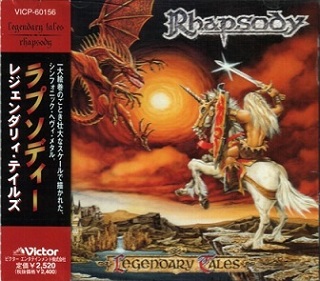
In Wolfsburg, of all places, a car town with no metal reputation to speak of, the producing pair of Sascha Paeth and Miro recorded Legendary Tales for Rhapsody of Fire, then still called Rhapsody, at Gate Studio in April and May 1997, and Limb Music released it on 27 October. Paeth would go on to become the most sought after practitioner in the symphonic end of the genre, later producing Kamelot's Karma and The Black Halo, Tobias Sammet's Avantasia records from The Scarecrow onward, and Epica's The Phantom Agony and the albums that followed it. Across the Atlantic the American school had already found its own room, Morrisound in Tampa, where Tom Morris and Jon Schaffer produced Iced Earth's Night of the Stormrider in 1991, in the building that was also recording Florida's death metal.
The pattern holds everywhere. The record shows a genre that rarely built its own rooms and almost always rented someone else's, and that took from each of them a flavour it had not asked for: Copenhagen's thrash weight, Gothenburg's melodic death dryness, Tampa's saturated low end. Sabaton paid for its own sessions at The Abyss in the Swedish forest with Tommy Tägtgren from August to November 2004, with no label behind the band, and Primo Victoria came out on Black Lodge on 4 March 2005.
Guitars against keyboards in the midrange
The hardest problem in the style is arithmetic. A distorted rhythm guitar, doubled or quadrupled and panned hard left and right, fills the spectrum from roughly 100 Hz to 5 kHz with a dense wall of harmonics, and a power metal keyboard, a string pad or a lead synth or a harpsichord patch, wants almost exactly the same territory, above all the stretch between 1 and 4 kHz where the ear is most sensitive and where both instruments carry their bite.
Put them together at full level and they mask each other. The guitars go soft, the keyboards go grey.
So the mix engineer on a power metal record mutes the band the way a big-band arranger mutes a brass section, ramming a metal straight mute into the bell of one trumpet and a cup mute into the next until each horn loses the band of its tone that was trampling its neighbour, except that here the bells are frequency ranges and the mutes are equalisers. The guitars lose a notch around 2 to 3 kHz so the keyboard lead can speak through it; the keyboard pad loses its low end below 200 Hz so it does not muddy the palm mutes; the bass is filtered and compressed until it sits underneath both like a floor rather than beside them.
The mix engineer mutes the band the way an arranger mutes a brass section, ramming a straight mute into the bell of every horn.
Placement does the rest. Rhythm guitars live at the edges of the stereo field, keyboard pads spread wide but pushed back with reverb, and a keyboard solo that duels with the guitar is panned opposite it and brought forward only for its bars, so the two alternate in the ear instead of colliding in it. The trick is subtraction. Every instrument that sounds big on a power metal record sounds big because something else was cut to make room for it.
People think a big mix is everything turned up. A big mix is everything turned down in exactly one place, so something else can live there.
Curtis Vance, KaosMetal
Two kick drums and a trigger
The other problem is the feet. A power metal drummer at speed plays a continuous stream of sixteenth notes on two bass drums, often at 180 or 200 beats a minute and in the fastest bands beyond, and every one of those strokes has to be heard as a separate note underneath guitars that are themselves thick with low end. A real kick drum recorded with a microphone cannot do it. At that speed the shell is still booming from the last hit when the next one lands, and the notes smear into a rumble.
The solution arrived in the late eighties and has never left. A trigger, a small piezo sensor clipped to the drum head, sends a pulse to a sampler every time the beater lands, and the sampler fires a recorded kick sound, usually a short, clicky attack with the boom trimmed away, so that each stroke comes back identical in weight and length whatever the drummer's foot actually did. The recorded kick is often kept for body and the sample laid on top for definition. On some records only the sample survives.
What that does to a drummer is easy to hear and hard to forgive. It turns his feet into a pair of castanets clamped in a vice under a drill press, every click struck at the same depth by the same steel bit, so the fastest kick patterns in the genre come back perfectly even, perfectly audible and perfectly incapable of a single human accent. Defenders call it clarity. Detractors call it a sewing machine with a click track. Both are describing the same waveform.

DragonForce took the method to its limit. Valley of the Damned, released on 25 February 2003, was rerecorded through 2002 mostly at Thin Ice Studios in Surrey and at Herman Li's own Lamer Luser studio in London, with the drums tracked separately at Jail House Studios in Denmark in May that year. Herman Li and Sam Totman share the producer credit; Karl Groom, the Threshold guitarist, engineered and mixed.
Listen to the title track and the kick is less a drum than a surface, a continuous textured plane that the guitars and the twin leads skate across, which is exactly what the arrangement asks of it. Nobody could play that part and have it sound that way without the sampler. Nobody really tried.
One voice, a hundred throats
The chorus is the genre's reason to exist, and for most of its history the chorus was not sung by a choir. It was sung by the band's own singer, recorded again and again on separate tracks and stacked until one voice sounded like a crowd. The lineage runs back to Queen and to the multitracked harmonies of the seventies, and the German bands learned it early, but nobody pushed it further than Blind Guardian.
Recorded from January to December 2001 at Twilight Hall and at Hammer Music in Hamburg, where much of the backing vocal work was done, and produced by Charlie Bauerfeind, A Night at the Opera is the record on which the Krefeld quartet's singer, Hansi Kürsch, stacked his own voice so thickly that the mix itself became the problem. Released on 25 March 2002, it left Bauerfeind a year of layers to fold down into two speakers.
Kürsch's voice on that record is a hydra with a tenor's throat on every neck: cut one take from the stack and two grow back, each head singing its own line of the chord. A choir is many voices blending; this is one timbre multiplied until it has the mass of many and the colour of one, which is why the chorus sounds uncanny rather than merely large. And Then There Was Silence, fourteen minutes long and released as the lead single in November 2001, is the extreme case.
One timbre multiplied until it has the mass of many and the colour of one.
The method has a craft of its own. Each layer is sung slightly differently, chest voice and head voice, an octave down, a whisper, and the doubles are tightened by hand or by software so the consonants land together, because an unedited stack turns to mush on every S and T. Real choirs, hired and recorded in their own sessions, belong to the symphonic bands and to the orchestra's story rather than to the band's.
Reverb and the size of the room
Recorded dry in small rooms and then placed, one instrument at a time, into spaces that never existed, the typical power metal album of the nineties is an architectural fiction, and the engineers who built it drew the building with reverb units: a plate or a long digital hall on the vocal, a shorter room on the snare, a wide, dark hall behind the keyboard pads. Speed metal had been recorded close and dry. The Helloween school needed air around the tenor.
The risk is the same as with the keyboards. At 200 beats a minute a long tail on the snare blurs every bar into the next, so the craft lies in timing: pre-delay to keep the attack clean, tails tuned to the tempo, the reverb filtered so its low end does not fog the guitars. Get it wrong and the band plays in a concert hall whose back wall has been knocked out, every chord flying off into the dark and never coming back to the stage.
From the splicing block to the bedroom
The first power metal records went onto two-inch tape, twenty-four tracks and a razor blade. A stacked chorus meant bouncing tracks together and losing a generation of quality every time, so that a chorus bounced four times came back worn thin, like a hymnal photocopied from its own photocopy until the staves blur. A Blind Guardian vocal arrangement or a Rhapsody orchestral bed needed far more than twenty-four tracks.
Then the tape went, and the machines that replaced it gutted the old signal chain from the console to the reel. Digital multitrack and then computer systems such as Pro Tools took over the European studios through the nineties, and the razor blade went into the drawer with its edge still sharp. Tracks became unlimited, drums could be moved to the grid hit by hit, vocals tuned note by note. Power metal production took to it faster than almost any other metal's, because the style had always wanted perfection more than grit.
Perfection has a price, and mastering collected it. Through the 2000s records across rock and metal were limited ever harder to sound louder than the one before, and power metal, with its dense mixes and its wall of kicks and keyboards, had less headroom to give than most. The general story of the loudness war is metal's as a whole; its mark on this genre is the chorus that should explode arriving at the level of the verse, because the verse was already at the ceiling.
The last room to go was the studio itself. Once a laptop could run the tracks, amp simulators could replace the four-by-twelve cabinet and sample libraries could stand in for strings and brass, the power metal band no longer needed to rent anything but a place to record drums. After 2000 guitars, keyboards, bass and even vocals moved into the members' homes, sent between countries as files and assembled by whoever did the mix.
Beyond dispute, that move cost the genre its rooms and saved it its bands. Stripped of the rented weeks that had eaten most of a small label's advance, a band could spend a year on a record instead of a month, and the price was that every record could now be sanded down to the same frictionless finish.
Stories told in sound, and concerts put on tape
The concept album is where production stops being a service and becomes part of the composition. Nightfall in Middle-Earth, released on 24 April 1998 and drawn from Tolkien's The Silmarillion, alternates its songs with short spoken scenes and sound effects, so that the production has to carry the story between the tracks, and the narration had to be recorded, cast and mixed to sit beside the music without stopping it dead.
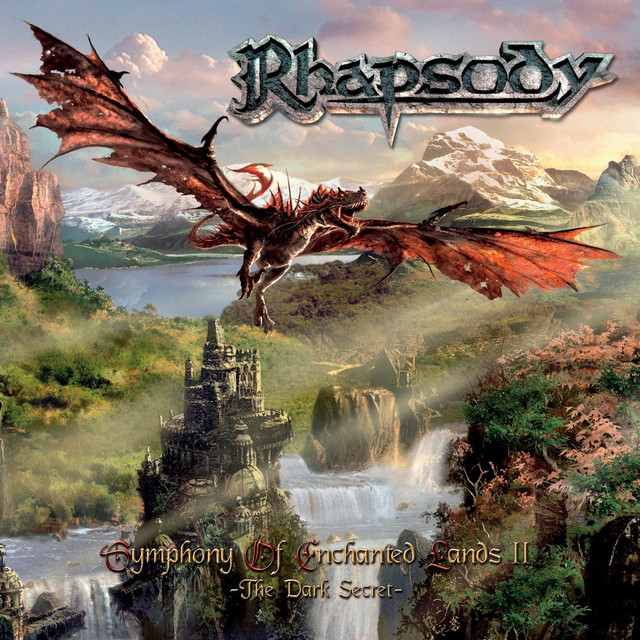
Rhapsody took the device into the cinema. Symphony of Enchanted Lands II: The Dark Secret, released on 27 September 2004, carries narration by Christopher Lee, recorded at Sanctuary Townhouse in London, and the band's later records kept him in the role: he returned in 2006 for Triumph or Agony and in 2010 for The Frozen Tears of Angels. Interludes, narration, battle effects and orchestral links are the sound designer's craft on such albums. The orchestra itself is another matter, and the way it is scored and recorded belongs to the symphonic metal story. Those themes and the worlds they come from, the subject of power metal fantasy, are what the production is there to serve.

The live album is the opposite problem, capturing what the studio built without the studio's tools. Tokyo Tales, Blind Guardian's first, was taped on 4 and 6 December 1992 at Koseinenkin Hall and NHK Hall in Tokyo, produced by Kalle Trapp and released by Virgin on 22 March 1993. Stratovarius built Live! Visions of Europe, released on T&T in July 1998, from shows in Milan and Athens in September 1997.
The crowd is the instrument no studio owns. On Blind Guardian's live recordings of Valhalla the audience carries the chorus on its own after the band has stopped playing it, true of the version taped for Tokyo Tales in 1993 and of the version taped again for the 2003 live album simply titled Live, the one sound the stacked-vocal method was always imitating. Multitrack recorders on stage, microphones hung over the audience and, across live rock generally, repairs made in the studio afterwards: the live album is a studio record with a concert inside it.
From Musiclab in 1985 to a laptop in a spare room, the craft has kept one purpose. Every tool power metal picked up, the trigger, the stacked take, the reverb hall and the sample library, was taken for the chorus, and every one was judged by whether a hall full of people could still sing the record back.

