
The four-song demo Metallica recorded in Ron McGovney's garage in April 1982, later known as the Power Metal demo, took the name from a business card, not the tape itself. McGovney, the band's bassist, had the cards printed for club promoters and added the two words himself, to fill space under a bare logo and a phone number. Lars Ulrich hated the phrase on sight and said so, but it had already gone out on the cards, and the band that would carry it around the world without ever playing a bar of the music was Metallica.
The word came first. The music took three years.
Power metal history is the story of that gap closing. Assembled out of the Rainbow records Dio sang on, the Judas Priest and Iron Maiden songbooks and the tight German riffing of Accept, then fixed in Hamburg between 1985 and 1988, the sound now filed as power metal wrenched the high notes out of the British lead guitar, bolted them to two kick drums in major keys and dragged the whole apparatus through a hostile decade to the top of the European album charts.
It owes nearly as much to what it refused. A style that sings clean where thrash barked, writes in major keys where doom crawled and keeps its keyboards in full view where the American underground buried them, it is defined by its borders almost as sharply as by its core, and what power metal is not fills as much of the argument as what it is. The borders came later. The records came first.
Power metal history begins before the name
Recorded early in 1976 with Dio at the microphone and Cozy Powell behind the kit, the second Rainbow album, Rising, set down the two songs every later power metal band would treat as scripture: Stargazer, eight minutes of Eastern scales, a wizard and a tower, and A Light in the Black, which Powell drove at a speed nobody in hard rock had yet asked a drummer to sustain for eight minutes. It was cut at Musicland Studios in Munich.
Powell beat that second song the way a conservatory pupil hammers a Hanon exercise on the night before an examination, over and over until the felt wears off the piano hammers and the strings ring bare wood against steel, and it was the tempo, more than the wizard, that survived into the next decade. Ritchie Blackmore supplied the rest: minor scales borrowed from Bach, solos that climbed rather than wandered. The quarrel over where power metal came from begins with those two songs and has never settled on a single record.
Judas Priest supplied the drum pattern. Opening Stained Class, released on 10 February 1978, Exciter put Les Binks on a double bass drum run from the first bar to the last, with Rob Halford screaming over it in a register that made every hard rock singer of the period sound as if he were talking. Iron Maiden supplied the harmony and, from 1982, the voice. On The Number of the Beast, Bruce Dickinson set the template for the clean, high, projected tenor that every European band of the next generation would go looking for, while Dave Murray and Adrian Smith played their leads in thirds above the riff. How power metal is built still comes down to that inheritance, a Priest drum line, a Maiden harmony and a Dio vowel, set in a brighter key.

The German contribution came from two directions. The Solingen quintet with the machine-shop discipline and a singer who sounded like coarse sandpaper drawn across sheet iron was Accept, who released Breaker in 1981 and then, a year later, opened Restless and Wild with Fast as a Shark, a double kick drum stampede that flattened every British tempo of its day and has been claimed by speed, thrash and power metal alike. The older school was Scorpions, where Uli Jon Roth spent the middle of the seventies filling records such as Virgin Killer with harmonic-minor runs that gave German guitarists a classical vocabulary long before anybody printed the word neoclassical on a sleeve.
Two American records of 1982 and 1983 pulled the pieces closer together. The singer who had left Rainbow and then Black Sabbath formed Dio, and Holy Diver, in 1983, put the dragon, the rainbow and the fast riff on one sleeve and in one voice. Manowar, meanwhile, had released Battle Hymns in 1982 and preached a loud, humourless creed of loyalty to true metal that later European bands would quote with a straight face and a raised fist. Neither record is a power metal album. Both taught Hamburg what an audience would stand for.
None of these bands was playing power metal. Every one of them was lending it a part.
A demo tape and a word nobody owned
The phrase itself was loose change in early-eighties America, coined by a bass player and hated by his own drummer from the moment he saw it printed. The tape that carried the words went round the trading circuit anyway, and within a year Metallica had moved on to Kill 'Em All and to a different name altogether. The American rock press kept the phrase and pinned it on anything heavier than Priest and cleaner than thrash, which in 1984 meant bands such as Omen, Jag Panzer and Savage Grace, loud records with sword-and-sorcery lyrics and singers who could hold a high note without breaking it. As late as 1988 a Texas band still in spandex, Pantera, could title an album Power Metal and mean nothing more precise than heavy and fast.
Europe took the word and gave it a meaning. Only later, once bands such as HammerFall were filling charts under the name, did German magazines such as Rock Hard and Metal Hammer narrow the phrase to a specific grammar: double bass drums, clean high tenor, melodic twin leads, major-key choruses, fantasy or uplift in the lyrics. The Americans had coined it by accident. The Germans wrote the catechism.
The Americans had coined the word by accident. The Germans wrote the catechism.
Hamburg, 1985: the Keeper records
The Berlin label that gave the city its outlet was Noise Records, founded by Karl-Ulrich Walterbach in 1983, and its compilation Death Metal, released in May 1984, put two Hamburg bands on the same record as Hellhammer, one of which was barely a year old.
The elder of the two was Running Wild. Led by Rolf Kasparek and still dressed in the leather and satanic imagery of the moment, the band released Gates to Purgatory on Noise in 1984, a speed metal record with its melodies turned up, and three years later it would take the whole Hamburg sound to sea. The younger was Helloween, formed in 1984 out of Kai Hansen's Gentry and Iron Fist, Michael Weikath's Powerfool and Ingo Schwichtenberg's Second Hell, and it is the younger one the story turns on.
Two records made the turn. Walls of Jericho, late in 1985, was still a speed metal album with Hansen singing and playing at once, and then, in 1986, a teenage tenor, eighteen years old, named Michael Kiske took the microphone. Keeper of the Seven Keys Part I followed in 1987 and Part II in 1988, and between them Hansen and Weikath wrote choruses that sound like a nursery round sung in canon at a sprinter's tempo, the entries piling onto each other so fast that the choirmaster's podium tips off its rostrum and takes the music stands down with it. The Hamburg chapter of the story was written in those two years, and every European band since has either copied it or argued with it.
The sound of those records was a studio decision as much as a writing one. Tommy Hansen, a Danish producer, and Tommy Newton, working together at Horus Sound Studio in Hanover, kept the guitars bright and the drums dry and pushed Kiske's voice to the front of the mix, where a thrash producer of the same year would have sunk it behind the riff. How power metal is recorded still follows that decision, with the voice and the melody placed first and the guitars cleared out of the way to make room for them.

Then the founder walked out. Hansen left Helloween on 1 January 1989 and launched Gamma Ray, while the German school spread outward from Hamburg: Blind Guardian released Battalions of Fear in 1988 and Follow the Blind in 1989, Rage and Grave Digger were already on the road, and within a few years the country held enough bands for the critics to name a German style of its own. The subgenre map starts at that point, with Teutonic power metal as the first branch and the trunk it grew from.
The heavier American school
Across the Atlantic the phrase had never stopped meaning something heavier. The Kansas trio built around Mark Shelton's guitar and his taste for Robert E. Howard was Manilla Road, whose Crystal Logic appeared in 1983, and it was joined within two years by Jag Panzer's Ample Destruction, Omen's Battle Cry and Savage Grace's Master of Disguise, records that kept the high voice and the fantasy but refused the European brightness. The American branch never used keyboards as a lead instrument and never wrote a chorus that sounded happy.
Where Hamburg played its melodies on the top string of the violin, America bowed the same lines on the C string of a viola, so hard and so close to the bridge that the rosin rose off it in clouds and the bow bit a groove into the gut. That is the whole difference, heard from the stalls. Crimson Glory took it to its most refined form on Transcendence in 1988, the same year Sanctuary released Refuge Denied with Dave Mustaine producing, and Savatage had already borrowed Grieg for Hall of the Mountain King in 1987. Riot answered with Thundersteel, and Queensrÿche started on the same ground before walking off it toward progressive rock.

The Californian band built around Geoff Thorpe's guitar was Vicious Rumors, whose debut Soldiers of the Night came out on Shrapnel in 1985 and which, once Carl Albert took the microphone for Digital Dictator in 1988, ground the European melody down to something harder and colder. The lyric sheets matched. Manilla Road and Omen sang Howard's barbarians and doomed kings, Jag Panzer sang tyrants, and what power metal sings about was set on both shores in the same years, sorcery and battle in America, hope and quest in Hamburg.
The American school had a problem the Germans did not. Thrash took its audience, the major labels took thrash, and by the end of the decade a style that had carried the name first in America was already selling most of its records abroad. Then came the flannel.
The history of power metal in the grunge years
Released in September 1991, Nirvana's Nevermind did not kill power metal so much as close the room it had been playing in, and the decade that followed came down on the genre like the iron fire curtain of an opera house dropped in the middle of the tenor's aria, cutting the stalls off from the stage. Europe and Japan answered by jamming a brick onto the sustain pedal of the pit piano so hard that the pedal lyre cracked, holding the dampers off the strings so that the last chord of 1988 went on ringing through years in which nobody in America was listening.

The ringing was not comfortable. Helloween signed to EMI in 1990 on their management's advice, and Noise sued the band for breach of contract. The fight delayed the German release of Pink Bubbles Go Ape into 1992, a year after Europe and Japan already had it, and by the time Chameleon followed on EMI in 1993, both records had lost the audience the Keeper albums had won. Kiske was out by 1993, Andi Deris came in, Master of the Rings in 1994 brought the band back to speed, and The Time of the Oath in 1996 opened with We Burn and carried Power, a single that sounded as if the flannel years had never reached Germany. The chapter since 1990 starts in that trough, and it starts with the bands that kept writing through it.
Kai Hansen's new band opened the decade with Heading for Tomorrow in 1990, sung by Hansen himself, handed the microphone to Ralf Scheepers for the three records that followed, and by 1995 had Hansen back at it for Land of the Free, which opens with the nearly nine minute Rebellion in Dreamland, the same year Blind Guardian's Imaginations from the Other Side went out on Virgin. The critics who wrote the German school off in 1992 were wrong within three years. Nobody apologised.
America kept one door open. The Florida band led by rhythm guitarist Jon Schaffer was Iced Earth, and across Night of the Stormrider in 1991, Burnt Offerings in 1995 and The Dark Saga in 1996 it drilled the heavier school into a triplet-riff machine. American radio never noticed; the Rodon Club in Athens sold out two nights running in January 1999 instead. It was the exception. The rule was silence.
The money came from the east. The Tokyo monthly Burrn!, founded in September 1984, put Helloween and its descendants on its covers through the years when American magazines would not, and Japanese labels paid advances and asked for bonus tracks that kept whole careers solvent. The Brazilian quintet led by Andre Matos was Angra, whose Angels Cry of 1993 carried Carry On, a song that shows how fast the Hamburg grammar had travelled, and how well. Power metal around the world dates from exactly these years, when the genre survived by leaving home.
America dropped the fire curtain. Europe and Japan jammed a brick on the sustain pedal.
1997: the revival and the northern wave
Released by Nuclear Blast on 27 June 1997, the record that told a generation it could stop apologising was Glory to the Brave, and the band behind it was HammerFall, founded four years earlier by guitarist Oscar Dronjak, who brought in Jesper Strömblad of In Flames as its first drummer. Strömblad kept the credit on the sleeve; the drums on the record itself were played by session musician Patrik Räfling. The album entered the German chart on 14 July 1997 at number 38, a position no debut record in the style had reached before. By common consent that album is where the revival begins.
It did not arrive alone. Stratovarius released Visions the same year, with Timo Tolkki's guitar, Timo Kotipelto's voice and Jens Johansson's keyboards trading solos at full speed, Rhapsody released its first album on Limb Music, and Nightwish put out Angels Fall First, a debut still cut to the power metal pattern. Sonata Arctica followed with Ecliptica in 1999 and Edguy with Vain Glory Opera in 1998. The bands you need to know are mostly from these five years.
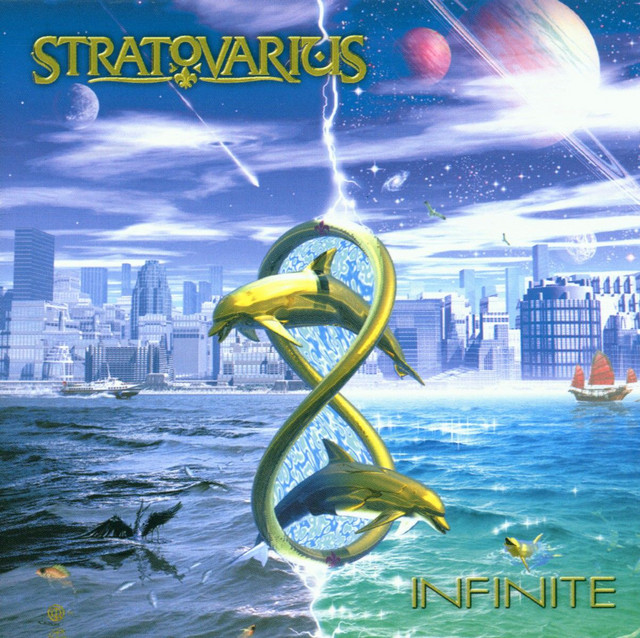
Finland turned it into a national sport. By the time Stratovarius released Hunting High and Low as the single from Infinite in 2000, the album itself had gone to number one in Finland and spent nine weeks on the chart, and the single reached number four there. The band had built the model for the northern sound by then, bright keyboards, a tenor pitched at the very top of the male range and guitar and keyboard solos traded in unison lines, and Sonata Arctica, Nightwish and later Beast in Black would all draw on it.
The genre also learned to think in whole productions. Edguy's singer Tobias Sammet assembled Avantasia in 2001 as a metal opera with Kiske, Kai Hansen and a cast of guest voices, each singer playing a character, and the idea of the power metal album as a staged work with a cast list took hold from there. Kamelot and Blind Guardian pushed it further. The single guitar hero was giving way to the ensemble.
The Trieste duo of Luca Turilli and Alex Staropoli, calling itself Rhapsody before a trademark dispute renamed it Rhapsody of Fire in 2006, made Legendary Tales the loudest argument of 1997: it loaded a guitarist's music stand with a film composer's full score, thirty staves to the page, until the stand buckled at the knee and the pages slid across the stage. Italy supplied Labyrinth and Vision Divine in the same years. The orchestras belong to another family's story. The guitar lines belong to this one.
The machinery behind the revival was German. Nuclear Blast, founded by Markus Staiger in 1987 as a hardcore mail-order business, signed HammerFall and turned the style into the core of its catalogue, while Century Media, Noise and smaller houses such as Limb Music and the Finnish Spinefarm filled the racks around it. Wacken Open Air, begun in 1990 as a village festival in Schleswig-Holstein, grew into the genre's annual congress. By the turn of the century the lean years had become a full order book.
| Year | Record | Band | What it added |
|---|---|---|---|
| 1976 | Rising | Rainbow | The fantasy epic and the fast drum part |
| 1982 | Restless and Wild | Accept | The German double kick stampede |
| 1983 | Crystal Logic | Manilla Road | The American sword-and-sorcery school |
| 1987 | Keeper of the Seven Keys Part I | Helloween | The European grammar, fixed |
| 1988 | Transcendence | Crimson Glory | The refined US high point |
| 1995 | Imaginations from the Other Side | Blind Guardian | Proof the German school survived the nineties |
| 1997 | Glory to the Brave | HammerFall | The revival |
| 1997 | Legendary Tales | Rhapsody | The film-score turn |
| 2006 | Inhuman Rampage | DragonForce | The crossover into America, through a video game |
| 2013 | Preachers of the Night | Powerwolf | First German number one for the genre |
Guitar Hero and the chart years
America came back through a plastic guitar. Formed in London by Herman Li and Sam Totman, the band signed to Roadrunner for Inhuman Rampage, released worldwide on 9 January 2006, was DragonForce. Its opening track ended up as the song widely called the hardest in Guitar Hero III: Legends of Rock, which arrived on 28 October 2007, and Through the Fire and Flames taught millions of American teenagers the sound of European power metal before any of them had heard of Helloween. Inhuman Rampage went gold in the United States, though not until 21 July 2017, more than a decade after its release, something no Hamburg record had managed even once.
The second breakthrough happened on the charts, and it happened in Europe. Through the 2010s the genre that had been laughed off the radio in 1992 began topping national album charts. Sabaton came second in Sweden with Carolus Rex in 2012 and first with Heroes in 2014, Blind Guardian reached number four in Germany with Beyond the Red Mirror in 2015, and a German band with an organ, a werewolf mythology and a number one album of its own was about to go further still. The essential albums of the genre now include records that outsold the pop charts of their week, which nobody in 1995 would have believed.

The Saarbrücken quintet in vestments and corpse paint, singing Latin fragments over a church organ, was Powerwolf, and Preachers of the Night had already taken them to number one on the German album chart in August 2013, the first time the style had topped it. Blessed & Possessed followed in 2015 and peaked at number three. The costume was the argument. The visual language of the genre had moved from the fantasy paintings of the eighties to the stage as a single designed object, and the charts rewarded it.
Demons Are a Girl's Best Friend, the single from The Sacrament of Sin in 2018, shows how much the arena had changed the writing: a verse cut to the bone, a chorus that arrives inside the first minute and a key change held back for the last lap, while the album itself gave Powerwolf a second German number one. Helloween closed the circle. The Pumpkins United tour of 2017 put Kiske and Hansen back on stage beside Deris, and the self-titled album of 2021 took the band that had started it all to the top of the German chart for the first time.
A key change is a promise the last chorus has to keep. Power metal is the only genre that keeps it every time.
Julien Vasseur, KaosMetal
The genre in 2026
Four decades after the Keeper records, the scion of a Hamburg rehearsal room is a festival headliner on three continents. Finland added Beast in Black and Battle Beast, with synthesizers taken straight from eighties pop; Scotland gave the genre Gloryhammer's comic space opera; Sweden sent Twilight Force, Germany Orden Ogan, Canada Unleash the Archers; and the American school came back to life with Visigoth and a generation of bands that took Manilla Road rather than Helloween as their pedigree. Helloween, still with all three singers, released Giants & Monsters in 2025.
The writing has changed with the rooms. Songs that ran past ten minutes in 1987 now arrive at four, the choruses land inside the first minute, and the keyboards that Stratovarius used for baroque solos have been rewired by Beast in Black into eighties Eurodance, with synth patches that would not embarrass a pop producer. The purists call it a betrayal. The tempo, the tenor and the major key are all still where Hamburg left them, which is the only test that has ever mattered.
The ground that fed all of it is still there. Keep It True in Germany, founded in 2003, books the American cult bands of the eighties beside new ones, ProgPower USA has carried the European strain to Atlanta since 2001, and the Japanese pressings with their bonus tracks remain the collectors' prize. The fans and the underground kept the genre alive when the market would not, and they still set its terms.
The chroniclers of 1992 called power metal a relic of the eighties with no future. The history since has answered them record by record, from a Kansas trio's sword songs and a Hamburg tenor's top notes to number one albums in Sweden and Germany. The relic outlived its critics. Its choruses simply took thirty years to reach the rest of the world.
