
In 1984, a year before the Hamburg band Helloween released its first EP, Metal Blade Records put out Battle Cry.
Written by the guitarist Kenny Powell, who had just played on Savage Grace's 1983 debut EP before walking out to start his own band, sung by J.D. Kimball in a voice that stayed in its middle without once turning sweet, and carried by songs such as Die by the Blade and Last Rites, the Los Angeles quartet with a bad sign for a name was Omen. Its debut ripped the velvet lining out of heavy metal and left the riffs standing on bare boards, which remains, by common consent, the plainest working definition of US power metal anyone has offered.
Nobody called it a scene yet. It was simply what came after Judas Priest.
Across the next seven years, from the Kansas plains to the Washington coast and from the Gulf of Mexico to the Connecticut suburbs, some two dozen bands took the twin guitar heavy metal of Judas Priest and Iron Maiden, stripped out every keyboard that might have softened it, bolted the riff to the floor and sent the singer up into the rafters. Then the country stopped listening. The whole branch was sawn off the tree in a single season, and the wood was shipped to Germany.
What the phrase meant in America
Before Europe claimed it, power metal was American shorthand, printed on club flyers, in label advertisements and in fanzine columns to mean the harder and faster edge of heavy metal, the ground between Priest's Screaming for Vengeance and the first thrash demos that any account of how power metal began places near the root of the whole family. It named a temperature, not a form. A record was power metal because it hit harder than the radio, and for no subtler reason.
The word was still being used that way at the end of the decade, which is why, when Pantera titled its 1988 album Power Metal, Phil Anselmo's first with the band, the title meant heavier than the charts and nothing more precise than that.
Europe had meant something else for a year by then. The German answer, set out in the account of how Europe built the sound, found its template with Keeper of the Seven Keys Part I, released by Noise in 1987, and it made the phrase stand for major keys, double bass drumming at full stretch and a tenor aimed at the stars. Two continents, one name, two meanings. They have been talking past each other ever since.
Two continents, one name, two meanings. They have been talking past each other ever since.
US power metal: riff first, keyboards last
The difference in US power metal is audible in the first bar. Both schools were reading from the score that Priest and Maiden had written between 1980 and 1984, but the Americans played it the way the chorus in Verdi's Il Trovatore sings the Anvil Chorus, with real hammers on real iron, the melody kept whole while every blow drowns the strings in the pit and cuts the sustain of each chord dead.
In practice that meant guitars recorded to sound thick rather than bright, riffs that chugged under the palm where the Germans let their chords ring, drums that could run at speed metal tempo but more often marched, and lyrics that went looking for sorcery, apocalypse and the occult rather than for the sunlit fantasy Hamburg would favour. The singers were the one thing both sides shared. Harry Conklin, Midnight, J.D. Kimball and Warrel Dane sang as high as any German tenor, then set their voices against a wall of rhythm guitar instead of a cushion of synthesiser.
Keyboards were rare and choirs rarer still. Where a European band of the late nineties would pack the chancel with voices, the American bands of the eighties had sent the choristers home and burned their surplices in the churchyard, and the space the choir would have filled went to a second rhythm guitar tracked a fraction behind the first.
The forebears are plain to hear. Judas Priest's Defenders of the Faith, released in January 1984, sits behind half the records on the American shelf and Iron Maiden's Piece of Mind of the year before sits behind most of the rest, but the Americans took the darkest songs on those British records as the rule rather than the exception, and built whole albums out of what Priest had kept for side two.
The British records had reached those teenagers the ordinary way, on the radio. Screaming for Vengeance had gone platinum within nine months of release, in April 1983, and Priest and Maiden were crossing the country every year with American support acts underneath them, so the apprentices of Wichita, Tampa and Seattle learned the craft from the front row of arenas rather than from imported vinyl. What they did with it was their own.
The Northwest and the church of the riff
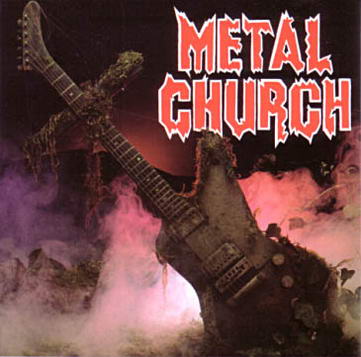
Founded by the guitarist Kurdt Vanderhoof in San Francisco in 1980 and carried north with him to Aberdeen, Washington the following year, the band that took its name from the house where a congregation gathers was Metal Church, and its self-titled debut came out on the small Ground Zero label in October 1984 before Elektra picked it up in 1985.
Beyond the Black, the song that opens the record, is the American method at its barest. David Wayne screams over riffs that Vanderhoof and Craig Wells voice low and together, as though someone had handed the entire melody to the contrabassoons and locked the flutes in the instrument cupboard with their keys bent shut, and the song runs six minutes and twenty seconds without a keyboard in sight or a chorus shaped for daytime radio.
The Dark followed on Elektra in 1986 and took the band deep enough into American record shops that the chroniclers still file it under thrash as often as under power metal. In the Northwest nobody guarded that border.
Across the state, in Bellevue, the quintet with an umlaut it did not need was Queensrÿche, and its 1983 EP, led by Queen of the Reich, is as close to a founding document as the American branch owns. Rage for Order in 1986 and Operation: Mindcrime in 1988 then steered the band toward progressive rock, and Empire in 1990 steered it into the arenas. Whether the band that made Empire still counts is a fair quarrel. The EP answers it for four songs.
Seattle's Sanctuary arrived last and hit hardest. Refuge Denied, released by Epic in 1988 with Dave Mustaine of Megadeth in the producer's chair, put Warrel Dane's shriek on top of riffs already leaning into thrash, and when the band came apart after Into the Mirror Black in 1990, its scion Nevermore carried that voice into the next decade.
Florida, silver masks and the mountain king
Raised on the Gulf Coast of Florida by the brothers Jon and Criss Oliva, who had started out in Tarpon Springs in 1979 under the name Avatar and renamed themselves in 1983 after finding the word already taken, the band that spent the middle of the decade searching for its own sound was Savatage, and it found one in 1987, when the producer Paul O'Neill came in for Hall of the Mountain King on Atlantic. The title track and its instrumental prelude dragged Grieg's troll king out of the concert hall by the beard and turned him loose among two guitars, a bass and a drum kit.
What followed, Gutter Ballet in 1989 and Streets in 1991, pulled the band toward the piano and rock opera. That road ends, years later, with the Trans-Siberian Orchestra filling American arenas every December, by some distance the largest audience any musician from this family ever found at home.
Further down the same coast, the Sarasota quintet in silver half masks was Crimson Glory, and its singer, known only as Midnight, had a voice like the clarino register of a baroque trumpet blown in a stone vault until the mortar dust comes down from the ceiling. The self-titled debut came out on the small Par Records in October 1986, and Transcendence followed on Roadrunner in 1988. The second is the record most often named as the summit of the branch.
From Kansas to Connecticut: the epic road

The oldest root of the branch grew in Wichita, Kansas, where Mark Shelton had led Manilla Road since 1977, and by Open the Gates in 1985, released in Europe by the French label Black Dragon, the trio was playing Arthurian epics that sounded like a monk's plainchant recited over a drone by a man who has just been handed a fuzz pedal and told the abbey is on fire.
It was the epic side of American metal, slower and stranger than the rest. It was also the side Europe noticed first.
West of Kansas, the Colorado quintet named after a German tank destroyer was Jag Panzer, and Ample Destruction, released in August 1984 on the small Iron Works label, set the voice of Harry Conklin, the singer everyone called The Tyrant, over riffs so dense that the album is still the first one handed to anybody who asks what the American sound was.
Out on the Pacific edge, The Axeman carried the Los Angeles reading of the same argument: a riff that stamps rather than gallops, Kimball's voice set square against it, and no harmony stacked above the chorus to sweeten it. Powell followed Battle Cry with Warning of Danger in 1985 and The Curse in 1986, all three on Metal Blade, the label Brian Slagel had built out of a 1982 compilation called Metal Massacre.
Upstate in New York, meanwhile, the quartet that posed in fur and leather on its sleeves was Manowar, and Hail to England in 1984 took the epic side to its loudest and most theatrical extreme, a record whose very title admitted where its warmest audience lived.
Connecticut supplied two more. Built around John Arch's long, winding vocal lines and the guitar of Jim Matheos, the band that made Night on Bröcken in 1984, The Spectre Within in 1985 and Awaken the Guardian in 1986, all on Metal Blade, was Fates Warning, early American power metal at its most ornate, before Ray Alder replaced Arch and No Exit in 1988 took the band into progressive metal for good.
Their neighbours in Liege Lord took the opposite road, starting close to Priest on Freedom's Rise in 1985 and finishing, with Joe Comeau at the microphone on Master Control in 1988, faster and heavier than almost anyone else on the East Coast.
Thundersteel and the crowded year of 1988
By 1988 the branch had reached its crest, and the release calendar shows it. Transcendence, Refuge Denied and Master Control all landed inside the same twelve months, and two more records from opposite ends of the country joined them.
Rebuilt by the guitarist Mark Reale around the singer Tony Moore and the drummer Bobby Jarzombek, the New York band that had been playing hard rock since the middle of the seventies came back as Riot with Thundersteel on CBS Associated, whose title song took the gallop of Defenders of the Faith and drove it through the floor of the rehearsal room at a tempo the German school was only then learning to reach.

On the other coast, the Bay Area band Geoff Thorpe had led since 1979, the one that had given Vinnie Moore his first album with Soldiers of the Night in 1985, was Vicious Rumors, and Digital Dictator, released on Mike Varney's Shrapnel label in 1988, put Carl Albert's tenor in front of two lead guitars and an arrangement with no room left in it for anything soft.
Atlantic signed the band for the self-titled album of 1990, and Don't Wait for Me got a video and airtime on Headbangers Ball, the weekly metal programme on MTV. It was the furthest into the American mainstream the branch ever travelled under its own name, and it lasted about as long as the video.
Who paid for it
Almost none of this music reached the shops through a major label first. Started by Brian Slagel with the first Metal Massacre in 1982, the compilation that also carried an early Metallica track, the small Californian label that released Omen, Fates Warning and Liege Lord's last record was Metal Blade, and it did for the American branch what Noise was doing for Hamburg, which was to press the records nobody else would.
Mike Varney's Shrapnel, set up to sell guitar virtuosity by the pound, took Vicious Rumors. Roadrunner, founded in the Netherlands, handled Crimson Glory from across the ocean, and the French Black Dragon picked up Manilla Road and Liege Lord before most American labels had heard of either. The pattern was set early. Europe paid, America shrugged.
The majors arrived late and left early. Atlantic took Savatage and then Vicious Rumors, Epic took Sanctuary, Elektra took Metal Church, and not one of them had a rack in the shops or a slot on the radio ready for a band that was too melodic to sell as thrash and too heavy to sell as anything else. Even Metal Church's debut, the best seller of the lot, moved barely seventy thousand copies. When sales stayed in the tens of thousands, the contracts were not renewed, and by the time the options lapsed the bands had spent their best years waiting for a push that never came.
| Band | Home | Record | Label | Year |
|---|---|---|---|---|
| Manilla Road | Wichita, Kansas | Crystal Logic | Roadster | 1983 |
| Jag Panzer | Colorado | Ample Destruction | Iron Works | 1984 |
| Omen | Los Angeles | Battle Cry | Metal Blade | 1984 |
| Metal Church | Aberdeen, Washington | Metal Church | Ground Zero | 1984 |
| Fates Warning | Connecticut | Awaken the Guardian | Metal Blade | 1986 |
| Savatage | Florida | Hall of the Mountain King | Atlantic | 1987 |
| Crimson Glory | Sarasota, Florida | Transcendence | Roadrunner | 1988 |
| Sanctuary | Seattle | Refuge Denied | Epic | 1988 |
| Liege Lord | Connecticut | Master Control | Metal Blade | 1988 |
| Riot | New York | Thundersteel | CBS Associated | 1988 |
| Vicious Rumors | San Francisco Bay Area | Digital Dictator | Shrapnel | 1988 |
| Iced Earth | Florida | Night of the Stormrider | Century Media | 1991 |
Why the country turned away
The reasons American power metal withered at home were commercial before they were musical. Between 1986 and 1990 the ground on either side of it was taken, thrash led by Metallica seizing the underground and then the charts while the Los Angeles glam bands held radio and MTV, and a style too melodic for the first camp and too heavy and too strange for the second was left without a rack of its own in the record shops.
I hear America singing, the varied carols I hear.
Walt Whitman, Leaves of Grass
Then came the autumn of 1991. Nirvana's Nevermind, released that September on DGC, went through the practice rooms of American metal like a caretaker with a bin bag, sweeping the method books, the chord charts and the whammy bars off the shelves in a single pass, and within two years the major labels had dropped most of the heavy bands still on their rosters.
In the country that built it, the style became a heresy kept alive by a few thousand collectors. Behind the names that survived stand dozens that did not, among them Heir Apparent, Warlord, Helstar, Attacker, Sacred Oath and Titan Force, whose records turned into collectors' objects long before anyone thought to reissue them.
Europe took in what America threw out. The German label Century Media had already signed Iced Earth, Jon Schaffer's band out of Florida, for a debut in 1990 and Night of the Stormrider in 1991, and through the rest of the decade European labels and European stages kept the American bands in work. Founded in 2003 in the small town of Lauda-Königshofen, the German festival Keep It True put Omen on its first bill that year, then Jag Panzer in 2008 and Liege Lord in 2013, with a dozen others back in front of a crowd.
Germany had something America never offered these bands, which was a trade in them. It had specialist shops, magazines that reviewed a Colorado record with the same seriousness as a Hamburg one, and a summer circuit of festivals where a band with one great album from 1984 could still headline a field. The American collectors were fervent and few. The German ones were fervent and many.
The branch did not die so much as emigrate. Iced Earth, Nevermore and a reformed Jag Panzer carried the heavier reading of the phrase through the grunge years while the lighter reading spread across Scandinavia and Italy, and how the two strains fared in the decade that tried to bury them both belongs to the story of the power metal 90s, told from the other side of the ocean.
The records stayed in print in Germany. At home they went into the bargain bins, and waited.

