
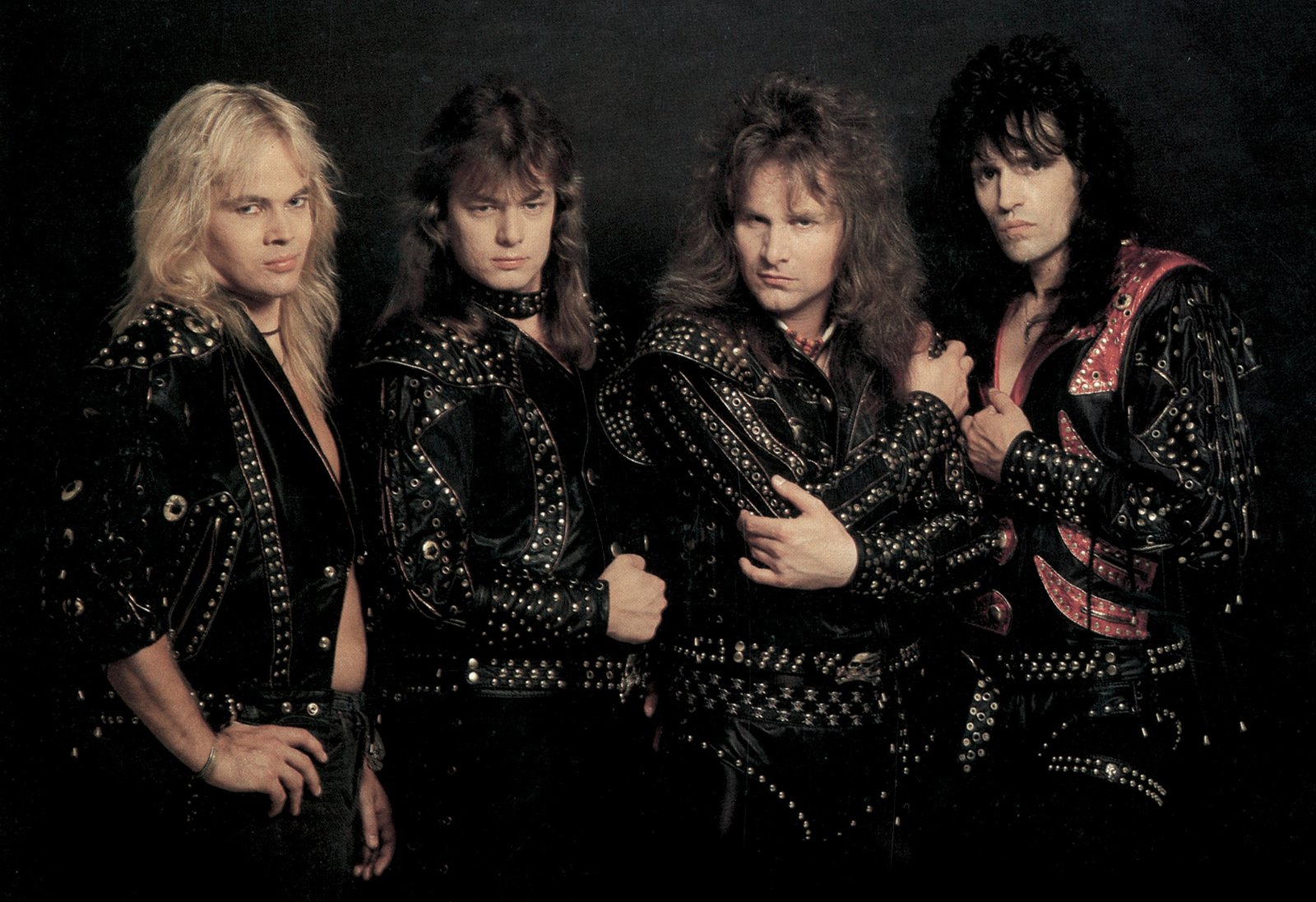
Pressed in Berlin in 1984 by a label that had begun life selling punk records, shared between four unknown bands who could barely afford their amplifiers, and sold under a title promising a genre nobody had yet invented, the compilation that first put Hamburg's new noise on vinyl was Death Metal, and the young quartet from the port that gave it two songs was Helloween.
Nobody bought it for them. That changed quickly.
Within eighteen months the same four players had released an EP and a full album on the same label. On both records the guitarist and singer Kai Hansen and his partner Michael Weikath tore the bullet belts and the pentagrams off the speed metal sleeve, then planed the riff underneath the way a luthier planes a warped fingerboard back to true, until every note sat clean, bright and a hair above the frets, ready to be played faster than anyone in northern Europe had yet dared. That was the first working model of european power metal. It had no name. It had a sound.
The roots reach further back, to the riffing of Accept, the melodic hard rock of Scorpions and the twin leads of Judas Priest and Iron Maiden, and anyone asking what is power metal has to begin with those records. What Hamburg and a handful of towns in the German west added between 1984 and 1990 was an arrangement: a harmony, a drum pattern, a vocal ideal and a way of building a song that the rest of the continent would copy for forty years.
A punk label, a port and a compilation called Death Metal
Founded in Berlin in 1983 by Karl-Ulrich Walterbach, who came to it from the punk label Aggressive Rockproduktionen, and run for years on budgets that would not have paid for one rehearsal of a provincial opera chorus, the small independent that assembled the most improbable roster in German music was Noise Records. Within three years it had Celtic Frost, Kreator and Tankard on the same release schedule as Helloween, Running Wild, Grave Digger and Rage. Thrash and melody grew up under one roof.
Much of that catalogue went through the hands of the engineer Harris Johns at Music Lab in Berlin, and the speed of the work shows on the records. An album was often finished in the time a major label spent choosing a studio. The sound was thin, fast and dry. The ideas were not.
Hamburg supplied more of the early catalogue than any other city. The port had a rock history reaching back to the Reeperbahn clubs where The Beatles served their apprenticeship in the early sixties, and by the late seventies its teenage bands were rehearsing in the same cellars. Hansen had played with the guitarist Piet Sielck in a school band called Gentry from 1978, which became Second Hell and then Iron Fist before merging with Weikath's group Powerfool into Helloween in 1984. Running Wild, led by the guitarist Rolf Kasparek, had been active in the same city under the name Granite Heart since 1976.
The compilation is a photograph taken one second before the roads divide. Helloween sound like a speed metal band on Metal Invaders and Oernst of Life, Running Wild were still dressing their songs in Satanic imagery, and Hellhammer were busy digging toward something far darker. Three roads branch from one sleeve. Only one of them led to choirs and major keys.
European power metal finds its major key
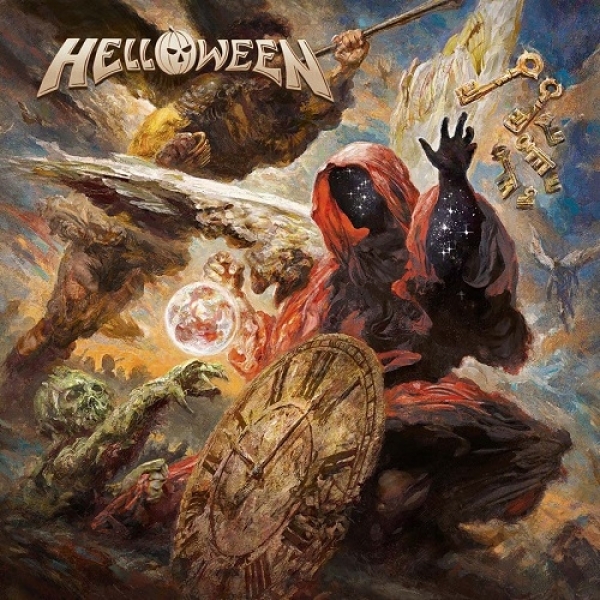
Released on 29 April 1985, the self-titled five-song EP is where the decisive change can be heard. Starlight and Victim of Fate keep the speed of the compilation tracks, but the riffs now resolve upward, the choruses land on major chords instead of circling a minor one, and Ingo Schwichtenberg's double bass drumming runs under everything as a continuous stream rather than a burst saved for the climax. The melody leads. The riff follows.
Harmony is the heart of the matter, and it is where the style made its central decision. Speed metal had taken its harmony from the blues and from the minor scales of Priest and Maiden. Hansen reached instead for the harmony textbook of the conservatory, tore out the chapter on the perfect cadence and nailed it to the front skin of the bass drum, so that every chorus drives through a dominant chord and lands squarely on the tonic, the way a hymn ends or an overture closes. To ears raised on thrash it sounds happy. It is, more exactly, resolved.
Released on 18 November 1985 and opened, after a short instrumental, by Ride the Sky, a Hansen song that gallops for six minutes without once pausing for breath, Walls of Jericho turned the draft into a statement, pairing the speed with lead guitar lines that sing rather than shred. On How Many Tears, seven minutes long and closing the record, the band tried for the first time the long sectional song that would become a fixture of the style. Hansen sang it all. His reedy tenor reached the notes the writing demanded, but only just.
Hansen reached for the harmony textbook of the conservatory, tore out the chapter on the perfect cadence and nailed it to the front skin of the bass drum.
The chroniclers who return to the record tend to agree on both halves of the verdict: the songs are ahead of the playing, and a production built for speed flattens the guitars the writing wanted to lift. Nothing on it is timid. Several things on it are rough, and the most obvious of them had a single cause, which was the microphone.
The Keeper years and a tenor from Hamburg
Hired in 1986 at eighteen, the Hamburg singer who freed Hansen to stand back and play the guitar was Michael Kiske, and with him the band recorded Keeper of the Seven Keys Part I in 1987 and Part II in 1988. The two records fixed the European template so firmly that its parts, the keyboard overture, the fast opener, the singalong single and the long epic near the end, still appear in that order on albums released this decade. Every later exponent of the style learned from them. Most still build a running order the same way.
Behind the tenor, the machinery of the style locked into place in the same years. Built from Ingo Schwichtenberg's two kick drums played as one unbroken roll and from two guitarists harmonising their leads a third apart, the engine room of the Keeper records was copied across the continent, and it ran like the bellows of a church harmonium worked by two feet that never lift, pumped until the leather cracks, holding the air dead level while the melody above it climbs. Nothing else in the band was that steady. The steadiness was the point.
Of all the turns in power metal history, the one between the autumn of 1985 and the summer of 1988 was the sharpest. Promoted in less than three years from a speed metal act with its guitarist at the microphone to a group booked for the Monsters of Rock festival at Castle Donington on 20 August 1988, on a bill under Iron Maiden, the band from the port watched Keeper of the Seven Keys Part II enter the British album chart at number 24. A German label with no money had a band on the biggest heavy stage in Britain. The industry noticed.
A German label with no money had a band on the biggest heavy stage in Britain.
Pirates, gravediggers and a band called Rage
Helloween were not alone, and the rest of the Noise stable shows how wide the European style was in its first years, before the Keeper template narrowed it. Each band took something different from speed metal and kept something different from heavy metal. Several reached the power metal sound by a road of their own.

Led since the seventies by Rolf Kasparek and armed with a clipped, marching downstroke that owed more to Accept than to anyone in its own city, Hamburg's second standard-bearer was Running Wild, and its debut Gates to Purgatory, released on Noise in 1984, was a fast, blunt heavy metal record dressed in the occult imagery everybody wore that year. The change came with Under Jolly Roger in 1987. The pentagrams went overboard, the flag and the cutlass came up, and the capstan rhythm of the sea shanty was prised off the deck and bolted to a snare drum at double time.
That swap opened a whole lyrical territory and gave the German school its darkest, most rhythmic branch. Running Wild's melodies sat lower and marched harder than Helloween's, the guitar tone kept its weight, and for its admirers the band remained the most stubbornly heavy of the lot. It never wanted a tenor. It wanted a crew.
Formed in Gladbeck in 1980 and signed to Noise for Heavy Metal Breakdown in 1984, the Ruhr quintet around the singer Chris Boltendahl was Grave Digger, and on its first albums it sounded like a hacksaw drawn across the lowest string of a double bass, a voice so coarse that it dragged the whole register of the band down beneath the tenor ideal Hamburg was setting. After Witch Hunter in 1985 and War Games in 1986 the group softened, recorded one album as Digger in 1987 and split. Its return belongs to the nineties.

Born in Herne as Avenger, under which name it released Prayers of Steel in 1985, and renamed in time for Reign of Fear on Noise in 1986, the trio fronted by the bassist and singer Peavy Wagner was Rage, and it stayed closer to thrash than any other band in the stable. The records that followed through 1990 kept that edge while the melodies grew. Rage proved the new style could swallow aggression whole and keep its shape.
Around them stood a second rank the period's historians still argue over. Stormwitch made melodic fantasy records in the mid eighties that anticipate much of what followed, and a dozen smaller German groups cut one or two albums on shoestring budgets and vanished. In Sweden, Heavy Load had been playing an epic, melodic heavy metal since the late seventies that pointed the same way from further north. None had Helloween's reach. Several had its ambition.
| Year | Band | Record | Label | Note |
|---|---|---|---|---|
| 1984 | Helloween, Running Wild, Hellhammer, Dark Avenger | Death Metal | Noise | Compilation, Helloween's first appearance on record |
| 1984 | Grave Digger | Heavy Metal Breakdown | Noise | Debut album |
| 1985 | Helloween | Walls of Jericho | Noise | Debut album, Kai Hansen on lead vocals |
| 1986 | Rage | Reign of Fear | Noise | First album under the name Rage |
| 1987 | Helloween | Keeper of the Seven Keys Part I | Noise | Michael Kiske's first album with the band |
| 1987 | Running Wild | Under Jolly Roger | Noise | First album with the pirate theme |
| 1988 | Blind Guardian | Battalions of Fear | No Remorse | Debut album |
| 1988 | Helloween | Keeper of the Seven Keys Part II | Noise | Last studio album with Kai Hansen |
| 1989 | Blind Guardian | Follow the Blind | No Remorse | Kai Hansen guests on Valhalla |
| 1990 | Gamma Ray | Heading for Tomorrow | Noise | Debut album, Ralf Scheepers on vocals |
Krefeld, and the bards in the rehearsal room
Raised on the Lower Rhine near the Dutch border, recording demos in the mid eighties under the name Lucifer's Heritage and renamed in 1987, the last great band of the German eighties was Blind Guardian. The bassist and singer Hansi Kürsch and the guitarist André Olbrich wrote the songs. From the start they wrote them about books.

Released on the small label No Remorse Records on 18 May 1988, the debut Battalions of Fear is a speed metal album first and a power metal album second, fast, thin and crammed with riffs, with Majesty opening it at a length and ambition the rest of the record barely matches. The Tolkien references are already there. So is the habit of treating a chorus as a crowd rather than one singer.
On Follow the Blind in 1989 the song Valhalla carried Kai Hansen as a guest voice and became the band's first real anthem, its chorus built for a hall to take over, which halls have done ever since. By Tales from the Twilight World, released on 3 October 1990, Kürsch had begun stacking his own voice into choirs, part by overdubbed part, until the chorus sounded like a twelve-part madrigal sung by one man who had torn up the other eleven contracts and taken every line himself. The orchestral records of later years grew out of that habit.
Why Europe, and why Germany first
The question of why the style took root on this side of the Atlantic has several answers, and none works alone. By the middle of the decade the American market was split between the glam bands MTV played and the thrash bands that despised them, and a melodic, high-voiced, speed-driven music with fantasy lyrics had room in neither camp. America had its own power metal. It was heavier, darker and descended from a different lineage.
Germany, by contrast, had built the infrastructure for exactly this kind of band. Rock Hard, founded as a fanzine in Dortmund in 1983, and the German edition of Metal Hammer, launched in 1984, gave a serious hearing to records the English-language press often ignored, and the audience in the German-speaking countries had been buying Accept and Scorpions in large numbers for years. The first Wacken Open Air, held on a gravel pit on 24 and 25 August 1990, drew barely 800 people. It grew from the same audience.
The deeper answer lies in the music. The European bands wrote in the harmonic language of the church and the concert hall, major keys and strong cadences and melodies that move by step, a language their listeners had sung in school choirs and heard at Christmas services long before they heard Iron Maiden. Japan heard the same appeal almost immediately, and by the time the band played two nights in Tokyo in November 1987, Helloween's following there had grown fast. English writers had meanwhile started calling the German bands Teutonic, a word first fitted to the drilled riffing of Accept and later stretched over the melodic school as well.
1989 to 1990: a lawsuit, a departure and Gamma Ray
The decade ended with the German school at its commercial peak and its founding band in pieces. Kai Hansen left Helloween on 1 January 1989, exhausted by touring and by a hepatitis B hospitalisation the band had refused to reschedule dates around, and the guitarist Roland Grapow took his place. The band then signed to EMI, and the dispute with Noise that followed held the next album back until 1991. The court case padlocked the lid of the piano for two years. The most important band in european power metal released no new studio music at all in that time.
Its most important composer did not wait. Hansen had walked out of his own opera house with half the score under his arm, and in 1989 he began a new project with the singer Ralf Scheepers of the band Tyran' Pace. The line that ran from Gentry through Iron Fist and Helloween took its next step here, and the new band stayed on Noise.
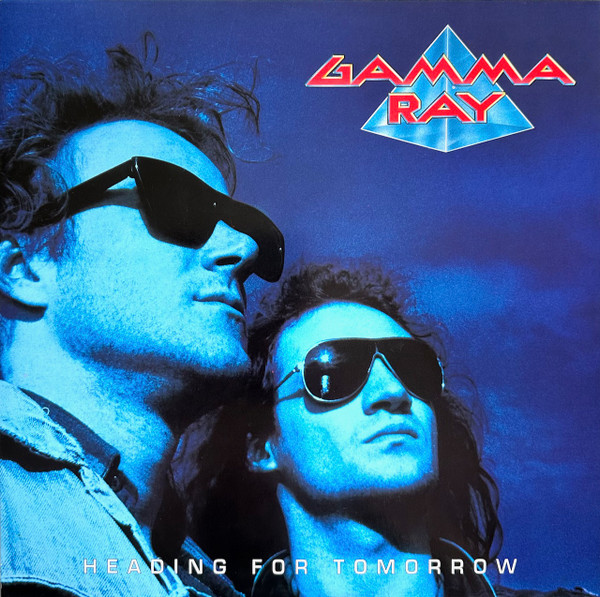
Released on 26 February 1990, with Scheepers pitched as high as Kiske had been and a running order that repeats the fast opener, the singalong numbers and the long title track near the end, the debut that proved how much of the Keeper template had been one songwriter's property was Heading for Tomorrow, and the band that made it was Gamma Ray. It does not surpass Keeper. It does not need to.
Heaven Can Wait was the single and gave its name to an EP later that year, and the live album released as Heading for the East, filmed in Tokyo that November, shows how far the style had travelled in six years. A German band that had not existed two years earlier was playing Japan. The song sounded exactly the way the European school had decided a song should sound, which meant the style had become a method, portable from one band to the next.
By 1990 european power metal had its founding band, its canon, its second generation and a label that had built half of it. Across the Atlantic, meanwhile, a heavier and darker strain had been growing under the same name since the early eighties, and us power metal owed almost nothing to Hamburg. The two schools had grown up apart. The nineties would test both.
