
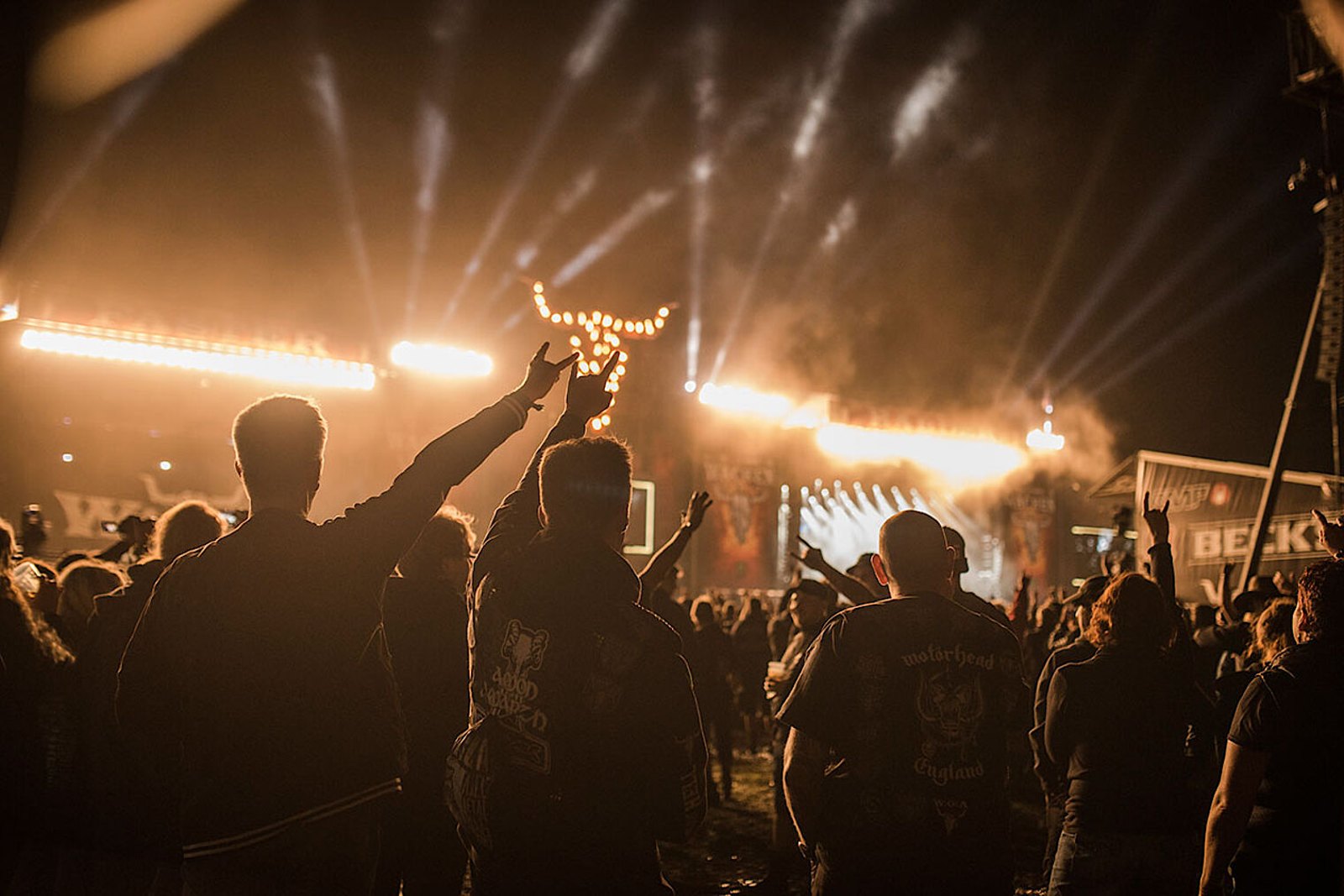
A market town hall in Baden-Württemberg that sells out within days of presale, its bill still incomplete when the last ticket goes, booked since 2003 by a heavy metal singer and a magazine editor who called the whole weekend a festival of fans for fans: the German institution that proved power metal fans would sooner build their own rooms than wait to be let into anyone else's is Keep It True.
No London office signed it off.
Take a music publisher's copper plates, smash them in the press room and withdraw the edition, and then watch the players copy the parts out by hand in their own ink, a second violin posted from one town to a cellist in another, a viola part traced from somebody else's tracing until the stems lean the wrong way, until there are more manuscript copies in circulation than the printer ever ran off. That is what the audience of this genre did for itself between roughly 1984 and the arrival of the modem, and it is why the audience behaves as it still does.
Set beside the power metal overview, where the story runs through studios, labels and records, the story of the listeners runs on postage, photocopier toner and bandwidth. The record shows two parallel histories with almost no overlap in personnel. One of them has famous names in it. The other one kept the genre alive through a decade when the famous names could not get arrested.
What power metal fans built when nobody would build it for them
The word underground usually means a sound too extreme for daylight. Here it means something else. Power metal fans have never been a small audience: the genre fills halls in Germany, Finland, Italy, Spain, Japan and Brazil, and it has done so for thirty years. What it has never had, in the English speaking world, is a press. Through the nineties the British and American monthlies treated the whole European school as an embarrassment to be got past quickly, and the labels with American distribution deals put their money elsewhere. An audience that large with no coverage at all does not disappear. It organises.
So the fans became the infrastructure. They wrote the reviews, ran the mail order, typed the discographies, booked the halls, drove the vans and eventually built the database that every journalist now quotes. Launched in July 2002 by a couple in Montreal writing under the names HellBlazer and Morrigan, the Encyclopaedia Metallum is the clearest monument to the habit: an archive of line-ups, labels and release dates assembled, entry by entry, by people nobody paid.
An audience that large with no coverage at all does not disappear. It organises.
Two arguments grew out of that arrangement and have never stopped running. One is the sneer, the long standing contempt in which parts of the metal press hold the genre, which has its own accounting elsewhere. The other is the answer the audience gives back, which is that the sneer has never once cost the music a ticket sale. Both are worth a hearing on their own. The arrangement itself produced something simpler and harder to argue with: a fandom that does the work instead of waiting for it.
The envelope, the dubbed tape and the photocopier
Before the network was electronic it was postal. A trader kept a typed list of what he held, posted it to the addresses printed in the small ads at the back of the magazines, and dubbed whatever was asked for onto a blank C90, inlay card drawn by hand, sleeve notes copied out in biro. Nothing about the practice was specific to this genre, and thrash metal has the more famous version of the same story. What was specific was the geography. German, Italian and Finnish records reached listeners in Chile, Greece and Japan through those envelopes years before any of them reached a shop.
The photocopier did the rest. A fanzine in 1985 was forty stapled pages of interviews conducted by post, reviews written by a teenager and a cover drawn in marker pen, and some of them grew into the press the genre still reads. Founded in Dortmund in 1983 as exactly such a fanzine, the German title that turned into a newsstand magazine and then into a festival promoter is Rock Hard, and the trajectory is the whole point: the professional apparatus of this music was built out of amateur apparatus, by the same people, without ever passing through a corporation.
Tape trading and the fanzines each have a longer account of their own, and both deserve it. The mechanism is what survived. Every copy in that system was made by hand, at a cost paid by the person making it, for somebody he had never met, and a listener who has paid postage to hear a band does not then treat the band as background music.
Obi strips, bonus tracks and the collector's proof

Japan took this music seriously when almost nowhere else outside Europe did, and Japanese labels licensed European power metal in volume through the late eighties and the nineties, pressing each album with an extra track or two and wrapping the sleeve in a printed paper band. Helloween's Keepers Live is the Japanese title of the same November 1988 tapes Europe got as Live in the U.K. and America got as I Want Out Live. The Japanese and American pressings share one cover and drop the track Rise and Fall that the European edition kept, which is exactly the kind of variant a collector outside Japan spent years and real money tracking down.
The paper band, the obi, does the job that the printed label glued inside a violin does. It carries the maker, the catalogue number and the date, it is the strip a buyer squints at before he believes what he is holding, and like every mark of provenance in the instrument trade it attracts forgery: steam an obi off a common pressing, glue it onto a scarcer one, and the fake has a certificate. Collectors learned to read them the way a dealer reads a scroll and a varnish line.
Bonus tracks turned the practice into something stranger. Victor Entertainment, the Tokyo imprint behind the Japanese pressings of Helloween's Master of the Rings and Stratovarius's Infinite, added a song to each that the European edition never carried: Can't Fight Your Desire on the one, What Can I Say on the other. That meant the complete version of a record was the imported one, at three times the price, and that a European fan who wanted the whole thing had to buy the album twice. What collectors chase, and why the obi strip became a reliquary rather than a wrapper, is a story with its own shelf.
From the newsgroup to the forum
The modem changed the postage bill and nothing else. The lists moved onto the alt.rock-n-roll.metal hierarchy on Usenet in the early nineties, the same people arguing about the same records at greater speed and lower cost. Forum software took over from the newsgroups once it arrived in the early two thousands, carrying the argument onto boards like Ultimate Metal, founded in 2001.
Two habits carried over from the envelope years and are still visible. The first is completism: the audience wants the whole discography, the line-up on every record and the label for each pressing, which is why the fan built databases are better than the labels' own archives. The second is proselytism. A power metal listener who finds a new band does not keep it. He posts it, with the release date, the country and three tracks to start with, exactly as the tape trader once wrote out a list.
Tip a music librarian's card catalogue onto the floor of the reading room and set a machine to deal the cards back out face up, one at a time, to whoever stands still long enough, and you have the mechanism that replaced all of it. Streaming and the recommendation engine now do in eleven seconds what the postal network took eleven days to do, and they do it for an audience that never had to earn anything. Whether that has been good for the genre is a live argument, and it has its own accounting.
The hall that sells out before the bill is announced

Held every spring in the Tauberfrankenhalle at Lauda-Königshofen and run since 2003 by Tarek Maghary, who sings in a German power metal band, and Oliver Weinsheimer of Rock Hard, the German weekend that books what the monthlies will not is Keep It True, and its founders described the thing plainly from the start as a festival of fans for fans. A municipal hall built for brass band prize givings gets its folding chairs stacked against the wall once a year and its parquet gouged by a thousand pairs of boots.
America built the same institution from the same materials. Conceived over dinner among friends after a trip to the Powermad festival in Baltimore, the American weekend that gave the European school a landing site is ProgPower USA, founded by Glenn Harveston and first held on 23 and 24 February 2001 in Lansing, Illinois, before settling into the Center Stage Theater in Atlanta. Bands that had never crossed the Atlantic crossed it for that one bill. Listeners flew in from four continents for a room that holds a fraction of an arena.
| Institution | Started | Where |
|---|---|---|
| Rock Hard, fanzine to magazine to festival | 1983 | Dortmund |
| Wacken Open Air | 1990 | Wacken, Schleswig-Holstein |
| ProgPower USA | 2001 | Lansing, Illinois, then Atlanta |
| Encyclopaedia Metallum | July 2002 | Montreal, online |
| Keep It True | 2003 | Lauda-Königshofen |

The pilgrimage habit went further still. Sabaton have run a festival on their own ground at Falun since 2008, when Rockstad: Falun launched to mark the release of The Art of War; it took the Sabaton Open Air name in 2013. A cruise that sails with the audience aboard followed from December 2010, and the live record cut on the 2014 sailing is the sound of a room where every person present chose to be at sea for four days with the same band. Festivals in this genre have their own long account. The hall is where the music is actually transacted: records are how people find out, and the field is where they join.
Ten thousand throats and no choirmaster
Dismiss a cathedral choir by decree, empty the stalls, burn the surplices in the churchyard, and then listen to the congregation sing the anthem anyway, all the parts, from memory, until the lead in the windows rattles. That is what happens to a power metal chorus the moment a crowd learns it, and the music is built to make it happen. The melodies move mostly by step, the range sits inside an octave for the refrain even when the studio vocal climbs far above it, the harmony resolves onto a major chord the ear can predict, and the refrain comes back often enough to be learned in one hearing.
The proof is a song with no drums in it. The Bard's Song, written by Blind Guardian for acoustic guitars and a tune plain enough for a drinker to hold, long ago stopped belonging to the band that recorded it: at their shows the floor takes the whole thing while the stage stands back, and the band has filmed and released the result more than once because the result is the point.
Singing with open mouths their strong melodious songs.
Walt Whitman, I Hear America Singing
What that does to the balance of power is not small. A genre whose choruses are written to be given away has handed its audience a part in the arrangement, and the audience knows it. The crowd as a second choir is a subject with a long account of its own. It is also the only section of the ensemble that pays for the privilege of turning up.
A genre whose choruses are written to be given away has handed its audience a part in the arrangement.
The joke the audience told first
Every accusation levelled at this music, that it is cheese, that it is Dungeons and Dragons with a distortion pedal, that it is what happens when a tenor reads too much fantasy, arrived in print before the fans were old enough to be embarrassed by it, and the response was to take the words and stamp them on the instrument case. The faithful now use cheese as a compliment, sell it on shirts and put it in the names of their own playlists. A word used as a weapon and then adopted as a badge stops working as a weapon.
From that habit came a whole wing of bands. Formed in Italy in 2003 to make fun of the way the genre carries itself, and signed by Napalm Records in October 2019, the parodists who turned the joke into a career are Nanowar of Steel, whose Norwegian Reggaeton, put out in July 2019, took 800,000 views in five days and 2.8 million in its first month. The joke reached further than most of the records it was mocking.
Music history has seen this before. The comic intermezzo was written to fill the gaps between the acts of a serious opera while the scenery was changed, a small thing with two singers and no pretensions, and by 1733 Pergolesi's La serva padrona had walked off with the audience and left opera seria talking to an empty house. Parody in this genre works the same way: it needs the thing it mocks to be intact, it plays it correctly, and it keeps winning rooms. Gloryhammer made an entire discography out of the trick by never once breaking character.

The best evidence is a rubber duck. Unable to hang a backdrop aboard Full Metal Cruise in 2015, Alestorm projected the only image left on keyboard player Elliot Vernon's laptop, a banana with a duck's face, and the room went up. An actual inflatable duck followed once the band needed something to compete with Sabaton's stage tank, then bigger ones, then a duck that fills the width of the stage and inflates during the changeover while the floor chants at it. Nobody in the band planned a mascot. The audience adopted one and the band was obliged to keep buying it.
Whether the genre is hated, and whether the cheese is the flaw or the feature, are two arguments with their own long entries and their own evidence. On any honest reading both are downstream of this: an audience that gets the joke in first cannot be humiliated by it.
Costume, screens and where the next crowd comes from
Break open the costume store of an opera house, carry the chorus's mail and cloaks out into the street, and hand them to people who have never been paid to sing and who know the chorus part better than the chorus does. That is a power metal festival field on the Saturday afternoon, and it is why the medieval markets, the armourers' stalls and the whole trade in mail shirts sit alongside the merchandise tents at the German festivals rather than in a separate convention. Cosplay in this genre is not a costume contest bolted onto a concert. It is the audience dressing for the world the records describe.
The same overlap runs into animation, and it runs both ways. Japan's own bands, Galneryus foremost among them, have played this style at a very high technical level since the early 2000s, and European bands have gone the other way: Victorius put out Space Ninjas from Hell through Napalm Records on 17 January 2020, a German record built end to end out of anime, and Nippon Knights is its most shameless three minutes. An audience raised on orchestral scores, sung themes, heroic plots and a villain with a name is already an audience for this music, whichever medium delivered it first.
Video games did the rest of the recruiting, and the single largest act of recruitment the genre has ever had came through a plastic guitar controller in 2007. That has its own entry. So does streaming, which took the introduction business away from the tape trader and gave it to an algorithm with no taste and infinite patience. Both brought crowds that the postal network could never have reached, and both brought them without the apprenticeship.
What has not changed is the shape of the bargain. The audience is still expected to know the words, still expected to supply the choir, still expected to argue the discography and dress for the field, and it is attested by every sold out hall that this is a feature rather than a toll. The newcomer's first question is never about tape trading, though. It is about borders, and the oldest of them, power metal vs thrash metal, is where every argument in this music starts.
