
To strive, to seek, to find, and not to yield.Alfred, Lord Tennyson, Ulysses
Having ripped the dole queue, the needle and the tenement stairwell out of the lyric sheet that punk and thrash had written by the middle of the eighties, and restocked it from the fantasy paperback, the history syllabus, the Latin missal and the star atlas, the music that went out from Hamburg across Europe after 1987 was power metal, and power metal fantasy is still the first thing a stranger hears in it.
The dragons arrived first. The battles, the saints and the stars followed within a decade.
The reason is acoustic before it is literary. An organ builder voicing a thirty-two foot pedal pipe cannot hand it a parish notice to read out, because the pipe shakes the dust of centuries off the vaulting and rattles the lead in every window, and it demands a cathedral to fill. A tenor pitched above the guitars, a double kick drum laid under every bar and a major-key chorus built for a festival field are that pipe, and a song about the rent would crack under the weight of them. So the genre went looking for subjects the size of the instrument.
Traced through the roots, the scenes and the branches, the sound of the genre changed a great deal more than its subject matter did. A German record of 1987 and a Swedish one of 2022 run at different tempos, through different studios, for crowds of very different sizes, and they still share a lyric sheet with five great chapters: the invented world, the real battle, the church, the old myth and the sky. A sixth, the tavern, is kept for the encore.
Power metal fantasy and the bookshelf behind it
Printed in paperback through the sixties and seventies and read to pieces by the generation that went on to buy electric guitars, the bookshelf behind power metal fantasy holds Tolkien at the top, then Michael Moorcock's Eternal Champion, Robert E. Howard's Conan and, a shelf lower, Stephen King's Dark Tower. By common consent, the Krefeld quartet that pulled more of that shelf into song than anyone else in the genre is Blind Guardian.
Somewhere Far Beyond, released by Virgin Records on 29 June 1992, is the whole bookshelf in one sitting. The Quest for Tanelorn travels to Moorcock's city at the edge of the multiverse, the title song takes its road from King's Gunslinger books, and the two halves of The Bard's Song end in the Shire with The Hobbit. The Tolkien habit was already old in that band by then. It would only deepen.
Six years later Nightfall in Middle-Earth turned the wars of The Silmarillion into a single concept record, stitching spoken interludes between the songs the way an oratorio stitches recitative between its arias, and the habit had long since spread beyond one band. The Italians of Rhapsody of Fire borrowed Tolkien's maps and elves for an invented kingdom of their own, and Wind Rose writes whole records from inside a dwarven hall. Nobody in Middle-earth pays rent.
What the fantasy gives the music is not decoration. It gives it stakes that are total and a moral map that is legible at two hundred beats a minute: a dark lord, a fellowship, a road and a return. Irony cannot survive that tempo, and power metal has never tried to make it.
Dragons, swords and the saga told in instalments
Spread across five albums between Legendary Tales in 1997 and Power of the Dragonflame in 2002, scored for choir, harpsichord and guitars played at conservatory speed, the story that the Trieste duo of Luca Turilli and Alex Staropoli called the Emerald Sword Saga turned the concept album into a serial, one quest delivered in instalments, and its title weapon gave the band the song everyone still knows them by. Other bands had told one story across a record. These two told one across five.
Why the dragon, then? Because it is the one enemy in European legend large enough to justify the final chorus. A tax collector cannot carry a key change, and a dragon can carry three. DragonForce took the beast into its name, Twilight Force keeps a whole sky of them, and Rhapsody named the record that closed its saga after dragonflame. The obstacle is sized to the chorus, exactly as the subject is sized to the pipe.
A tax collector cannot carry a key change, and a dragon can carry three.
Under all of it lies the oldest plot there is. Joseph Campbell laid out the hero's departure, ordeal and return in The Hero with a Thousand Faces in 1949, and nearly every power metal saga since has marched to that skeleton, because a concept record running past an hour needs a road for its hero to walk and a door at the end for him to come home through.
| Chapter | Record | Year |
|---|---|---|
| Tolkien and high fantasy | Blind Guardian, Nightfall in Middle-Earth | 1998 |
| The serial saga | Rhapsody, Legendary Tales | 1997 |
| Military history | Sabaton, The Art of War | 2008 |
| Arthurian myth | Grave Digger, Excalibur | 1999 |
| Liturgy and the werewolf | Powerwolf, Bible of the Beast | 2009 |
| Goethe's Faust | Kamelot, Epica | 2003 |
| Space | Gamma Ray, Somewhere Out in Space | 1997 |
| The tavern | Wind Rose, Wintersaga | 2019 |
History at full tempo, and the undertow beneath the battle
Borrowed from the history classroom, not the paperback rack, and argued out with dates and the names of regiments, the second great chapter of the lyric sheet belongs to Grave Digger, whose run from Tunes of War in 1996 to Knights of the Cross in 1998 gave the German school its Scottish wars and its crusades, and above all to the Falun band that built a career out of the archive, Sabaton.
History did for the second generation what Tolkien had done for the first. From Primo Victoria in 2005, whose title song lands on the Normandy beaches of 6 June 1944, the Swedes proved that a real battle could fill the thirty-two foot pipe as well as any invented one, and with a bonus no dragon offers: the listener can look it up afterwards. The band made sure of it, opening its own Sabaton History channel on YouTube on 7 February 2019, narrated by the historian Indy Neidell, to explain the battles behind the songs.
The Americans went just as deep into the textbook. Iced Earth gave the Civil War more than half an hour on The Glorious Burden in 2004, a three-part Gettysburg (1863) that runs to about thirty two minutes and follows the three days of July in order. Whether this is history teaching or history in costume is an old quarrel among the chroniclers of the genre. The music settles it: the dates are real, and so is the weight.

The Art of War, released on 30 May 2008, hung its songs on Sun Tzu's treatise, with readings from the text set between the tracks, and on it the Swedes argued a whole album as strategy rather than singing it as adventure. It is also the record where the undertow shows most plainly.
The Price of a Mile, on the same record, goes down into the mud of Passchendaele, the Third Battle of Ypres in the autumn of 1917, and asks what the ground cost, which is never the question a recruiting song asks. Listen to how the genre's war songs are built at their best and the argument becomes audible: it is as if the second bassoon in a pit orchestra had been told to play the Dies irae two bars behind the victory march and to keep sawing at it until the triumph above splits down the middle.
Power metal war songs rarely preach. They count the dead in the verse and leave the chorus to decide whether it is a celebration or a funeral, and the better the song, the less certain the answer becomes.
Arthur, Odin and Väinämöinen: the old myths on the lyric sheet
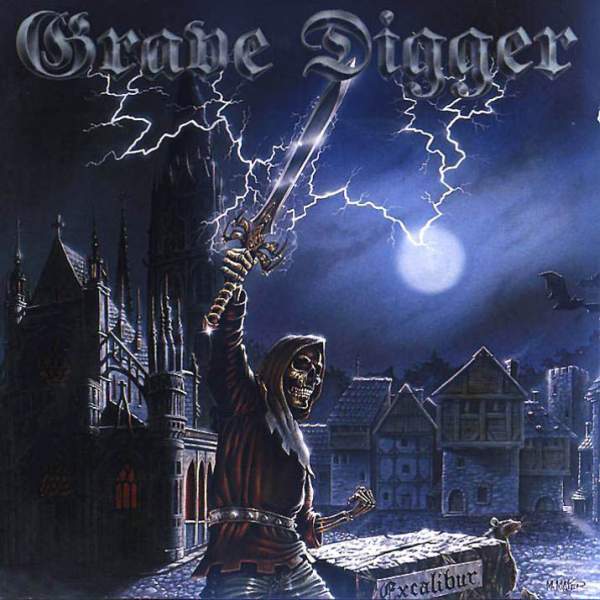
Older than the history book and older still than the paperback, the myths of Europe entered power metal through the opera house as often as through the saga, and the German veterans who proved it were Grave Digger again, whose Excalibur, released on GUN Records in 1999, closed their medieval trilogy with the Round Table. Their Rheingold of 2003 went to Wagner's Ring for its gods, its cursed gold and its pantheon of doomed schemers.
That record is the method in miniature. Take the full score of the Ring, fifteen hours of it, bring a butcher's cleaver down across the pages until only the leitmotifs survive, throw the recitative on the floor, and what remains is a set of choruses with a god inside each one. Kamelot took Camelot for its very name and named Siège Perilous in 1998 after the forbidden seat at the Round Table.
The North came in through Valhalla, which Blind Guardian recorded for Follow the Blind in 1989, though the longships themselves sailed off soon enough to folk metal and viking metal, where they belong. Finland's national epic travelled a stranger road. The Kalevala, with its singer-sage Väinämöinen, was sung mostly by Finland's heavier bands, Amorphis above all on Tales from the Thousand Lakes in 1994, while Finland's power metal bands, Stratovarius and Sonata Arctica among them, built their lyric sheets from space travel and invented kingdoms rather than the national epic.
The organ, the Mass and the werewolf
Faith came in through the organ loft, and it came as sound before it came as doctrine. Dressed in cassocks and face paint, singing Latin over an organ mixed as loud as the guitars, the Saarland pack that turned the Mass into a stage show is Powerwolf, and it plays the liturgy as theatre, not as creed. Sabaton fills its songs with abbeys and chapels and uses them as settings for history. The openly Christian bands, Narnia among them, sound no different from their neighbours, and Tobias Sammet's Avantasia opened The Metal Opera in 2001 with Gabriel Laymann, a Dominican novice in Mainz in 1602, reading the book his order had forbidden him. The choir came first. Belief, where it came at all, came later.

Where the church stands, the crypt is never far. Powerwolf's werewolves and vampires, Kamelot's reading of Goethe's Faust across Epica in 2003 and the record that followed it, and Iced Earth's Horror Show of 2001, a gallery of Dracula, the Wolf Man and the Phantom of the Opera, give the genre its gothic side, and with it the minor keys it otherwise saves for the ballads.
The organ does the work the words only claim. Pull the vox humana, the rank built to imitate a singer, set the tremulant shuddering until the stop moans like something scratching at the church door under a full moon, and the werewolf is inside the building before a single word about him has been sung.
Out past the atmosphere
Long before space became a joke about keyboards and spandex, it was a Hamburg obsession, and the guitarist who kept flying there was Kai Hansen, who had already written the future into Helloween's songs before he left the band at the end of the eighties and who, with Gamma Ray, turned the whole sky into a lyric sheet.
Somewhere Out in Space, released by Noise Records on 25 August 1997, filled a record with aliens, dying planets and machines, from Men, Martians and Machines to the title song, and nothing about its sound is cosmic in the synthesizer sense. The guitars are the same guitars. The drums are the same drums.
Beyond the Black Hole opens that record at full speed and makes the point plainly. Space in power metal is not a sound. It is a direction. And it is older than rock by three and a half centuries: Johannes Kepler wrote the planets out as melodies in Harmonices Mundi in 1619, each orbit a phrase rising and falling with its speed, and power metal tore those phrases out of the treatise, handed them to a double kick drum and sent a tenor up after them.
The modern version wears its tongue in its cheek and plays with a straight face. Built by Christopher Bowes of Alestorm as a fantasy parody performed with complete seriousness, the band that moved its hero Angus McFife from medieval Fife to the year 1992 is Gloryhammer, whose Space 1992: Rise of the Chaos Wizards of 2015 puts wizards, unicorns and space marines into one plot and dares the listener to laugh first. Its title song plays the whole absurd premise at full tilt, choirs and all.
What power metal lyrics are for: hope, escape and allegory
Black metal wants the church burning, doom wants the coffin lowered, and thrash wants the government in the dock. Power metal, alone among the heavy families, writes toward the victory, and nihilism is the one subject that remains anathema to it. Its founding records said so outright: Future World on the first Keeper in 1987 promised a better one, and I Want Out on the second in 1988 refused to be told what to be.
Written in the minor mode far more often than its reputation admits and resolved upward almost every time, that optimism works like the Picardy third, the major chord baroque composers rammed onto the last bar of a piece in the minor. Power metal rams it onto the end of history itself. The war is lost in the verse and won in the chorus. The dragon burns the village, and then the dragon dies. That is the covenant with the listener, and Freedom Call went as far as calling its own music happy metal.
The war is lost in the verse and won in the chorus. The dragon burns the village, and then the dragon dies.
Look at the pronouns. Thrash points at them, the men in power; black metal sings from a single voice alone in the forest; the power metal chorus is sung in the plural, a fellowship, a company of the free, a crowd addressed as if it were one body. The words are written to be sung back from the floor, and a chorus that a whole festival field is shouting at once cannot stay about despair for very long. The optimism is built into the arithmetic of the room.
The charge that all of it is escapism has an answer, and Tolkien supplied it himself. In the lecture On Fairy-Stories, given at St Andrews in 1939 and printed in 1947, he separated the flight of a deserter from the escape of a prisoner and refused to call the second one cowardice. In the foreword to the second edition of The Lord of the Rings in 1965 he added that he disliked allegory and preferred history, true or feigned, which readers could apply to their own lives as they chose.
The genre lives exactly there. A dark lord is not a named politician, and so he fits every tyrant a listener has ever had to endure, from a headmaster to a government. The songs do not smuggle in a message. They leave the application open, and forty years of crowds have filled it in.
The tavern song and the last round
Every quest ends at a table. Written by Blind Guardian for acoustic guitars and a melody plain enough to be learned in one hearing, The Bard's Song left the record long ago and became the property of the room, and at the band's own shows the crowd has carried it for years with little help from the stage.
The song is a lute with a tankard-cracked belly, passed hand to hand along a tavern bench, four chords any drinker can finger and a tune pitched low enough for voices wrecked by the second hour. The Bard's Song needs no drummer and no tenor at the top of his range. It needs a room that knows the words, and it has one wherever it is played.
The drinking song proper came later and louder. Alestorm's pirates raised the tankard highest, and Wind Rose took a cover of Diggy Diggy Hole, a song first written for the Yogscast channel, down a dwarven mine on Wintersaga in 2019 and brought an audience far beyond metal down the shaft with it. The tavern is where the genre admits it is having fun. It is also where the choruses are tested hardest, by people with no reason to be kind.
The sleeves had to keep up with all of it. Whatever the lyric sheet promised, a dragon over a burning keep, a battlefield at dawn, a cathedral at midnight or a planet on the rim of the galaxy, the painters of power metal album covers were left to show it, one oil painting at a time. The words came first. The pictures had to catch up.
