
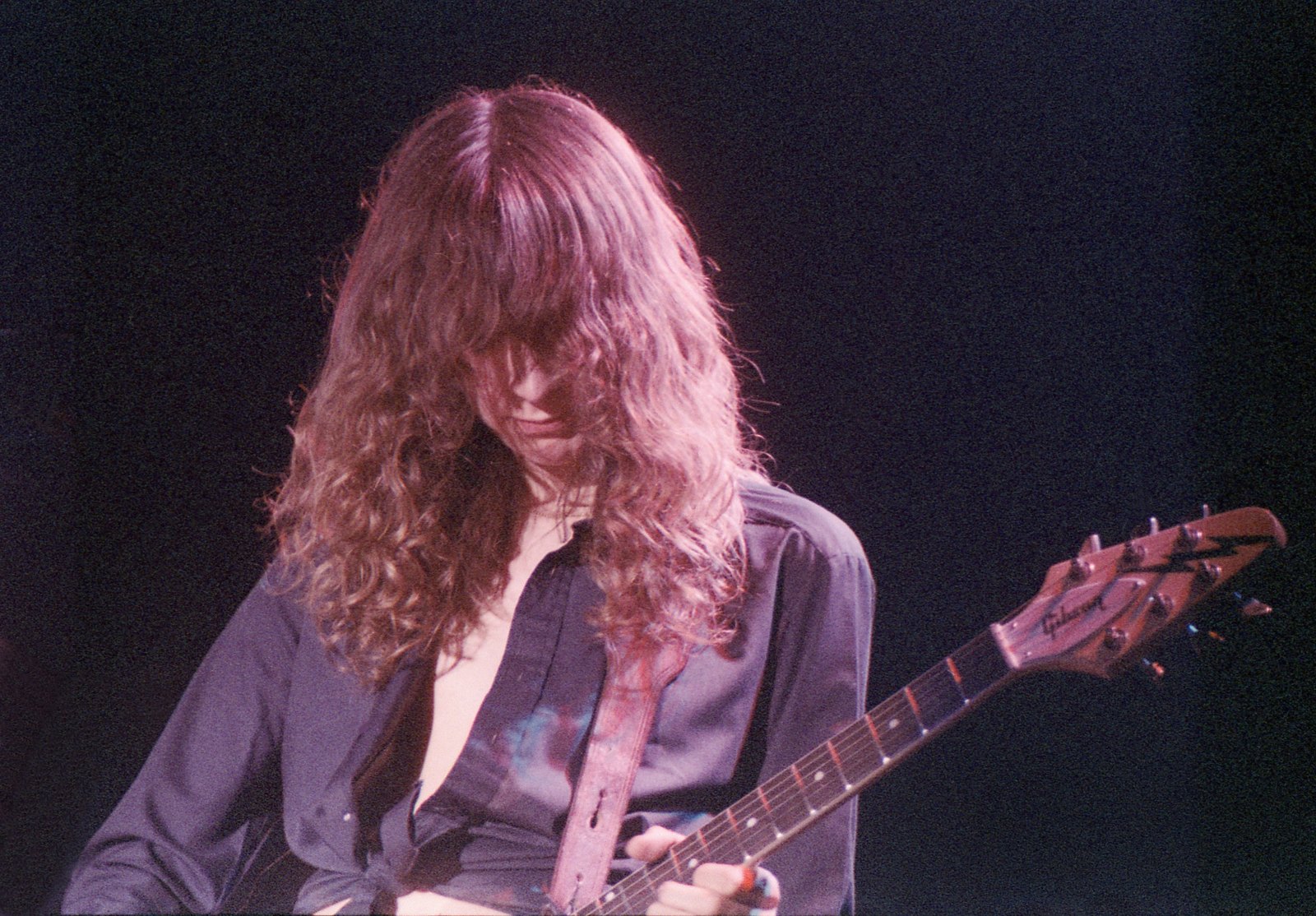
Seven songs, four bands, one Californian quartet and fourteen years. Between the B-side of a single in 1984 and a covers album in 1998, Metallica recorded and released seven songs written by the young bands of the new wave of British heavy metal between 1979 and 1981, four of them by Diamond Head and one apiece by Holocaust, Blitzkrieg and Sweet Savage, every one of them played faster and heavier than the band that wrote it.
The Stourbridge guitarist who co-wrote four of the seven, in a band that could not find a label and pressed its first album through a tiny independent, a thousand copies in a plain white sleeve, was Brian Tatler. His riffs had a longer career than most of the bands that sold.
Cadmus, in the Greek story, killed a dragon, pulled its teeth and scattered them on the ground, and out of every tooth a man in full armour rose with a spear already in his fist, and the new-born army turned on itself and hacked itself down until five were left standing. The nwobhm riffs were scattered the same way, a few hundred teeth strewn across seven-inch singles and dubbed cassettes at the turn of the decade. What came up out of the ground in 1983 was armed.
What the nwobhm riffs took from punk
The raw material was not new. A power chord, a pedal on the open low string and a figure cut into four bars came straight down the motorway from Birmingham, and what the young bands added was tempo and a refusal to rest. They had spent two years hearing punk singles played at the same volume as Judas Priest records, and they took the Sabbath cell, doubled its speed and stopped leaving the gaps the seventies had left for a singer to breathe in.
The riff that opens Saxon's Wheels of Steel, released by Carrere on 3 April 1980, belongs to "Motorcycle Man", and it does nothing but go. Paul Quinn wrote the driving riff, punk and Motörhead are all over its speed, and Biff Byford has said the song is all attitude, aggression and speed, with hardly any words on it. No pause for breath.
The open string mattered more than it looks. A pedal on the low E or A keeps ringing between the fretted notes, so a guitarist on a cheap amplifier at full volume can sound like two players, the drone holding the floor while the fretting hand moves on top. It was cheap, and it was loud.
The London band that opened its December 1980 debut on Bronze with a song carrying its own name was Angel Witch. On that title song Kevin Heybourne welded a killer riff to a sing-along chorus, and the scene had its anthem.
It was cheap, and it was loud.
Riffs that come in chains
The second thing the young bands did was pack more riffs into a song than anyone needed. A seventies heavy song mostly ran one riff for the verse and one for the chorus. A song by the new bands could run five or six, each played for eight bars and then kicked aside, with the arrangement lurching from one to the next and never looking back.
"The Prince", from Lightning to the Nations, released on 3 October 1980, is the model. It charges from the first second with Tatler soloing over the intro riff, then lurches through changes of tempo and section for some six minutes, and its best riff only arrives past the three minute mark. Metallica recorded it for the B-side of "Harvester of Sorrow" in 1988. The Bay Area had been listening.
A gaucho's bolas, three stones sewn into hide pouches on braided cords, is whirled round the head and let go, and it flies spinning across the pampas until the cords meet the legs of a running rhea, wrap tight and slam the bird into the dust. The single-note runs that tie those riffs together are thrown the same way, flung from the wrist, spinning through the bar and wrapping round the next riff until the song falls into it.
The East London band that threw those runs through a seven minute song on its debut, released on 11 April 1980, was Iron Maiden, and the song is "Phantom of the Opera". Steve Harris wrote it in sections, by his own account, threading winding guitar lines through fast heavy parts and a slow middle, and every change in it comes down like a stone on a cord.
The slow branch
Not every riff was fast. A smaller set of bands kept the Birmingham tempo exactly where Black Sabbath had left it and wrote riffs that circle and drag, and those riffs matter out of all proportion to the records they sold, because they are where a later genre went looking for its ancestors.
"The Small Hours" first reached vinyl on Holocaust's Live (Hot Curry & Wine) in 1983, taped at a hometown show in Edinburgh in September 1981, more than six minutes of it. Metallica dragged it onto the EP of covers it released in 1987, and the chugging main riff sits in doom and sludge until a thrash break tears through the middle.
Out of Stourbridge, the same town that sent Diamond Head, came the other slow branch. The band that took early Black Sabbath's gloom whole and set it down unhurried on "Burning a Sinner", its first single, on Heavy Metal Records in 1981, was Witchfinder General, and doom metal has claimed the band as a founding influence ever since.
| Song | Band | Year | First released on |
|---|---|---|---|
| Motorcycle Man | Saxon | 1980 | Wheels of Steel, Carrere LP |
| The Prince | Diamond Head | 1980 | Lightning to the Nations, Happy Face LP |
| Phantom of the Opera | Iron Maiden | 1980 | Iron Maiden, EMI LP |
| Blitzkrieg | Blitzkrieg | 1981 | B-side of "Buried Alive", Neat single |
| Killing Time | Sweet Savage | 1981 | "Take No Prisoners" single, Park Records |
| The Small Hours | Holocaust | 1983 | Live (Hot Curry & Wine), taped in 1981 |
| Burning a Sinner | Witchfinder General | 1981 | A-side of the first single, Heavy Metal Records |
The debt paid in public

Released by Elektra on 24 November 1998, Garage Inc. gathered the Metallica covers of the previous fourteen years onto one disc and added a new batch on the other, "It's Electric" among them, so that anyone who had missed the singles could hear the British riffs in a single sitting. The debt was paid in public, on a record that sold in the millions to listeners who had never heard of Stourbridge. The royalties became, by Tatler's own account, his biggest source of income.
The Northern Irish guitarist who co-wrote "Killing Time", carried on Sweet Savage's first single, "Take No Prisoners", in 1981, and who left early in 1983 for Dio and joined Def Leppard in 1992, was Vivian Campbell, long gone by the time the riff he had helped build came back across the Atlantic at twice the weight. Metallica put the song on the B-side of "The Unforgiven" in 1991, the last of the seven to reach a record before the covers album gathered them up.
What the American bands took was not a sound. The production on most of those singles was thin and the budgets were smaller still. They took a method: speed borrowed from punk and never apologised for, the open string ringing under the fretting hand, and a song built as a chain of riffs rather than a verse and a chorus with a riff attached, which is the whole lineage of thrash compressed into three habits. How the bands behind those riffs fared on the charts and in the clubs belongs to the section that covers it.
The names, from the three that went round the world to the hundreds that went back to work on Monday, are gathered in the new wave of British heavy metal bands. Most of them are remembered for a single, and the single is remembered for its riff.
The raw parts every one of those riffs was made from, the bare fifth, the flattened interval and the slackened string, are older than any band in 1980, and they are laid out in the riff, the tritone and the tuning. The young British bands added no new note to them. They only played them faster, and in longer chains, than anyone had dared.
