
Two players sat at the keyboards of a machine that weighed almost two hundred tons, sixty feet of geared alternators in a hall on Broadway turned by a motor of one hundred and eighty five horsepower so that flute, clarinet, bassoon and cello could be cut out of current alone and pushed down telephone wire into hotel dining rooms. It never sounded like a flute. Strangers who lifted a receiver to place a call got the music whether they wanted it or not; Bell's engineers would sooner refuse to extend the wire than let that signal near their long distance circuits, and the last of Thaddeus Cahill's three Telharmoniums went under the breaker's hammer most likely around 1958, a machine built to be every instrument in the orchestra and recognised inside one bar as none of them.
The electronic synths power metal uses are the same bargain at domestic scale, an instrument that will be anything at all and gets identified by the decade whose setting it is wearing. The band whose guitarist writes its keyboard parts out of Italo disco records and Sega soundtracks is Beast in Black, and the kick drum on every beat under its choruses is not a prank played on the genre but its oldest keyboard habit, borrowing another sound's identity, committed in daylight. Every patch is a decision about what a chorus is supposed to feel like. The guitars only decide how hard it hits.
What the keyboard plays when it is not doubling the guitar
The unison run, keyboard and lead guitar locked to one line at one speed, is the part an audience remembers, and Stratovarius made it the signature of the Nordic school. It is also the smallest part of the job, and the oldest story about repetition says why. The nymph left holding the ends of other people's sentences and nothing else of her own was Echo, who wasted down to a voice over a heap of stone, and a keyboard doubling a guitar note for note has about that much to add. Most of the time the instrument holds a chord under two palm muted guitars and fills the holes the mutes chop into the bar, so that a chorus lands on a surface rather than in gaps. Mute the keys on a European power metal record and a demo is left behind; mute them on an American one, where the lineage gave that ground to a second rhythm guitar, and a record is left behind.
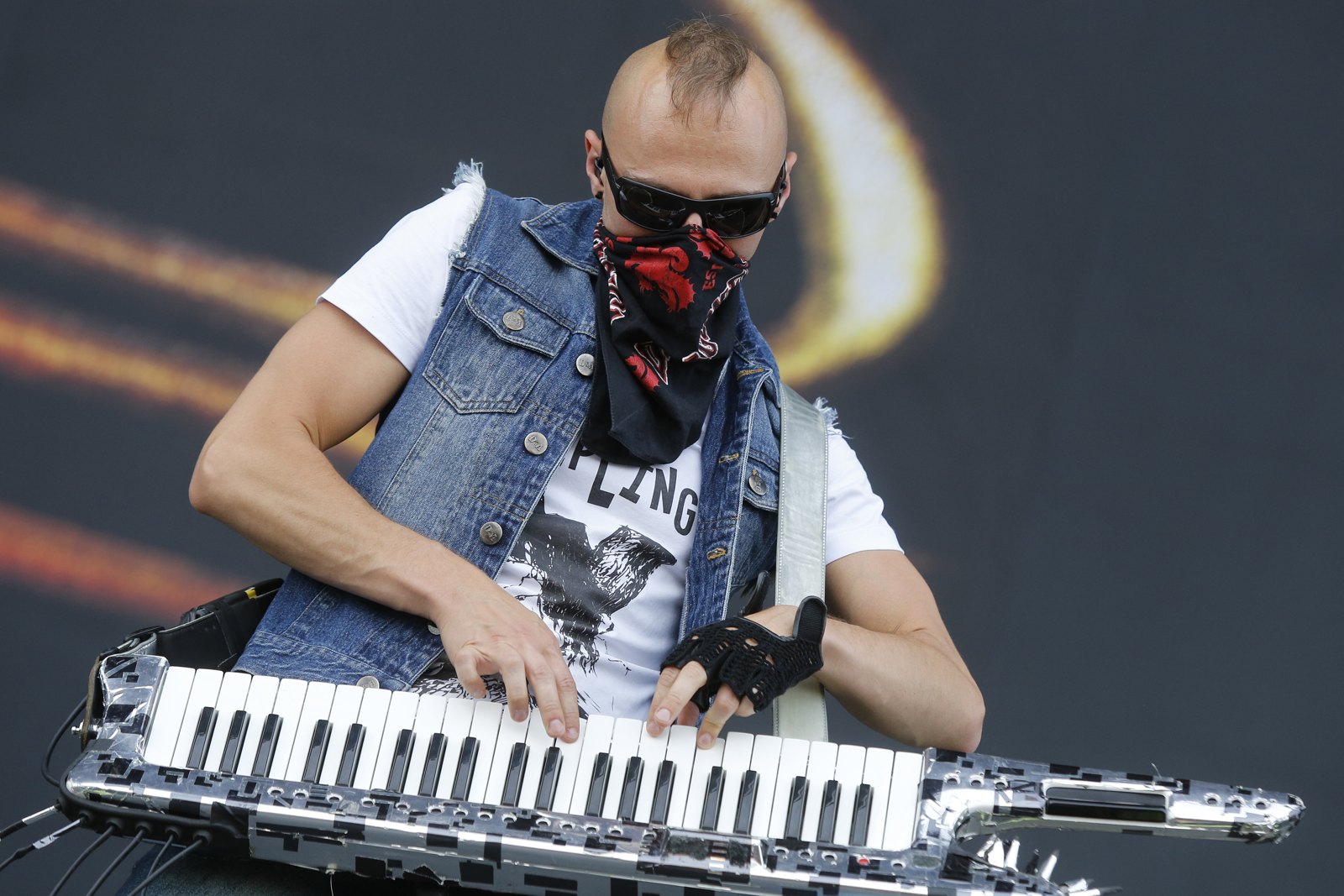
Two smaller jobs come with it. The keyboard answers at the end of a vocal phrase, four notes into the hole the singer leaves, and it carries the subdivision in sixteenths when the double kick is not. Strapped into a keytar on stage since early 2003, the player who rebuilds with one hand in front of a crowd what he cut with two hands in a studio is Henrik Klingenberg of Sonata Arctica, and the arithmetic in that is plain enough: a finished power metal record carries more keyboard layers than any stage has hands for.
The guitars decide how hard a power metal chorus hits. The keyboard decides what year it comes from.
The electronic synths power metal actually uses
The imitation patches came first, and what they imitated was old instruments. A harpsichord and a counterfeit church organ carried the Italian school from the start. The band that put both of them under a guitar at Gate Studio in Wolfsburg in the spring of 1997, with Sascha Paeth and Miro producing for Limb Music, was Rhapsody of Fire. On Legendary Tales the keyboards of Alex Staropoli sit beside a baroque recorder played by his brother, so the forgery and the real article sound on one record with the forgery holding the song up.
DragonForce put the same instrument to the opposite use. The keyboard player who spent his nights picking out weird atmospheric sounds and computer game noises, one at a time, before carrying them into the studio, is Vadim Pruzhanov, and a keyboard loaded that way has been handed the furniture and the sound effects while the guitars keep every tune on the record. A video game noise in the middle of a guitar solo is a patch choice and not a gag.
The other family of sounds has no acoustic ancestor to answer to. A stack of sawtooth waves sounds wide and bright because the waves inside it are deliberately out of tune with one another, and Roland's JP-8000 put seven of them in a single oscillator in 1997, when getting that sound had previously meant three or four oscillators detuned by hand and shoved through a chorus pedal. On any honest reading that patch, rather than the double kick, is what makes a 2017 power metal chorus sound like 2017.
The counterfeiting job disappeared the moment a band could afford the real article. The Finnish band that spent its new money on a full London orchestra was Nightwish, and with real players on the tape there was nothing left for the keyboard to fake, so it took the drums and programmed a beat.
A kick drum on every beat, and what it displaced
Eurodance is a kit of about six parts, and every one of them does something specific to a chorus. A bass drum on all four beats at anything from 120 to 150, with the snare dropped to a whisper on two and four, strips the clock off the double kick and bolts it to the lowest and dullest voice in the mix, which is why a chorus built this way needs no drum fill to lift it. A kick on every beat was anathema in a scene raised on the double kick, and it does the double kick's old job with a quarter of the notes.
An open hi-hat on the offbeats adds four hits to the four kicks of a bar, eight events where a cymbal used to mark two. A sixteenth note arpeggio under the voice carries the subdivision, which lets a drummer thin out and still sound fast. A resonant filter opened across eight bars does the lifting a fill once did, and it can be opened further on the last chorus without touching the semitone lift the genre saves for that spot. The hook is sung rather than played, so the riff drops to a muted stab on the offbeat and the record sounds as though the guitars have been moved in behind the keyboards. A chorus engineered that precisely gets accused of cheating by the faithful every time.
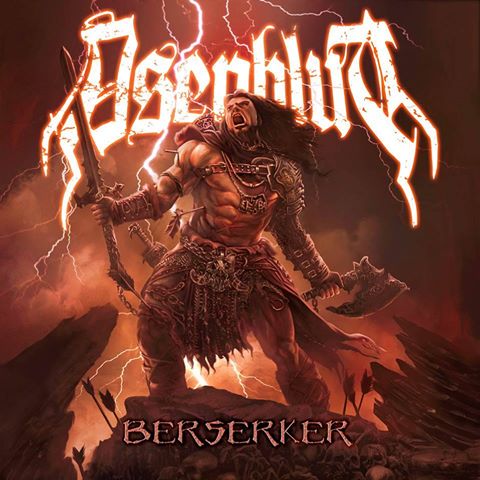
Nothing on Berserker, released by Nuclear Blast on 3 November 2017 and recorded at Sound Quest Studio with Anton Kabanen producing it and playing both the guitars and the keyboards, hides that arithmetic. Crazy, Mad, Insane sits at track seven, three and a half minutes of dance club synthesizers and a processed voice over a beat lifted whole out of Italo disco and screwed down under a chorus that survives the transplant without losing a hair, and the album went to seven in Finland.
Nowadays I don't listen to Metal, I listen to Synth-Pop, game soundtracks from Nintendo, Sega and PC games from early and middle 90's and some obscure stuff that many have not even heard of.
Anton Kabanen, Antichrist Magazine, 16 February 2019

The band that put its own keyboard player behind the desk instead of hiring a producer is Battle Beast, whose No More Hollywood Endings was cut at JKB Studios and released on 22 March 2019 with Janne Björkroth playing the keyboards and producing and mixing the record, and the complaint that came back writes itself: all too often on that album the guitars stand behind club beats and orchestral swells. Eden is the exhibit either way. A hard driving beat underneath, floaty strains on top.
None of it arrived unannounced. The keyboards on Reckoning Night in 2004 took more room than on anything Sonata Arctica had cut since its debut, and Don't Say a Word, the single off it, is built on the guitar and keyboard interplay the Finnish school had been sharpening since 1999, which is the same instrument doing the same job one fashion earlier. The change of taste is what this part of the history records; the change of job is what the instrument records.
Where the keyboard has no chair
Count the people on a Brothers of Metal sleeve from 2020: eight, three of them singers, three of them guitar players, and no keyboard player among them, one guest on keyharp for the 2024 record aside. The Swedish band that was an eight piece until 2023 is the test case for what the instrument has become, because the melodic jobs a Finnish keyboard would take were shared out among three throats instead, and the electronic synths power metal depends on were left sitting on the record as a production layer with no chair in the line-up.
A keyboard is the cheapest part of a power metal band to swap and the hardest layer to lift back out of a finished mix, which is why it carries more of an arrangement than anybody gives it credit for, and the exponents of that are easy enough to follow among the new power metal bands, where a dance beat under a chorus is nothing anybody apologises for. The guitars are still in the room. They are no longer the ones setting the terms.
