

Rob Halford's vocal range is the least useful number ever printed about him. The four octaves the magazines repeat are an estimate assembled from a handful of screams, and a range records nothing but the two furthest notes a throat has ever reached. The work happens between them.
Handed the Judas Priest microphone in 1973, gone from 1992 to 2003 with Fight and then Halford, and still cutting studio vocals at seventy two, the singer the whole lineage of metal tenors measures itself against is Rob Halford. The case for him rests on a few recorded takes in which he drives the voice clean through two guitars and a drum kit, from the lowest verse to the last shriek, without once letting the join between registers show.
The conservatory has a better word than range. Tessitura is where a part lives, the band of notes a singer holds for most of a song, and Halford's is the real scandal: on his best records it sits where most tenors would only dare to visit, and he keeps it there for four minutes at a time. A range is a boundary. A tessitura is an address.
The difference matters. A note at the very top of a range can be forced out once, on a good night, by a throat that could never sit there for a verse, and a chart built from such notes flatters everybody. Halford's lowest and highest recorded notes are the edges of the map. The records show where he actually lived.
Rob Halford's vocal range, heard take by take
Start soft, because he did. The closing song of the first side of Sad Wings of Destiny, released in March 1976, is "Dreamer Deceiver", and for most of its length Halford sings above the acoustic guitars in a light head voice, close to falsetto, quiet and unhurried, before the song hands him a long wordless line that climbs past anything a hard rock singer of 1976 was attempting.
That high, thin line behaves like lake ice on a night of hard frost, a sheet a foot thick contracting in the cold and cracking across from shore to shore with a long, whooping, almost electronic note that carries for a mile over the snow, a sound made of pure tension with nothing behind it but more ice. It frightens because nothing is pushing it. The chest voice has not yet entered the room.
Two years on he went to the other end. The ballad at the heart of Stained Class, released on 10 February 1978 and written by Halford with the drummer Les Binks, is "Beyond the Realms of Death", and its verses lie low, almost spoken, in a dark and narrow chest voice, before each chorus throws the voice open and the closing section tears it loose altogether. The low floor and the high ceiling sit in one song. That is the range, attested on a single side of vinyl.
A range is a boundary. A tessitura is an address.
Screaming for Vengeance, and the tessitura that never comes down
The title track of the 1982 album that reached number 17 on the Billboard 200 and went platinum inside a year, taking Judas Priest into American arenas, is "Screaming for Vengeance", and it is the purest proof of the argument. Released in July 1982, it is sung almost from end to end in the territory other singers keep for the climax, verse and chorus alike pitched high and delivered hard, with no low stretch in which the voice gets its breath back.
Take after take on that song breaks off the top of the band the way a tidewater glacier calves in summer, a slab of blue ice the height of a tower block tearing away from the face with a crack like artillery, dropping into the fjord, throwing up a wave that swamps the shoreline, and then the next slab already leaning out behind it. Nothing in the song lets the pressure off. Every chorus is another block coming down.
The seed was already on Stained Class, where "Exciter" had set the voice screaming over double kick drums in 1978, but that song still came down to earth between its climaxes. By 1982 he had stopped coming down.
The difference from the Painkiller scream matters too. That one is a peak. This is a plateau, and a plateau is harder to live on than a peak is to reach.
The narrative epic of Defenders of the Faith in 1984, "The Sentinel", shows the same voice doing a different job: the verses tell a story in a hard, clipped middle register, and the high notes arrive as punctuation, each one placed where the drama needs it rather than where the range allows it. On any honest reading it is the better lesson for a young singer. It is also the one fewer of them copy.
Resurrection and Lochness: the floor under the scream
The band he built after walking out of Judas Priest in 1992 was Fight, and War of Words, released by Epic on 9 September 1993, drags the voice down into a register his old records hardly visited, a lower, grittier bark over riffs closer to the groove metal of the early nineties, with the high screams rationed to a few seconds a song. The top end went into storage.
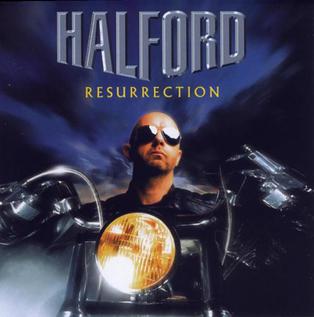
The producer who took it back to the top on the solo band's Resurrection, released by Metal-Is on 8 August 2000, with a title track that opens on a long, climbing scream, was Roy Z, and the record told the faithful the high end had survived a decade of disuse.
Five years later, back inside Judas Priest, came the other extreme. The thirteen minute closer of Angel of Retribution, released in 2005, is "Lochness", and Halford sings most of it low and slow, in a register the high tenor records rarely asked him to use. It is not the most loved song he ever cut. It is the clearest evidence that the bottom of the range is a working voice and not a party trick, able to carry a long song on its own without a single scream to prop it up. Most high tenors keep their low notes hidden. He built a closer on them.
Seventy two, and the voice that learned to spend

The record that settles the question of age is Invincible Shield, released on 8 March 2024, when Halford was seventy two. On "Trial by Fire" the voice works mostly in the grainy middle, with the grit carrying the menace the high notes once carried, and the top register comes out for a few bars at a time, placed like a signature at the foot of the page rather than written across the whole letter.
That is not decline dressed up. It is a singer who knows exactly what every note in his range now costs him, and spends accordingly, which is more than most singers half his age have ever learned. The high tenors who burned through their top end in a decade left no such records at seventy.
A soprano is judged on her high C, and a good teacher never believes the high C. The teacher listens to the middle of the voice, where the aria actually lives, because that is where you learn whether the singer will still be singing in twenty years.
Julien Vasseur, KaosMetal
Measured that way, Halford is the most complete exponent of the high metal tenor on record: a floor he proved on "Beyond the Realms of Death" and "Lochness", a ceiling he proved on "Dreamer Deceiver" and "Screaming for Vengeance", and a middle he has been living in, with interest, since 1973. The rest of heavy metal singing is measured against that address, not against the number.
The top of it, the part everybody asks about, is its own craft, with its own technique and its own damage, and it belongs with how metal singers scream.
The number is four octaves. The voice is fifty years.

