
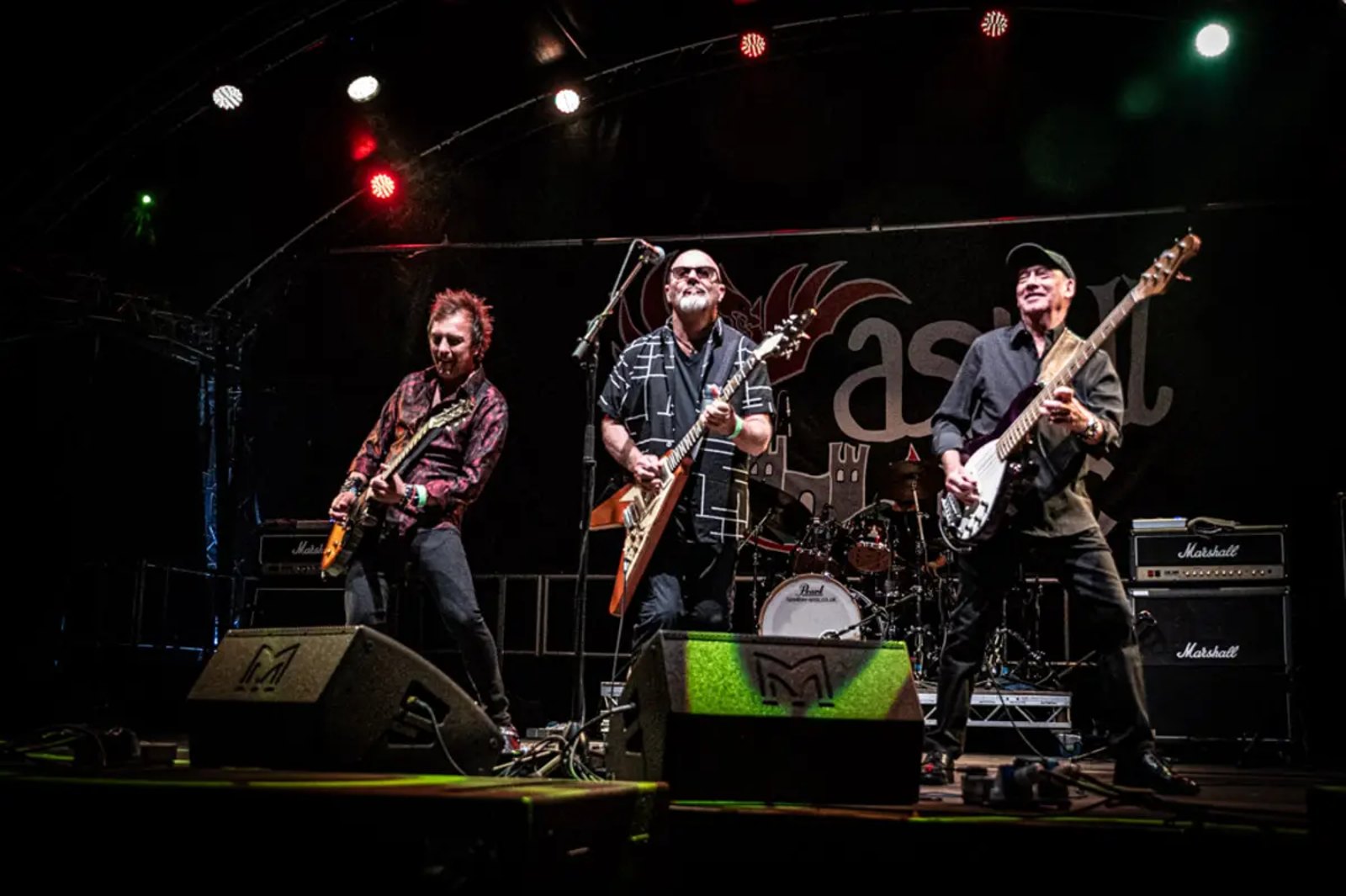
Two guitars playing the same riff are not a harmony. They are a thicker riff. The device begins only when the second guitar takes a different note from the first, drawn out of the same scale, held for the same length and moving in the same direction, so that what comes out of the speakers is one melody with a second voice welded down its side. The band that wrote the second line before it had finished the first, in 1972, was Wishbone Ash, and twin guitar harmonies have been standard issue in heavy metal ever since.
Set two photographs of one hillside next to each other, taken an inch apart, and both of them are flat. Drop the pair into a stereoscope, put the hood against your face, and a third thing appears that is in neither print: depth, the near rocks standing clear of the far ones, the gully opening up between them. Tear one card across and the hill goes flat again and stays flat. That is the whole trick, and the mechanism underneath it is arithmetic.
What twin guitar harmonies actually are
The second guitar plays a third above the first, and a third means two steps up inside the scale rather than a fixed distance in semitones. Because the scale itself is built out of unequal steps, the gap between the two lines keeps changing while both stay in key, four semitones here, three semitones there, without the player having to think about it. Move the line up by a fixed four semitones instead and it walks straight out of the key within two notes. Where the key comes from in the first place is the work of the chapter that covers it.
| Melody | Harmony | Gap |
|---|---|---|
| E | G | Minor third, 3 semitones |
| F sharp | A | Minor third, 3 semitones |
| G | B | Major third, 4 semitones |
| A | C | Minor third, 3 semitones |
| B | D | Minor third, 3 semitones |
| C | E | Major third, 4 semitones |
| D | F sharp | Major third, 4 semitones |
Seven notes, four of them harmonised at three semitones and three at four, and the ear hears none of the joins. That alternation is the engine. It is also why a harmony written by hand on paper and a harmony found by ear on a fretboard come out identical, which is the rarest thing in this music.
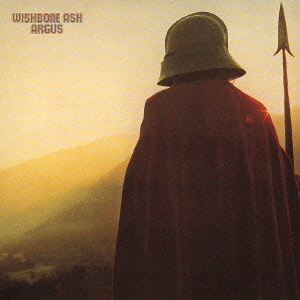
"The King Will Come" opens Argus with the two lines already locked, and the thing to listen for is that neither guitar is playing anything worth hearing on its own. The two men who cut those lines were Andy Powell and Ted Turner, and the bass player who has said the two guitars were written to work with each other rather than against each other, a concept in the band from its first day, was Martin Turner. Heavy metal took the method wholesale, added distortion, and never gave it back.
Why thirds, and what the interval declares
A power chord is a root and a fifth, and the note it leaves out is the third, which is the only note in the chord that would say whether the music is major or minor. That omission is the source of the genre's whole flat grey weight, and it means a riff built from power chords declares nothing about its key at all. The harmony line is where the declaration finally gets made, because the moment a second guitar sits a third above the first, the mode is on the table and cannot be taken back. Which mode gets chosen, and what the flattened second does to the top of it, is Phrygian and the dark modes.
Two guitars in thirds is the one place heavy metal says out loud, in public, whether the song is major or minor. Everywhere else it refuses to answer.
Julien Vasseur, KaosMetal
Fourths and sixths are both available and both used, and each has its own temperature. A sixth above is a third below in disguise and sounds warmer and more open, which is why it turns up under choruses. A fourth is colder, harder and faintly wrong, sitting at the one distance theory itself flip-flopped on: ranked a consonance through the Middle Ages, called a dissonance by the theorist Tinctoris in 1473, then reckoned consonant again by Zarlino in 1558. Bands reach for it when the harmony is meant to sound like a threat rather than a melody. The fifth is not used, because through a distorted amplifier a harmonised fifth is not a second voice at all. It is a chord, and the ear files it as one.
Two amplifiers, and why one will not do
Distortion is not a coat of paint on a signal. It is a squeeze that shaves the peaks off the waveform, and the price of that squeeze is that any two notes fed through it together come out accompanied by the sums and differences of their own frequencies, a litter of extra tones that belong to neither. A single power chord survives this because its two notes stand in a simple ratio and the extra tones land close to notes already sounding. A third does not survive it. Put both harmony lines through one amplifier at high gain and the result is porridge.
Put both harmony lines through one amplifier at high gain and the result is porridge.
So the parts are tracked separately, through separate amplifiers, and pushed out to opposite sides of the stereo picture, which is why every twin harmony worth the name arrives with one guitar in each ear. It is an engineering solution to a physics problem, arrived at by ear in the early seventies by people who would not have used either word. On a mono transistor radio the whole arrangement folds back into one channel and roughly half of the effect dies on the spot.
The player who proved a band was not even required was Tom Scholz, who built almost the entire first Boston album alone in a basement in Watertown, Massachusetts, stacking the harmony parts himself, one at a time, onto tape, while the label believed it was hearing a proper studio session. "Foreplay / Long Time" carries the result. Stacked harmonies of that kind are cut to a precision two men on a stage cannot hold, and they are also weightless, which is the trade every band since has had to price.
What the harmony does to a riff, and what it costs
A dovetail is cut so that the pins of one board splay into the tails of the other, and a joint cut properly cannot be pulled apart along its length at all: the boards break first, and the joint is left standing in the wreckage of both. Two harmony lines are cut into each other the same way. Remove either one and the passage does not merely thin out, it stops meaning anything, because the melody the listener remembers was never in one part.
That is what the device does to a riff. A riff is a rhythm with notes attached, and a harmonised line is a theme, which is a different class of object: it can be whistled, it survives being played on something other than a guitar, and it gives a metal song the one thing the form struggles to produce, a tune with no words in it. The cost is paid in tempo. Harmony needs notes long enough for the ear to hear both, so the fastest palm muted passages cannot carry it, and the harmony almost always arrives when the song opens out.
The band that stopped using the harmony as decoration and made it carry the hook was At the Gates, whose "Blinded by Fear" opens Slaughter of the Soul in 1995 on harmonised lead played at a speed the seventies would have thought impossible, over a rhythm guitar doing the muting underneath. Everything Gothenburg exported afterwards, by common consent, runs on that arrangement, and the lineage from Argus in 1972 to a Swedish record about slaughter is unbroken. The melody sits on top, the violence is kept below it, and the two jobs never change hands. The Swedish band that carried the method furthest into the mainstream was In Flames.
The bill comes later, and it is always the same bill. A band with a harmony catalogue needs two players who can hold a line together, and when one of them leaves, every song built that way is either rearranged, handed to a hired player, or dropped from the set. The band that turned the problem into a feature was Iron Maiden, which confirmed its three-guitar line-up on 10 February 1999 and split the parts three ways, harmonising in full chords. Most bands do not have that option. They have two amplifiers, two sides of a stage, and one melody that only exists when both men are standing on it.

