
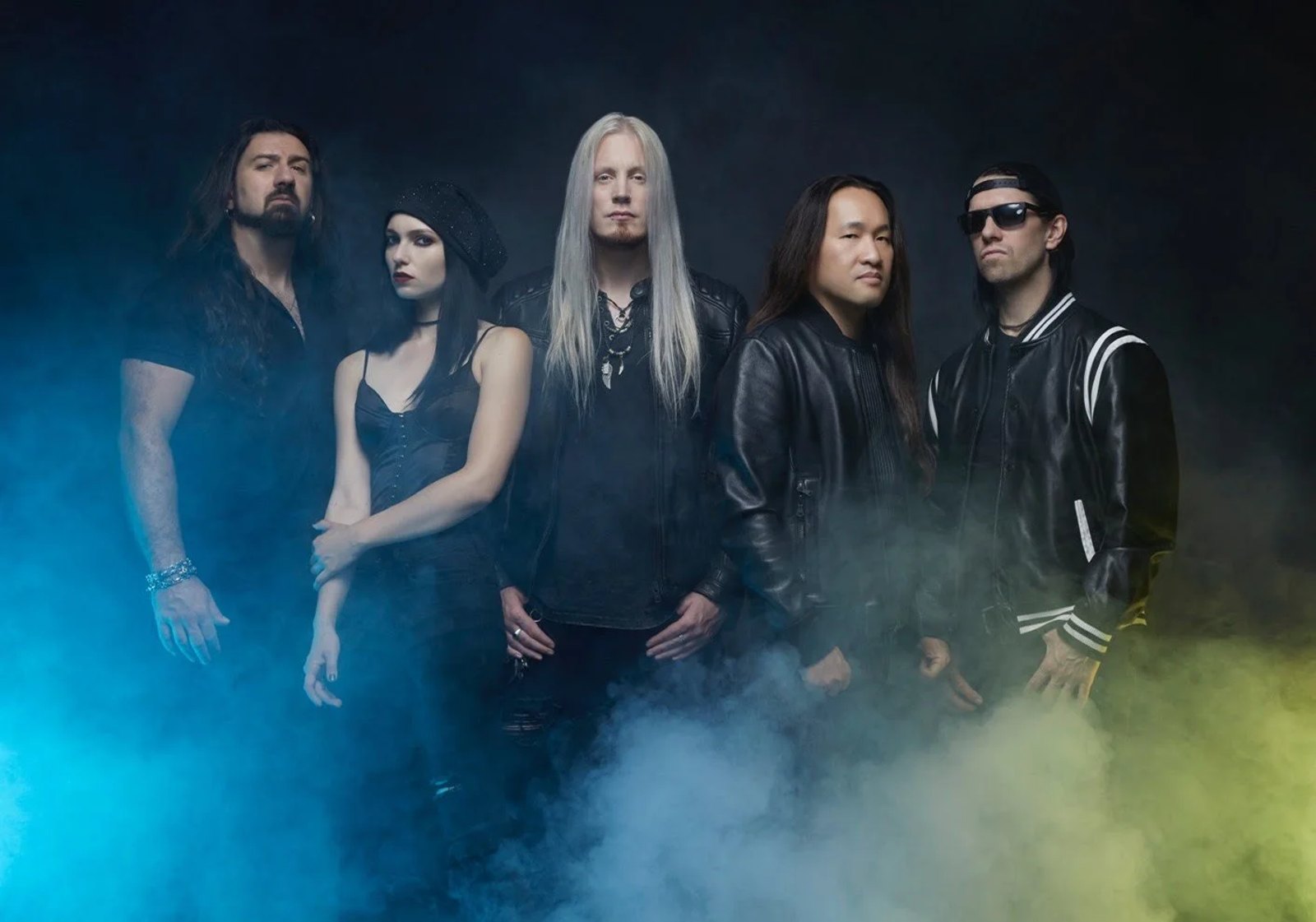
"Our musical influences actually come from video game music!" So Herman Li told U Weekly in July 2006, in an interview Blabbermouth reprinted the same month, and the line has been held against his band ever since, as though a sound lifted off an eight-bit console could haul a whole group out of heavy metal and drop it in the toy department.
Filed as plain power metal on Metal Archives, billed by its own members as extreme power metal since the middle of the 2000s, and racked beside Helloween and Stratovarius in any shop that still sorts its stock by genre, the London band whose guitar solos were mistaken for keyboards is DragonForce, and the answer to what genre is DragonForce is power metal, the European melodic school with every brake on its tempo ripped out.
The console sound is real. It is a colour, not a grammar.
Strip away the bleeps and what remains is the family grammar, line for line: a double kick that drives the song rather than decorating it, major keys and bright modes, a clean high voice carrying a chorus built to climb, harmonised guitar leads, keyboards doubling the hook. Every piece of it is already in place on Valley of the Damned, the 2003 debut released by Noise Records, the German label that had put the Keeper of the Seven Keys records into the shops in the late eighties, and the same grammar still holds up the songs of Warp Speed Warriors, released by Napalm Records in March 2024.
The neighbouring branches, symphonic, progressive, epic, pirate and the rest, each have their borders drawn in the full account of the power metal subgenres. DragonForce sits on none of them. It sits on the trunk, and for more than twenty years it has shaken that trunk as hard as the wood will stand.
What genre is DragonForce, counted at the drum kit
Built on a relentless double kick under songs set at or past 200 beats a minute, Through the Fire and Flames among them, the typical DragonForce song takes the drum pattern Helloween set under its choruses in the eighties and screws it two full turns tighter, to a velocity at which the pedal springs on a lesser kit would shear before the second chorus.
The drummer whose arrival, dated 2003 on some lists and 2004 on others, handed the band its own name for the style was Dave Mackintosh, and what he brought, blast beats and long runs of double bass at the top of the tempo range, is the extreme in extreme power metal, the term the band is said to have adopted once he was behind the kit.
A blast beat is a death metal tool. Set under a major key chorus, it stops being one.
That is the point the speed argument always misses. Tempo on its own sorts nothing: thrash bands and grindcore bands play fast, and nobody mistakes a DragonForce chorus for either. What decides the family is the cargo the speed is carrying, and at 200 beats a minute this band carries exactly what the Keeper records carried at a gentler pace, a tune written to be sung back by a room, with the drums laying the floor under it rather than tearing it up.
Two guitars, a keyboard and a sound chip
Played fast and high on the neck, two lead guitars through a bright, saturated amplifier come out thin and bleeping, close to the chiptune of the home consoles of the late eighties, and the band never hid the connection. Herman Li built it into the solos on purpose: chirps, trills and whammy bar dives that drop like a slide whistle with its plunger wrenched out to the stop, a full octave of pitch collapsing in a blink before the next salvo sets off from the bottom of the neck.
Some listeners in the middle of the 2000s did not believe a guitar was making those noises. Speaking to Decibel in February 2024, Li recalled that people heard them and "said keyboard", without knowing he had played every one on the guitar. The keyboard player who stood behind the two guitarists from 2001 to 2018 was Vadim Pruzhanov, on keyboards and keytar, doubling the leads and answering them, so that the console colour came at the listener from two instruments at once.
The timbre is far older than anyone accusing it. The crumhorn, the curled wooden reed of the Renaissance, has its double reed shut inside a windcap and a parallel bore that favours the odd partials, which is the spectrum of a square wave as well, and a consort of four of them played at the speed of a DragonForce solo, the reeds buzzing inside the windcaps at the players' lips on every note, would be filed as video game music by anyone born after 1980.
A consort of crumhorns played at the speed of a DragonForce solo would be filed as video game music by anyone born after 1980.
Its range is about a ninth. Inside a ninth there is no room for anything except the tune.
The sound chips of the eighties worked under the same poverty, a handful of voices and a handful of waveforms, and that is what Li meant in the same 2006 interview when he argued that the games of the decade had great melodies precisely because the sound they had to work with was so poor. A tune with nothing to hide behind has to be good. Power metal was built on that priority, the melody first and every other part in its service, which is why the console colour fits the genre instead of dragging the band out of it.
A clean voice on top of the speed
The singer who fronted the first four studio albums, from Valley of the Damned to Ultra Beatdown in 2008, was ZP Theart, and his clean tenor sits where a post horn sounds its call, a straight bright line with no valve to hide behind, blown from the box of a mail coach hard enough to rattle the shutters of every village on the road, and it cuts through a drum part that would bury a softer voice in its first bar.
That register is a gift from the forebears, the tenor Michael Kiske set above the stave on the Keeper records and the whole European school adopted. Marc Hudson, announced as Theart's successor in March 2011, kept it, so the one element a genre argument usually turns on never moved.

Handed to a producer from outside the band, Jens Bogren at his Fascination Street Studios, Maximum Overload came out on earMUSIC in August 2014 with the need for speed, in one review's phrase, "ever the credo", and Sam Totman summed it up as "an overload of music, faster guitar playing and more of everything", a boast that names three quantities and not one change of kind.
More of everything included a guest harsh voice. Matt Heafy of Trivium guested on three songs, among them the opener The Game, where he sits as a backing voice behind Hudson's, and one review judged the three cameos "subtle at best". Three years later, on Reaching into Infinity, the band had planned to bring in a guest for the harsh vocals and Hudson ended up doing them himself. Neither record moved the chorus, and the same review found a band that had "played the same hand, round after round through six albums".
Speed metal, nerd metal, progressive: the labels that miss
Each label that misses measures one element and ignores the rest. Laid side by side, the misses are easy to see.
| Label | Who uses it | What it measures | Verdict |
|---|---|---|---|
| Power metal | Metal Archives and Wikipedia | Tempo, clean high voice, major key chorus, keyboards, harmony leads | Holds |
| Extreme power metal | The band itself, since the middle of the 2000s; an album title in 2019 | Speed and blast beats on top of the power metal grammar | Holds, as a description inside power metal |
| Speed metal | Listeners who count tempo alone | Tempo alone | Half right: it misses the voice and the keyboards |
| Nerd metal, Nintendo metal | Detractors and interviewers from the middle of the 2000s | The timbre of the leads | A colour, not a genre |
| Progressive metal | Tags around Reaching into Infinity (2017) | Longer forms, one eleven minute song | One record's reach, not the band's grammar |
Speed metal is the nearest miss, because it is the parent the whole genre came out of in the early eighties and DragonForce plays at its tempos. It does not write like it. Speed metal ran on the riff and a shouted or shrieked top line; DragonForce runs on a sung chorus with a keyboard doubling it, and the riff exists to deliver the singer to that chorus at full speed.
Nerd metal was an insult, and the band's own guitarist has attested as much. When Inhuman Rampage reached the shops outside Japan in January 2006, he told Decibel, the abuse was "pretty extreme", with people calling the band nerd metal and nerds. Nintendo metal is the kinder cousin of the same jibe, and when Decibel put the phrase to Li he said it did not bother him. Both pin a sound effect on the band, and a sound effect has never yet founded a genre.

Progressive is the label with the best evidence behind it, and even that evidence comes from one record. Reaching into Infinity, released on earMUSIC on 19 May 2017 and written mostly by Frédéric Leclercq and Sam Totman, with Leclercq a bassist who has said he listens more to heavy, thrash, death, black and progressive metal than to power metal, runs sixty minutes and forty six seconds, the longest studio album in the catalogue, and holds the longest song the band has recorded.
The rest of that album answers the tag by itself. Ashes of the Dawn, the first full song after the one minute twenty five second title intro, runs four minutes and thirty three seconds, which is the length of a single and not of a suite. One long song is an ambition. It does not move a band.
The same test, run on the German band at the slow end of the tempo dial, decides what genre is Powerwolf, where the doubt is raised by a church organ and a werewolf costume rather than by a sound chip.
Power metal at its fastest
A band leaves a genre when it stops doing the thing the genre exists to do. In nine studio albums between 2003 and 2024, DragonForce has not stopped once. The tempo went up, the drummer added blast beats, guests brought growls, one record stretched a song past eleven minutes, and through all of it the sung chorus stayed at the centre of the songs, clean, high and in a major key.
That is the definition the genre has used since the late eighties, and the band meets it on every record. DragonForce is power metal, played faster than its founders ever needed to play it.
