
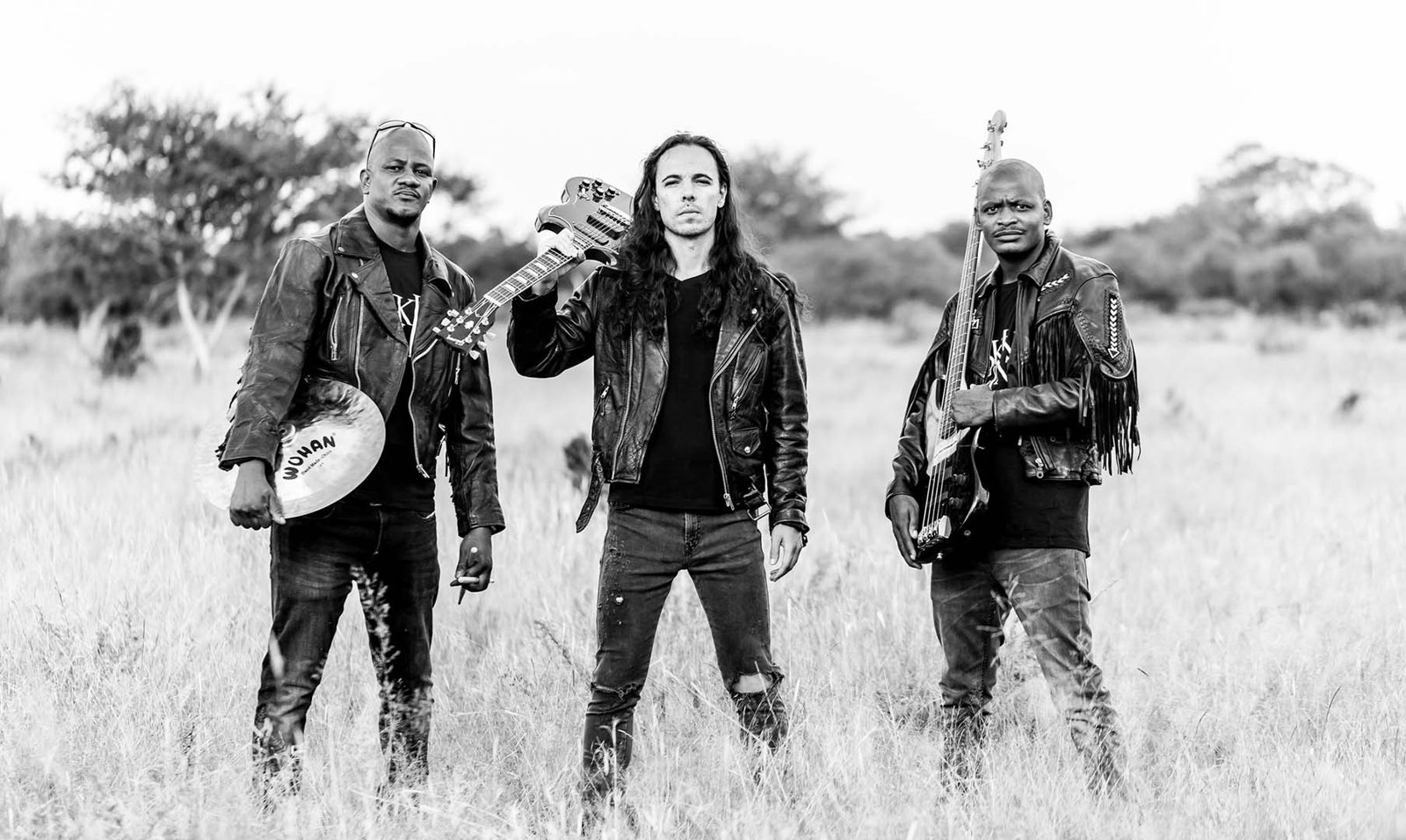
Formed in Gaborone in 1990 by Jarona Spencer Sekwababe and Bophelo Santos Thabakgolo, and made to wait nine years for a first album, the band counted as the country's first heavy metal group is Metal Orizon, and Ancestral Blessings finally came out in 1999. Thabakgolo is still on bass. The band is still playing.
A Channel swimmer walks into the sea below the Dover cliffs in a plain costume and a coat of grease, with a pilot boat keeping station a few yards off, and the one rule that matters is that she may not touch it. Not the hull, not the rail, not a hand held out from the deck, for twelve or fifteen hours, while the cold hammers at her ribs, the jellyfish lash her face and the tide drags her miles off the line to France. One hand on the gunwale and the swim is void. The boat watches. It never carries her.
African heavy metal bands have swum the whole distance that way. The record industry, the import shops, the radio playlists and the touring circuit that carried the British and American bands all stayed alongside and out of reach, and the bands pressed their own discs, booked their own halls and ground out albums a decade after their first rehearsal. What made the far shore was built stroke by stroke. Very little of it was lifted.
African heavy metal bands in Botswana
How the scenes of Cairo, Casablanca and Gaborone fit the wider map, and what the police made of some of them, belongs to the related chapter. The music those scenes play is the question here. In Botswana, beside a strong death and thrash wing, it is heavy metal in the strict sense, the twin-guitar, gallop and chorus heavy metal of 1982, and the country's fans, who call themselves Marok, turn out for it in black leather and cowboy hats, as Frank Marshall's portrait series Renegades, finished in 2010, showed to galleries far from Gaborone.
Metal Orizon wrote its early songs about death, life and freedom, and after Myopic... Enslavement in 2001 and a self-titled record in 2009 it called its 2018 album Kings of Africa, a title the standard-bearer of the country's first generation had earned. The band still plays the country's own festivals, and its own film of "We Are Rolling" at Winter Metal Mania in 2017 comes from Ghanzi, a town far out in the west of the country, a long way from any capital. Nothing in it has been sanded down for export.
Target archers shooting at the gold sometimes put an arrow so exactly into the one already standing there that the steel point splits the first shaft down its length and drives the fletching out in two torn halves, and the second arrow finishes where the first one did, only harder. Heavy metal had been shooting at myth since Iron Maiden set Coleridge to music in 1984. Botswana split the arrow.
The Gaborone trio that aimed at exactly that target is Skinflint, founded in 2006 by the guitarist and singer Giuseppe Sbrana and, among the chroniclers of the continent's metal, the band most often held up as its model. Traditional heavy metal sits under every record. What sits on top is the folklore of half a continent: the Zulu stabbing spear on Iklwa in 2010, the Xhosa prophetess on "The Prophecy of Nongqawuse" in 2018, the tokoloshe on the same record, the Akan forest creature of "Sasabonsam" on Hate Spell in 2023.
The riffs stay plain and heavy and the groove does the work, three players with nowhere to hide, and "Sangoma Blood Magic", which closes Baloi, released in October 2024, takes its title from the southern African word for a traditional healer, while Baloi itself is the Setswana word for witches. The band first toured Europe in July 2013. Few European bands had ever written a song about Nongqawuse. None had needed to.
Madagascar: heavy metal as a highland sound
The Antananarivo band founded in 1983 by Milon, Lallah and Fidy, silent until 1985 and still led by the first two, is Kazar, and its first full-length album, Apokalipsa, came out in 2002, nineteen years later. Apost followed in 1986 under the name Apostoly Rock, and in the second half of the eighties the island's heavy metal bands found success well beyond the metal crowd, recording partly in English and partly in Malagasy, a split still carried in the title of Kazar's 2014 album Nofy ratsy. The long wait was the rule, not the exception. Lokömotiva, formed in 1986, put out its first album in 2013, and Ortho'doxs, a heavy and speed metal band from 1988, reached a full-length only in 2021, thirty-three years after the band was formed.
The music never went down to the coast. The anthropologist Markus Verne, working in Antananarivo, found that Malagasy metal had always been confined to the central highlands, a highland thing in the eyes of highlanders and coastal people alike, and even the provincial bands, such as Vatofant from Fianarantsoa in 1988, came from the same high plateau. The popularity fell away in the nineties and, in the years since, has been rising again. The bastion held.
Tunisia, and the legacy in the name

Formed in 2001 as Xtazy in the suburbs south of Tunis and renamed in 2006 with the Arabic word for legacy, the band that became the first from Tunisia to sign with a record label abroad is Myrath, and on Legacy, released on 19 February 2016, the voice of Zaher Zorgati bends Arabic ornament over riffs that owe as much to power metal as to the progressive school. Myrath is not heavy metal in the strict sense. It is the continent's most travelled cousin.
Paid for through a crowdfunding campaign and reported to have cost about €45,000, with two producers from the Game of Thrones crew hired for the shoot, the video for "Believer" went past ten million views on YouTube. The faithful paid for it. The rest of the world watched it.
Across the city, the Carthage band that formed in 1997 and did not release its first album until 2015, eighteen years on, is Carthagods, closer to power metal than Myrath and with the Dutch guitarist Timo Somers on lead since 2019. Tunisia never needed a single band to do the work alone.
South Africa, Namibia and Angola
The Pretoria band that led the heavy metal vanguard of the late eighties, formed in 1987 and recording demos in 1989 and 1990, was Aragorn, and out of its ruins came Stryder, whose only release, a self-titled EP of 1992, was sold on cassette alone. Cape Town and Johannesburg ran scenes of their own through the same years. Much of what came later in South Africa went to death metal, thrash and metalcore, and that story belongs to those genres.
Released in 2007 and named with the plain Afrikaans words for heavy metal, Swaar Metaal won best Afrikaans rock album at the 2008 South African Music Awards and is regarded as the first heavy metal album in Afrikaans, and the Cape Town band that made it was Kobus! The Port Elizabeth band founded in 2009 that went the other way entirely, singing Norse myth on Ásatrú in 2016 before moving to Ireland, was LadyAxe. Skinflint looked home for its gods. LadyAxe looked north.
Skinflint looked home for its gods. LadyAxe looked north.
Namibia's first heavy metal band to reach an audience beyond its borders is Arcana XXII, formed in Windhoek in 1997, and it went dark for years between Fallen from Grace in 1999 and its return with Anthems of Adversity in 2022. The Luanda band formed in 2000 that kept the same slow rhythm, its two albums, Innocence Falls in Decay and Feedback, arriving four years apart in 2006 and 2010, was Neblina. Kenya's scene arrived through metalcore and death metal, with bands such as Last Year's Tragedy from 2006 and a Nairobi Metal Festival since the late 2010s, and it belongs to those genres rather than to this one.
Every one of these scenes answers the same question differently, and the reasons, from the language on the lyric sheet to the gear a band can afford, are taken apart in why regional metal scenes sound different. Botswana answered with its folklore. Madagascar answered in Malagasy. Tunisia answered with a melody from its own side of the sea.
