

On 17 March 1948 a handful of young men back from the war founded a motorcycle club in Fontana, California. The Californian club whose members hacked the sleeves off their jackets at the shoulder seam and sewed a winged skull between two curved strips of lettering across the back went out as the Hells Angels, and every battle jacket at every metal festival since has worn that layout, usually without knowing whose it was. The fans took the scissors and the back patch. They left the club behind.
Scatter iron filings on a sheet of card laid over a bar magnet, give the card one sharp rap with a knuckle, and the loose grey dust jumps and slams down again in curved ranks running from pole to pole, a force nobody can see drawn on paper in iron. A battle jacket does the same work with a fan's allegiances. The back patch is the magnet, and everything sewn round it falls into line.
From the club cut to the battle jacket
The biker's three piece patch, a top rocker naming the club, an emblem in the middle and a bottom rocker naming the territory, became the metal fan's back patch, with a band's logo on a strip above it and often a second strip below. The layout was borrowed whole. The meaning changed completely, because a club patch is issued by the club and a band patch is chosen by the wearer, and nobody ever had to earn the right to a Saxon strip.
Britain had its own rehearsal for it. Gathered at the transport cafés along the arterial roads out of London in the early sixties, the young motorcyclists the newspapers called rockers studded their jackets, painted slogans across the backs and pinned badges down the lapels, and the studs went from their shoulders to the club circuit fifteen years later with hardly a pause. The habit skipped a generation. It never left the family.
The name was military before it was musical, and Britain got there first. Its army had issued a short waisted battledress blouse from 1939, the cut Eisenhower admired on a colleague's coat in England and copied for his own troops, and the American version issued from November 1944 went home with soldiers as the Ike jacket. How the sleeveless denim reached the club circuit of 1979, and where it sits in the story of the music's whole look, belongs to the wider history of its culture. The garment itself deserves a closer look.
How a battle jacket is built
No two are alike, and almost all of them are assembled from the same parts:
- the back patch, a large printed panel across the shoulder blades for the one band that matters most;
- strip patches, a band's logo alone on a narrow band of cloth, above and below the back patch or down the front panels;
- small patches, embroidered or printed, packed edge to edge until hardly any denim shows;
- pin badges down the lapels and along the collar;
- studs and spikes, pyramid or cone, set along the seams, the pocket flaps and the edge of the back patch.
The work is done by hand, at a kitchen table, over months and usually years. Patches go on with heavy thread or, on the folk advice passed from one fan to the next, with waxed dental floss, which does not rot in the rain and does not snap in a crowd. Each stud goes in from the outside, its prongs punched through the denim and folded flat on the inside with the back of a spoon, and a jacket with a few hundred of them weighs noticeably more than the one it started as.
The placing follows an order older than anyone who enforces it. The back patch changes rarely, sometimes never. The bands closest to it are the ones the wearer would defend in an argument, and the small patches spread outward from there towards the cuffs and hems, the allegiances thinning as they go. The Newcastle trio whose goat's head logo became a fixture on those outer panels through the whole of the thrash years was Venom, a band worn by far more people than ever owned its records. A jacket is a set of banners, and not every banner is a vote.
The thrash years and the poser test
The Bay Area quartet that closed its first album, released by Megaforce on 25 July 1983, with a marching song addressed not to a girl or a demon but to its own audience, drafted as an army and dressed for the part, was Metallica. "Metal Militia" closes on tramping feet and bullet ricochets fading into the distance, stomped by the band themselves and multiplied on tape into the sound of an army on the march. The kids it described already owned the uniform. Most of them had cut it themselves.
The same year handed the wearer his favourite name for himself. The Ottawa trio whose 1983 debut on Shrapnel carried the title Heavy Metal Maniac was Exciter, and the phrase went onto patches, shirts and the sides of rehearsal rooms for the rest of the decade. Nobody asked Exciter first.
A jacket in a bar invites a test, and the test is famous. A stranger who points at a patch gets asked to name a song from that band's second album, and the question works like a strip of blue litmus pressed into a glass of something unknown: one dip, and the paper either stays blue or flushes red in front of everybody, with no second strip and no appeal. The test is unfair and nearly everyone has been on the wrong end of it once. It survives because it is quick.
One dip, and the paper either stays blue or flushes red in front of everybody, with no second strip and no appeal.
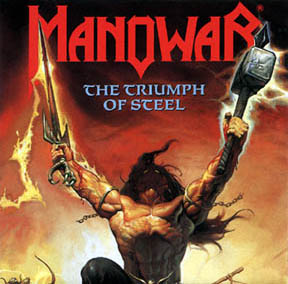
The band that made the test its whole creed, printing the words Death to False Metal on the sleeve of its second album in 1983 and carrying them onto shirts and patches ever since, was Manowar, from upstate New York, and The Triumph of Steel, released by Atlantic in September 1992, carries its fullest statement on the subject.
"Metal Warriors" is a muster roll set to a mid tempo stomp, a song that divides the hall into the believers and the pretenders and orders the second group out, and it was written for a crowd in patched denim to shout back with their fists up. It is absurd. It is also sung back at every Manowar show by people who know exactly how absurd it is.
Revival, and the jacket for sale
The jacket never went away, but in the nineties it went quiet, worn in Germany and in the small clubs while the American charts belonged to flannel. It came back with the young bands of the next decade, which played the old rules straight. The Rock Hard editor and the Majesty singer who founded Keep It True in 2003, a festival for traditional heavy metal where the patched jacket is close to the uniform of the audience, were Oliver Weinsheimer and Tarek Maghary, and the standard-bearer of the revival was not a band so much as a jacket.
Money followed, as it does. Specialist patch shops and mail order sellers now offer a denim vest with a set of patches already stitched on, bootleg printed patches go for a few coins online, and a finished jacket from the eighties with the right back patch can fetch more than the records on it. None of that changes the covenant between a fan and the needle. A jacket that arrived finished records a purchase. A jacket built over twenty years records a life.
The best place to see a thousand of them at once is still a field in summer, among the heavy metal festivals that grew up around this music. Walk through any of them on the first afternoon and the backs tell the running order before the programme does, and some of the jackets in the queue for the bar are older than the bands on the stage. Nobody wearing one needs a badge to prove he came.
