
Sixty-six books make up the Protestant Bible, and heavy metal has worn out two of them. The biblical imagery metal lyrics keep returning to comes almost entirely from Exodus and Revelation, from the plagues sent down on Egypt and the riders sent out at the end of the world, while the Psalms, the Proverbs and nearly every letter Paul ever wrote sit untouched on the shelf.
The shelf looks like a family Bible kept for show in a Victorian parlour, its pages still folded shut at the top edge the way the binder left them, except in two places, where somebody went through the folds with a kitchen knife, slitting the paper open leaf by leaf, then thumbed those two stretches so hard that the spine split straight across at both and the book now falls open by itself. Everything else is uncut. Nobody has missed it.
What drew the bands was never doctrine. It was the effects budget: blood in the river, a city in flames, a horse the colour of a corpse, the whole archive of divine violence available free of charge and already known by heart, like a catechism, to every listener raised in a Christian country. The wider inventory of what the style sings about, from Balaclava to the dole queue, is laid out in the chapter above. The scripture shelf keeps a pattern of its own.
Exodus: the biblical imagery metal lyrics wore out first
The bassist who gave the tenth plague its metal name, sprawled in front of his parents' video recorder, was Cliff Burton. The young Metallica used to watch Cecil B. DeMille's The Ten Commandments at the Burton house, because his family owned a VCR when few families did, and when the green mist of the last plague slid down off the screen and through the streets of Egypt, choking every firstborn it touched, Burton said it looked like creeping death. James Hetfield told him to write it down.
Released by Megaforce on Ride the Lightning in July 1984, "Creeping Death" is sung by the plague itself, the angel of death moving through Egypt house by house, reciting the earlier plagues as its credentials and passing over only the doors daubed with lamb's blood, while the riff tramples through the verses like a column of soldiers through a market, kicking over every stall in the street. The narrator is not Moses. The narrator is the weapon.
That choice of voice is the whole trick, and the style has repeated it ever since. Scripture tells Exodus from the side of the people being freed; metal tells it from the side of the thing doing the killing, four decades of crowds shouting the bridge back at the stage and hardly one of them thinking of Passover.
Revelation, with two riders swapped
Handed a song called "The Mechanix", which Dave Mustaine had brought into the band with a lyric that leered at the women pulling their cars into a gas station, the singer who threw it out and put the four horsemen of the apocalypse in its place was James Hetfield, and "The Four Horsemen", on Kill 'Em All in July 1983, rides them straight out of the sixth chapter of Revelation. Mustaine kept his version. It came out on the first Megadeth album in 1985, faster and unrepentant.
Only it is not quite Revelation. The riders of tradition are conquest, war, famine and death; Hetfield's are time, famine, pestilence and death, two of the originals prised out of their claws and two new stones pressed in, the way a jeweller resets an inherited ring and keeps the band, because the band is what people recognise. Nobody complained. Hardly anybody noticed.
Scripture tells Exodus from the side of the people being freed; metal tells it from the side of the thing doing the killing.
The Birmingham band that opened its first CBS album with an apocalyptic rider of its own, six years before Kill 'Em All, was Judas Priest. Sin After Sin, released in April 1977 with Roger Glover producing, opens on "Sinner", close to seven minutes written by Rob Halford and Glenn Tipton, in which a destroying figure rides the storm with the devil at his side and the vultures gather over the war underneath.
On any honest reading it is Revelation's pale horse loosed without the chapter and verse, the judgement kept and the judge removed. K.K. Downing's lead break, the one he carried on stage as his solo spot for years afterwards, tears through the middle of the song the way a loose dog tears through a line of wet sheets in a back yard, pulling every peg down in one run and leaving the rhythm section to pick up the washing.
The reason Milton wrote in fetters when he wrote of Angels & God, and at liberty when of Devils & Hell, is because he was a true Poet and of the Devil's party without knowing it.
William Blake, The Marriage of Heaven and Hell, c. 1790
Babylon, and the devil at the gate
The singer who wrote the words over Ritchie Blackmore's eastern riff was Ronnie James Dio, and "Gates of Babylon", on Rainbow's Long Live Rock 'n' Roll in April 1978, turns the Bible's great city of sin into a dream of temptation, with the devil keeping the gate and the sleeper warned that he may never find his way back out. Blackmore built the riff on the Phrygian dominant, the mode that sounds like a bazaar to Western ears.
Dio never names the chapter. He did not need to. Every listener who had sat through a Sunday reading already had Babylon filed under Revelation's great city, drunk and dressed in scarlet, and the song only had to say the name for the whole indictment to arrive with it. That is the economy of the scripture shelf: one proper noun carries a thousand years of anathema, and the band pays nothing for the freight.
A parable at funeral pace
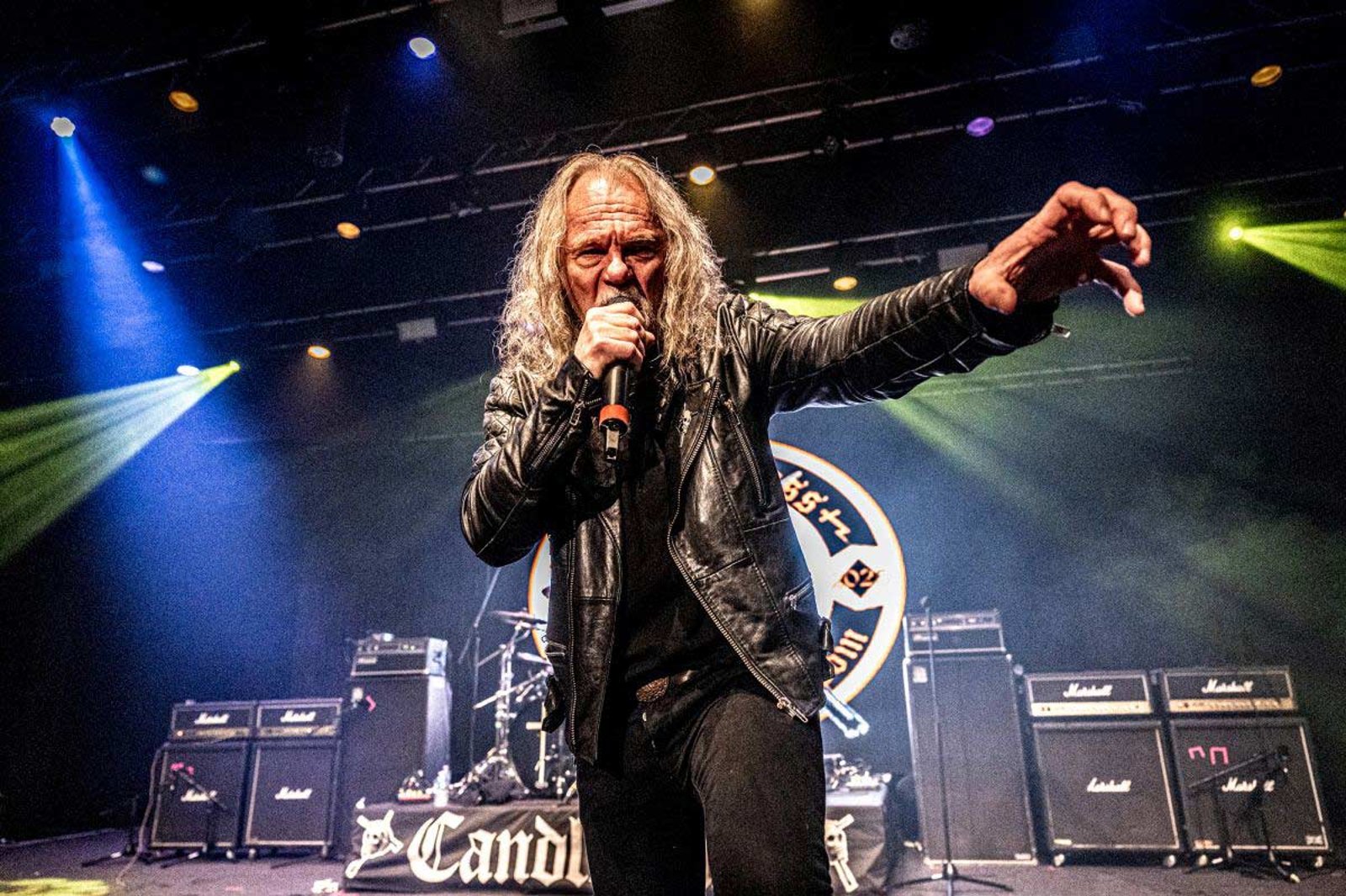
The Stockholm quintet that went looking in the Gospels, in the part of the book the rest of the style left alone, was Candlemass. It is the one clear exception to the rule of plagues and horsemen, and it arrived from a band that measured its tempos in funeral steps.

Nightfall, released through Axis on 9 November 1987 and the first Candlemass album with Messiah Marcolin singing in a monk's habit, carries "Samarithan", which takes the parable of the Good Samaritan from Luke and carries it past the end of the story, a man taking in a beggar in rags, giving him a room, a bed and a meal, and fifty years later, on his deathbed, being met by three angels bearing gifts.
It is the gentlest story in the New Testament, the one taught to six-year-olds with felt figures pressed onto a flannelgraph board, and Leif Edling's riff drags it along at the pace of a cortege, as if somebody had carried the board out into the chapel yard and set it alight, and the felt Samaritan were curling at the edges in the flames while the congregation sang on regardless. The kindness survives. It simply weighs a ton.
Recorded at Thunderload during the sessions that produced Nightfall in the summer of 1987, the song went out the following spring as one of the album's two singles, a Gospel parable pressed onto plastic and sent into shops that mostly stocked plagues. The plagues never had to wait.
The pattern holds because it is structural, not devotional. Exodus and Revelation are the two books in which God acts like a bombardment rather than a shepherd, where the verbs are burn, smite, pour and fall, and a band with two guitars and a double bass drum can set those verbs to a riff without translating anything. The Sermon on the Mount offers a singer nothing to shout. The seven bowls of wrath offer seven choruses.
So the bands kept the scorched earth and left the consolation, and the believers who later wanted the consolation set to riffs had to write it themselves. The fear the Bible supplied ready-made, the style soon learned to build by hand, out of films, paperbacks and graveyards, and the same appetite runs straight into horror in heavy metal lyrics, where the monster has no scripture behind it and has to be introduced from scratch. The fire stays. Only the author changes.
