
In 1969 a queue of paying customers stood on a Birmingham pavement waiting to be frightened by a horror film, and across the road four young men from Aston, still booked as Earth and still playing the blues to rooms that were half empty, watched it with professional interest. The singer who repeated the story afterwards as his own, though Iommi and Geezer Butler have each been credited with the same remark, was Ozzy Osbourne: if people would pay good money to be scared, the band would give them something scary to listen to.
Every horror theme in heavy metal lyrics since has come out of that box office. Lifted from the late show, the drive-in and the paperback rack, from Hammer's Dracula of 1958 to the masked killers of the eighties slasher cycle, the horror lyric dragged the slow dance off the school hall floor and smashed the mirror ball over the heads of the couples still swaying beneath it, all on the promise the queue had made that night. The audience wanted to be caught.
A gin trap lies open in the leaf litter for hours doing nothing whatever, two steel jaws folded flat against a coiled spring and a round pan set between them to take a weight, and the whole of its cruelty is patience, because nothing happens until the animal walks into the middle and the steel comes up through the bone. The heavy metal horror song is built to that plan. The verse lays the jaws open. The chorus is the pan.
Horror themes in heavy metal lyrics start at the cinema
The actor who taught a whole generation what a monster looked like in colour, with a cape, a castle and blood the shade of a pillar box, was Christopher Lee, and when the two men appeared together on camera in 2013, Iommi told him plainly that the band used to go watch Dracula and the rest of his horror pictures, over and over, and that was what had influenced them.
Hammer's studio at Bray handed the style its catechism: a village at dusk, a warning nobody heeds, a graveyard, a stake. The lyric sheets of the seventies and eighties read like shooting scripts for pictures nobody ever filmed. The horror always had a location before it had a victim.
The film that reached furthest into the music was not Hammer's at all. Directed by Michael Reeves and released in 1968, with Vincent Price riding through the English Civil War as the witch hunter Matthew Hopkins and hanging his way across East Anglia, Witchfinder General gave its whole title away a decade later, and the Stourbridge band that wore the name of a real seventeenth century killer across its sleeves was Witchfinder General. Its debut, Death Penalty, released by Heavy Metal Records in 1982, hung Black Sabbath riffs from the film's gallows and slowed them to the pace of a cart on the road to the hanging tree. The doom bands of the following decade treated it as holy writ. The film had never asked to be.
The cinema came first and the library second, which is the reverse of the order in most of heavy metal themes, where the war songs come out of history books and the fantasy out of paperbacks. A horror lyric is usually a film somebody saw at fourteen and never got over. The debt shows in the titles.
Alice Cooper wrote the lyric as a stage direction
The Detroit-born singer who first wrote horror songs as scenes, with the lighting cue built into the words, was Alice Cooper. Released by Atlantic in early 1975, the date given as both 28 February and 11 March, with Bob Ezrin producing, Welcome to My Nightmare, his first album as a solo artist, follows a boy called Steven through one long night of bad dreams, song by song and room by room, until the record is less a set of tracks than a haunted house with a running order. It reached number five on the Billboard 200.
The voice that walks the listener round the spider collection on "The Black Widow", in the unhurried tone of a museum curator who has fed a visitor or two to the exhibits, belongs to Vincent Price. ABC broadcast a television special built on the album in April 1975, with Price as the Spirit of the Nightmare guiding Steven from scene to scene. Every lyric on the record tells a stagehand where to stand.
Eleven years later the same singer wrote a fan letter to a man in a hockey mask. "He's Back (The Man Behind the Mask)", on Constrictor in 1986, served as the theme of Friday the 13th Part VI: Jason Lives, fired a salvo of synthesisers and slasher clichés straight at the multiplex and climbed to number four in Sweden the following year, while "Teenage Frankenstein", from the same record, played inside the film as well. Horror had stopped being the subject. It had become the client.
Listen to them, the children of the night. What music they make!
Bram Stoker, Dracula, 1897
King Diamond and the horror serial
What the style got next was a serial, and the man who wrote every episode was Kim Bendix Petersen, known on every sleeve as King Diamond. Them, released by Roadrunner in 1988, brings a young narrator's grandmother home to the house of Amon along with the unseen presences that give the record its title. Conspiracy, released in late August 1989 and given as the 21st on some listings and the 28th on others, sends the grown narrator back down into the abyss of the same house to strike a bargain with them.
The records open like a matryoshka on a kitchen table, the painted narrator split at the waist to show the grandmother inside him, the grandmother split to show the house, the house to show the things that live in its walls, each doll smaller and nastier than the one that held it and every one of them sung by the same throat, overdubbed part on part until one singer is a whole cast.
The Eye, released on 30 October 1990, left the haunted house for seventeenth century Paris and the Chambre Ardente, the royal court that tried poisoners and witches under Nicolas de la Reynie, and followed a necklace that had watched a woman burn at the stake. History had joined the film. It was worse.
Midian, a horror novel turned into a record

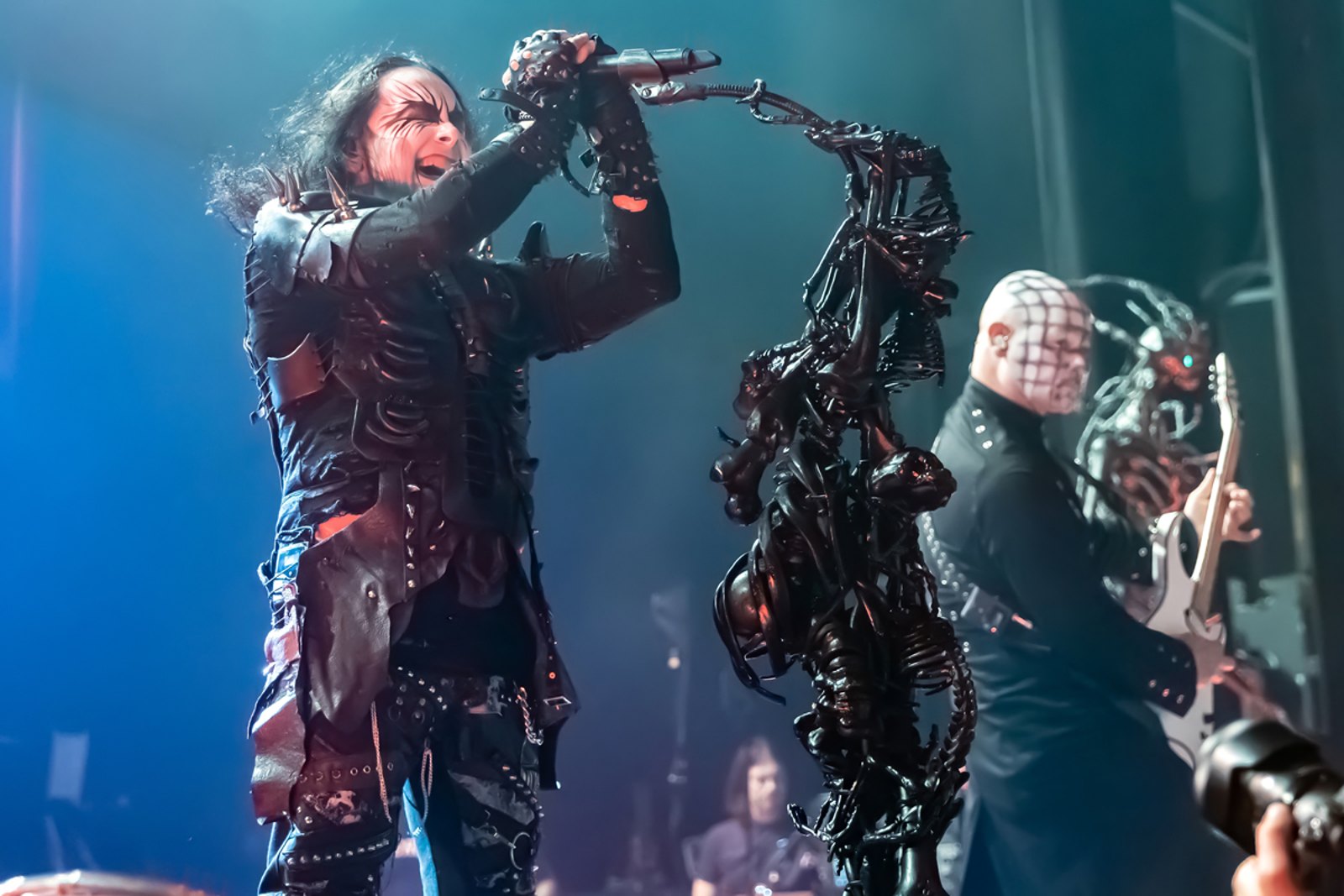
The English band that dragged black metal's speed into the gothic parlour and made horror its entire business was Cradle of Filth, and Midian, released on 30 October 2000, takes its title and its world from Clive Barker's novella Cabal of 1988 and the film Barker made of it, Nightbreed, in 1990. Midian is the city of monsters buried beneath a cemetery, where the creatures the living hunt have gone to ground.
The desecration of the parlour arrives with a guest. Doug Bradley, the actor under Pinhead's grid of nails in Hellraiser and one of Barker's creatures in Nightbreed, narrates three tracks, "Death Magick for Adepts", "Her Ghost in the Fog" and "Tortured Soul Asylum", a ghost story told in the old gothic manner. He could not make the shoot for the video, and the actor David McEwen mimed his lines in his place.
Horror in these songs always has a face, a mask, a name on the poster. The older fear, the one with no face at all and no interest in the people it destroys, has its own story, the one of Lovecraft and heavy metal, where the monster never fits inside the frame.
A horror lyric is usually a film somebody saw at fourteen and never got over.
What the horror song promises
None of these songs has ever frightened anybody the way the films did, and beyond dispute none of them was trying to. A horror film has ninety minutes to build its dread. A heavy metal song has four, a chorus that has to come round three times and an audience that already knows the ending, so it keeps the costume, the setting and the name of the monster and throws the suspense on the fire. It is a fair trade. The film gets watched once, and the song gets shouted back at the stage by a hall full of people who know every word.
What it adds in exchange is the one thing the films never had. The film ends and the lights come up. The riff goes on playing in the car park, long after the exit sign is the only light still burning.
