
Eight bands, seven of them second-hand.
Signed one at a time between September 2012 and May 2018, collected from a Chicago hardcore label, a Californian brutal death metal shop, a New York company that had started life as Koch Records, an Australian independent and its own German rival in Dortmund, the label that bought deathcore second-hand for the whole of the decade was Nuclear Blast. Only Aversions Crown, a Brisbane band whose debut had been self-released, walked in without another company's logo on the back of a sleeve, out of a roll that also held Suicide Silence, Thy Art Is Murder, Carnifex, Fallujah, Despised Icon, Rings of Saturn and Fit for an Autopsy. Every one of the other seven had already split the plywood of a hundred club stages on somebody else's money.
That is how deathcore record labels worked once the genre had a past. The small companies found the bands, paid for the first records and the first vans, and soaked up the cost of every breakdown that flattened a folding table at a merch stand in front of forty people, and then the big metal companies arrived with a chequebook and bought the finished article. Read the signings band by band and the 2010s stop looking like a gold rush. They look like a transfer market.
Think of the ladder as the wristbands a kid collects over one summer of shows. The paper band from a basement show gets torn off in the pit by the first breakdown and kicked under the stairs; the vinyl one from a club takes a knife in the van at two in the morning; the woven festival band, cinched by a plastic bead that only slides one way, stays on through the shower, the drive home and the next tour, until the cloth frays into a grey thread nobody can get a blade under. A small label is the paper. Nuclear Blast and Century Media were the woven kind.
The splits, the walkouts and the move off MySpace are the wider story of the decade. The contracts are the part of it that was written down and signed, and they tell it in a colder voice.
How deathcore record labels bought a finished band
Signed by Victory in November 2007 after a debut for the underground This City Is Burning, sent to number 175 on the Billboard 200 by the Chicago label with Hell Chose Me in February 2010 on about 3,100 first-week copies and to number 159 with Until I Feel Nothing in October 2011 on 2,679, the San Diego band that changed hands in the summer of 2013 was Carnifex. Nuclear Blast announced the deal on 9 July. Die Without Hope came out on 4 March 2014 and went into the Billboard 200 at 98, the best first week of the band's career to that date.
Same band. A higher number.
The cleanest measurement came out of the Bay Area. Out on its own with Embryonic Anomaly in 2010 and signed by Unique Leader that November and sending Lugal Ki En into the shops in October 2014, where it sold 3,025 copies in its first American week, the band that signed to Nuclear Blast on 17 May 2016 was Rings of Saturn, and Ultu Ulla, its first record for the Germans, released on 28 July 2017, sold about 7,900 in its first week. The records were the same kind of animal. The barrel behind them was not. Load a rolled shirt into the hand-pumped cannon a sponsor wheels out between sets at a club and it clears the first ten rows; load the same shirt into the compressed-air rig on a festival main stage and it slams into the side of the sound tower at the back of the field hard enough to make the engineer duck. That was the gap between a Unique Leader release and a Nuclear Blast one: the same sweep runs and the same drop, fired out of a wider tube.

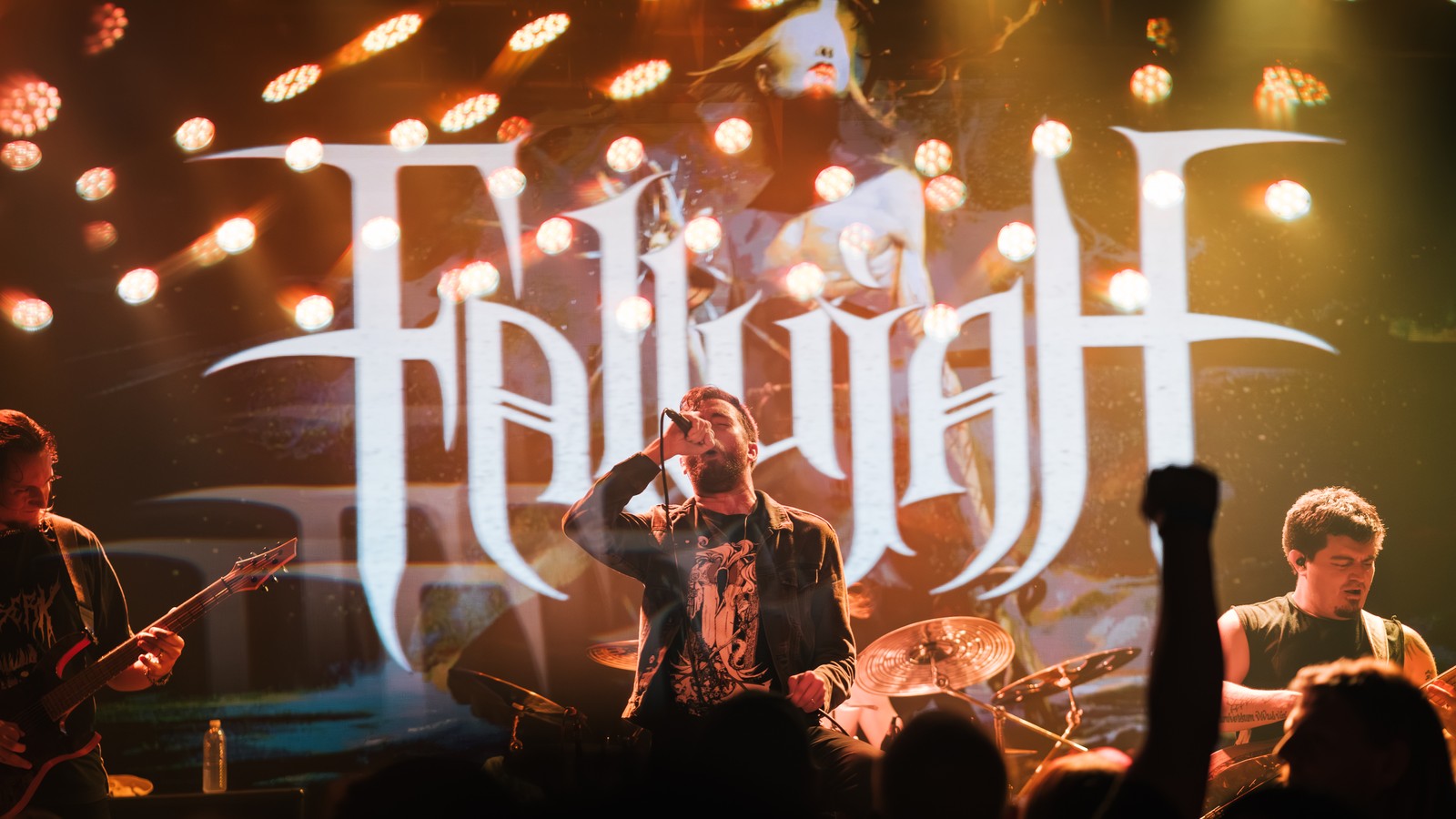
The chart does not always follow the cannon. Signed to Unique Leader in March 2011 and in the shops with The Harvest Wombs that November, at number 115 on the Billboard 200 on 2,900 first-week copies with The Flesh Prevails in July 2014, and calling the jump, in the band's statement on signing in January 2015, "the most obvious and logical step", the San Francisco band that Nuclear Blast took off the Californian label's roster that winter was Fallujah. Dreamless, released on 29 April 2016, sold roughly 4,700 copies in its first week, about 1,800 more than its predecessor, and still went in around number 150, below the 115 of the record before. It also topped the Heatseekers chart and reached 131 in Canada. The bigger cannon had cleared the crowd, and the chart still put the shirt in the car park.
"Abandon" is the video Nuclear Blast put out for Dreamless, and it sits on the label's own channel, the German logo now stamped on a band that had come up through a death metal shop in California and was by then shelved with the technical death metal records. A transfer measures a label's reach. It does not rewrite the record, and the charts proved it in both directions inside two years.
Then there is the band that came across with a map already drawn. Out of Blacktown, the band that put Hate into the Australian chart at 35 on the Halfcut label in October 2012 were Thy Art Is Murder, and the deal they signed with Nuclear Blast on 24 January 2013 covered Hate outside Australia only. The world was cut in two along a coastline. The home market stayed with the Australian independents, UNFD carrying Holy War there in 2015, and the German company took everywhere else.
| Band | From | To | When | What followed |
|---|---|---|---|---|
| Whitechapel | Siege of Amida (Europe), Candlelight (North America) | Metal Blade | October 2007 | This Is Exile, Billboard 200 at 118, July 2008 |
| Impending Doom | Facedown | eOne | March 2011 | Baptized in Filth, 13 March 2012 |
| Thy Art Is Murder | Halfcut | Nuclear Blast, outside Australia | January 2013 | Hate released abroad |
| Carnifex | Victory | Nuclear Blast | July 2013 | Die Without Hope, Billboard 200 at 98, up from 159 |
| Fallujah | Unique Leader | Nuclear Blast | January 2015 | Dreamless, about 4,700 first-week copies at around 150, against 2,900 at 115 |
| Rings of Saturn | Unique Leader | Nuclear Blast | May 2016 | Ultu Ulla, about 7,900 first-week copies against 3,025 |
| Emmure | Victory | SharpTone | October 2016 | Look at Yourself, March 2017 |
| Fit for an Autopsy | eOne | Nuclear Blast | May 2018 | The Sea of Tragic Beasts, October 2019 |
| Bleed from Within | Century Media | Nuclear Blast | November 2021 | Shrine, June 2022 |
| Mental Cruelty | Unique Leader | Century Media | March 2022 | Zwielicht, June 2023 |
| Signs of the Swarm | Unique Leader | Century Media | August 2022 | Amongst the Low & Empty, July 2023 |
| Ingested | Unique Leader | Metal Blade | September 2021 | Ashes Lie Still, 4 November 2022 |
Victory, Facedown and eOne: the middle of the ladder
The middle labels paid for the second and third records, the ones that turn a band with a page of plays into a band with a van that starts in January, and they lost their best acts the moment the bigger companies noticed. Victory lost two. Signing to the Chicago label for Goodbye to the Gallows in 2007, letting its first four-album contract run out, signing again in January 2012 ahead of Slave to the Game and once more in September 2013 ahead of Eternal Enemies, the Connecticut band that finally walked on 13 October 2016 was Emmure. Nine years, two extensions.
Drummers know that arithmetic from a cracked crash cymbal. You drill a hole at the tip of the crack to stop it spreading, hammer the thing through another tour on the first beat of every breakdown, drill again when the crack walks past the hole, and in the end you sling it off the riser into the dumpster behind the venue with the rest of the night's empties. Victory drilled twice. The third time the cymbal went in the bin.
Facedown played the same role on the Christian side of the floor. The Fallbrook label signed Impending Doom in January 2007 and put out three of its records, the last of them There Will Be Violence on 20 July 2010, and the band's fourth, Baptized in Filth, arrived on 13 March 2012 through eOne, the New York company that had traded as Koch Records until it took the E1 name in 2009 and that signed the band in March 2011.
"Murderer", the first video from Baptized in Filth, now sits on the channel of MNRK Music Group, the name eOne's music arm took in September 2021 after Blackstone bought it. The sign over the door changed twice in a decade. The video stayed where it was, and so did the band's catalogue. eOne also carried Fit for an Autopsy, the Jersey City band built around Will Putney's guitar and production, for Hellbound in September 2013, Absolute Hope Absolute Hell in October 2015 and The Great Collapse in March 2017, and then lost it to Nuclear Blast on 8 May 2018. A middle label is a stage of the journey, not a home.
The people asking is deathcore dead every couple of years were counting first-week sales. The transfer list counted something else. A German company rarely pays to take a band off a Chicago label or a New York one unless it expects that band to keep selling for years.
The Californian nursery and Century Media's shopping trip
Founded in the late nineties by the brutal death metal band Deeds of Flesh after it lost its contract with Repulse, Unique Leader spent the 2010s and the years after as the genre's nursery. It signed bands young, paid for the records that taught them to tour, and watched the big companies take them. Fallujah and Rings of Saturn went to Nuclear Blast in back-to-back years. Then Century Media came shopping.
Signed by Century Media on 2 March 2022 after a debut for Rising Nemesis in January 2018 and a move to the Californian label for Inferis on 10 May 2019, the Karlsruhe band that strung black metal over its slam riffs was Mental Cruelty. Six months later it was the turn of the Pittsburgh band that had self-released Senseless Order on 29 April 2016, joined Unique Leader that same year and given it three records, Absolvere on 24 September 2021 the last of them, before announcing on 29 August 2022 that a relationship of nearly six years was over: Signs of the Swarm. Distant, whose first album Tyrannotophia had come out on Unique Leader in 2019, signed to the same German company and released Heritage there on 10 February 2023.
Read the signings band by band and the 2010s stop looking like a gold rush. They look like a transfer market.
The German company that had signed Despised Icon worldwide in January 2005 and Suicide Silence two years later, and that signed Black Tongue the summer the downtempo road opened and Lorna Shore more than five years after, was the same one that spent 2022 raiding a Californian roster. It signed Ov Sulfur, a band barely two years old, that May, and that year it also took Suicide Silence back, the Riverside band returning to the label that had released its first three albums after nearly a decade on Nuclear Blast. A muster of that size in one year is beyond dispute as a statement of intent. The nursery refilled anyway: Worm Shepherd self-released In the Wake ov Sòl on 25 December 2020, and Unique Leader reissued it on 4 June 2021.
Metal Blade kept its bands
All three of the big companies had built their catalogues on the music whose business story belongs to the death metal labels, and deathcore came to them as a second crop. They did not farm it the same way. Nuclear Blast bought mid-career. Century Media signed founders and then went back to the nursery. Metal Blade signed early and held on.
Formed in 2006, sent out on its first album through Siege of Amida in Europe and Candlelight in North America, signed by the Californian label in October 2007 and in the Billboard 200 at 118 with This Is Exile the following July, the Knoxville band that has put out eight studio albums for one company since, Hymns in Dissonance on 7 March 2025 the most recent of them, is Whitechapel. Metal Blade even went back for the first record, releasing a remixed and remastered The Somatic Defilement on 16 April 2013. That is a label buying the band's pedigree along with its future. Job for a Cowboy came the same way: the Doom EP of 2005, pressed by the band and then by King of the Monsters, was reissued by Metal Blade with a bonus track once the Glendale teenagers signed, and every Job for a Cowboy album from Genesis in 2007 to Moon Healer on 23 February 2024 has carried the same logo.

Woven bands get cut too. Signed to Century Media in August 2012 and on that label with Uprising on 25 March 2013, the Glasgow band that announced on 12 November 2021 that it had moved to Nuclear Blast was Bleed from Within, and Shrine, released on 3 June 2022, was the first record of the new deal. The move ran from one German company to the other, which is the clearest sign of where the decade had left the genre's succession: at the top, the bands now changed hands between the big labels themselves.
"I Am Damnation" was the single that announced it, released on 12 November 2021 alongside the news, and its video sits on Nuclear Blast's channel. Nine years of Century Media records stayed behind in the old catalogue.
Down a rung and back up
The ladder runs both ways. Debuting in June 2009 through Siege of Amida and Candlelight, moving up to Century Media for The Architect of Extinction in 2015, dropping back to Unique Leader in 2016 for The Level Above Human in April 2018, and over to Metal Blade in September 2021, where Ashes Lie Still in 2022 and Denigration on 8 May 2026 followed, the Manchester band that has climbed, slipped and climbed the whole ladder again is Ingested. Going down a rung did not end it. It bought time on a label that wanted its sound.
Smaller labels kept the vanguard alive in the gaps. Lorna Shore released Psalms through Density Records on 9 June 2015, signed to Outerloop on 21 September 2016, and only reached Century Media in October 2019, a decade after the band formed and on its third company. Oceano made four albums for Earache, starting with Depths on 7 April 2009, before announcing on 17 February 2017 that it had signed to Sumerian, which released Revelation that May. Neither band was handed anything. Each one earned the bigger contract on a smaller label's money.
So the 2010s were the decade the big metal labels signed deathcore, and the dates prove it. What the dates also show is what they signed. Almost none of it was raw. The independents in Chicago, Fallbrook, New York, Australia and California did the finding and the first spending, and the German and Californian companies at the top bought bands that had already proved they could fill a room. That is still how a deathcore band starts out. It starts small, and it gets bought.

