
In 1938 a schoolboy in a mechanical drawing class in Moline, Illinois, was told to design something, and he handed in a drum kit with two bass drums where every kit in the country had one, the second shell set beside the first so that the left foot, idle on the hi-hat since dance bands began, could hammer the bandstand as hard as the right. The student who drew it, and got his pass mark for the drawing, was Louie Bellson.
The double bass drumming origins are not quite as tidy as that classroom, and no earlier two-bass-drum kit is well documented. What nobody disputes is that Bellson's is the first attested design, the first anybody can date, and the first one a working band carried from town to town.
At the clog dancing contests of the northern mill towns the judges sometimes sat beneath the stage, under the boards, where they could not see a single foot and could hear every one, marking heel and toe by the crack of wood on wood, so that a dancer with a proud carriage and a lazy left foot was found out by judges who never once saw the performance. A kit with two bass drums is judged from the same place. Nobody in the hall sees the feet. Everyone hears them.
Nobody in the hall sees the feet. Everyone hears them.
Double bass drumming origins on the swing bandstand
Unveiled in public in 1944 on the bandstand of Ted Fiorito's orchestra, the twin bass drum kit followed its owner through the big bands of the next seven years, Tommy Dorsey's from 1947 to 1949, Harry James's in 1950 and finally the most exacting of them all, where a drummer who could split a bar between two feet stopped being a novelty and became part of the arrangement. The bandleader who hired him in 1951 was Duke Ellington.
The proof was "Skin Deep", Bellson's own feature for the Ellington orchestra, recorded in 1952 and issued by Columbia the following year, kept in the band's book long after he had moved on. In it the two bass drums do not double each other. They answer each other, left against right, like two voices in a canon, the second entering before the first has finished.
What the second drum bought was not volume but continuity. One foot on one pedal can lay down a steady stream of quarter notes or eighths and not much more before the beater starts landing late; two feet alternating, right, left, right, left, can pour out sixteenth notes that no single ankle of the period could sustain, and the kick stops being a series of separate blows and becomes a roll. Swing rarely needed that. Bellson needed it every night.
A blues trio brings the second drum to rock
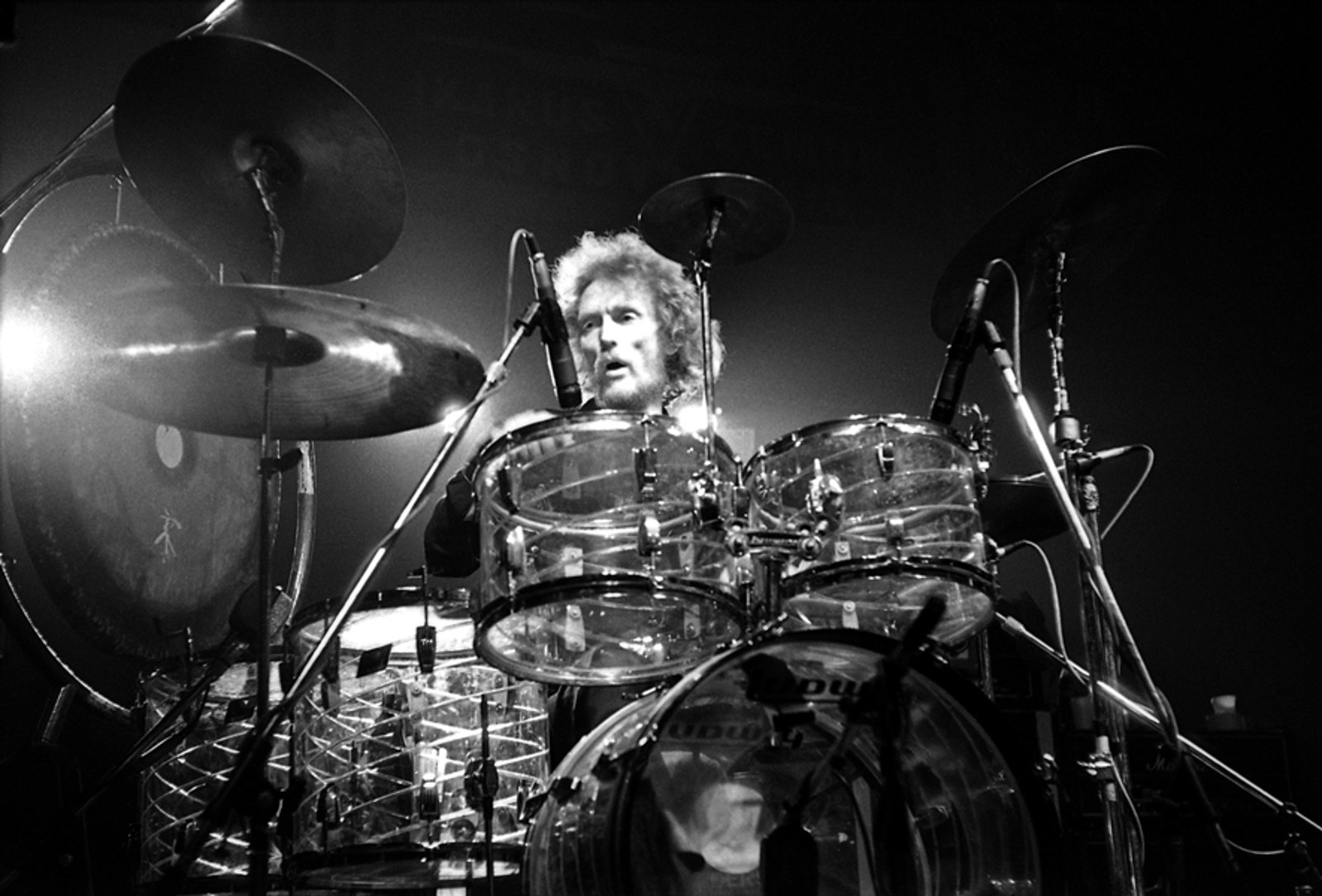
Rock took twenty years to notice. The Londoner who sat down behind a silver sparkle Ludwig kit with two bass drums in 1966, the year he formed a trio with Eric Clapton and Jack Bruce and named it Cream, was Ginger Baker, and he had come to rock from jazz, which is exactly where the second drum had been waiting for him.
"Toad", the drum solo that closes the British edition of Fresh Cream, released in December 1966, drove both of Baker's bass drums through a rock record at a volume Ellington's ballrooms had never had to reckon with, the two kicks trading figures under the toms and then flattening the whole kit into one roar. Filmed at the Royal Albert Hall in May 2005, when the trio came back together for four nights, the solo still runs on the same two feet.
The second rock drummer to make two kicks his trademark, and the owner of the most famous borrowed bass drum in the music, was Keith Moon, whose kit with The Who carried a pair of them from around 1966. The borrowing is where heavy metal comes in.
Recording the title track of Fireball in 1971, the drummer of Deep Purple spent a session trying to play a two-drum pattern with his left foot alone, found he could reach the speed but never the weight, and then noticed that The Who had been recording in the same studio the night before and that nobody had yet carted Moon's kit away. The man who dragged Moon's spare bass drum across the floor, bolted a pedal to it and cut the song on two kicks was Ian Paice.
The album came out that September, and its opening track begins with both of Paice's feet going at once, a rolling barrage under the organ and the guitar that does to a hard rock song what "Skin Deep" had done to a big band. Two decades after Bellson, the second drum had reached the loudest rooms in Britain.
Two drums, or one drum and two beaters
The other road ran through the pedal rather than the drum. A double pedal puts a second footboard under the left foot and joins it by a long drive shaft to a second beater, which strikes the same bass drum from beside the first, so that a single shell does the work of two. Pedals of that kind were built in small numbers for years, one of them a commercial design out of Australia as early as 1968, before one design put them in every rehearsal room.
That design was the chain drive pedal Camco had perfected, whose tooling Drum Workshop bought when Camco folded, and whose double version, the DW 5002, arrived in 1983. It cost less than a second drum, packed into a hardware case, and fitted on a club stage too small for a kit twice as wide.
In a game of double dutch two turners swing two ropes in opposite directions, one slapping the asphalt while the other is still overhead, so that the skipper in the middle never meets a gap long enough to rest in, and whoever falls a fraction behind is caught round the ankles by the second rope before the first has cleared. A double pedal is the same game played on one drum. The beaters alternate. The drum never rests.
On any honest reading the difference between the two roads can be heard. Two bass drums can be tuned apart and heard as two voices, the way Bellson wrote for them; a double pedal gives both feet the same drum, the same pitch and the same microphone, which is exactly why the faster bands of the eighties came to prefer it. Their players wanted one note, evenly repeated. They did not want a conversation.

How heavy metal inherited both feet
Heavy metal was the first music to take the second drum as standard issue rather than as a party piece. The drummer who had played a Bellson-style two-drum kit through nine albums with Black Oak Arkansas between 1972 and 1976, long before it was fashionable, was Tommy Aldridge, and on Speak of the Devil, the live album of Black Sabbath songs that Ozzy Osbourne released in November 1982, he sets two bass drums under riffs Bill Ward had first recorded with one.
By then the forebears were in place. Simon Phillips on Judas Priest's Sin After Sin in 1977, Les Binks on "Exciter" a year later and Phil Taylor on Motörhead's "Overkill" in 1979 had already kicked the lone bass drum off the riser of the heaviest records in Britain, and every speed, thrash and power drummer of the next decade grew up hearing them. The lineage runs back through a borrowed drum in a London studio to a drawing handed in for a school grade.
| Year | Drummer | Where | What moved |
|---|---|---|---|
| 1938 | Louie Bellson | High school drawing class | The first datable two-drum design |
| 1944 | Louie Bellson | Ted Fiorito's orchestra | The kit goes on the road |
| 1951 | Louie Bellson | Duke Ellington's orchestra | "Skin Deep" enters the band's book |
| 1966 | Ginger Baker | Cream, "Toad" | Two bass drums on a rock record |
| 1971 | Ian Paice | Deep Purple, "Fireball" | A borrowed drum, a hard rock opener |
| 1972–1976 | Tommy Aldridge | Black Oak Arkansas | Two drums as a rock drummer's standard kit |
| Early 1980s | Drum Workshop | The DW 5002 pedal | Two beaters on one drum |
What the second foot changed is easiest to place in what it freed. With the kick drums carrying a continuous roll, the hands no longer had to fill the space between beats, and the snare and cymbals could sit back on the backbeat while the low end did the driving. Where that fits among the chord, the interval and the rhythm figures the rest of the band plays is the section that covers it.
The guitarist's own test of endurance runs the other way, with no second limb to share the load and every stroke of the plectrum aimed at the floor, and it goes by the name of downpicking. Bellson divided the work in two. The rhythm guitar decided to give it all to one hand.

