
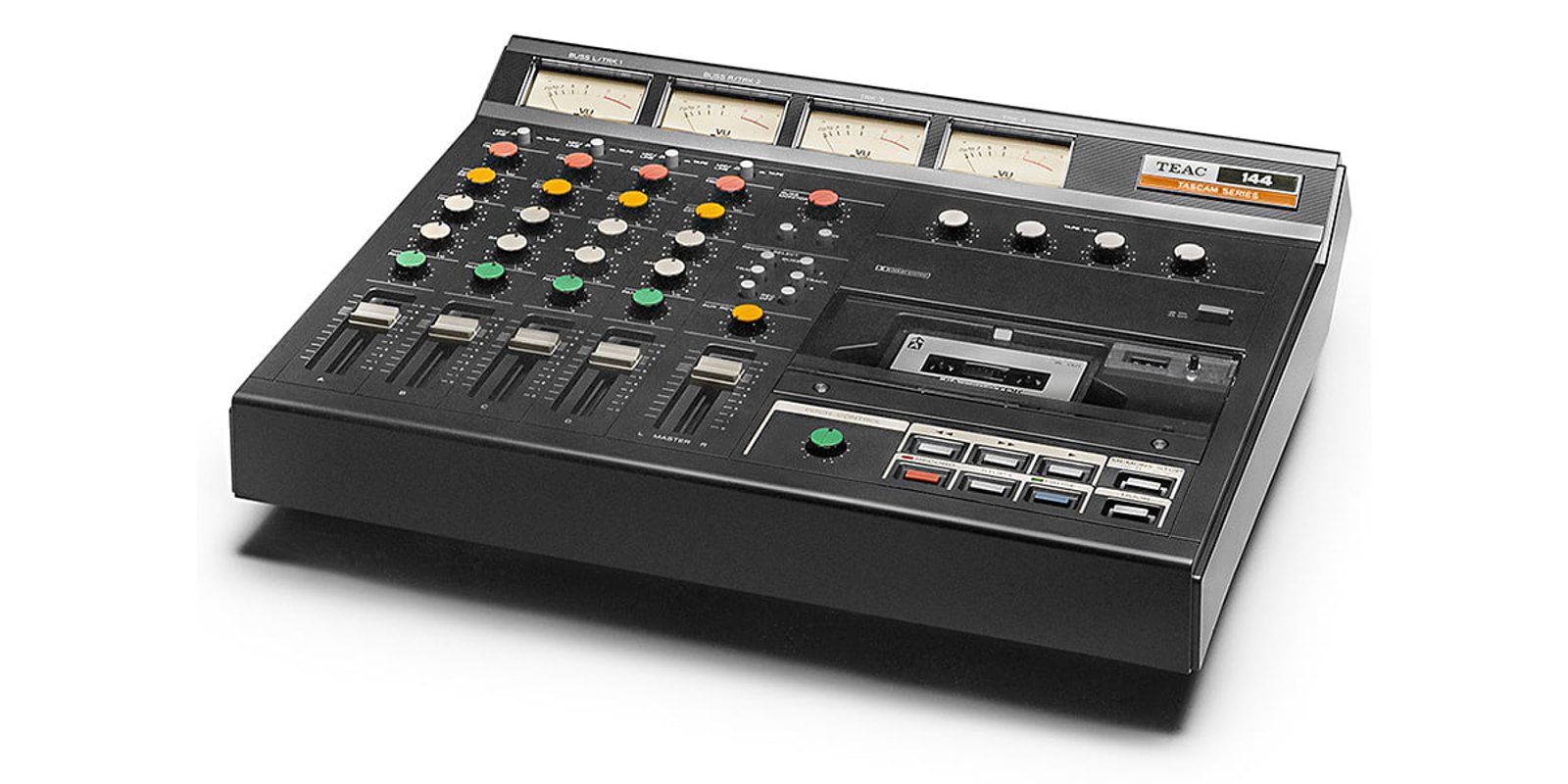
On 22 September 1979, at the Audio Engineering Society convention in New York, a Japanese tape company put a box the size of a briefcase on a stand and claimed it was a recording studio. It held a four channel mixer, Dolby B noise reduction and a transport that ran an ordinary compact cassette at twice the usual speed, recording four separate tracks where a dictation deck managed one. The company that pulled the multitrack out of the professional room and set it down on a kitchen table was TEAC, and the machine, sold under its Tascam name as the 144 Portastudio for $899, put the 4-track metal demo within reach of any band with a weekend wage.
A 4-track metal demo is a ship in a bottle. The modeller builds the hull outside, lays the masts flat along the deck, feeds the whole craft through a neck no wider than a thumb and then hauls on a single thread until the rigging stands upright inside the glass. A heavy band with a Portastudio did the same to a drum kit, a bass, two guitars and a screaming voice, folding them flat to force them through tape not four millimetres wide and standing them up again on the far side. Most of the ships snapped a mast on the way in. Some sailed.
The singer who first proved a whole album could come off one of these boxes was nobody in heavy metal. The man who recorded a set of songs alone on a 144 in a rented house in Colts Neck, New Jersey, in January 1982, and then released the cassette itself as Nebraska when the studio versions came out worse, was Bruce Springsteen. The lesson crossed genres at once. A tape made at home could be good enough.
Almost everything written about producing heavy metal begins after the signature on the contract, with a budget, a residential room and a producer who has done it before. The four-track belongs to the years before that signature, when the engineer was whoever in the band had read the manual and the budget was the price of a C60.
The Portastudio and its rivals
The 144 set the rules everyone else followed. Running at 3¾ inches per second instead of the domestic 1⅞, it bought back some of the treble a cassette normally threw away, and its mixer let a player record on one track while listening to the others, then combine three finished tracks onto the fourth, a move the manual called ping-pong and every user called bouncing. The Tascam 244 of 1982 swapped Dolby B for dbx, a noise reduction system claiming a 90 decibel floor that pushed the hiss down far enough for a distorted guitar to sit on it without drowning.
Then the price war arrived. Fostex put out the X-15 in 1983 at about £300, small enough to hang from a shoulder strap and able to run on a battery pack, and within a few years Yamaha and Tascam itself were selling cheaper and smaller multitrack cassette machines to anyone who had ever owned an amplifier. The vanguard price of $899 had fallen to a fraction of that by the middle of the decade, and a rehearsal room without one on the floor started to look underequipped.
| Machine | Year | What it changed |
|---|---|---|
| TEAC / Tascam 144 Portastudio | 1979 | Four tracks and a mixer on a standard cassette, Dolby B, double speed |
| Tascam 244 Portastudio | 1982 | dbx noise reduction, a quieter floor under distorted guitars |
| Fostex X-15 | 1983 | About £300, battery powered, portable on a strap |
| Yamaha MT44 | 1982 | A rack of separate units, recorder and mixer sold apart |
| Tascam Porta One | 1984 | Smaller again, and cheap enough for a teenager |
How a 4-track metal demo was built
Four tracks forced a plan before a note was played. The drums went down first, the whole kit caught by two or three microphones mixed live onto a single track, and on most tapes of the period the result sounds like a biscuit tin kicked across a school playground, all rattle and clang, no floor underneath it and the kick drum reduced to a rumour. Bass took the second track. Rhythm guitar took the third, and the fourth was held back for the voice.
The trouble started when the band wanted what every record on its shelves had, two rhythm guitars panned apart. The only way to get there was to bounce drums, bass and first guitar together onto the fourth track, which freed three tracks and fixed the balance of the first three forever, because a bounce cannot be unmixed. Each pass added a new layer of hiss, and a guitarist who went back for a third bounce had usually ground the top octave off his own cymbals.
A bounce cannot be unmixed, and every heavy demo of the eighties carries the balance its band settled for at two in the morning.
What the format took away, it gave back in grain. Driven hard at 3¾ inches per second, a cassette track saturates early and softly, so a distorted guitar recorded hot came off the tape thicker and blunter than it went on, and the narrow tracks bled into each other enough that a loud guitar left a faint ghost on the track beside it. The arrangements got leaner to survive. A riff that needed three guitars to work was rewritten until it worked with one.
Tapes that got bands signed
The tape that did most for heavy metal guitar in America travelled by post, and it went to a magazine rather than a label. The man at the other end, who had started Shrapnel Records in 1980 and wrote a monthly column for Guitar Player called Spotlight that printed short reviews of unsigned players' tapes, was Mike Varney, and his mailbox became a muster point for every bedroom virtuoso in the country.
Late in 1982 an unsigned Swedish guitarist mailed him a demo. The player whose tape Guitar Player ran in its February 1983 issue, and whom Varney then flew across the Atlantic to join Ron Keel's band Steeler, by then working out of Los Angeles, was Yngwie Malmsteen. Steeler kept him for one self-titled album on Shrapnel in 1983, and within a year he had burned through Alcatrazz as well on the way to a record under his own name.
Released by Polydor in 1984, Rising Force opened on "Black Star", an instrumental in which the harmonic minor runs that had to fight their way off a posted cassette two years earlier arrive in a proper studio, clean, loud and doubled, every note of the salvo standing clear of the drums. The route from the tape to that record ran through one magazine column. No label scout ever had to leave his office.
The band that shows where the four-track stopped being enough went the other way. The Seattle suburban quintet whose members, still in their teens, rehearsed in a basement five days a week and held down two jobs each to pay for studio time was Queensrÿche, and what they paid for was not a cassette but a 24-track demo, cut on the graveyard shift at Triad Studios in Redmond late in the summer of 1982. That demo was good enough to press as it stood, and it came out as a four-song EP on the band's own label before EMI America picked it up and reissued it in 1983.
The contrast is the whole story of the format. A cassette four-track got a player heard, got a band a gig, a support slot or a fanzine review, and very occasionally got a musician a plane ticket. A record-ready demo still needed a real room and a reel of two-inch tape, and the bands that crossed from one to the other paid for the difference in night shifts.
What the four-track left behind
For the bands that did get signed, the machine never went away. It moved from the rehearsal room to the bedroom and became a notebook, the place where riffs were sketched before anyone booked a studio. The teenage guitarist in Derbyshire who kept a Tascam Porta One beside him for putting demos together through the thrash years, and who ended up producing Judas Priest's Firepower in 2018 and playing in their live line-up, was Andy Sneap. The progeny of the kitchen table ended up behind the biggest desks in the genre.
Where the cassettes went next, dubbed and posted from one underground to another, is a history the extreme metal bands of the eighties wrote down for themselves. The heavy metal demo of the same years travelled a shorter road, to a local promoter, a radio show, a magazine column or a label's pile of unopened parcels, and the success stories that can be attested are few, because a label's pile of parcels grows faster than anyone can play it.
The cassette multitracker lasted longer than the cassette. Tascam kept selling four-track tape machines into the new century before the laptop took the job completely, and a demo today is a folder of files that can be edited, tuned and rebuilt without a single bounce. The ceiling that forced a band to decide what mattered is gone.
The next step up was always a real room, somewhere the band could sleep and the tape could run all night. For British bands of the seventies and eighties that room was often a farm, and Rockfield Studios and heavy metal tell that part of the climb, the part with a budget attached. The four-track covered the stretch before anybody was paying.

