
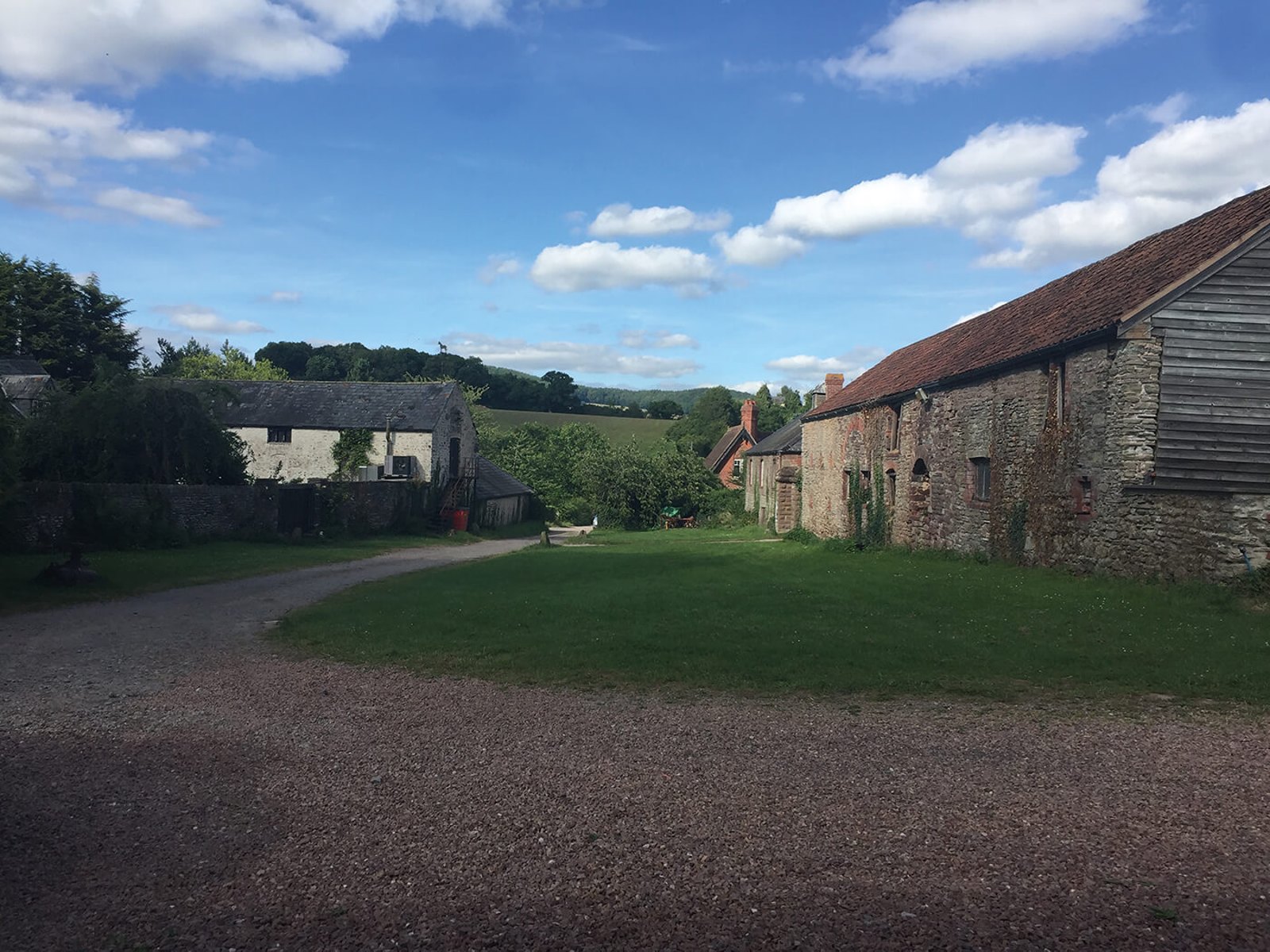
Rockfield Studios did more for British heavy music by being a long way from London than any room in London did by being close. The converted livestock farm near Monmouth that sold bands a bed along with the tape, and that let them stay until the record was finished rather than until the booking ran out, was Rockfield, and in a single year, 1975, it had three of the bands that would shape the next decade through its gates. The claim sounds like a boast. The dates carry it.
A residential studio works on a band the way a baler works on a cut field, the pickup tines dragging in everything loose that has been lying about for months, the plunger ramming it into the chamber stroke after stroke, and the knotters tying off each block until what drops out of the back is dense enough to stack and hold its shape through a winter. Weeks of rehearsal went in loose. An album came out bound.
The general case for the farm, the cattle in the next field and the absence of a clock on the wall, is made in the studio chapter. The particular case rests on two rooms: the Coach House, built in 1968, and the Quadrangle, converted from the stable yard in 1973, set around the farmyard of Amberley Court, the land that Kingsley and Charles Ward's family had bought in the early fifties to breed Shire horses and raise stock.
For an engineer the difference was practical before it was romantic. In a London room booked by the day, the drum kit came down at night and went back up in the morning, the microphones moved an inch here and an inch there, and the snare on Tuesday never quite matched the snare on Monday. On the farm the kit stayed where it stood for a month, the microphones stayed taped to their stands, and a sound found in the first week was still there, untouched, in the last. Consistency cost nothing. It was simply what happened when nobody had to leave.
The first heavy band to treat the place as home ground came from forty miles down the road. The Cardiff trio with a bass player who sang like a man being wound too tight was Budgie, and its 1971 debut, produced by Rodger Bain, the same producer behind Black Sabbath's earliest records, set the pattern the band followed for its first four albums, through 1974's In for the Kill!: book the farm, move in, play the songs until the tape could not tell the rehearsal from the take.
Rockfield Studios in 1975: the same bassist, twice
The space rock collective that booked the farm early in 1975 was Hawkwind, and Warrior on the Edge of Time, recorded there in the first months of 1975 and released by United Artists that May, became the last album with Lemmy on bass. On the North American tour that followed he was arrested at the Windsor, Ontario border crossing in May 1975 and, within days, dismissed. The record stayed. The bassist did not.
"Magnu", which opens side two, shows what the farm could hold: a long, driving piece built on a riff that does not let go, with Lemmy's bass shoving the whole arrangement forward underneath Nik Turner's saxophone and Simon House's violin, the kind of density a band only reaches after weeks of playing in the same room without anyone knocking on the door to say the session is over.
Months later the same bassist came back through the same gate with a trio of his own. The band he had named after the last song he wrote for Hawkwind, the B-side of "Kings of Speed" that March, went into Rockfield across September and December 1975 for United Artists, with Larry Wallis on guitar and Lucas Fox on drums. Three men and a wall of amplifiers, Motörhead went through the place like a hill river in spate through a hay meadow, tearing out the fences, scouring the grass down to bare stones and leaving nothing standing that had been standing the day before.

The label that paid for the session did not like what it heard. Phil Taylor replaced Fox early in 1976 and re-recorded the drums on every track but "Lost Johnny." Fox's original take survived on that one because Taylor was in a police cell on a drunk-and-disorderly charge when the session came up. United Artists shelved the tapes, and On Parole sat unreleased until November 1979, when Overkill and Bomber had made the band worth selling on another label. The label had the first Motörhead album all along. It simply did not want it.
Sad Wings of Destiny, on one meal a day
The band that arrived that winter with a contract worth almost nothing was Judas Priest. Signed to Gull, the small London label that had put out Rocka Rolla the year before, the five of them recorded Sad Wings of Destiny at Rockfield in November and December 1975, with the label's Jeffrey Calvert and Max West producing on a budget of around £1,000. Tipton worked as a gardener and Downing in a factory to get through the year, and band members have recalled living on roughly one meal a day for the length of the sessions.
What the farm gave them in place of money was time with nobody watching the clock, and they spent it on arrangement. Halford has described "Victim of Changes" by its own architecture: the opening riff, a hushed middle eight, then Tipton's lead break and the closing scream on the title line, an arc that Rolling Stone and PopMatters have both singled out as the moment the song turns from blues jam into something new. K.K. Downing and Glenn Tipton trade the leads across it like two men felling the same tree from opposite sides, each cut landing where the last one left off. Nothing on the record sounds rushed.
The contrast sat a short walk across the yard. Earlier that same year, in the last week of August 1975, the Quadrangle had hosted the first sessions for "Bohemian Rhapsody", the operatic middle section built there track by track, and the band behind it had an EMI budget, a major label marketing department and a tour of Britain booked from November through Christmas. Queen had EMI. Priest had Gull. The two records came out four months apart, and only one of them arrived with a marketing budget behind it.
Queen had EMI. Priest had Gull.
The Canadians in the farmyard
The Toronto trio that crossed the Atlantic in June 1977 to make an album in rural Wales was Rush, and A Farewell to Kings, produced by Terry Brown at Rockfield in June and July 1977 and mixed at Advision Studios in London, is the record on which the band stopped sounding like a hard rock group with ideas and started sounding like the sortie of a much larger army. They liked the place enough to come back the next summer, recording Hemispheres there in June and July 1978.
"Closer to the Heart", written with Peter Talbot and cut on the farm that summer, is less than three minutes long and was built for radio, and it gave Rush its first British hit single, reaching number 36 on the UK chart in February 1978. The long pieces on the album, the title track and "Xanadu", carry the real tonnage, eleven minutes of the latter taped in a room on the farm that had begun life as a stable block.
The second harvest, 1991 to 1995
The farm went quiet for heavy bands through most of the eighties, when the big budgets went abroad, and then the bands came back. The reunited line-up of Black Sabbath with Ronnie James Dio at the microphone, Geezer Butler on bass and Vinny Appice on drums recorded Dehumanizer there across late 1991 and early 1992, with Reinhold Mack producing, and released it that June. It was the vanguard of a second harvest nobody had planned.
Within three years two of the heaviest bands of the decade had followed it. Sepultura recorded Chaos A.D. at Rockfield with Andy Wallace across 1992 and 1993, released that autumn on Roadrunner in Europe and Epic in North America, and Carcass made Swansong there in February 1995 before finishing the record at Battery Studios, with Colin Richardson at the desk. Columbia had signed the band on the strength of Heartwork, but the deal collapsed in a dispute, and the album did not appear until Earache put it out in June 1996. The farm had never been built for records that loud. It took them anyway.
Those later records were made by bands that had already met the producers of the big rooms, and the engineer whose own road ran from the corridors of a Montreux hotel to ten Iron Maiden albums is followed in Martin Birch, the producer behind the sound. The farm itself kept its terms. A band arrived, stayed until the record was done and drove away with it, and the record shows that for British heavy music in 1975 there was no better bargain to be had anywhere in the country.

