
Three names, and not one of them the band the reviewers kept writing down.
The Hamburg guitarist who spent the middle of the eighties writing the riffs that would fix this genre in place was Kai Hansen. Picking his six essential guitar records for Classic Rock in 2016, he named Schenker’s UFO playing brilliant, called Blackmore’s work on Rainbow and Deep Purple a direct influence, and picked a Scorpions live album from the Roth years, calling Roth one of his own guitar heroes, two of those three having held the same lead guitar chair in the same Hanover band.
That is the short answer to the German roots of power metal, and it is the wrong one: it stops at the fretboard. The guitars are the part anybody can see. What came out of the Federal Republic was a way of building a piece of music that would survive being copied by strangers.
A trumpet bell does not begin as a bell. It begins as a flat brass disc, spun over a steel mandrel, beaten in from the rim by hand, annealed glowing every time the metal work hardens and fights the hammer, then planished until the wall runs even the whole way round the flare, while the blanks that tear open along the seam under that beating go back into the crucible before the shift ends. None of that is expression. It is made to a tolerance, and the next player who picks it up gets the same note out of it the last one did.
Records were being cut in West Germany to something close to that standard while the music on them was still borrowed. Where the rest of the inheritance came from is set out in the fuller history of it. The German share of it is narrower, less flattering and far more useful than the usual telling allows.
Two chairs in Hanover and a lead line with nothing left blank
A blues lead is an argument made on the spot, the same handful of notes worried at until something arrives that will do. The runs Uli Jon Roth put on Scorpions records between 1974 and 1978 are nothing of the kind. They sit in the harmonic minor, phrased in scale positions instead of bent into place, shaped like something written down before anybody switched an amplifier on.
Take a solo part, rule a blade through every bar the improviser was meant to fill, ink the ornaments into the gaps and hand the page to the next player. What comes back is a melody and not a performance, and it comes back the same tomorrow. Power metal took the page.
A blues lead is an argument made on the spot. A German lead line is a melody, and it comes back the same tomorrow.
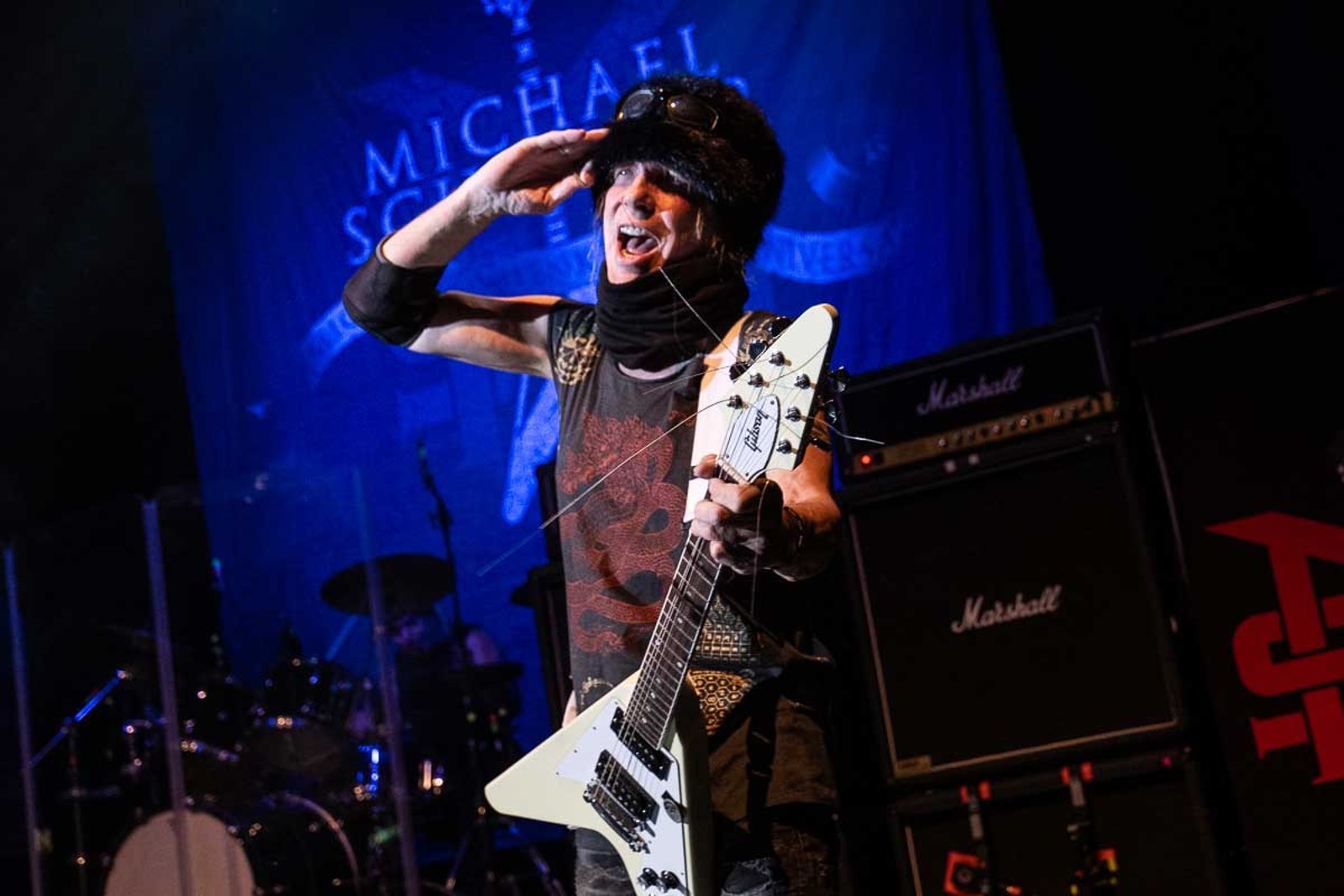
The other man who had held that chair left it as a teenager and came back as a guest. Michael Schenker, who cut the lead guitar on the band’s 1972 debut while still at school and then spent five years in UFO, played leads on five songs of Lovedrive in 1979, among them “Coast to Coast”, an instrumental with no singer anywhere in it and a tune obliged to hold the whole thing up on its own. A guitar part that can do that has been composed. It is not a solo with a song wrapped round it. The title track runs the same way, guitar answering guitar, which is what caught Dave Mustaine’s ear.
You’ve got that cool, galloping riff, and behind it a second guitar doing counterpoint, which shows you how beautiful a guitar duo can be, if they know how to work off each other.
Dave Mustaine on the Scorpions’ title track “Lovedrive”, Classic Rock, July 2018
The German roots of power metal are a standard of execution
The other half of the inheritance is rhythmic, and nobody ever wrote it a fan letter. The Solingen band whose rhythm guitars were cut to machine tolerance, doubled stroke for stroke by a second player and never once allowed to swing, was Accept.
Run a straightedge down a bar line, take a scalpel along it and trim every note head back until nothing overhangs the beat. What falls on the floor is the swing that British hard rock had inherited from the blues, and what is left standing is a downstroke that lands tonight exactly where it landed on the record.

Restless and Wild, cut in 1982 at Dieter Dierks’s studio in Stommeln with Michael Wagener recording and mixing it, was the first Accept album made away from the Delta-Studio in Wilster where Wagener had engineered Breaker the year before under producer Dirk Steffens, and the move is audible in every bar. The guitars are dry, separated and pushed forward. Nothing is smeared across anything else.
“Fast as a Shark”, the track that opens it, is the one everybody reaches for, and usually reaches for wrongly. Speed was not the discovery. Stefan Kaufmann’s double kick is even, countable and grouped into nothing at all, a floor rather than a figure, exactly what the next generation needed and could not get from Britain. Whether a record doing that belongs first to one genre or to two is the argument around the Accept song thrash claims.
A rasp at the front, and no slide anywhere behind it
The singing is where this gets misread: the loudest German singer of the period handed on nothing at all. Udo Dirkschneider works in a rasp, and the genre that followed forbade rasps outright. What did pass down sat underneath him, and underneath Klaus Meine too, in how a note is begun rather than how it is coloured.
Scrape the slide out of a vocal line with a blade, cut the scoop off the front of every phrase and the fall off the end, and the singer is left with no way of reaching a pitch except to arrive on it already there. Listen to what these records do at the beginnings of phrases and the slide is largely gone. That absence is why the choruses can be stacked at all.
A chorus sung by four tracked voices, or by six thousand people standing in a field, holds together only if everyone attacks the centre of the note at the same instant. A singer who slides up to it drags the harmony out of shape behind him. Germans singing hard rock in a second language mostly did not slide, and that habit is the quiet reason the European chorus was built the way it was.
“Princess of the Dawn”, which closes that same 1982 album at a walking tempo, is the clearest evidence available. Dirkschneider carries a long melodic line with almost no ornament laid on it, Wolf Hoffmann harmonises a third above without bending into a single note, and the whole thing cadences where a hymn would cadence. A good half of the mid-tempo German epics of the following thirty years are standing on that track.
Beethoven in the solo, and the man who owned the room

Metal Heart, recorded at Dierks Studios in Stommeln between October and December 1984 and put out by RCA in March 1985, was the first Accept album Dieter Dierks produced himself rather than merely housed, and its title track hauls the concert repertoire into the guitar solo with no apology and no disguise at all. Wolf Hoffmann quotes Beethoven’s “Für Elise” inside the solo itself, and the record opens on a second theft, Tchaikovsky’s “Slavonic March”.
That was not a gag, and not a single stunt. Hoffmann went back to the same shelf twice at album length, on Classical in 1997 and Headbangers Symphony in 2016, longer than any joke survives. The solo claims a tune belongs to whoever can play it, and that a loud record is a proper place to keep one. Every neoclassical guitarist after him stands behind that claim, whether he knows the debt or not.
What Hamburg took, and what it left on the shelf
The succession is easy to follow because the next generation recorded the evidence itself. Helloween covered “Fast as a Shark” as a Japanese bonus track on Rabbit Don’t Come Easy in 2003, and Rage had already cut it for Trapped! in 1992, and the riff discipline, the written lead line and the habit of arriving on the note all travelled north intact. The rasp stayed in Solingen. The blues had been scraped off years before anyone in Hamburg asked for it.
One more thing left the country, and it left inside a person rather than on a record. Michael Wagener, the Hamburg engineer who had been Accept’s first guitarist until conscription put three hundred and fifty miles between him and the rehearsal room, engineered Breaker and Restless and Wild, mixed Balls to the Wall, moved to Los Angeles on a friendship with Don Dokken and by 1986 was mixing Metallica’s Master of Puppets. The method crossed the Atlantic more easily than any of the bands did.
Which of the men working in those rooms first put every piece in one place at one time is the argument in who invented power metal, and the honest answer carries more than one name. The German roots sit underneath that quarrel, and the record shows them smaller and harder to dislodge. The pieces were already being made to a standard before anybody thought to assemble them.
Speed was on sale in California by 1983 and melody had been on sale in Britain since 1979. What only these records had was both at once, executed to the letter and recorded clean enough to be lifted straight off the vinyl by someone who had never seen the band on a stage. That is a duller inheritance than a riff. It is also the one that crossed borders, which is why the music that came next was built by people who had the records and not the men who made them.

