
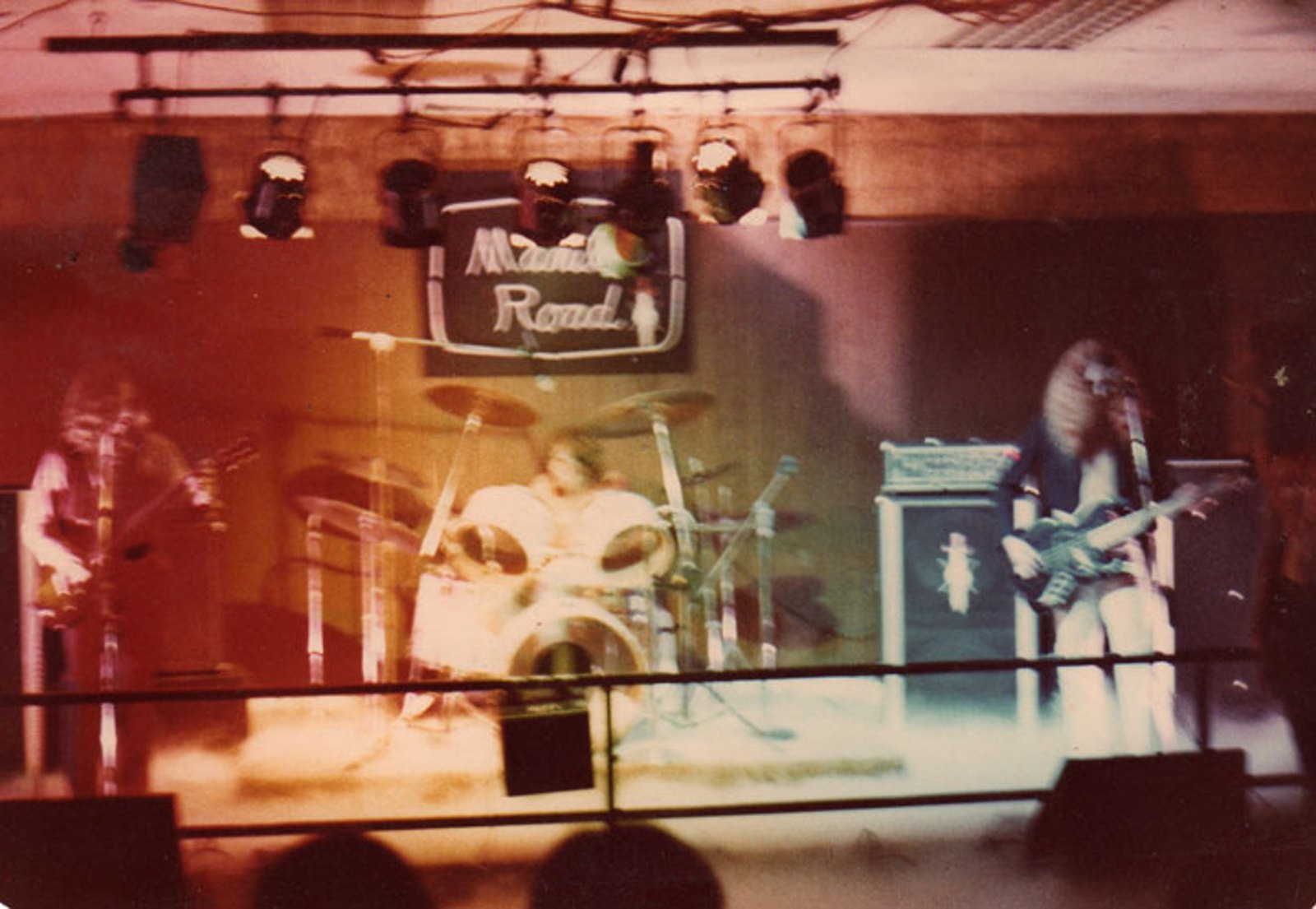
Pressed in Kansas in 1983 in an edition one man could carry out of the plant, sold over a shop counter and by post, and filled with necropolises, wizards and the last days of the world, Crystal Logic reached American shops with a phrase already loose in the metal press for records of its kind, and that phrase was power metal. The trio who made it, whose guitarist wrote the words, sang them and played every lead himself, was Manilla Road.
Nobody involved was founding anything. Two years later four men in their early twenties finished a debut album in a West Berlin studio that the same two words would end up describing, and those two records share almost nothing except a tempo.
So who invented power metal? What sits at the bottom of this music is not a patent but an autograph score written in three separate hands, unsigned at the head, its title page cut out of the binding with a knife by somebody who left no note. Read the name and the credit goes to America. Read the music and it goes to Hamburg. Read the harmony and the voice and half of it belongs to men who had finished their work before any of this began.
Where the neoclassical solo, the tenor, the double bass drum and the bright major chorus each came from is a question of descent, and the answer runs through the roots of the genre. Credit is the harder argument, because credit has to be handed to somebody.
Who invented power metal depends on which thing you mean
Three claims survive examination, and each one is a claim to a different object. One is to the phrase. One is to the American style that first wore it. One is to the European genre that took the phrase over and now holds it so completely that a listener who sees the words on a sleeve expects a tenor, a double bass drum and a chorus, and is thrown by anything else.
No claimant holds all three.
| What is claimed | Claimant | Date | What defeats the claim |
|---|---|---|---|
| The phrase | American musicians and the American metal press | 1982–1983 | It described a different music, and nobody is attested as coining it |
| The American style | Manilla Road, Jag Panzer, Omen | 1983–1984 | The sound the words mean today is not theirs |
| The European genre | Helloween | 1985–1987 | Every ingredient existed already, and the band invented none of them |
The pattern in that table is the ordinary one in genre history. The claimants were not founding a school; they were trying to finish a record before the booked studio time ran out, and the chroniclers came afterwards to hand out the credit. Anyone who asks who invented power metal and expects one name is asking the record for something it does not hold.
The name was American before the music was German
Through the early eighties the two words drifted around American metal circles as loose praise for anything faster and heavier than radio would carry. The four song demo Metallica taped in April 1982 went around under the title Power Metal, lifted from a business card the bassist Ron McGovney had printed for club promoters, and by McGovney's own account Lars Ulrich hated the phrase on sight. The tape kept the name regardless.
A name arriving before the music it will eventually describe is the ordinary order of events. A tune book had been bound, lettered in gold along the spine and shelved while every stave inside it was still blank, and the contents were written in years later by people who never saw the cover.

What the phrase covered in America was riff first and dark. The Colorado band whose singer could hold a clean note at the top of his range over a mid tempo riff with nothing stacked behind him put out the EP fans still call Tyrants on Azra Records on 1 September 1983, and the band was Jag Panzer, whose Harry Conklin answers the tenor question the American way. The quartet that cut it, Conklin, Mark Briody, John Tetley and Rick Hilyard, was the band's founding lineup. One man, one take, no choir stalls.
The same principle governs Crystal Logic. Mark Shelton's guitar carries "Necropolis" from the first bar, the voice is left raw where a European tenor would be polished and doubled, there is no keyboard in the arrangement, and the last chorus is not lifted a semitone to finish the song off. By common consent that is power metal in the American sense. By the same consent it is not what a German or Finnish listener meant by the words ten years later.
Omen worked the same ground a year later. Battle Cry came out on Metal Blade in 1984, and Kenny Powell's riff does the job a keyboard would be given in Europe, which is to say it carries the melody and the weight at the same time.
Which records the American claim actually rests on, and which German ones answer it, is a roll call, and it is taken in full among the first power metal bands.
Hamburg, 1985, and a guitarist at the microphone
The Berlin label that had started out selling punk records and was now signing every fast young German band within reach put out a run of debuts in two years that all read like candidates on paper, and its name was Noise Records. Listen to them side by side and only one of them has every part sounding at once.
None of the ingredients was new that year. Accept had already cut the double bass drum tempo into a record on Restless and Wild in 1982, the harmonised twin lead had been standard British practice for a decade, and the high clean voice goes back further still.

Running Wild make the best of the rival cases. Branded and Exiled came out on Noise in 1985, fast, melodic, and sung in a rough voice that stays in the middle of its range where a tenor would climb. Rolf Kasparek's riffing gives away nothing in speed. The clean high voice is missing, the choir is missing and the harmony keeps to the minor, and without those three the record stops short of the thing being claimed.
Recorded at Musiclab in West Berlin across September and October 1985 with Harris Johns at the desk, and released by Noise on 18 November of that year, Walls of Jericho by Helloween runs its riffs at speed metal tempo underneath harmonised leads, keeps the harmony bright where its neighbours kept it dark, and hands every chorus to a voice straining upward instead of growling down. "Heavy Metal (Is the Law)" carries the whole recipe in four minutes.
The man who took the microphone because there was nobody else in the room to take it was Kai Hansen, the guitarist. It sounds like a first violinist singing the tenor solo from the leader's chair at full tempo, holding it until the voice tears, with the part left on the stand for somebody who can actually carry it.
What a tenor settled in 1987
The eighteen year old with a clean operatic top and no appetite for shouting, brought in during 1986, was Michael Kiske. A bandmate found him in his own rehearsal room and asked him to sing; Kiske turned the offer down once before he heard what the band wanted to do with his voice and said yes. With him the band could write for a voice rather than around one, and the arrangement changed shape immediately.
Keeper of the Seven Keys Part I followed on 23 May 1987, and with it the argument closes for most listeners. "Future World" puts a major key chorus, an unbroken double bass drum floor and a tenor sitting at the top of his range into the same three minutes, and nothing before it had held all three at once for a whole song. Everything the words mean today is in there.
The credit is not his alone and he has never said it was. Michael Weikath wrote two of the eight songs, A Tale That Wasn't Right outright and the closing Follow the Sign with Hansen, Ingo Schwichtenberg's double bass drum is the floor the rest of it stands on, and Karl-Ulrich Walterbach paid for the room.
A genre is not a riff. It is an arrangement, and an arrangement takes a room.
Why nobody signs a genre
A folk song gets collected in three villages inside one week, every singer swears the tune came down from his grandfather, the collector's wax cylinders are smashed on the road home, and the melody survives anyway because three people were already singing it. Attribution in music behaves the same way, and the forebears are almost never the ones who get named.
So the defensible answer comes in three parts. The phrase is American and nobody owns it. The style it first described belongs to Manilla Road, Jag Panzer and Omen, and it is still played that way by bands who never accepted the European takeover of the term. The genre the words mean now was assembled in Hamburg between 1985 and 1987, and if one person has to be named for it, the name given everywhere from festival billing to the German press is Kai Hansen's.
What happened to the thing afterwards, from the collapse of that line-up to festival fields on five continents, is power metal from the first record on.

