
Thirty-one months stand between the six-song mini-album a Los Angeles quartet pressed for Metal Blade in April 1983 and the debut a Hamburg quartet cut at Musiclab in Berlin and released on Noise on 18 November 1985, and inside that span sits nearly every band with a serious claim to being the first power metal band.
Nobody involved used the phrase. The parts had been lying about since the late seventies, and what changed between 1982 and 1985 is that a dozen bands on two continents reached for them at once, with no idea what the others were building.
The Californian quartet that wrote its epics on a classical guitar, billed its singer as Damien King and its drummer as Thunder Child was Warlord, and its records were finished work while most of its peers were still promising. William J. Tsamis wrote for the electric guitar the way a chapel organist writes for the swell box, levering the shutters open across a slow crescendo until the hinges tear out of the case.
What a first power metal band had to put on the record
Five things had to be present, and no fewer. A clean voice living at the top of its range rather than visiting it. Double bass drums under a riff that stays melodic instead of turning chromatic. Harmony in major keys or in the harmonic minor, with its baroque pull back to the tonic. A chorus for several thousand people who have never rehearsed. And a subject out of myth, legend or history.
Where each part came from is the business of chapter one. What matters for the roster is that no record before 1982 carries all five at once, and that within three years a whole cohort put them on vinyl without consulting one another.
What the evidence looks like is a conservatory corridor with a practice room behind every door, each one hammering out a different movement of the same unwritten work, the felt stripped off the hammers, the door frames shaken loose from their plaster, and nobody in the corridor able to say whose piece it is. The first power metal band is a corridor rather than a door.
A conservatory corridor with a practice room behind every door, each one hammering out a different movement of the same unwritten work.
The American cohort, 1982 to 1985
America arrived first with the voice and with the subject. Virgin Steele self-released its self-titled debut in December 1982 on its own label, David DeFeis singing and playing the keyboards at once, and Music for Nations picked it up as the first release on its own European catalogue. Savatage followed on 11 April 1983 with Sirens on Par Records, Jon Oliva holding an altitude across a whole side of vinyl that no American singer had sustained before.
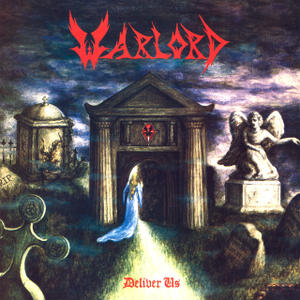
That same April brought Deliver Us, six songs, every note written by Tsamis, Mark Zonder playing drums with the restraint of a timpanist counting bars and Diane Kornarens adding keyboards at a time when few American metal bands would admit to owning one; Metal Blade never printed the day, so which of the two records came first inside the month stays open. It is a mini-album. It behaves like a cathedral.
That song, named after a novel about a comet striking the earth, opens on a guitar figure built from broken chords, and puts Damien King in exactly the register European tenors would occupy three years later. The form was there before the name was.
Kansas answered with something rougher. Manilla Road released Crystal Logic in December 1983 on Roadster Records, and "Necropolis" walks through a city of the dead like a lectern Bible chained to its desk and read aloud at a sprint, the chain hammering the wood on every downbeat.
Colorado supplied the tempo the American records had lacked. The quintet from Colorado Springs whose singer answered to the Tyrant was Jag Panzer, and Ample Destruction, cut at Startsong Studio and issued by the small Iron Works label in August 1984, set Harry Conklin over the twin guitars of Mark Briody and Joey Tafolla with a snare cranked until the gut strands bite through the head. The label had no idea what it was holding. The record got bootlegged instead.
The same two years brought the rest. Omen put Battle Cry out on Metal Blade in November 1984, while Helstar opened with Burning Star on Combat that March, Fates Warning pressed Night on Bröcken on Metal Blade that September, Liege Lord followed with Freedom's Rise on Black Dragon in 1985 and Attacker answered with Battle at Helm's Deep on Metal Blade the same year.
The Washington band that financed its own first EP in 1983 and was picked up by EMI on the strength of it was Queensrÿche. "Take Hold of the Flame", from The Warning on 7 September 1984, comes closer to the European template than any American record of that year: an operatic line over a mid-paced riff, and a chorus pitched for a hall.
The German four, and the record that put it all in one place
Germany came to it late and got through the whole job in eighteen months. Three of the four were signed to one small Berlin label before 1986, and two of them cut their debuts in the same room.
The band from Gladbeck in the Ruhr whose singer had taught himself a rasp off Accept records was Grave Digger, and Heavy Metal Breakdown, recorded at Musiclab Studio in West Berlin in January 1984 and released by Noise that April, set a chorus a hall can shout back over a tempo that never sits down. Running Wild put Gates to Purgatory out on the same label that year, fast, melodic, and still audibly the British new wave played by German hands.

The Hamburg quartet whose lead guitarist was also, for want of anyone better, its singer was Helloween, and Walls of Jericho, recorded at Musiclab that autumn with Harris Johns producing and released on 18 November 1985, is the first album carrying all five parts inside a single song rather than spread across a catalogue. Kai Hansen sang it and played the leads. He would not sing lead on another until 2021.
"How Many Tears" closes the record and makes the case alone: seven minutes and fifteen seconds, a Michael Weikath composition credited to him alone that shifts tempo more than once, leads harmonised in thirds over double bass drums, a chorus written for a hall, and a key bright enough to let the song climb where a thrash record of the same year would grind. The arc from there to festival headliners on five continents belongs to a history of power metal.
The fourth of the German four arrived under another name. Formed in Herne in 1984, the trio recorded its debut, Prayers of Steel, as Avenger on the small Wishbone label in May 1985, then renamed itself Rage after a British band already held the name, and Reign of Fear came out on Noise in 1986 with Peavy Wagner singing and playing bass. By common consent those four bands, and the Berlin label behind them, are where the European reading of the genre begins.
Stockholm, and the bands one step behind
One band had been doing much of this since the seventies and is left out of nearly every list. Heavy Load, founded in Stockholm in 1976 by the brothers Ragne and Styrbjörn Wahlquist, released Full Speed at High Level in 1978, built its own Thunderload label, and put out Death or Glory in 1982 and Stronger Than Evil in 1983, with swords, longships and northern light in the lyric sheet years before Hamburg thought of it. Those records barely left Sweden, sales thin enough that the group broke up in 1985 and reissues only reached the rest of the world decades later, which is the only reason the line usually gets traced through Germany instead.
Behind the first cohort came the progeny. Blind Guardian played as Lucifer's Heritage until 1987 and did not reach a debut album until Battalions of Fear in 1988. Gamma Ray did not exist until Hansen left Helloween, and Stratovarius began in Finland in August 1984 under the name Black Water, took the name Stratovarius the next year and did not press its own debut, Fright Night, until 1989. Standard-bearers, all of them. First, none of them.
The first records, in order of pressing
| Date | Band | Record | What it put on the shelf |
|---|---|---|---|
| 1982 | Heavy Load | Death or Glory | Northern myth and a heroic chorus, three years early |
| 1982 | Virgin Steele | Virgin Steele | The high clean voice and the keyboards in one man |
| April 1983 | Savatage | Sirens | An American voice held at full height for a whole side |
| April 1983 | Warlord | Deliver Us | The epic form, finished, in six songs |
| December 1983 | Manilla Road | Crystal Logic | Fantasy at length, with the riff in front of the melody |
| April 1984 | Grave Digger | Heavy Metal Breakdown | German speed metal with a chorus bolted on top |
| August 1984 | Jag Panzer | Ample Destruction | Tenor, harmonised leads and double bass together |
| September 1984 | Queensrÿche | The Warning | An operatic line over a mid-paced American riff |
| November 1984 | Omen | Battle Cry | Chivalry as an American subject |
| 26 December 1984 | Running Wild | Gates to Purgatory | Melody kept intact at speed metal tempo |
| 18 November 1985 | Helloween | Walls of Jericho | All five parts inside one song |
Set those dates side by side and the argument changes shape. Which pressing starts the clock, and whether a record counts before the phrase had attached itself to the music, is the question behind when did power metal start.
The bands settle the matter better than any adjudication could. Eleven records in four calendar years, made across a dozen towns on two continents by people who had never met, every one of them reaching for the same five things and catching four or five each. The record shows a cohort. It does not show a founder.

