
Nineteen eighty-four was the biggest year heavy metal ever had, and the case for it rests on the heavy metal albums of 1984 and the evidence around them, not on anybody's fondness for a particular haircut. Between 1983 and 1984 the music's share of everything sold over American record counters climbed from eight per cent to twenty, its bands crowded the upper reaches of the Billboard 200 in the same spring, and a film arrived that could only have been made about something the whole country already recognised.
The Birmingham five who opened the year's offensive, putting Defenders of the Faith into the shops in the first days of January while the Christmas stock was still being cleared off the racks, were Judas Priest. Van Halen's 1984 followed within days. After that the records kept coming, month after month, from both sides of the Atlantic, from major labels and from companies run out of spare rooms.
In a mast year every oak across a whole country drops its acorns at once, a glut no single tree could manage alone, and the jays and squirrels crack them open by the thousand, gorge themselves, bury more than they will ever dig up again and still cannot touch a fraction of the crop. The seeds nobody ate become the next century's wood. That was 1984 for the heavy metal albums: far more than the market could swallow, most of it gone within a season, and enough left in the ground to seed everything that followed.
The heavy metal albums of 1984 that mattered
Ten records, from the chart toppers to the independents, each with what it proved about the year.
| Album | Band | Label | What it proved |
|---|---|---|---|
| Defenders of the Faith | Judas Priest | Columbia | The veterans could still set the pace |
| 1984 | Van Halen | Warner Bros. | A hard rock band could sit at number two behind Thriller |
| Love at First Sting | Scorpions | Mercury | A German band could crack the American top ten |
| Out of the Cellar | Ratt | Atlantic | The Sunset Strip had become a sales territory |
| Stay Hungry | Twisted Sister | Atlantic | A video could sell a whole album |
| The Last in Line | Dio | Warner Bros. | The sword and sorcery song had an audience of millions |
| Powerslave | Iron Maiden | EMI | A British band could tour the world for most of a year |
| The Warning | Queensrÿche | EMI | A major would sign a band for its ambition |
| Crusader | Saxon | Carrere | The British wave was chasing American radio |
| Heavy Metal Breakdown | Grave Digger | Noise | An independent could start a national scene from scratch |
None of the ten is a debut by a band that went on to change nothing, and none is filler from a band already in decline. That density, from January to December, is the first piece of evidence. The second is money. The third is a joke.
Twenty per cent of the counter
The band that carried a West German hard rock sound into the American top ten that spring, on "Rock You Like a Hurricane" and "Big City Nights", was Scorpions. For a few weeks Love at First Sting, 1984 and Ratt's Out of the Cellar sat together near the summit of the Billboard 200, with only Thriller standing above the highest of them. Heavy records had charted before. They had never charted in a pack.
The songwriter who handed Judas Priest the single for its new album was the American Bob Halligan Jr., and "Some Heads Are Gonna Roll" comes down on its chorus like a coalman's sack upended down a cellar chute, the whole load landing in one black rush. Nothing else on Defenders of the Faith was built for radio that way. Even the purists were recording for the charts now. The charts were listening.
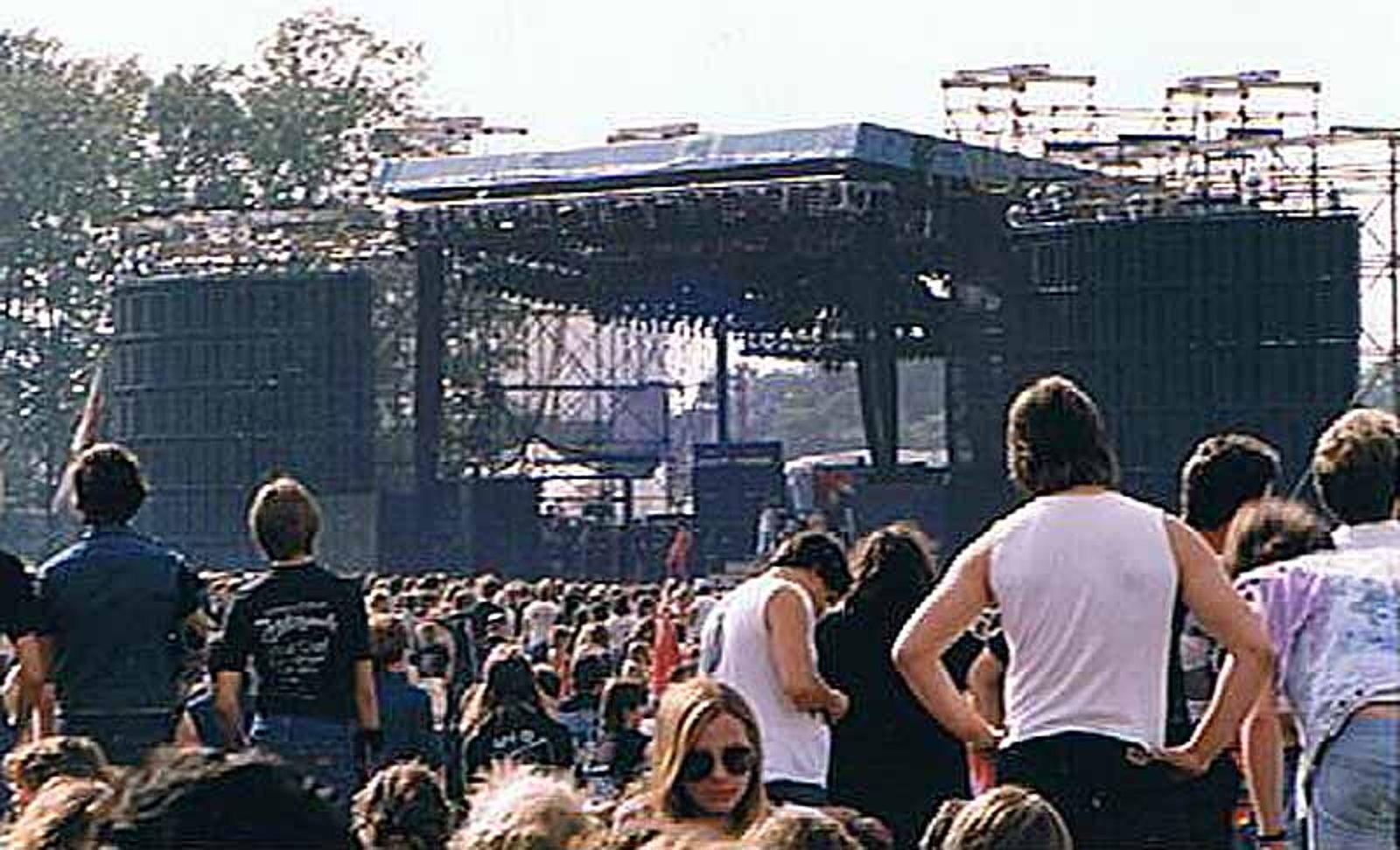
The stages grew with the sales. On 18 August the Monsters of Rock festival at Donington put AC/DC, Van Halen, Ozzy Osbourne, Accept and Mötley Crüe on a single bill before a crowd that filled the old racing circuit to the fences.
The East London band that took a full stage production behind the Iron Curtain that August, opening a tour in Warsaw that would run for most of a year and close to two hundred shows, was Iron Maiden, and "2 Minutes to Midnight" went out as the single ahead of it with the Cold War in its title. A mummy the size of a house stood behind the drum riser. Spectacle had become a business with a payroll.
A caricaturist on a seaside pier cannot draw a stranger. He takes the nose, the chin and the eyebrows the whole queue already knows, blows them up three sizes, and the crowd laughs because it recognises the face before it notices the exaggeration. The fictional British band whose amplifiers were marked up to eleven was Spinal Tap, and This Is Spinal Tap reached cinemas in March 1984. Satire of that precision is proof of size. Nobody lampoons a cult.
Satire of that precision is proof of size. Nobody lampoons a cult.
The independents in the same twelve months
The glossy end of the year took the charts. The other end went to the independents. In West Berlin a company that had only just begun putting out records, Noise, went looking for German bands to set beside the British and American imports, and the vanguard of a whole national scene arrived under a title that sounded like a joke and was not one.

The Ruhr quartet whose Heavy Metal Breakdown made it one of the first bands on Noise was Grave Digger, and Running Wild followed on the same label with Gates to Purgatory before the year was out, the two of them hammering a harder, rougher German sound out of the British records they had grown up on. Manowar put out two albums inside twelve months, Hail to England through the London independent Music for Nations and Sign of the Hammer through 10 Records, and neither one sounds like a band pacing itself. Nobody was rationing.
From Seattle, EMI released Queensrÿche's The Warning in September, a long, cold, ambitious record that sold modestly and pointed straight at the concept album the band would make four years later. The fastest records of the same year, Ride the Lightning and a Swedish debut recorded almost alone, grew into thrash and black metal and belong to those genres' own histories.
Why not 1983, why not 1986
The year before has a serious case. It held Metal Health, the first heavy metal album to reach number one in America, alongside Pyromania, Piece of Mind, Holy Diver and Shout at the Devil, a handful of records getting through a year ahead of the crowd that came in 1984.
Nobody proposes 1985, and the reason is instructive. The records kept coming, Accept's Metal Heart and Iron Maiden's live double among them, but the talk of that year was of warning stickers, hearings and lawsuits, and a music whose arguments have moved from the record shop to the courtroom has already passed its crest.
The strongest rival is 1986, which sold bigger single records and made harder ones. By then the family had already split: the glossy bands had gone one way, the fast ones another, and a fan who bought Slippery When Wet no longer bought the thrash records of the same summer. In 1984 the same shop, the same magazine and often the same teenager still took both.
The backlash settles it. The Parents Music Resource Center, founded in the spring of 1985, had senators hearing testimony about record lyrics by that September, a reaction of that weight aimed only at something already enormous. What it was aimed at had been built the year before. Beyond dispute, the peak came first and the alarm second.
Several of these records also sit among the essential heavy metal albums, where they are judged against every other year rather than against each other.
How the rest of the decade built on that year, from the stadium records of 1987 to the last big releases before grunge, is traced through the 80s heavy metal albums.
Twelve months, ten records worth keeping and a fifth of the American market. No other year has all three.
