
For the apparel oft proclaims the man.William Shakespeare, Hamlet, Act I, Scene 3
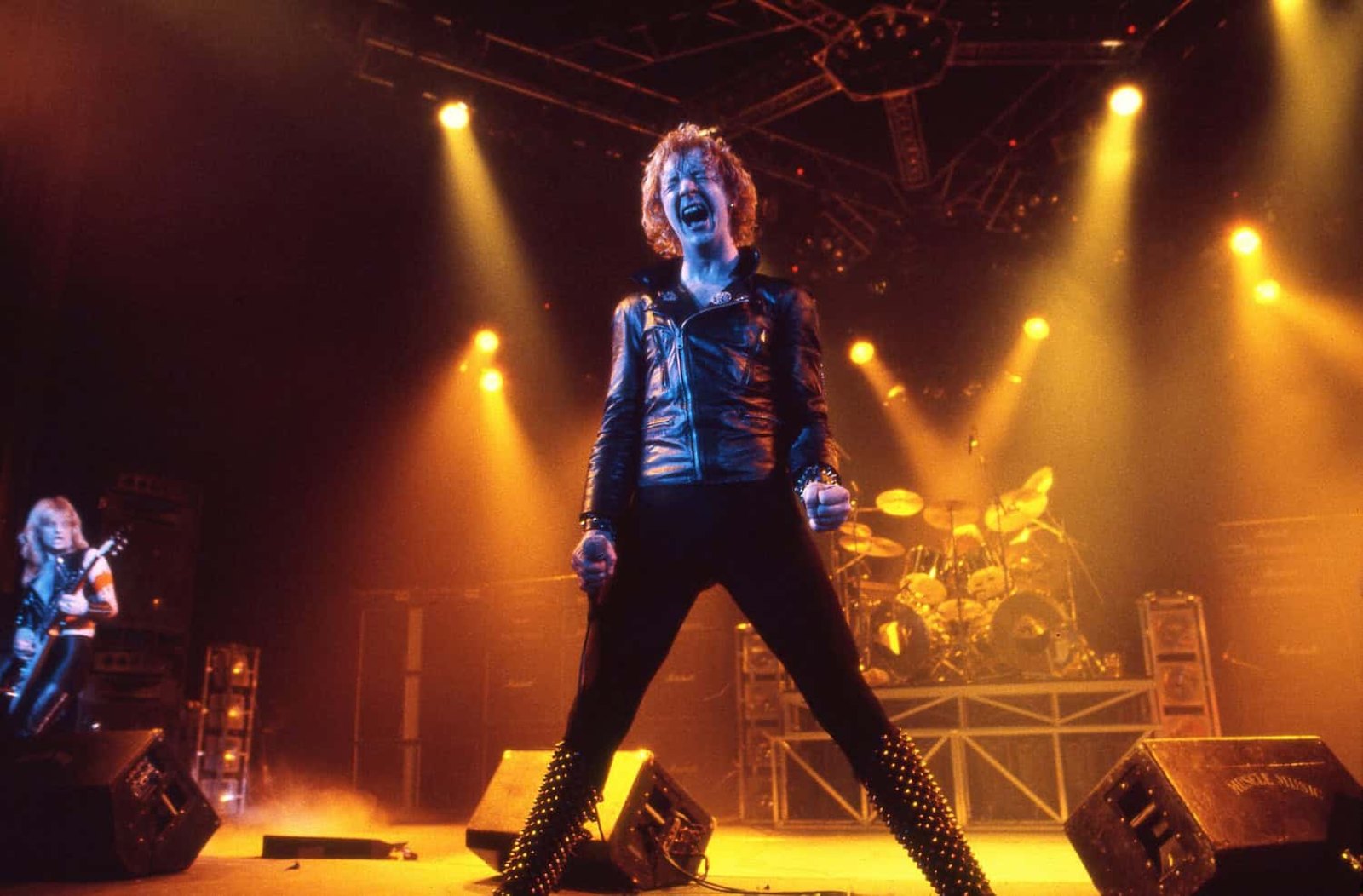
In 1978 the singer of a Birmingham band that had spent five years on stage in satin and flared trousers went to London to be measured for leather. The shops that fitted him in Soho sold to the city's gay leather scene, and the West Midlands singer who walked out of them in a black cowhide jacket and peaked cap, with chrome spikes screwed through the gauntlets at his wrists, was Rob Halford. Halford credited the idea to his guitarist K.K. Downing in his 2020 memoir Confess. The new kit ripped five years of satin off the band's backs in a single season. Heavy metal fashion was born in a fitting room, and it has barely changed its cut since.
A knight sealed inside a great helm had no face at a tournament, so he wore his name on his surcoat and his shield, and the heralds read him from across the lists by tincture alone, two metals, gold and silver, and a handful of colours, sable for black among them, all governed by one law as old as the tournament itself, the rule that forbids laying metal on metal. The heavy metal wardrobe has kept that law for close to fifty years without once reading it. Silver on black. Studs on hide.
Everything that followed was a variation on those two tinctures, and the variations are where the arguments live. The patch, the shirt and the ink have their own stories, set out in that part of the history. The cloth and the hide are another matter, and so is the question of who cut them.
Heavy metal fashion before the leather
The first heavy bands dressed like everyone else in rock, only darker. The Aston quartet whose singer's father had made them aluminium crosses at his workbench, worn on chains over velvet and cheesecloth, was Black Sabbath, and those crosses were the only piece of its stage clothing that anyone copied. Ozzy's father, John "Jack" Osbourne, made them from spare metal at the factory where he worked. The rest was the wardrobe of 1970. It aged accordingly.
The New York four who went furthest the other way were Kiss, strapped into studded breastplates, bat wings and platform boots seven inches high, much of it cut by the costume designer Larry LeGaspi, who had dressed Labelle from 1972 and went on to dress Parliament and Funkadelic. It was costume, not clothing. Nobody in the audience could wear it home, and that was the gap the leather would close.
Soho, 1978: the hide and the chrome
Released in October 1978 as Killing Machine and retitled Hell Bent for Leather for America the following year, the album that arrived with the new uniform carried a title track built on a clipped, charging riff that sounds exactly like the clothes look, and the band that recorded it, Judas Priest, never went back to satin. CBS had issued the album in Britain that October, before the American retitling the next year. The uniform was the sound, worn.
The source mattered, and for twenty years almost nobody in the audience knew it. The peaked cap, the harness and the studded cuffs came straight out of the gay leather bars of London and San Francisco, and the teenagers of the British club circuit copied them from the stage without the faintest idea where they had been bought. Halford came out publicly in an interview with MTV News on 4 February 1998. The clothes had told the story first, in plain sight.
The most borrowed look in heavy metal was borrowed from a scene most of its audience would have crossed the road to avoid. The chrome did not care, and neither, in the end, did the music.
Declan Rourke, KaosMetal
By 1980 the kit had spread across the whole British wave. Leather was dear, so most fans wore a single jacket for a decade, and the chrome went on piece by piece, a belt one birthday and a wristband the next, until the full outfit gleaming under the lights of a town hall stage represented years of Saturday jobs. The creed was written in hide. It was paid for in instalments.
Spikes, spandex and the topiary years
The American bands of the next few years took the leather and turned it into spectacle. The Hollywood four who dressed the video for "Looks That Kill" in 1984 as a gang of post-apocalyptic raiders, all spiked shoulders, torn leather and a woman in warrior gear freeing the captives, were Mötley Crüe, and the clip put that costume into millions of American bedrooms through MTV. Within two years the same band was wearing lace and lipstick.
The look of the Sunset Strip in the middle of that decade was topiary. A box hedge clipped into a peacock holds its shape only as long as a gardener comes back with the shears every fortnight, and the moment he stops, the tail feathers sprout, the neck thickens and one wet summer returns the bird to a shapeless green lump. Hairspray, scarves knotted round the microphone stand and spandex in leopard print needed a stylist on the payroll. When the budgets went, the peacocks went with them.
A box hedge clipped into a peacock holds its shape only as long as a gardener comes back with the shears every fortnight.
The leather outlasted every one of them. It needed nobody to maintain it, and it looked better scuffed.
The haircut of 1996

The biggest heavy band of the era broke the uniform from the inside. Photographed by Anton Corbijn for Load, released by Elektra in June 1996, the San Francisco quartet that turned up after a decade of jeans and long hair with short hair, eyeliner, tailored jackets and cigars was Metallica, and the fans who had copied it for ten years read the pictures before they heard the record. Elektra put the album out that June. Several of them never forgave the haircut. The music got the blame for the clothes.
The video for "Until It Sleeps", directed by Samuel Bayer and staged as a series of tableaux after the paintings of Hieronymus Bosch, made the point at full volume: the band dressed as figures in a gallery, not as the men in the front row. It peaked at number ten on the Billboard Hot 100, the highest the band ever climbed there. The audience that had worn the old uniform went looking for it elsewhere, and found it in Germany and on the small labels.
Short hair was not the only defection. Through the middle of the nineties the heavy bands that sold in America, from the groove bands of Texas to the nu metal bands of California, played in tracksuits, basketball shorts and baggy jeans, the clothes of the skate park and the hip hop video, and a teenager dressed like Halford in 1995 would have been taken for a man on his way to a fancy dress party. For a few years the leather looked like a costume. It was only waiting.
| Piece | Arrived | Borrowed from |
|---|---|---|
| Black leather jacket and cap | 1978 | The gay leather scene |
| Studded cuffs and gauntlets | 1978 | The same shops |
| Platform boots and armour | 1974 | Glam rock and the theatre |
| Spiked shoulders | 1983 | Post-apocalyptic cinema |
| Spandex and scarves | 1984 | Dancewear and the Strip's stylists |
| Short hair and tailoring | 1996 | The art photographer's studio |
From the revival racks to the runway
The young bands of the new century answered by going back to 1983 as if it were scripture. The Swedish quartet that walked on stage in tight jeans, white leather and studded belts with no trace of a joke on any of its members was Enforcer, and its debut, Into the Night, came out on Heavy Artillery in November 2008. The revival did not update the pedigree. It restored it, stud for stud.
The German festivals had kept the black cowhide in daily use through the lean years. The field at Wacken in Schleswig-Holstein, where the festival began in 1990 as a small local event, became the largest single gathering of the old uniform anywhere, tens of thousands of leather jackets in one field every August, with traders on site selling studs by the bag. Roughly eight hundred people came the first year, in 1990; the festival now sells around eighty five thousand tickets before it names a single band. The fitting room of 1978 had become a village.
Luxury went the other way, and took the look without the music. Nicolas Ghesquiere put Iron Maiden's logotype on a black satin sweatshirt for Balenciaga's autumn and winter 2012 collection, and by the middle of the decade Vetements and a Supreme collaboration with Black Sabbath had carried the same lettering and studs onto the runway and the rail. The tinctures were the same. The allegiance was missing.
The screen got the look before the catwalk did, and what the cinema made of it is its own subject, in the heavy metal movies. The fans who never took the jacket off saw the whole cycle out. Fashion came to them, left and came back, and they were standing in the same place, wearing the same leather.
