
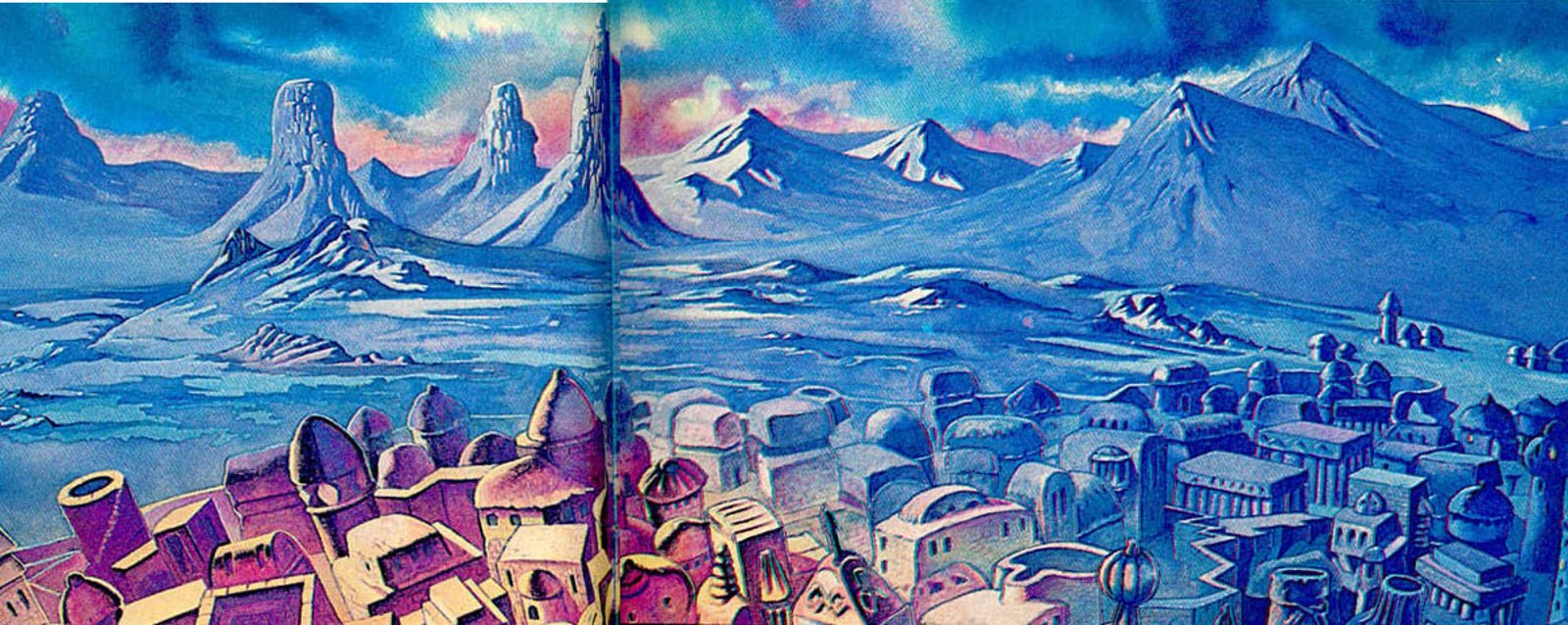
Fifteen years. From its cinema run in the summer of 1981 until Columbia TriStar finally put it on tape in 1996, the most famous of all heavy metal movies could not be bought, rented or borrowed in any legal form, because its producers had cleared the songs on its soundtrack for the cinema and for the record and for nothing else. Nobody thought the omission mattered. It mattered for a decade and a half.
Released by Columbia Pictures on 7 August 1981, directed by Gerald Potterton and produced by Ivan Reitman for about 9.3 million dollars, the Canadian animated anthology strung together by a glowing green orb called the Loc-Nar was Heavy Metal, and its idea of an evening's entertainment was to send that orb tearing through the fuselage of a wartime bomber and hauling the dead gunners out of their turrets to finish the mission. It took about twenty million dollars. Then it disappeared.
So it lived the way whiskey lives in the hills while the revenue men watch the roads, copied off late night cable onto a blank cassette, copied again from that copy, every generation of tape cloudier than the last, and handed from seat to seat at the back of the school bus with the guitars still burning through the hiss like proof spirit through the glass of a mason jar. Nobody paid. Everybody saw it.
Heavy Metal, 1981: the film that took the name
Eight stories, a dozen hands. Drawn from a comic magazine that had already given the phrase a second life on the news stands, the film handed its segments to studios in several countries at once, among them Atkinson Film-Arts and the old London house of Halas and Batchelor, and let each one keep the look of its source. There was Richard Corben's "Den", with John Candy voicing a bookish teenager turned into a naked giant, Bernie Wrightson's "Captain Sternn" and a bomber crew rotting at their guns in "B-17".
The music was a salvo fired in every direction at once. The Californian singer who would take over the microphone in Van Halen four years later, and who gave the film its title song, was Sammy Hagar, and his "Heavy Metal" shared a double album with Don Felder's "Heavy Metal (Takin' a Ride)", which climbed to 43 on the Hot 100, the Billboard singles chart, alongside Cheap Trick, Nazareth, Journey, Devo and Black Sabbath. The soundtrack reached number 12 on the Billboard 200. Perhaps a third of it is metal.
That was never the point. The film sold a teenage fantasy of the style, all chrome, cleavage, swords and spaceships, to people who had met the records first and wanted pictures to go with them, and anyone curious about where the records themselves came from will find it in the introduction rather than in the film. The cartoon borrowed the name. The name was already bigger than the cartoon.
The closing segment is the one people remember. Modelled on Moebius's wordless strip "Arzach", the silent warrior who rides a winged mount to her last battle against a horde of barbarians is Taarna, and the film gives her the whole of Blue Öyster Cult's "Veteran of the Psychic Wars" as she arms herself for the last ride, the one moment in ninety minutes where picture and song carry the same weight. It is the best thing in the film by common consent.
Nobody paid. Everybody saw it.
Heavy Metal 2000, and the remake that never came
The sequel arrived with the owner's name on it. Directed by Michael Coldewey and Michel Lemire and adapted from The Melting Pot, the graphic novel Kevin Eastman wrote with Simon Bisley and Eric Talbot, Heavy Metal 2000 gave its lead to the model Julie Strain, Eastman's wife since 1995, put Michael Ironside and Billy Idol in the voice cast and went straight to video in North America on 17 October 2000.
Its soundtrack beat it to the shops by six months. Released on Restless Records on 18 April 2000, the album put Pantera and Machine Head beside Queens of the Stone Age and System of a Down and stopped at 101 on the Billboard 200, which on any fair reading is a better result than the film managed with the critics. The records outlived the pictures again.
Then the remake that ate twenty years. Paramount set one up in 2008 with David Fincher attached, and names from James Cameron to Zack Snyder and Guillermo del Toro drifted in and out of the project until it collapsed, and the anthology idea itself resurfaced in 2019 in a different home, the Netflix adult animation series Love, Death and Robots, though no writer or studio has claimed a direct line from the stalled remake to it. The Loc-Nar stayed in its sepulchre.
The heavy metal movies about the music itself
Every film about the genre since 1984 has worked in the shadow of one joke. Largely improvised by Christopher Guest, Michael McKean and Harry Shearer in front of Rob Reiner's camera, the mock documentary about a British band in decline was This Is Spinal Tap, and the three men went on to tour as the band for real. Reiner brought them back for Spinal Tap II: The End Continues on 12 September 2025, with Paul McCartney, Elton John and Metallica's Lars Ulrich among the cameos. Forty one years on, the reviews came back mixed.
Hollywood tried the straight version once and ran it through a chop shop. Taken from a New York Times profile of the Ohio tribute band singer Tim Owens, who replaced Rob Halford in Judas Priest in 1996, the Warner Bros. drama that opened on 7 September 2001 was Rock Star. On the way to the screen it had the plates unbolted, the serial numbers ground off and the whole chassis resprayed, so that Priest became Steel Dragon, Owens became Mark Wahlberg's Izzy Cole and the story came out the far side unrecognisable to the people who had lived it.
Owens himself called it a Spinal Tap kind of movie. It took 19.3 million dollars worldwide against a budget of at least 38 million, and at the box office the fans stayed home. The film was a rout.
| Year | Film | Kind | Director |
|---|---|---|---|
| 1981 | Heavy Metal | Animated anthology | Gerald Potterton |
| 1984 | This Is Spinal Tap | Mock documentary | Rob Reiner |
| 1986 | Trick or Treat | Horror | Charles Martin Smith |
| 2000 | Heavy Metal 2000 | Animated feature | Michael Coldewey, Michel Lemire |
| 2001 | Rock Star | Drama | Stephen Herek |
| 2015 | Deathgasm | Horror comedy | Jason Lei Howden |
| 2018 | Heavy Trip | Comedy | Juuso Laatio, Jukka Vidgren |
| 2025 | Spinal Tap II: The End Continues | Mock documentary | Rob Reiner |
The smaller films have done better by the faithful than the studio ever did. Trick or Treat in 1986 put Gene Simmons behind a radio DJ's microphone and Ozzy Osbourne in a television preacher's pulpit railing against the music both men actually made. The Finnish comedy Heavy Trip in 2018 sent a village band that had rehearsed for twelve years without a gig stealing a hearse, a corpse and a border crossing to reach a festival in Norway, which is closer to the life most bands lead than anything Warner Bros. ever shot.

The cameras that only watched, the chroniclers rather than the storytellers, belong to another shelf. After the seventeen minutes of Heavy Metal Parking Lot in 1986 came Penelope Spheeris on the Sunset Strip in 1988, Sam Dunn's Metal: A Headbanger's Journey at the Toronto festival in 2005, and in 2008 the Sundance premiere of Anvil! The Story of Anvil, which sent a generation back to Anvil's Metal on Metal. Each is a better film than Rock Star. None of them needed a script.
Where the camera still gets it wrong
Black metal got its feature in 2018, when Jonas Åkerlund premiered Lords of Chaos at Sundance, and that story has its own silo and its own arguments. The rest of the genre still waits for a drama that treats a band the way the animators of 1981 treated a sleeve, with the lights turned down and the volume turned up.
Until it comes, the best heavy metal movies remain a cartoon nobody could buy for fifteen years and a comedy that every touring musician watches through his fingers. Both understood that the music is sold as much through the eye as through the ear, which is the whole argument of the aesthetic that surrounds the records.
The screen took one more thing from the sleeve and never gave it back. A painted corpse on an East London street became a film star without ever appearing in a film, touring the world on stilts and in fibreglass, and his story, from an art student's plaster cast to a samurai, is told in Eddie, Iron Maiden's mascot.
