
In 1978 an art student called David Arthur Brown, a friend of the band's lighting man Dave Beazley, took a plaster cast at East Ham College of Technology and pulled a vacuum formed plastic face out of it, and Iron Maiden hung that face at the back of its stage. It cracked. It kept cracking.
Rebuilt in fibreglass with eyes that flashed in time with the lights and a mouth that spat red smoke over the drum riser on the band's name song, the grinning prop the crew had been calling simply the Head became Iron Maiden Eddie, a name Steve Harris has traced to how that nickname sounded in an East London mouth. He went on to tear the lid off his own tomb, work the Devil himself on a string and outlast every singer, guitarist and drummer the band had yet to hire.
He has worked ever since like Mr Punch, the carved wooden head that has been clubbing the constable, the crocodile, the hangman and at last the Devil himself on English sands since at least 1662, when Samuel Pepys watched an Italian puppet play in Covent Garden. The head is repainted every season and dressed again for every town, the hooked grin always the same above the new clothes, so that a child who missed last summer's show recognises this summer's before the curtain is fully open. Eddie is Punch with a record contract.
The sleeve that made him famous on a lamplit street in 1981, and the angular lettering above it, belong to what surrounds the records. Everything else he did happened away from that street.
Iron Maiden Eddie on paper: the Riggs decade
The young English painter who never meant to paint for a heavy metal band at all was Derek Riggs, and the picture Rod Smallwood found in his portfolio in 1979 had started out as Electric Matthew Says Hello, a speculative cover for a punk record that Riggs's own agent had already turned down as uncommercial. Riggs grew the hair out, the band put the corpse on the front of its debut in April 1980, and for twelve years every Maiden sleeve and almost every single came off his easel.
The singles did the early damage. "Running Free" in February 1980 kept Eddie's face in shadow so that the album could reveal it, and "Sanctuary" that May showed him standing over the body of Margaret Thatcher with a knife in his hand, her eyes hidden behind a black bar once EMI agreed to censor the sleeve. Smallwood had proposed the cut himself, telling EMI it would hand the tabloids an angle, and the Daily Mirror obliged with a front page on the mugging of Maggie. "Women in Uniform" in October gave the Prime Minister a machine gun and a corner to wait behind. The joke ran for two sleeves and stopped.
Then the album that made him a puppeteer. Riggs painted Eddie working the Devil on marionette strings while a smaller Eddie dangles below from the Devil's own hand, and the picture was meant for the single "Purgatory" until Smallwood judged it too good to waste there and held it back for The Number of the Beast in 1982. In the United States it made the band anathema to the Moral Majority, whose followers burned the back catalogue in public. It sold records.

Riggs kept him changing. Eddie was lobotomised and chained in a padded cell for Piece of Mind in 1983 and carved into a pharaoh's colossus for Powerslave in 1984, and for Somewhere in Time in 1986 he became a cyborg with a laser pistol on a rain soaked future street. Riggs wired that street the way a sapper wires a culvert, a charge packed into every corner and every sign: a clock reading two minutes to midnight, the Aces High bar under a diving Spitfire, a cinema marquee billing Life After Death and Blade Runner both, and a street sign for Acacia Avenue. Fans went over it with a magnifying glass for years and it kept going off.
Eddie is Punch with a record contract.
After Riggs: a succession of painters
The line broke in 1992. Hired for Fear of the Dark after management opened the commission to outside artists for the first time, wanting Eddie taken from comic book horror toward something more straightforward and more threatening, the first painter other than Riggs to put the mascot on a studio album was Melvyn Grant, who turned him into a clawed thing growing out of a dead tree under the moon. Riggs submitted more than twenty sketches of his own and lost the job anyway. Grant would come back for Virtual XI in 1998 and The Final Frontier in 2010.
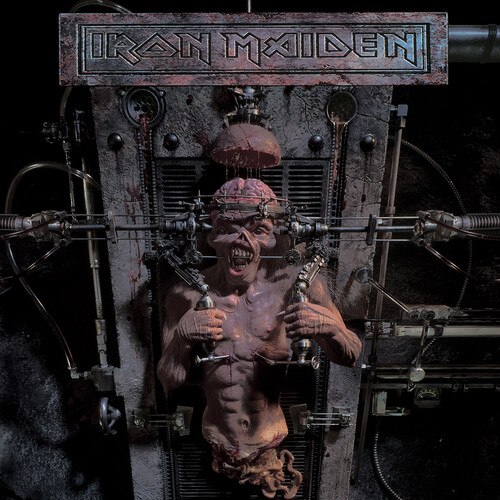
The strangest of them came in 1995. For The X Factor, the first album with Blaze Bayley singing, the Canadian designer best known for the sleeves of Rush, Hugh Syme, built a lifelike Eddie and photographed him strapped to an operating table in the middle of a vivisection, the skull opened and cables running into the brain. It is the only Eddie a fan could believe had a pulse. The image split the audience badly enough that some pressings swapped it for a tamer shot of Eddie seen from a distance, the operating table kept only inside the booklet.
| Year | Album | Eddie as | Artist |
|---|---|---|---|
| 1992 | Fear of the Dark | A creature grown out of a tree | Melvyn Grant |
| 1995 | The X Factor | A vivisection subject | Hugh Syme |
| 1998 | Virtual XI | A monster breaking out of a game | Melvyn Grant |
| 2003 | Dance of Death | The Grim Reaper | David Patchett |
| 2006 | A Matter of Life and Death | A rider on a tank | Tim Bradstreet |
| 2010 | The Final Frontier | An alien | Melvyn Grant |
| 2015 | The Book of Souls | A Maya figure | Mark Wilkinson |
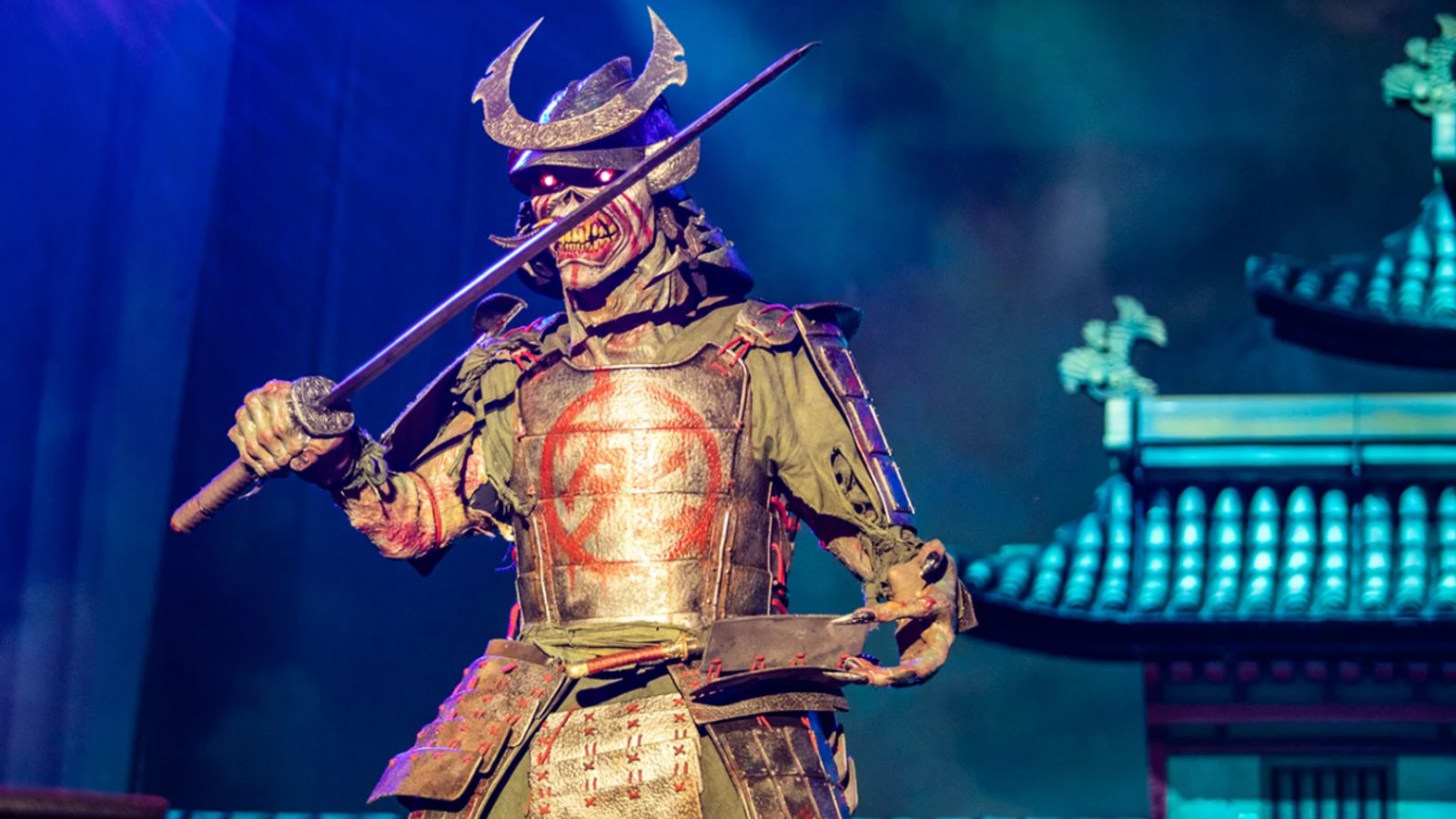
| 2021 | Senjutsu | A samurai | Mark Wilkinson |
Riggs came back for Brave New World in 2000 after a decade away, painting the upper half of the sleeve while the digital artist Steve Stone built the lower half, and the unhappiest commission followed. The painter who asked for his name to be taken off Dance of Death in 2003, after the band printed a version of his Grim Reaper he considered unfinished, was David Patchett. By the time Mark Wilkinson painted the Maya Eddie of 2015 and the samurai of 2021, the band had settled into what it had always really wanted, a character any skilled hand could draw, as long as the grin stayed put.
The Eddie that walks
The stage Eddie came out of a pantomime. The lighting man who watched a Christmas pantomime of Jack and the Beanstalk and worked out that its giant was a man on stilts in a big costume was Dave Beazley, and he built the band a walking Eddie about ten feet tall for the Beast on the Road tour of 1982. Since then Eddie has lumbered across the stage behind the guitarists on almost every tour the band has played.
The siegeworks grew around him. For the World Slavery Tour a mummified Eddie some thirty feet tall rose behind the drums and shot sparks from his eyes, and later tours sent him out in whatever costume the new album wore: the cyborg, and the redcoat who duels Bruce Dickinson, an accomplished fencer offstage, during "The Trooper" on the Legacy of the Beast and 50th Anniversary tours. The Future Past Tour that opened in 2023 stood the samurai of Senjutsu beside that same cyborg, on a set built around the Somewhere in Time skyline. The album changes the costume. Eddie keeps the part.
The videos gave him the rest of the job. Directed by Llexi Leon for the 2015 single "Speed of Light", the five minute clip sends Eddie through thirty years of video games, from blocky arcade screens to a first person shooter, doubling the resolution with every era, and it passed three and a half million views inside its first four days online, the fastest moving clip the band had put out in years.
Six years later came the bigger commission. Conceived by Bruce Dickinson with the former Pixar men Mark Andrews and Andrew Gordon and directed by Nicos Livesey at the London studio BlinkInk, the animated film for "The Writing on the Wall", released in July 2021, took sixty artists nearly eight months, and it ends with a new Eddie breaking into full three dimensions for the first time. Beyond dispute, no mascot in music has a better showreel.
Singers are hired. Eddie is inherited. Every new man who joined Iron Maiden walked out in front of a crowd that had already pledged itself to a dead face on a painted sleeve, and not one of them ever got top billing over it.
Declan Rourke, KaosMetal
A corpse with a brand manager
Off the stage he became a franchise. Eddie was the hero of the shooter Ed Hunter in 1999, returned in the mobile game Legacy of the Beast in 2016 and in a pinball machine of the same name in 2018, and rode across the world on the tail of Ed Force One, the Boeing 747 the band flew between continents, wearing Wilkinson's Maya paint.
A dead man from an East London pub stage has now sold more shirts than any living member of the band could hope to. His face goes onto a jacket before the band's name does, and more back patches carry him than carry the lettering, which is why the corpse turns up across the shoulders of the battle jacket more often than any musician in the genre's whole pantheon. The band ages. The grin does not.
