
In 1911 the Rolls-Royce company had the sculptor Charles Sykes model a small figure to stand on the cap of a radiator, a woman leaning into the wind with her sleeves streaming out behind her, and the British motor trade called such things mascots. The figure drives nothing. It cools nothing, carries nobody, adds weight to a machine built to be light, and it is still the part a stranger recognises at fifty yards, the part that gets a name of its own, and the part that thieves come back for with a spanner and a deep coat pocket.
Heavy metal mascots are bolted to the front of a different engine and do the identical work. The band writes the songs and plays them. The creature on the sleeve goes out ahead of all of it, into a shop where nobody has heard a note, and takes the hand that was on its way past the rack.
The skull Dave Mustaine first drew on the inlay of Megadeth's Last Rites demo in 1984 is Vic Rattlehead, and the credit is routinely misplaced: the 1985 debut, Killing Is My Business... and Business Is Good!, carried no painted Vic at all. The riveted eyes, the capped ears and the clamp across the jaw arrived a year later, painted for the first time by Ed Repka for the record that followed. See no evil, hear no evil and speak no evil, with the ironmongery still attached, is an entire political position standing in for a band photograph.
The sleeves as objects, and the painters who were paid to make them, belong to the chapter that covers it. The creature bolted to those sleeves is a separate machine with requirements of its own, and most designs fail the first of them.
What heavy metal mascots have to do
A mascot has to read at the size of a thumbnail and at the size of a stage backdrop, so it is built out of a silhouette and two or three hard shapes rather than out of detail. It has to survive being redrawn by six different hands over forty years without any of them being accused of getting it wrong. It has to take a costume. It must not age, because the men in the band are going to.
That is a specification no logo can meet, which is why the device took hold in this music and almost nowhere else. Other kinds of band own marks: a tongue, a pair of dancing bears, a set of block capitals. A mark tells a browser which band this is. A creature tells him what the record intends to do to him, and that, standing in a shop with money for exactly one record, is the only question he actually has.
What immortal hand or eye could frame thy fearful symmetry?
William Blake, The Tyger
The mascot that proved the format works, and by common consent the most successful of them all, is the corpse on the front of Iron Maiden's sleeves. Everything after it was built on that proof, and the record shows how fast the rest of the genre moved: between 1985 and 1988 a skull, a jack o'lantern, a helmeted soldier and a cartoon in shorts all took up permanent residence on other bands' record sleeves.
Vic Rattlehead, and the mascot that argues

Most mascots menace the buyer. This one lectures him. Released by Capitol in September 1986, Peace Sells... But Who's Buying? stands Vic in a suit in front of a wrecked United Nations building with a For Sale board staked in the plaza, and the creature is not decorating Ed Repka's argument, it is making it. A skull cannot be interviewed. It also cannot be misquoted.
The title song did the rest of the recruiting. Its opening bass figure was taken up in 1990 as the theme of MTV News and stayed there for a decade, played to an American audience several million wide that had no idea it was listening to a thrash record, which is a piece of smuggling no press campaign of the period came close to matching. The mascot went with it. That is what a standard-bearer is for.
The beasts that climbed out of the logo
Most of the others began as a doodle attached to a name, and the good ones never lost that plainness. The winged skull that has ridden the front of every Overkill record since Under the Influence in 1988 is Chaly, a bat's skull with a spread of leather wings behind it, painted by Rich Larson and Steve Fastner, gleaming green on some sleeves and bone white on others, and it is the rare case of a mascot the band draws its whole visual grammar from rather than the other way round.
"Hello from the Gutter", from Under the Influence on Megaforce in July 1988, carries Chaly through the whole four minutes, which is what a small band does when it cannot afford a set. The mascot works for nothing. It also never misses a call time.
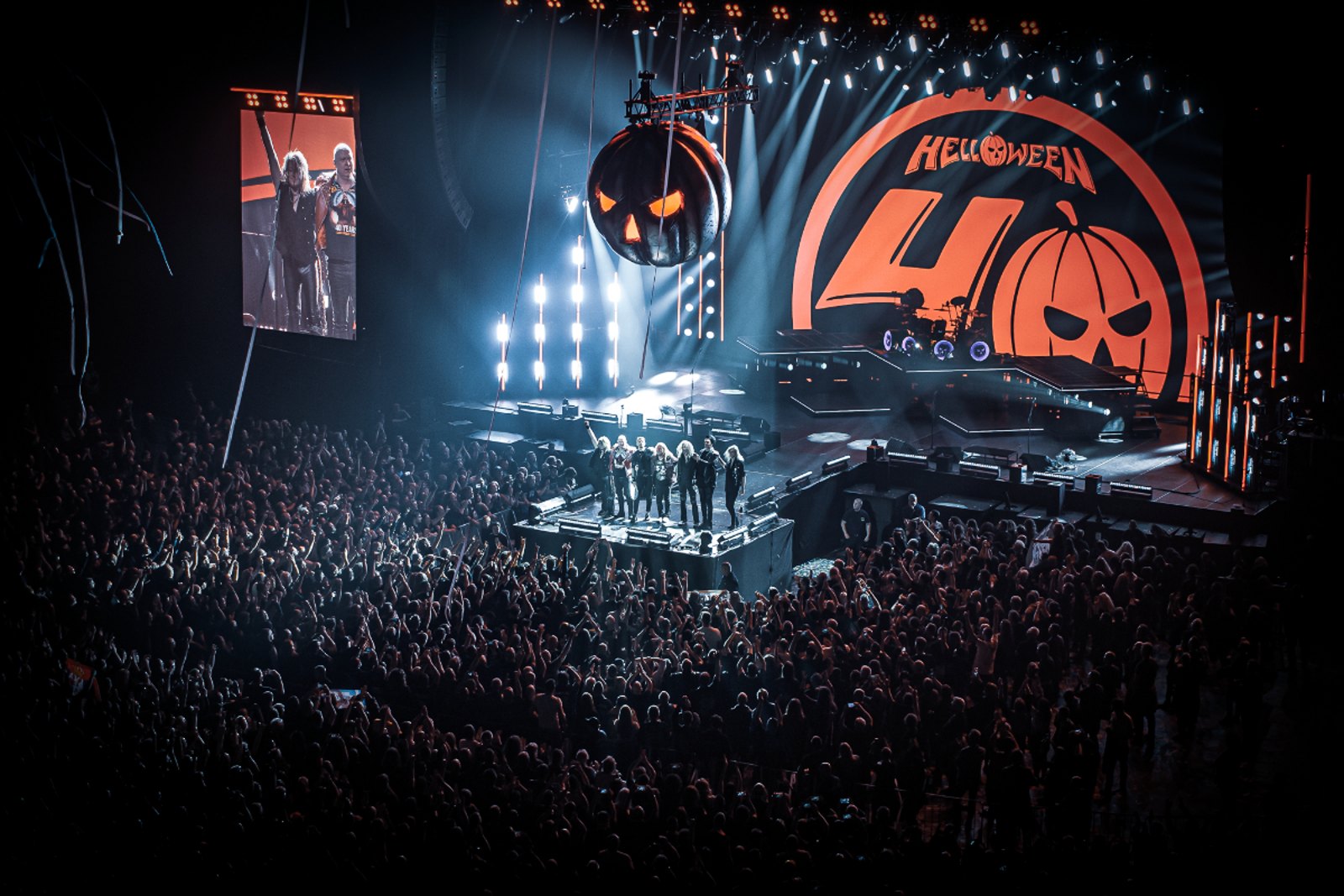
The German five who hung a grinning jack o'lantern where the band photograph belonged were Helloween, whose name had handed them the image before they had written a note of the music, and the pumpkin has sat on the sleeves, the shirts, the stage risers and the fan club paperwork ever since. It is the only mascot in the genre that is funny on purpose.
"Dr. Stein", the single lifted from Keeper of the Seven Keys Part II on Noise Records in 1988, is where the joke got a budget: a mad scientist, a laboratory, a cheerful chorus and pumpkins in shot, played entirely straight by five men who could have passed for a serious band that afternoon if they had wanted to.
The rest of the menagerie arrived on the same principle and stayed. Anthrax kept the Not Man, a suited cartoon figure with no head above the collar, borrowed from a Halloween novelty toy and carried since 1986, which is the only mascot in the genre with a sense of humour about the band carrying it. Sodom kept Knarrenheinz, a helmeted soldier in a gas mask drawn by Johannes Beck in 1987, who has been marching across German thrash sleeves ever since. Iced Earth built three albums of story around Set Abominae. Gwar solved the problem in the most direct way available, by making every member of the band a mascot and never appearing as anything else.
The failures teach more than the survivors do, and there are far more of them. A creature that appears on two sleeves and is then quietly never drawn again was not a mascot, it was a stage prop left in the back of a van, and the fault is nearly always one of three: too much detail to be redrawn by anybody else, a design that only works from a single angle, or a character invented after the band had already been photographed for three albums. The audience has to meet the creature before it meets the men. Arriving fourth is arriving too late.
Who owns the face
A mascot is worth more than the record it is printed on, and that is where the friendships go. The painter who walked away from the beast he had drawn, thirty two years after drawing it, was Joe Petagno, who announced in 2007 that he was finished with the skull he had made for Motörhead in 1975, blaming the band's management rather than the band itself. The band kept the skull. It was always going to.
Ed Repka painted sleeves for a dozen other bands after that one, and every mascot he painted stayed behind with the band that commissioned it. Commissioned work goes where the cheque came from. That is not a scandal, it is contract law, and it is worth stating plainly because the alternative story, in which a band steals a face from a painter, gets told about this genre more often than it happens.
The painter owns the brush. The band owns the face. That is the whole of the law here, and it has ended several long friendships.
The economics explain the ruthlessness. A mascot is a registered mark that sells shirts, patches, enamel pins, beer, pinball tables and playable characters, and it goes on selling them in years when the band is not touring, is not recording and is not speaking to itself, which makes it the single most reliable earner on the balance sheet. The show lives on stage for two hours. The trademark works all year.
That is also how these creatures got off the sleeve and onto a screen, a migration set out in the heavy metal video games. A mascot begins as a doodle on the back of a lyric sheet and ends as a registered trademark with a lawyer attached, and somewhere between the two it stops belonging to the person who drew it. Every band in the trade would take that bargain tomorrow.
