
In the spring of 1981 a song about taking the highway and answering to nobody became the first single by its band to reach the top ten of Billboard's Mainstream Rock chart, the American radio chart for album tracks, peaking at number ten. Written in the gaps of a schedule that had kept five men from the West Midlands in vans and hotel corridors for most of a decade, and recorded on a Spanish island in the autumn of 1980 with Tom Allom producing, the song was "Heading Out to the Highway", and the band that had not had a free month in years was Judas Priest. Freedom themes in heavy metal lyrics have always been written that way. By men on a timetable.
The freedom in these songs runs like the mechanical hare at a greyhound stadium, a stuffed lure on an arm bolted to a rail round the inside of the oval, driven from a box by a man whose only job is to keep it a length in front of the dogs, because on the rare night the pack catches it they rip the skin to rags, the race is declared void and the card stops. The chorus is the dog. The open road is the hare.
In that part of the history the road sits on a shelf beside war, myth and the dole queue, and it is the one subject on that shelf the writers never had to read up on. They lived in it. What they wrote about it was mostly the opposite of what they lived.
Riders out of the dark
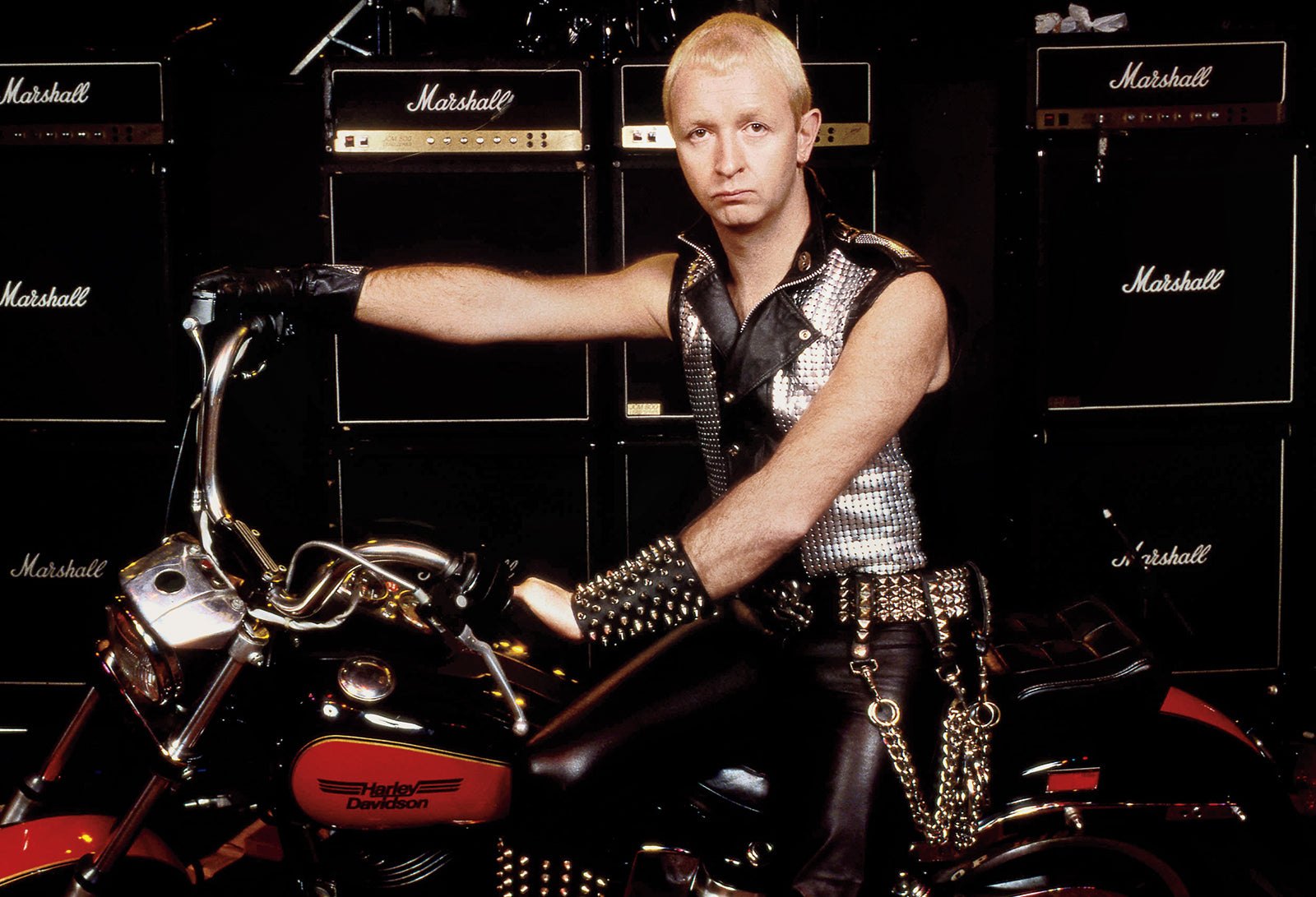
Three years before the highway single, the band had already built the figure the whole myth would ride on. The riff for the title song of the 1978 album Killing Machine, renamed Hell Bent for Leather for its American release the following year, came from the guitarist Glenn Tipton, and the words came after, fashioned by Rob Halford from the phrase the riff put in his head. Their rider is not a man with a destination but an apparition, a shape in black on a machine that comes out of the night, flattens whatever stands in the road and is gone before anyone can ask where he is heading. He never gets off the bike. That is the point of him.
Afoot and light-hearted I take to the open road, Healthy, free, the world before me.
Walt Whitman, Song of the Open Road, 1856
Whitman walked. The riders in heavy metal never do, because the engine is what turns wanting to leave into a sound, and a riff built on eighth notes in the low strings is the nearest thing a band owns to a cylinder firing under a man's legs.
The young British wave had already shown where that kind of leaving ends up. The east London five who put out "Running Free" as their first single, and watched it climb to number 34 on the British chart in February 1980, were Iron Maiden, with Paul Di'Anno singing, and the boy in the song, sixteen years old, thumbing lifts with no money and no plan, spends his night of liberty behind bars in Los Angeles, a jail Di'Anno later called an embellishment. Freedom and a charge sheet arrive in the same three minutes. Nobody in the song seems to mind.

On Point of Entry, released in February 1981, "Heading Out to the Highway" turned the apparition into a man with a grievance. Everybody within earshot has told him how to live, and he answers by leaving at a steady mid-tempo, no vehicle named, no destination given, the guitars of Tipton and K.K. Downing moving in step like two lanes of the same carriageway. It is a smaller song than the rider of 1978. It sold better.
Directed by Julien Temple, the video set the band on a painted studio set dressed as a desert highway at dusk and cut in footage of two vintage hot rods racing, so that the open road on screen was scenery and the only engines turning were in the insert shots. Nobody in the band was going anywhere that afternoon. The next city on the itinerary was already booked.
Freedom themes in heavy metal lyrics, and the clubs behind them
The darkest version came from Long Island, before heavy metal had a settled name. The producer and lyricist who took the Rolling Stones' free concert at Altamont in December 1969, where the Hells Angels had been hired to guard the stage and a young man in the crowd was killed, and rewrote the day as the work of a secret motorcycle club, was Sandy Pearlman, and "Transmaniacon MC" opened the first Blue Öyster Cult album in January 1972.
The club in that song is freedom with the brakes cut out: riders who owe nobody anything and have decided the rest of the world owes them everything. The bikes are the vanguard of a war, not a way out of one.
Five years after the debut the same band sang the clubs their funeral. Written mostly by Bruce Abbott, an old college friend of the guitarist Donald Roeser, and released on Spectres in November 1977, "Golden Age of Leather" follows an aging gang who gather in a beer hall and swear to go out on one last run, a prophecy that the oil crisis of 1973, draining the pumps dry from coast to coast, had already begun running the American biker off his own highway. Eric Bloom and Roeser trade the verses like a chieftain and his men.
It is the only song in the style that admits the road ends. The gang raises its glasses to the end and means it.
The songs promise a rider with no clock. The trucks carry the clock.
The road as a shift pattern
The singer who wrote the most complete road song of the nineties, for the 1991 album most of the world calls the Black Album, was James Hetfield, and "Wherever I May Roam", released as a single in October 1992, stacks one name for a drifter on top of another until the list becomes an identity. The video was cut from footage of the Wherever We May Roam tour, which opened in August 1991 and ran past two hundred and fifty shows before it closed in May 1993, and it shows exactly what the lyric leaves out: soundchecks, corridors, the long haul between cities.
The songwriter who had already put the misery of the road on tape in 1973, a musician stared at in a roadside diner and counting the hours to the next show, was Bob Seger. When Metallica covered "Turn the Page" on Garage Inc. in 1998, with Kirk Hammett's slide guitar in the place of Seger's saxophone, it held number one on the Mainstream Rock chart for eleven weeks, the band's longest run at the top. The confession outsold the fantasy.
Across Europe the gear of an arena tour travelled for decades in lorries fitted with a tachograph, a waxed paper disc in the cab on which a stylus scratches every change of speed and every stop of the night, gouging the whole drive into a spiral a traffic officer can read at a lay-by. The songs promise a rider with no clock. The trucks carry the clock. Most of the men who wrote those songs had come off shop floors and out of apprenticeships, and the half of their story in which there was no highway at all belongs to working-class rage.
Chrome as an article of faith
By the late eighties the freedom had hardened into doctrine. The four Americans who opened Kings of Metal, released by Atlantic in November 1988, on a motorcycle at full throttle were Manowar, and "Wheels of Fire" makes the ride a creed rather than a journey, nowhere to go and no reason to stop, the engine the only article of faith. The band rides; the song never asks where.
That is where attrition sets in. A freedom that cannot name a destination can only name a speed, and a speed repeated for thirty years becomes a uniform: the leather, the chrome, the tank painted with flames, all bought, all matching. The rebels of the road ended up dressed alike.
The songs that last in this corner are the ones that let the price into the lyric sheet: Pearlman's club riding out to make war on everyone it passes, Abbott's gang drinking to its own last run, Seger's drifter feeling every stare in the diner, Hetfield's nomad counting the corridors. They are not anti-freedom songs. They are freedom songs written by men who had been on the road long enough to read the bill.
The rest is a paint job on the side of a tour bus, and the bus leaves at nine.
