
Heavy metal was built by people who knew the shift, and it almost never sang about it. Taken at its word, working class heavy metal is a very short shelf, a handful of songs in forty-six years that name a job, a wage or a picket line, while every other lyric sheet in the style tears the clocking-in card in half at the works gate, drops the pieces in the gutter and rides out to Jerusalem, Mordor or the open road. The job is missing from the words. It is everywhere else.
Humphry Davy's safety lamp explains how that works. Inside a cylinder of fine iron gauze the miner's flame meets the firedamp seeping out of the coal face, and the gas catches and burns tall and blue inside the mesh, roaring against the wire, while the gauze drains the heat out of it before a single spark can reach the seam and bring the roof down on a whole district of men. The fury burns at full height. The mine never blows.
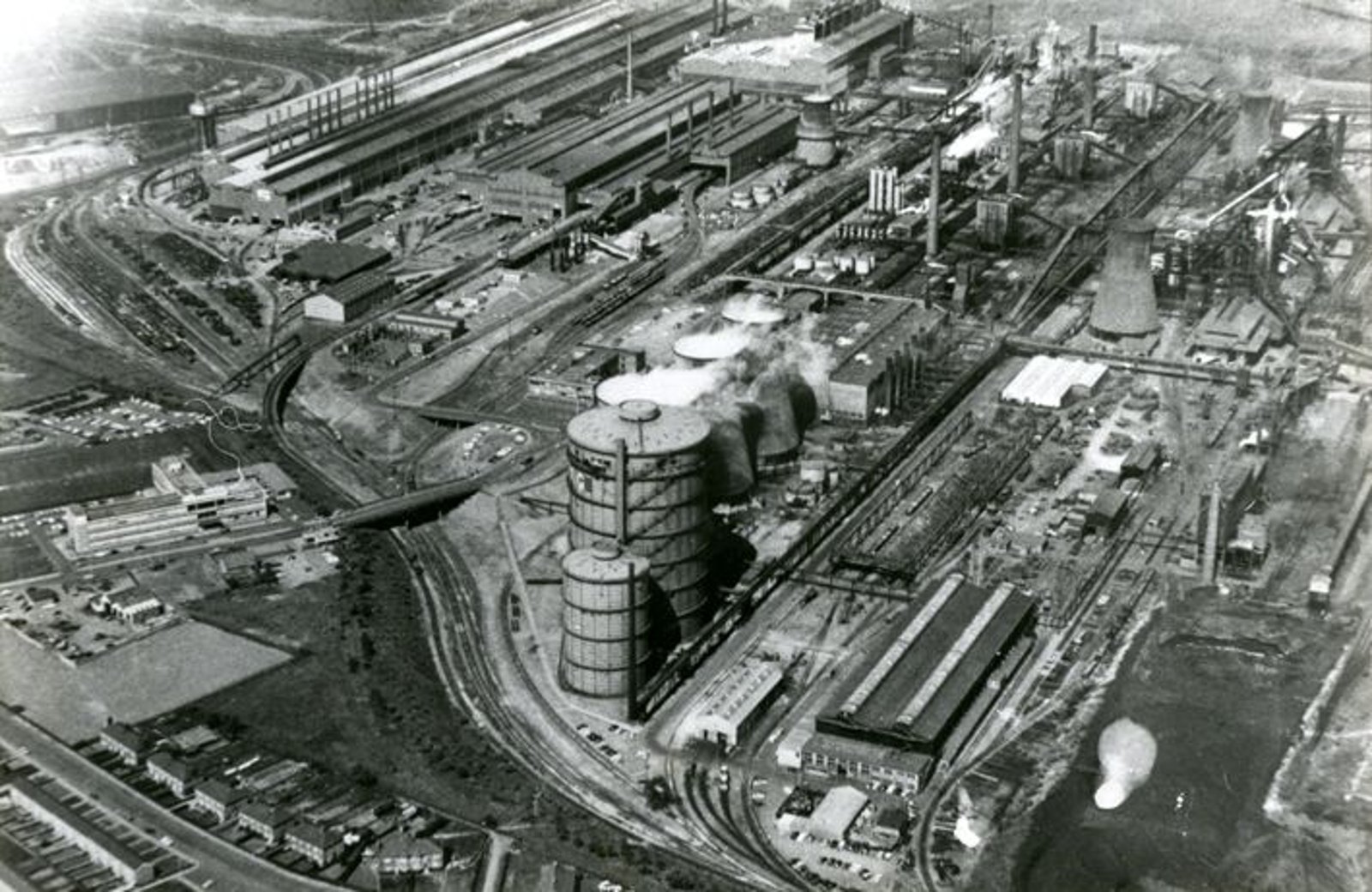
The guitarist who had spent five years on the payroll of the British Steel Corporation before any band could pay him was Glenn Tipton, and in January and February 1980, while some ninety thousand steelworkers stood on picket lines in the first national steel strike since 1926, he was at Tittenhurst Park in Berkshire cutting an album that Judas Priest would name after his old employer.
Why the style reached for the library rather than the payslip is a question for the full range of its subjects, and where it sits in the story is the shelf of war, myth and the road. The working life is the one subject that was lived rather than read, and the one that was hardly ever written down.
British Steel, cut during the steel strike
The strike ended on 3 April 1980, thirteen weeks after it began, with a sixteen per cent rise bought at the price of new working practices and, within a few years, of whole plants closed for good. Inside a fortnight, British Steel reached the shops with a hand gripping a razor blade on its sleeve and not one line about the dispute anywhere inside it.
What the record carries instead is the noise of the works. "Steeler", the closing track, takes the album's own pun and runs it at the pace of a mill line driven past its rated speed, K.K. Downing and Tipton chopping the riff into short identical lengths and stacking them like billets off a shear, the drums bolted to the beat with every trace of swing ground out of them. Nothing in it is about work. Everything in it sounds like work.
"Breaking the Law", on the same side of vinyl, is the exception that proves how rare the thing was: one young man with no job, one song, and no sequel.
Barnsley, the boiler house and the road to Jerusalem
The singer judged too tall at six foot one for seams three feet high, and set instead to mind the steam engine that drew the coal up a mile of shaft, was Biff Byford, and the band he sang for, Saxon, came up out of the South Yorkshire coalfield around Barnsley with that engine still turning in its ears.
And was Jerusalem builded here, Among these dark Satanic Mills?
William Blake, Milton: A Poem, preface, 1804

On 1 March 1984 the Coal Board announced the closure of Cortonwood colliery, a few miles from Barnsley, and within days the coalfield was out, the first week of a strike that ran for a year and broke the miners' union. The band from that coalfield released Crusader that same year, whose title track rides to the Holy Land behind the knights of the twelfth century. It is not a betrayal. A man who has spent the week underground does not buy a record to go back down.
A man who has spent the week underground does not buy a record to go back down.
The job reached a Saxon lyric only once it had become history. On Sacrifice, in 2013, "Made in Belfast" goes down to the slipways of the Belfast yards and salutes the men who laid the keels of the great liners and bent the plate for their hulls, a trade that by then employed a fraction of the hands it once had. Work had to close before it could be sung.
Solingen, where the knives come from
The German singer who walked on stage in army camouflage rather than a boiler suit was Udo Dirkschneider, and the band behind him, Accept, came from Solingen, a town in the Bergisches Land that has been making blades since the Middle Ages and still stamps its name on kitchen knives sold round the world. The uniform is the tell.
A working kid dressing for a fight chooses the soldier's kit and never the worker's, because the soldier is at least allowed to win. Accept marched its riffs in close order, downpicked and square, a parade-ground stamp beaten so hard into the rhythm section that the songs rip the plaster off a club ceiling while never once mentioning who plastered it. The fantasy on show was promotion, not the shop floor.
The rust belt, and the creed of true metal
America's industrial towns took their working songs from elsewhere. Billy Joel sang a closing Pennsylvania steel town in "Allentown" in 1982, and the metal audience in towns exactly like it, which the sociology of the decade described as young, male, white and largely blue-collar, bought warriors instead.
The American four who turned that purchase into a creed were Manowar, and "Heart of Steel", from Kings of Metal in 1988 and recut as "The Heart of Steel MMXIV" in 2014, is the whole blue-collar myth in one slow build: a man who will not bend, will not sell and will not stop, dressed in furs and a sword belt where the overalls and the snap tin should be.
The band's war on false metal is a work ethic with the serial numbers filed off. Volume is clocked like overtime, honesty is a full shift, and the posers are the men who skive, which is why Manowar chased a place in the record books for the loudest performance ever given as if decibels were tonnage and tonnage could be put on a timesheet.
Every November British children stuff an old suit with newspaper, prop the guy in a pram and wheel him round the streets begging pennies, and on the fifth they heave him onto the fire on waste ground and watch the flames eat him from the boots up, a man dead four hundred years burned again by a crowd with no quarrel against him. The warrior song keeps that trade. It hands the rage a stuffed enemy, and the real one goes unnamed.
The band that finally put a striking dock worker at the top of the American singles chart was, of all the unlikely candidates, Bon Jovi. "Livin' on a Prayer" reached number one on the Hot 100 in February 1987 with Tommy out of work on the docks and his union on strike, and the denim crowd filed it under hair metal and looked the other way. The one hit that sang the rust belt back to itself came from the band the purists despised most.
| Band | Song | Year | The job in it |
|---|---|---|---|
| Judas Priest | "Breaking the Law" | 1980 | A young man with no work at all |
| Motörhead | "(We Are) The Road Crew" | 1980 | The men who carry the gear |
| Fist | "S.S. Giro" | 1978 | The dole cheque |
| Bon Jovi | "Livin' on a Prayer" | 1986 | A dock worker with his union on strike |
| Saxon | "Made in Belfast" | 2013 | The shipyard, after it had gone |
Working class heavy metal lives in the sound
Five songs in forty-six years is not a tradition. The evidence sits in how the music is made rather than in what it says: sets run like shifts, riffs repeated to machine tolerance night after night, gear bought on credit and paid off in overtime, and a scorn for anything that looks like skiving that is attested in every interview the veterans of the style have ever given. The trio whose one song about labour was written for the men who humped its amplifiers was Motörhead, and it played "(We Are) The Road Crew" at a volume that could shake the bolts out of a lorry chassis.
The same instinct that swapped the payslip for the Crusades went straight for the oldest book on the shelf, and biblical imagery in heavy metal is where it found its promised cities, its plagues and its dark mills.
Where the working towns belong in the story of heavy metal is a matter of the map: Aston, the Black Country, Barnsley, Solingen, the steel valleys of Pennsylvania. The music took their noise, their hours and their pride in doing a hard thing the same way every night, and built a whole style on that bastion. It left the lyric sheet to the knights, and nobody who bought the records ever asked for it back.
