
Seventy-eight minutes and fifty-nine seconds. In 1996 that was the most a compact disc could be trusted to play without skipping in a domestic player, and the band that sequenced its sixth album to the last of those seconds, then had the number printed on a sticker on the shrink-wrap as if it were a boast, was Metallica. To get Load under the line, somebody cut about a minute off the end of "The Outlaw Torn", its closing song. The full take came out later on a single.
Every format is Procrustes' iron bed. The innkeeper in the Greek story kept one bed for every traveller and made the traveller fit it, hacking off the feet of the tall man and racking the short one until his joints gave. For sixty years the disc, the cassette and the file have done the same to heavy records, lopping the long songs, stretching the short albums with extra tracks and sawing the running order into whatever lengths the machine would hold. The music changed shape to survive the bed. Nobody asked it first.
What happened inside the studio is set out in the full chapter, from Regent Sound to the hard disk. What happened after the master left the building, when it had to be cut into a groove, wound onto a spool or burned into pits, is the other half of the sound, and metal recording formats decided more about the shape of an album than most producers ever did.
Metal recording formats and the twenty-minute side
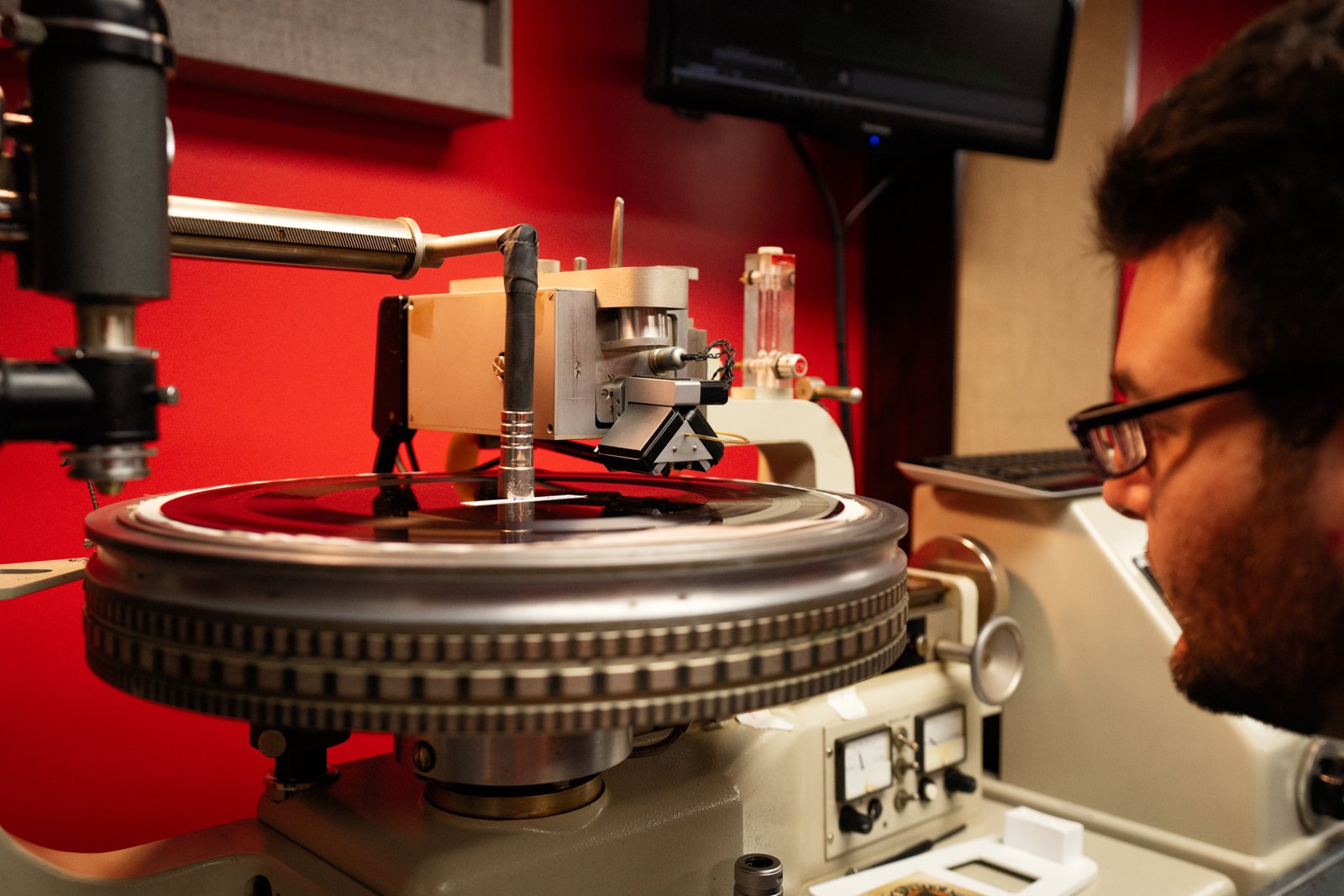
A twelve-inch record at 33⅓ revolutions a minute holds its best sound at around eighteen to twenty minutes a side. Past that, the cutting engineer has to pack the grooves closer together, which means cutting them quieter, which means less level and less bass, and the low end is exactly what a heavy record cannot spare. So the classic heavy LP ran thirty-five to forty-five minutes, and a band wrote to that length whether it knew it or not.
The side break was written in too. A side opened on the song meant to grab the room, and it closed on the song meant to leave it ringing while somebody got up and turned the disc over, so every album of the vinyl era carries two openings and two endings where a compact disc has one of each. The turn was an intermission. The best running orders used it as a gear change, the faster, harder material piled up front and the long, slow closer waiting at the end of side two, where the grooves run tightest.
The Sheffield band that tested the rule hardest in 1987 was Def Leppard. Hysteria, released on 3 August that year after Robert John Lange had spent the better part of three years building it, ran sixty-two minutes and thirty-two seconds, and Mercury put all of it onto a single vinyl disc, one of the longest single LPs ever issued, with sides of more than half an hour each. The tonnage was meant for the new silver disc. On the black one the grooves had to be crowded together to hold it.
The cassette, the car and the pocket
The company that took the album out of the living room and put it in a coat pocket, on 1 July 1979, was Sony, with the TPS-L2 Walkman, and inside four years the cassette had overtaken the LP in American sales, a crossing the industry's own figures date to 1983. For heavy music the change was bigger than a sales chart. A record that had to be played quietly at home because of a parent or a neighbour could now be played at full barrage through headphones on a bus.
The cassette asked for its own running order. Both sides of a tape run for the same time, so a label balancing an album onto one had to shuffle songs from side to side or leave several silent minutes at the end of one of them, and more than one heavy album crossed from vinyl to cassette with its running order rearranged rather than left intact. The car stereo made the same demand from the dashboard.
| Format | Usual capacity | What it did to the record |
|---|---|---|
| Twelve-inch LP | About 20 minutes a side at best level | Two openings, two closers, a break in the middle |
| Eight-track cartridge | Four equal programmes | Songs reordered, some split in two |
| Compact cassette | Two equal sides | Running order reshuffled, extra tracks to fill a side |
| Compact disc | 74 minutes, later close to 80 | One continuous programme, room for bonus tracks |
| Streaming | No limit | Tracks played one at a time, the album optional |
Seventy-four minutes and the bonus track
The compact disc went on sale in Japan in October 1982 and by the start of the nineties it was the format that mattered, and it came with one continuous side of about seventy-four minutes and nothing to turn over. The side break vanished. Bands that had written in two acts of twenty minutes found they had room for an hour, and many of them filled it, so that a heavy album of the middle nineties routinely ran past sixty minutes where one of the late seventies had stopped near forty.
That is the context of the minute cut from "The Outlaw Torn". Even a band that had grown into the full length of the disc hit its wall, and when the complete take appeared on the single of "The Memory Remains" in 1997, it ran ten minutes and forty-eight seconds under a title that said exactly what had happened, "The Outlaw Torn (Unencumbered by Manufacturing Restrictions Version)". It is beyond dispute the only song title in the genre that names its format as the villain.
Every format is Procrustes' iron bed, and for sixty years heavy records have been cut down or stretched out to fit it.
The disc also made the whole back catalogue into something that could be sold again. The bonus track became a habit, a B-side or a live cut or a demo tacked onto the end of a reissue to give the faithful a reason to buy the same album twice, and on some reissues the bonus sits after the old closing song and quietly spoils the ending the band had built. Rarely did a reissue change the album itself.

One did. The 2002 reissues of Ozzy Osbourne's Blizzard of Ozz and Diary of a Madman stripped the original bass and drum parts off the tapes and put new ones by Robert Trujillo and Mike Bordin in their place. The bassist and the drummer whose playing had been removed from both albums, and who were then pursuing a claim over royalties from those records, were Bob Daisley and Lee Kerslake. A Los Angeles federal court dismissed their suit in August 2002, and the original parts they had played did not surface again on the records until the 30th anniversary editions of 2011. For nine years the version on sale was not the record that had made the reputation.
Streaming, and the album with no floor
Streaming removed the bed altogether. There is no side, no spool and no seventy-nine minute wall, and an album now runs as long as the band wants and the listener tolerates, which in heavy music has turned out to be a great deal. The band that answered the end of the side with the longest studio records of its career was Iron Maiden: The Book of Souls in 2015 was its first to need two compact discs, and Senjutsu followed it in 2021 at a little under eighty-two minutes, spread over two discs and three vinyl LPs.
Even that record reached most of its listeners one song at a time. "Stratego", released as a single on 19 August 2021 and given an animated video once Senjutsu itself was out, runs about five minutes, a gallop set down among songs of ten and twelve, and on a streaming service most listeners met it alone, weeks before they could meet the album around it.
That is what streaming does to an album. The playlist works like a fishmonger with a filleting knife at the counter, taking the whole fish, running the blade down the spine, lifting off the two fillets anybody will pay for and sweeping the head, the tail and the bones into a bucket, and in a heavy album the head is the slow intro and the bones are the ten minute closer. The services count a play only after about thirty seconds, which puts a price on a long intro.
The riff at the front of a song has moved up to meet that rule, and the album survives mainly as an object, often a vinyl one, bought by the listeners who still want the succession of songs the band chose. The format that ended the side has made the side a luxury. Long before any label decided how long a band's songs were allowed to run, most bands had already made a first recording on a kitchen table, and the four-track demo had rules of its own.

